
TL;DR:
- Chlorine-free odor removal methods outperform traditional bleach-based products by targeting odors at the source safely. These advanced solutions include enzymatic sprays, molecular neutralizers, gels, and ClO2 pouches suitable for high-end spaces. Using systematic, multi-layered treatments enhances effectiveness, safety, and sustainability in luxury residential, hospitality, and commercial properties.
Many luxury property managers still reach for chlorine-based products when odor problems arise, assuming that stronger chemicals deliver better results. That instinct is understandable but outdated. Today’s most advanced odor removal methods are entirely chlorine-free, and they consistently outperform harsh bleach-based treatments in precision, safety, and lasting results. This guide breaks down what chlorine-free odor removal actually means, which technologies power it, and how to apply these methods across high-end residential, commercial, and hospitality spaces without compromising your guests, furnishings, or air quality.
Table of Contents
- What is chlorine-free odor removal?
- How chlorine-free solutions work: Enzymes, gels, and new tech
- Why choose chlorine-free? Health, sustainability, and certification benefits
- Implementing chlorine-free odor removal in luxury properties
- The hidden strengths (and common mistakes) of chlorine-free odor removal
- Explore professional chlorine-free odor removal for your property
- Frequently asked questions
Key Takeaways
| Point | Details |
|---|---|
| Chlorine-free defined | Chlorine-free odor removal uses enzyme and organic-based products instead of harsh chemicals for safer, deeper odor removal. |
| Best for luxury spaces | These solutions work especially well in high-end homes, hotels, and commercial properties. |
| Sustainability benefits | Chlorine-free methods help achieve health and green certification goals by reducing hazardous residues. |
| Effective for allergies | With no harsh residue, chlorine-free products are safer for allergy sufferers and sensitive groups. |
| Professional integration | Expert routines combine surface and air treatments for thorough, lasting odor control. |
What is chlorine-free odor removal?
Chlorine-free odor removal is exactly what it sounds like: a professional approach to eliminating interior odors that never relies on bleach, chlorine gas, or chlorine-based oxidizers. Instead, it uses scientifically formulated alternatives including enzymatic cleaners, plant-derived molecular neutralizers, chlorine dioxide pouches (which, despite the name, are fundamentally different from elemental chlorine), and organic gels that absorb and break down odor compounds at the molecular level.
This distinction matters more than most property managers realize. Chlorine-based products don’t actually eliminate odor molecules. They mask them temporarily or oxidize them in ways that can leave disinfection byproducts, known as DBPs, behind in the air and on surfaces. In a luxury guest room or a high-end residence, that residue is a real problem.
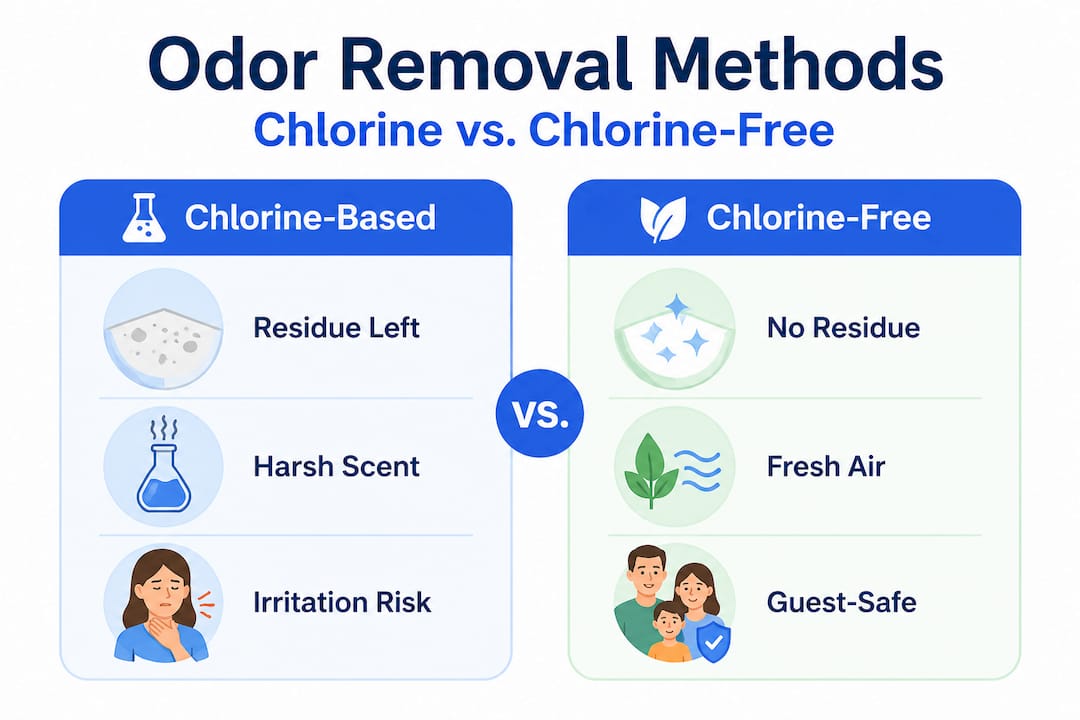
Chlorine-free solutions, by contrast, target odor at the source. Enzymatic formulas break down the organic compounds causing the smell. Molecular neutralizers bind to odor molecules and render them inert. The result is genuinely fresh air, not a chemical cover-up.
Here’s why this approach is becoming the preferred standard in premium property management:
- No harsh residue on fabrics, carpets, or hard surfaces
- Safer air quality for guests, children, pets, and staff
- No corrosive risk to high-end finishes, leather, or artwork
- Reduced allergy triggers compared to bleach-based alternatives
- Alignment with green building standards increasingly required in luxury hospitality
For spaces where guest experience defines your reputation, the case for allergy-safe odor removal is practically self-evident.
“Integrate enzymatic cleaners for surfaces, ClO2/organic neutralizers for air and trash areas, with HVAC diffusion for consistent coverage in high-turnover hospitality and residential settings, all without harsh chemicals.”
With this foundation in mind, let’s explore exactly how chlorine-free odor removal works and why it’s the preferred standard in luxury settings.
How chlorine-free solutions work: Enzymes, gels, and new tech
Now that you see what chlorine-free means, let’s look closer at the standout methods making this possible and where each one fits best.
The chlorine-free market has matured rapidly. Property managers today have access to several distinct product categories, each designed for a specific application. Understanding these differences is the key to building a truly effective, room-by-room odor control program.
| Product type | How it works | Best application |
|---|---|---|
| Enzymatic sprays (e.g., Ecodor) | Biological enzymes break down organic odor compounds | Carpets, upholstery, pet areas |
| Gels (e.g., Fresh Wave) | Absorb and neutralize airborne odor molecules continuously | Guest rooms, closets, common areas |
| ClO2 pouches (e.g., Green Klean, Star Brite) | Controlled chlorine dioxide release oxidizes odor at molecular level | Trash rooms, HVAC zones, storage |
| Molecular neutralizers (e.g., Drainwell Odor Control) | Bind and permanently deactivate odor molecules | Drains, restrooms, mechanical rooms |
Each of these product types works through a different mechanism, which is why layering them produces the best results in complex spaces. A luxury hotel suite, for example, might use an enzymatic spray on the carpet after checkout, a gel diffuser for the air during turnover, and a ClO2 application in the bathroom drain area. That multi-layered approach is how professional eco-friendly odor neutralization actually works in practice.
For enzymatic odor removal specifically, the science is compelling. Enzymes are proteins that catalyze chemical reactions, meaning they accelerate the breakdown of odor-causing compounds like uric acid from pet urine, volatile fatty acids from food waste, and sulfur compounds from tobacco. Once those source molecules are broken down, the odor simply cannot return from that source. That’s a fundamentally different outcome than masking or temporary oxidation.
Here’s what makes chlorine-free technologies stand out in high-end environments:
- No discoloration risk on premium fabrics, woods, or stone surfaces
- Safe for sensitive finishes including lacquered furniture and natural fibers
- No off-gassing of chlorine fumes that irritate airways and linger in enclosed spaces
- Controlled and targeted release, especially with gel and pouch formats
Pro Tip: In high-turnover spaces like hotel rooms or vacation rentals, enzymatic sprays work best when applied and given at least 15 minutes of contact time before ventilation. Rushing this step dramatically reduces effectiveness, and that’s one of the most common errors we see in hospitality settings.
The data supports the move toward these methods. Products like enzymatic sprays, gels, and ClO2 pouches are now applied via spray, fogging, or direct placement in HVAC systems, trash areas, and carpets. They are explicitly rated suitable for hospitality guest rooms, residential common areas, and commercial trash docks, covering essentially the full footprint of a luxury property’s odor management needs.
Why choose chlorine-free? Health, sustainability, and certification benefits
With these health and environmental benefits clear, let’s examine how property managers can apply chlorine-free methods most effectively in daily operations.
The decision to go chlorine-free is not just about being eco-conscious. It has measurable, bottom-line implications for asset value, liability exposure, and guest satisfaction scores.
| Factor | Chlorine-based | Chlorine-free |
|---|---|---|
| Residue left on surfaces | Yes, DBPs possible | No harmful residue |
| Risk to sensitive occupants | Higher (fumes, irritants) | Minimal |
| Long-term surface damage | Possible (bleaching, corrosion) | None |
| Green certification alignment | Generally not compatible | Fully compatible |
| Odor re-emergence | Common (masking effect) | Rare (source elimination) |
| Suitable for occupied spaces | No | Yes |
The certification angle deserves particular attention. Sustainable odor prevention isn’t just good practice. It can actively contribute to your property’s standing under LEED, WELL Building Standard, and USDA Biobased certification frameworks. Products like Microban EcoFresh, which are 43 to 62% biobased, meet the USDA Certified Biobased Product standard. For properties pursuing green certification, this matters enormously at audit time.
Here are the most impactful reasons luxury properties are switching to chlorine-free protocols:
- Guest health protection: Guests with asthma, fragrance sensitivity, or chemical allergies respond immediately and negatively to chlorine odors in a space, even at low concentrations. Chlorine-free environments are simply more comfortable for a broader range of guests.
- Staff safety: Housekeeping teams and maintenance staff who work with cleaning products regularly are at elevated risk from repeated chlorine exposure. Chlorine-free protocols dramatically reduce this occupational hazard.
- Surface and furnishing longevity: Chlorine compounds degrade natural fibers, bleach colored fabrics, and pit metal fixtures over time. Chlorine-free products preserve the investment you’ve made in premium interiors.
- Liability reduction: Properties using non-toxic, certified cleaning protocols are better positioned in any liability scenario involving guest health complaints.
- Market differentiation: Guests increasingly select properties based on wellness and sustainability credentials. A chlorine-free environment is a marketable attribute, not just an operational detail.
The biobased product movement is accelerating. Properties that integrate these solutions now are ahead of regulatory trends and guest expectations simultaneously.
Implementing chlorine-free odor removal in luxury properties
With practical steps in mind, let’s examine expert insights and what even seasoned managers often miss in chlorine-free applications.
Knowing which products work is only half the job. The real advantage comes from applying them systematically across every odor zone in your property. Here’s a practical workflow that works whether you’re managing a boutique hotel, a luxury condominium building, or a high-end vacation rental portfolio.
- Audit all odor zones: Walk every space and identify the specific odor sources. Common missed zones include HVAC return vents, trash chute openings, elevator interiors, and below-sink cabinet areas. Most odor programs fail because they treat obvious surfaces and ignore these secondary sources.
- Match product to surface and source: Use enzymatic sprays on organic odor sources (pet areas, food spills, bathroom surfaces). Use molecular gels in ambient air spaces like guest rooms and corridors. Deploy ClO2 pouches in enclosed, odor-dense areas like trash rooms and mechanical spaces.
- Treat the HVAC system: This step is consistently overlooked in high-end properties. Odors recirculate through HVAC systems and colonize filter media and ductwork. HVAC diffusion of safe, chlorine-free neutralizers ensures consistent coverage in high-turnover hospitality and residential environments.
- Establish rotation schedules: Gel products need replacement every 30 to 60 days depending on room size and occupancy. Enzymatic treatments should follow each guest checkout in hospitality settings. Build these into your standard operating procedures, not as an afterthought.
- Verify certifications before purchasing: Look for USDA Biobased certification, Green Seal, or EPA Safer Choice labeling. Marketing language like “natural” or “plant-based” without third-party certification is not sufficient for luxury property standards.
Pro Tip: For properties with dedicated trash rooms or loading docks, ClO2 pouch placement at key intervals (near drains, above compactors) creates a passive, continuous odor barrier that requires minimal maintenance and outperforms daily spray treatments in those high-concentration zones.
For eco-friendly routines for property managers, consistency beats intensity every time. A moderate, well-placed chlorine-free treatment applied regularly will always outperform an aggressive treatment applied once. This is a principle that most chlorine-based thinking actually works against, since chlorine products feel powerful in the moment but rarely hold results.
For luxury hotel odor strategies specifically, the guest room turnover window is the critical application moment. Applying enzymatic treatments immediately after checkout and before linen replacement gives the product maximum contact time and ensures the room is genuinely odor-neutral before the next guest arrives.
The hidden strengths (and common mistakes) of chlorine-free odor removal
After working with luxury properties across residential, hospitality, and commercial sectors, one pattern stands out consistently: property managers who switch to chlorine-free protocols often underuse the products initially, then overcorrect by over-applying them. Both errors reduce effectiveness.
Under-application usually happens because chlorine-free products don’t produce the strong chemical smell that many managers associate with “working.” When a space smells neutral after treatment, it feels like nothing happened. In reality, that neutral result is the goal. The absence of an overwhelming cover scent is the indicator of success, not its absence.
Over-application is a different problem. Enzymatic products, in particular, need to work at a specific concentration range. Flooding a surface with three times the recommended amount doesn’t triple the effectiveness. It can actually interfere with the enzymatic process and leave a sticky residue that attracts dirt. Follow manufacturer concentration guidelines precisely, and then trust the chemistry.
The second major mistake is incomplete spatial coverage. Property managers tend to treat the visible, accessible surfaces: countertops, floors, and soft furnishings. But odors live in HVAC ducts, inside wall cavities near plumbing, in elevator shaft pits, and in the spaces below raised flooring. Without treating these zones, expert odor elimination will always feel incomplete to guests, even when the obvious surfaces are spotless.
Certification confusion is also widespread. Several products marketed as “chlorine-free” or “eco-friendly” contain synthetic fragrances or preservatives that trigger allergies in sensitive guests. Genuine certifications like USDA Biobased, EPA Safer Choice, or Green Seal are your filter for products that meet a verified standard. Marketing copy is not a substitute for third-party verification, and in a luxury context, that distinction directly affects guest trust.
The most important perspective we offer is this: chlorine-free odor removal is not a compromise. It is not the “safer but less effective” alternative. In properly implemented programs, it consistently outperforms chlorine-based approaches on longevity of results, surface safety, and guest comfort. The luxury market’s move toward these standards reflects actual performance advantages, not just wellness trends. Properties that integrate HVAC diffusion for consistent coverage with surface enzymatic treatments and ambient air management are the ones receiving the best reviews and the fewest callbacks.
Explore professional chlorine-free odor removal for your property
Your property’s scent is part of its identity. Guests remember it, reviewers mention it, and it directly influences repeat bookings and referrals.

At Master Odor Removal, we specialize in green odor elimination built specifically for luxury residential, commercial, and hospitality environments. Our licensed professionals use only certified, chlorine-free, ozone-free methods that protect your furnishings, your guests, and your air quality. Every treatment is tailored to your property’s specific odor profile, not a generic spray-and-go approach. We offer same and next-day availability, and our results are guaranteed. Explore our science-backed odor removal services or review our full range of odor neutralization solutions to find the right fit for your property.
Frequently asked questions
Are chlorine-free odor removal products as effective as traditional methods?
Yes, modern chlorine-free solutions like enzymatic sprays and ClO2 pouches are highly effective, especially in high-end and sensitive environments. Products like Ecodor, Fresh Wave, and Drainwell Odor Control are rated for use across hospitality guest rooms, residential common areas, and commercial trash docks.
Are chlorine-free odor removal methods safe for people with allergies?
Chlorine-free methods produce significantly less residue and are explicitly safer for guests and staff with allergies or sensitivities. Biobased formulations like Microban EcoFresh meet USDA Certified Biobased standards and are designed to minimize irritants.
What spaces can benefit most from chlorine-free odor removal?
Luxury residences, hospitality guest rooms, and high-traffic zones like trash rooms and HVAC systems benefit most from these solutions. Chlorine-free products are specifically formulated for the full range of spaces found in premium properties.
Do chlorine-free odor removal solutions help with sustainability certifications?
Yes, biobased and chlorine-free solutions can actively support properties pursuing LEED, WELL, or USDA Biobased certification. Products that are 43 to 62% biobased already meet key federal certification thresholds relevant to green property standards.
Recommended
- Odor neutralization: eco-friendly solutions for luxury – Master Odor Removal
- Professional Odor Removal: Luxury Eco-Friendly Solutions – Master Odor Removal
- Odor removal guarantees: How luxury properties stay fresh – Master Odor Removal
- Why avoid ozone odor treatments: 5X safer solutions – Master Odor Removal
Recent Comments