
TL;DR:
- Pet odors penetrate deep into floors, drywall, and sublayers, requiring professional removal.
- Eco-friendly treatment involves inspection, targeted cleaning, sealing, and verification to ensure complete odor elimination.
- Professional odor removal services have a high success rate, preventing costly callbacks and tenant complaints.
A tenant moves out, your cleaning crew finishes up, and then the next prospect walks in and immediately notices it. That unmistakable pet odor. It does not matter how pristine the countertops look or how fresh the paint smells. One whiff of lingering urine can cost you a lease. For property managers of upscale residential and commercial spaces, pet odors are not just a nuisance. They are a direct threat to renewal rates, property reputation, and turnover timelines. Standard cleaning rarely solves the problem at its source. This guide walks you through a professional, eco-friendly approach to permanent pet odor removal, built specifically for the standards your properties demand.
Table of Contents
- Understanding pet odor challenges in managed properties
- Preparation: Inspection, assessment, and tools you need
- Step-by-step: Removing pet odors from carpets, hard floors, and walls
- Verification and troubleshooting: Ensuring odor-free results
- Why source removal and eco-friendly processes are non-negotiable for upscale property success
- Next steps: Professional odor removal solutions for property managers
- Frequently asked questions
Key Takeaways
| Point | Details |
|---|---|
| Layered treatment works best | Address odors in carpets, floors, and walls with cleaning, neutralization, and sealing for lasting results. |
| Eco-friendly solutions are effective | Plant-based and bio-enzymatic cleaners provide safe, sustainable options for odor removal. |
| Verify before move-in | Always stress-test with humidity and conduct pH checks to ensure odors are truly eliminated. |
| Know when to call experts | Professional services deliver significantly higher success rates and prevent repeat complaints or tenant turnover. |
Understanding pet odor challenges in managed properties
Pet odors are not a surface problem. That is the single biggest misconception property managers face when dealing with post-tenancy cleanup. Urine does not stop at the carpet fibers. It travels through the padding, soaks into the subfloor, and wicks up into drywall edges along baseboards. By the time your nose detects it, the contamination is already layered deep. As noted in the rental pet odor guide, pet urine penetrates multiple layers including the surface, padding, subfloor, and walls, and gets reactivated by humidity.
This reactivation factor is what catches most managers off guard. You treat a unit, it passes the sniff test, and then a new tenant moves in during a humid summer month. Suddenly the complaints start. The odor did not come back. It was never fully gone.
For upscale properties, the stakes are higher. Your tenants expect a certain standard, and they are paying for it. A single odor complaint in a luxury unit travels fast through word of mouth and online reviews. Knowing when to call an odor pro rather than relying on a cleaning crew alone is a judgment call that separates reactive managers from proactive ones.
Here is what happens when odors are not properly addressed:
- Renewal rates drop as current tenants grow frustrated
- Vacancy periods extend while units are re-treated
- Complaints increase, generating more management overhead
- Property reputation suffers in competitive rental markets
- Security deposit disputes become more frequent
“Masking odors with sprays or candles is not remediation. It is a delay. The odor source remains active and will resurface under the right conditions.”
The most common mistakes are surface-level cleaning and odor masking. Both feel like solutions in the moment but create bigger problems at the next turnover. A proper move-in/move-out cleaning service addresses contamination at depth, not just at the surface where your cleaning crew can reach.
Preparation: Inspection, assessment, and tools you need
Before any treatment begins, you need a clear map of where the contamination actually is. Guessing wastes time and product, and in an upscale unit, wasted time is wasted revenue.
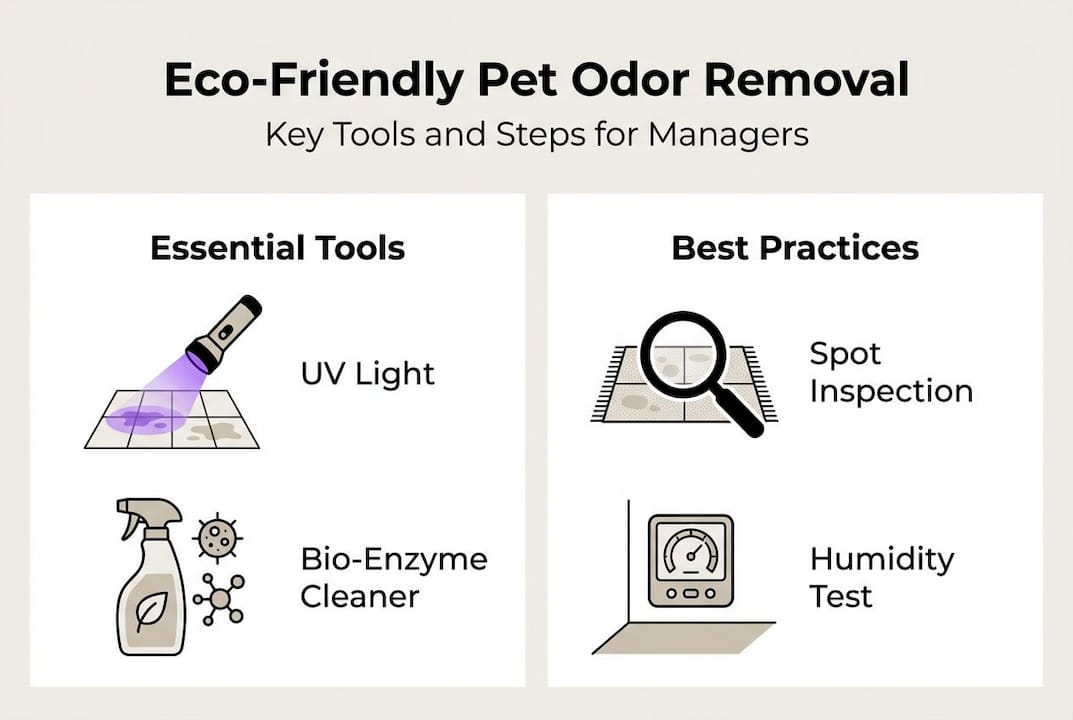
Start with a structured inspection process. The core methodology involves smell tests, UV lights, and moisture meters to identify contamination depth before any treatment begins. UV or black lights reveal urine deposits invisible to the naked eye. Moisture meters confirm whether saturation has reached the subfloor. pH strips help you understand the chemical state of the affected area, which guides your product selection.
Here is a quick reference table for matching inspection tools to contamination depth:
| Contamination depth | Detection tool | Recommended action |
|---|---|---|
| Surface fibers | UV light, smell test | Enzyme spray, extraction |
| Padding/underlayment | Moisture meter | Remove and replace padding |
| Subfloor | Moisture meter, pH strip | Seal or replace boards |
| Drywall/baseboards | UV light, smell test | Seal or cut and replace |
For eco-friendly supplies, prioritize these:
- Plant enzyme cleaners: Break down uric acid crystals at a molecular level
- Bio-enzymatic sprays: Safe for tenants, staff, and HVAC systems
- Activated charcoal: Absorbs residual odor molecules from the air
- Essential oil neutralizers: Used as a finishing layer, not a masking agent
For spring property turnover tips and seasonal prep, having this toolkit ready to deploy on short notice is a competitive advantage. Rapid turnaround is everything in high-demand rental markets.
Pro Tip: Mark each hotspot with painter’s tape after your UV inspection. Color code by severity so your treatment team knows exactly where to focus and how deep to go. This single step cuts treatment time significantly.
Refer to eco-friendly odor supplies for a vetted list of plant-based products that perform without harsh chemicals or residue.
Step-by-step: Removing pet odors from carpets, hard floors, and walls
Each surface type requires a different approach. Treating them all the same is a fast track to callbacks.
Carpets:
- Apply a bio-enzymatic pre-treatment to all UV-identified hotspots and allow full dwell time (usually 15 to 30 minutes)
- Extract deeply using a truck-mounted or high-powered portable unit
- Inspect the subfloor beneath the carpet after pulling it back in severe cases
- If the subfloor is saturated, apply a shellac-based primer or oil-based sealer before re-laying new padding and carpet
Hardwood floors:
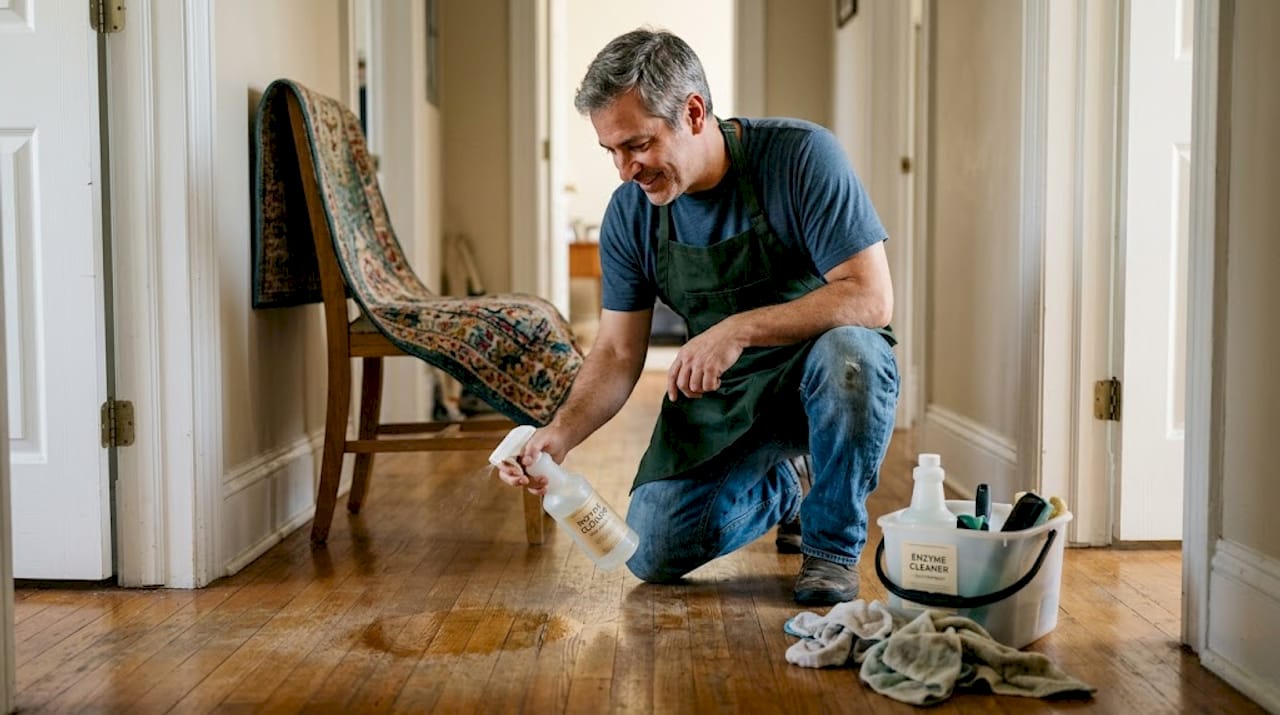
- Clean the surface thoroughly with a pH-neutral, wood-safe enzyme cleaner
- Seal any cracks or seams where urine may have seeped below the boards
- Replace boards that show deep staining or warping, as the wood itself holds odor
Walls and baseboards:
- Clean with enzyme cleaner along all baseboard edges
- For moderate cases, apply an odor-blocking primer before repainting
- For severe cases, cut and replace drywall sections that have absorbed urine
Here is a comparison of the main treatment methods:
| Method | Effectiveness | Eco-friendly | Best for |
|---|---|---|---|
| Bio-enzymatic cleaner | High | Yes | Carpets, hard floors, walls |
| Activated charcoal | Moderate | Yes | Air and residual odors |
| Ozone treatment | High | No | Not recommended for occupied spaces |
| Vinegar or steam | Low | Partial | Not recommended for urine |
The Chem-Dry P.U.R.T. process identifies urine crystals, applies a molecular treatment directly to the subfloor, and follows with extraction. Lab testing shows it virtually eliminates urine odor at the source. That level of precision is what professional odor removal delivers versus a general cleaning.
Avoid steam cleaning on urine-affected areas. Heat drives odor molecules deeper into porous materials. Vinegar, despite its popularity, is acidic and can react with urine salts in ways that intensify the smell. Eco-friendly options like bio-enzymatic cleaners and activated charcoal are safe for tenants and staff without the risks.
Pro Tip: Never re-lay new carpet over an untreated subfloor. The odor will transfer into the new carpet within weeks, and you will be back to square one at double the cost.
Verification and troubleshooting: Ensuring odor-free results
Treatment is only half the job. Verification is where most DIY efforts fall short and where professional services earn their value.
Once treated areas have fully dried, run a humidity stress test. Lightly mist the treated zones with water or increase room humidity using a humidifier for 30 to 60 minutes. Then re-enter and assess. If any odor returns, the source was not fully neutralized. This is the same method pros use before signing off on a unit.
As confirmed by professional remediation standards, humidity triggers reactivation, and certified pros rely on pH and moisture testing to confirm odors are fully gone before a unit is cleared.
Here is a comparison of DIY versus professional verification:
| Verification method | DIY | Professional |
|---|---|---|
| Sniff test | Yes | Yes |
| UV light re-inspection | Sometimes | Always |
| pH and moisture testing | Rarely | Standard practice |
| Humidity stress test | Rarely | Standard practice |
| Written clearance report | No | Yes |
Red flags that signal incomplete removal:
- Odor returns within 48 hours of treatment
- Tenant complaints within the first week of move-in
- Repeated hotspots in the same locations across multiple treatments
- Moisture readings that remain elevated after drying time
“If you are treating the same spots more than twice, you are not solving the problem. You are managing it.”
This is the point where escalating to odor removal experts becomes the smarter financial decision. Professional services report a 99.6% success rate in lab studies, while DIY approaches frequently result in callbacks due to missed contamination layers. One professional treatment often costs less than two failed DIY attempts plus the vacancy loss.
Why source removal and eco-friendly processes are non-negotiable for upscale property success
After years of working with property managers across luxury residential and commercial spaces, one pattern stands out clearly. The managers who consistently see high renewal rates and fewer odor-related complaints are not the ones who spend the most on cleaning. They are the ones who refuse to mask and move on.
Quick fixes feel efficient in the moment. Spray, deodorize, repaint, and lease. But in competitive rental markets, that approach creates a compounding reputation problem. One negative review mentioning odors can suppress inquiry rates for months.
A layered approach, meaning inspect, clean, neutralize, and seal, delivers results that hold up under real-world conditions. And when that process uses eco-friendly methods, it attracts a growing segment of health- and environment-conscious tenants who are willing to pay premium rates for spaces they trust. As green-certified firms demonstrate, layered eco-friendly methods consistently outperform single masking techniques in both odor elimination and tenant retention.
One often overlooked step: always run your humidity verification test before turnover, not after. Catching a reactivation issue before the new tenant arrives is the difference between a smooth transition and an emergency callback. Working with luxury interior specialists who understand these standards means you are not guessing. You are operating with a verified, repeatable process.
Next steps: Professional odor removal solutions for property managers
You now have the framework. But executing it consistently across multiple units, under tight turnover timelines, is where having the right partner matters.
Master Odor Removal works with property managers who cannot afford to get it wrong. Our green-certified process avoids ozone and chlorine entirely, using safe, proven methods that protect your tenants, your staff, and your property’s long-term value. Same-day and next-day availability means your units get cleared fast. Connect with our odor removal specialists to schedule an inspection, or learn more about odor removal done right and our commitment to green odor elimination that meets the standards your properties demand.
Frequently asked questions
Why do pet odors return after cleaning carpets and walls?
Pet odors persist because urine penetrates multiple layers and reactivates with moisture unless fully addressed at every contamination depth, including padding, subfloor, and drywall.
What eco-friendly solutions are best for removing pet odors in rentals?
Plant-based enzyme cleaners, bio-enzymatic sprays, and activated charcoal are the most effective and safest options. These eco-friendly solutions eliminate odor at the source without harsh chemicals that could affect tenant health.
How can property managers verify that pet odors are completely gone?
Use pH and moisture testing after treatment dries, then apply humidity to stress-test hotspot areas before the new tenant moves in.
Does professional odor removal really work better than DIY methods?
Yes. Professional services report a 99.6% success rate in lab studies, while DIY methods frequently lead to callbacks because they miss deep contamination layers that require specialized tools and products to reach.
Recommended
- Professional Odor Removal: Luxury Eco-Friendly Solutions – Master Odor Removal
- Odor removal guarantees: How luxury properties stay fresh – Master Odor Removal
- Next-day odor removal: Fast, eco-friendly luxury solutions – Master Odor Removal
- Pet odor removal tips for hotels: keep rooms fresh – Master Odor Removal
Recent Comments