
TL;DR:
- The shift to low-VOC materials and green certifications is now the standard in luxury renovations by 2026.
- Combating odors effectively involves combining technology, material choices, and system-level strategies.
- Permanent odor removal in luxury spaces requires a systemic approach, not just product solutions.
Luxury property managers once had a simple playbook: saturate a space with industrial-strength chemicals, mask the problem, and move on. That approach is finished. Low-VOC materials and finishes are now the 2026 renovation baseline, and the same shift is reshaping how elite properties address odors at every level. This guide breaks down the technologies, certification standards, and step-by-step protocols that property managers and business owners in the luxury segment need to protect their brand, their guests, and their investment in 2026.
Table of Contents
- Why 2026 marks a turning point in odor removal for luxury spaces
- Breakthrough technologies: From bio-enzymes to high-tech purifiers
- Setting the standard: Low-VOC materials and the GreenGuard Gold baseline
- Implementing a lasting, eco-friendly odor removal strategy
- What most experts miss about permanent odor removal in luxury interiors
- Eco-friendly luxury odor removal: Your next winning move
- Frequently asked questions
Key Takeaways
| Point | Details |
|---|---|
| Bio-enzymatic solutions dominate | Bio-enzymatic methods are leading the eco-friendly odor removal market for luxury interiors. |
| Low-VOC is the new norm | Materials with VOCs under 5g/L are now required for luxury interior renovations. |
| PECO and carbon purifiers excel | Advanced air purifiers combining PECO and activated carbon remove odors at the molecular level. |
| Layered strategies work best | Combining rapid and deep odor removal methods ensures both instant relief and long-term freshness. |
| Certification matters | Choosing GreenGuard Gold-certified materials is essential for sustainable, healthy luxury spaces. |
Why 2026 marks a turning point in odor removal for luxury spaces
The luxury interior market has always rewarded discretion and quality. But until recently, odor removal sat in a blind spot. Property managers could apply aggressive chemical treatments, air out the space, and call it done. That era is over, and the shift is being driven by three forces working simultaneously.
First, regulatory bodies across North America and Europe are tightening volatile organic compound (VOC) limits in commercial and residential interiors. Green building certification programs such as LEED and WELL have codified expectations that were once optional extras. High-end clientele now read certification documentation the same way they read ingredient labels. Second, consumer expectations have changed sharply. Guests in five-star hotels and premium rental properties are more informed about indoor air quality than ever before, and a single negative experience with chemical odors or residual mildew will generate a review that no PR budget can fully offset. Third, the science has caught up with the demand.
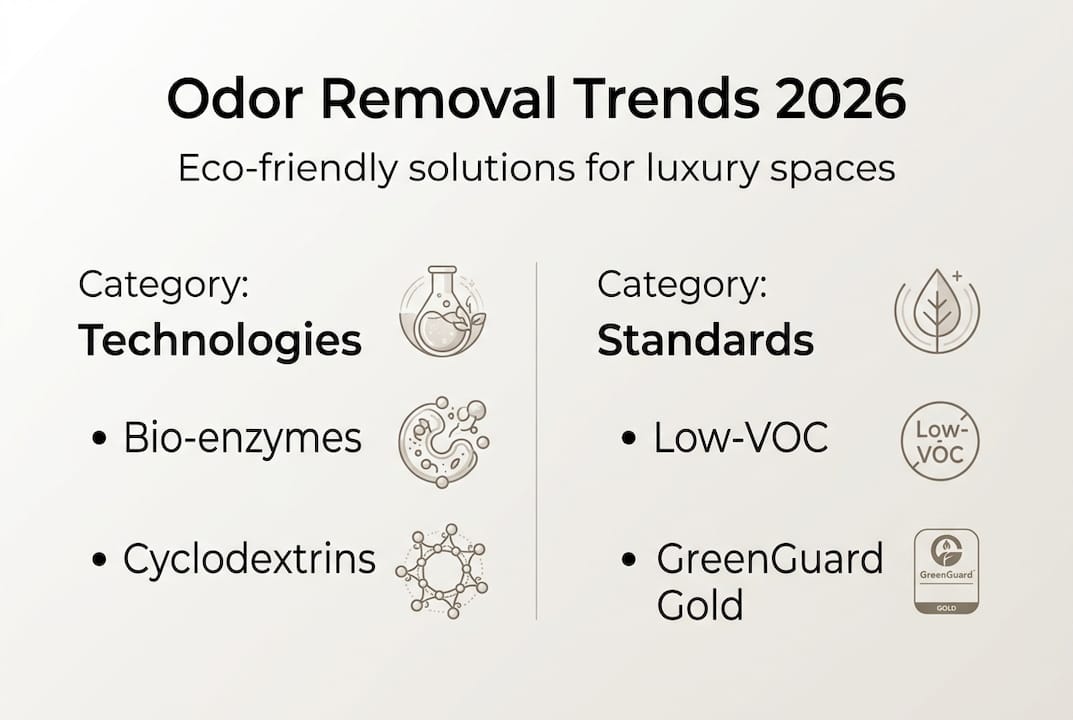
The bio-enzymatic odor control market is projected to nearly double by 2032, driven by regulatory requirements and aggressive intellectual property innovation. This is not incremental progress. It is a structural shift in how the industry approaches odor science.
What this means for you, practically, is that odor removal standards for luxury interiors now carry both commercial and ethical weight. Ignoring them isn’t just a health risk; it’s a reputational one.
Key market and regulatory shifts reshaping luxury odor management:
- Green building certifications (LEED, WELL, GreenGuard) now require documented VOC compliance
- Local building codes in major U.S. cities increasingly restrict high-VOC products in commercial interiors
- Guest and tenant health concerns have elevated air quality from a nice-to-have to a deal-breaker
- Insurance and liability frameworks are starting to incorporate indoor air quality as a baseline
“The assumption that strong chemical treatments signal effectiveness is the single most outdated belief in luxury property management. Today’s discerning clientele equate chemical smells with poor stewardship, not cleanliness.” — Industry consensus among high-end hospitality consultants
If you’ve been wondering whether signs of persistent odors in your property are a maintenance issue or a strategic one, the answer in 2026 is clearly both.
Breakthrough technologies: From bio-enzymes to high-tech purifiers
Once the market context is clear, it becomes essential to see which innovations are actually leading for eco-friendly, high-performance odor removal. Not every technology delivers the same results, and pairing the right method to the right situation is where elite property management separates itself from the rest.
Here is a side-by-side comparison of the leading odor removal technologies for luxury interiors:
| Technology | Speed of action | Residue-free | Best use case | Eco-credential |
|---|---|---|---|---|
| Bio-enzymatic solutions | Moderate (24-72h) | Yes | Deep remediation, pet, mildew | High |
| Cyclodextrin plus adsorption | Fast (under 24h) | Yes | Guest-ready turnovers | High |
| PECO air purification | Ongoing | Yes | HVAC integration, continuous use | High |
| Activated carbon filtration | Moderate | Yes | Smoke, VOC absorption | High |
| HEPA filtration | Ongoing | Yes | Particulate and allergen control | High |
| Traditional ozone treatment | Fast | No | Not recommended for luxury use | Low |
The bio-enzymatic category deserves particular attention. The global market was valued at $834 million in 2025 and is projected to reach $1,521 million by 2032. These solutions work by deploying live enzyme cultures that consume odor-causing organic compounds at the molecular level, leaving no chemical residue. The limitation is speed: a full enzymatic remediation cycle for a heavily affected space can take two to three days, making it unsuitable as a standalone solution for rapid turnovers.
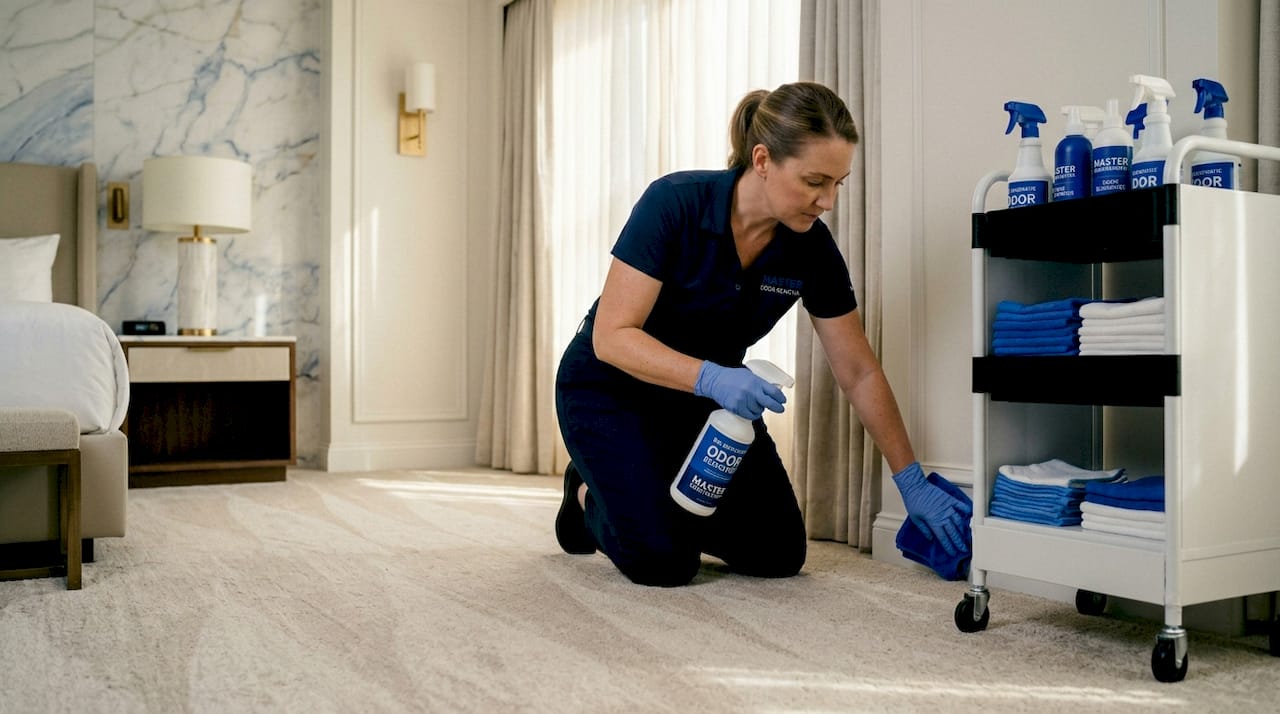
Cyclodextrin-based systems solve the speed problem. These compounds trap odor molecules inside a ring-shaped molecular structure, effectively neutralizing them on contact. Combined with adsorption technology, they can produce measurable results in under 24 hours, making them ideal for hospitality properties that can’t afford extended downtime between guest bookings.
PECO technology, which stands for Photo Electrochemical Oxidation, takes a different approach entirely. Rather than absorbing or trapping odor molecules, it destroys them at the molecular level using a light-activated catalyst. High-tech air purifiers with PECO, activated carbon, and HEPA are now recommended as the 2026 standard for luxury home interiors, and they integrate seamlessly with smart building HVAC systems for continuous background purification.
Pro Tip: Don’t treat these technologies as competing options. The most effective protocols for luxury spaces combine enzymatic remediation for deep source elimination with PECO or cyclodextrin applications for immediate air quality results. That layered approach delivers both the speed guests expect and the permanence that property owners require.
For more detail on pairing these technologies to specific interior challenges, our guide to luxury eco-friendly solutions covers property-specific protocols in full. You’ll also find targeted guidance on indoor air quality tips that go well beyond equipment selection.
Setting the standard: Low-VOC materials and the GreenGuard Gold baseline
Having covered innovative devices and biological treatments, the conversation must shift to the materials themselves. Because no amount of post-treatment remediation compensates for a renovation that introduced the problem in the first place.
Low-VOC paints and materials with under 5g/L VOC are the 2026 baseline for luxury renovations. They prevent off-gassing headaches and allow spaces to become occupant-ready significantly faster after construction or refurbishment. For high-end clientele who measure downtime in revenue, that acceleration matters enormously.
GreenGuard Gold certification is the benchmark to specify in every project brief. It certifies that products meet the strictest chemical emissions standards, including limits on formaldehyde, total VOCs, and 360 additional chemical compounds. Properties targeting LEED or WELL certification will find that GreenGuard Gold-certified products streamline their compliance documentation considerably.
Here’s how key material categories compare for VOC compliance:
| Material category | Standard product (VOC level) | Low-VOC compliant (VOC level) | GreenGuard Gold certified |
|---|---|---|---|
| Interior paints | Up to 250g/L | Under 5g/L | Available |
| Adhesives and sealants | Up to 150g/L | Under 10g/L | Available |
| Flooring finishes | Up to 200g/L | Under 25g/L | Available |
| Upholstery treatments | Varies widely | Specified low-emission | Available |
How to verify material compliance in a luxury renovation project:
- Request the product Safety Data Sheet (SDS) before purchase and confirm VOC content in grams per liter.
- Cross-reference the product against the GreenGuard or GreenGuard Gold certified products database, which is publicly searchable.
- Specify GreenGuard-certified products in the project contract and retain copies of all certification documentation.
- Conduct a pre-occupancy air quality test 48 hours after renovation completion to verify off-gassing has normalized.
- Keep a permanent material compliance file for each property for insurance, resale, and certification purposes.
Pro Tip: Always request third-party certification documentation and never accept a vendor’s verbal assurance of compliance. In the luxury segment, your liability and your clients’ health expectations both require paper trails.
The most sophisticated luxury managers go a step further. They build material specification templates that require low-VOC and GreenGuard Gold compliance by default, removing the need for case-by-case verification on every project. That kind of systematic approach is what distinguishes proactive property management from reactive damage control.
Implementing a lasting, eco-friendly odor removal strategy
With a thorough understanding of both the technologies and the material standards, you can now build a strategy that delivers immediate freshness and prevents odor recurrence for the long term. Speed matters for turnover. Permanence matters for reputation.
Cyclodextrin plus adsorption benchmarks show odor reduction within 24 hours, while enzymatic treatments work slower but are entirely residue-free. The most effective protocols for luxury properties don’t choose between these approaches; they sequence them.
Here is a five-step implementation workflow built for high-end interior management:
Assess the source precisely. Don’t treat symptoms. Conduct a thorough investigation of the odor’s origin: HVAC ducts, subfloor materials, porous upholstery, or embedded wall finishes. Use a professional-grade air quality sensor to establish a baseline measurement and identify and control luxury odors at the root.
Select a targeted eco-method matched to the source. Organic sources such as pet contamination or mildew respond best to enzymatic treatment. Smoke and tobacco penetration typically requires a combination of activated carbon adsorption and cyclodextrin surface treatment. Chemical off-gassing from renovations calls for PECO air purification running continuously through the first week post-completion.
Verify material and air certifications before and after treatment. Confirm that any products applied during remediation are themselves low-VOC and carry relevant green certifications. This step is non-negotiable in properties targeting LEED or WELL points, and it matters just as much for properties where clients simply expect chemical-free environments.
Apply multi-modal solutions in sequence. Begin with source elimination (enzymatic or direct extraction), follow with surface treatment (cyclodextrin-based for rapid neutralization), then deploy PECO or HEPA purification for ongoing air quality maintenance. This sequence ensures both immediate and enduring results without introducing chemical residues.
Validate results with documented air quality testing. A post-treatment air quality measurement is the only way to confirm success with objectivity. It also gives you documentation to share with property owners, guests, or certification auditors. Properties with documented air quality records command measurably higher trust from discerning clients.
Pro Tip: Always conduct pre-treatment and post-treatment air quality monitoring using a calibrated sensor, not just a smell check. Objective data is the only credible proof of a permanent result, and it’s the foundation of odor removal guarantees that actually hold up under scrutiny.
This workflow isn’t a one-time event. Build it into your property management calendar as a recurring protocol, timed to seasonal transitions and before major occupancy changes. Odor prevention is dramatically cheaper and less disruptive than emergency remediation.
What most experts miss about permanent odor removal in luxury interiors
Here’s the perspective that most vendor presentations and technology guides skip entirely: permanent odor removal in luxury interiors is not primarily a product problem. It’s a systems problem.
Most property managers encounter odor challenges and immediately ask, “Which product should I apply?” That question, while reasonable, starts the process in the wrong place. Products and technologies are the tools. The strategy is what makes the difference between a problem that stays gone and one that returns three months after treatment.
We’ve worked in spaces where every advanced technology available had been deployed and the odor came back within weeks. In every case, the root cause wasn’t the treatment. It was a gap in the surrounding system: HVAC airflow that continuously redistributed contaminated air, renovation materials that kept off-gassing at low levels, or staff who applied surface treatments without addressing sub-floor saturation. No single product, however sophisticated, compensates for an incomplete systems view.
The deeper issue is that luxury property management often treats odor removal as an episodic service rather than a design consideration. The most odor-resilient properties we encounter are ones where eco-friendly odor neutralization was factored into material selection, HVAC design, and maintenance protocols from the initial project brief. These properties don’t need emergency remediation because they were built and maintained with odor prevention in mind.
Staff training is another consistently overlooked variable. A property can have the best enzymatic treatment service in the country, but if housekeeping staff are applying conventional cleaning products that reintroduce VOCs daily, the benefits erode quickly. Educating the people who maintain your space is as important as the treatment itself.
Custom protocols, not off-the-shelf service packages, are what genuinely separate elite property management from the average. Every luxury interior has a unique combination of materials, occupancy patterns, and sensitivities. Treating them all with the same standard approach is a compromise that high-end clients will eventually notice.
Eco-friendly luxury odor removal: Your next winning move
Protecting a luxury property’s reputation means getting every sensory detail right. Odor is the one guests notice first and remember longest. Switching to advanced, eco-certified odor removal isn’t just an environmental position; it’s a direct investment in guest satisfaction, brand integrity, and the long-term value of the asset you manage.

Master Odor Removal specializes in permanent odor elimination for exactly these environments: upscale residences, hospitality venues, luxury yachts, and premium commercial spaces. Our protocols are green-certified, entirely free of ozone and chlorine treatments, and designed for clients who expect same-day or next-day results without compromising on safety. Whether you’re ready to audit your current approach or need an immediate service, our green odor elimination service gives you a clear starting point. For a broader look at how we approach results, explore odor removal done right and our science-backed odor strategies that power every engagement.
Frequently asked questions
What is the fastest eco-friendly odor removal method for high-end spaces?
Cyclodextrin plus adsorption technology can reduce odors within 24 hours while remaining entirely chemical-free, making it ideal for high-turnover luxury environments.
Do low-VOC materials really prevent odors in luxury interiors?
Yes. Materials with under 5g/L VOC prevent the persistent off-gassing that causes headaches and chemical odors after renovations, allowing faster occupancy and healthier indoor air.
What air purifiers are most effective in 2026 luxury homes?
Units combining PECO, activated carbon, and HEPA filtration are the 2026 recommendation for luxury interiors requiring complete, continuous odor and pollutant removal.
Does GreenGuard Gold certification matter for luxury renovations?
Absolutely. GreenGuard Gold ensures materials meet strict chemical emissions limits across 360-plus compounds, guaranteeing a healthy, odor-neutral environment that satisfies both regulatory and client expectations.
Recommended
- Odor removal standards explained: guide for eco-friendly interiors – Master Odor Removal
- Odor neutralization: eco-friendly solutions for luxury – Master Odor Removal
- Professional Odor Removal: Luxury Eco-Friendly Solutions – Master Odor Removal
- Eco-friendly odor removal for luxury hotels: 94% fewer complaints – Master Odor Removal
Recent Comments