
TL;DR:
- Odors like cigarette smoke and mold significantly decrease luxury car resale value.
- Professional odor inspection and remediation are essential to meet high buyer and dealer standards.
- Neutral, scent-free interiors are the key to maximizing vehicle value and sale success.
A faint whiff of stale smoke or mildew can quietly erase thousands from your luxury car’s asking price before a buyer even sits down. Smelly interiors drop $300 at auction and cigarette smoke alone can reduce resale value by 7.7%, which translates to $1,540 on a $20,000 vehicle. For a luxury car, the stakes are even higher. Serious buyers and dealerships treat interior scent as a direct signal of how well you maintained the vehicle. This guide walks you through which odors to check, where they hide, and the exact steps to take before you list your car for sale.
Table of Contents
- Why odor checks matter for luxury car resale
- The must-check list: Common and costly odors
- Expert inspection strategies: Where and how to sniff out odors
- Comparison table: Odor severity and impact on resale value
- Our take: The often-overlooked edge cases and why luxury matters
- Odor removal solutions for luxury car sellers
- Frequently asked questions
Key Takeaways
| Point | Details |
|---|---|
| Odors impact resale | Unpleasant scents in luxury cars can cost hundreds or even thousands of dollars when selling. |
| Critical inspection spots | Always check moisture traps, upholstery, and mechanical areas for hidden odors before listing. |
| Smoking is most destructive | Cigarette smoke has the highest negative impact on resale value compared to all other odors. |
| Professional removal pays off | Investing in expert odor removal can help preserve premium resale value and appeal to luxury buyers. |
Why odor checks matter for luxury car resale
When a buyer walks up to your vehicle, the first impression is visual. The second is olfactory. And that second impression can be the one that costs you money. Luxury buyers are not browsing for a bargain. They expect perfection, and a single off-putting scent can make them walk away or negotiate hard.
Auction houses and dealerships are not sentimental about it. Cigarette smoke reduces value by 7.7% and smelly interiors face a flat $300 deduction at auction, regardless of the car’s condition in every other respect. For a $60,000 luxury vehicle, that percentage loss climbs well above $4,000. That is not a minor inconvenience. That is a significant financial hit.
Certified Pre-Owned (CPO) programs make the stakes even clearer. CPO inspections treat interior odors as defects, the same way they treat mechanical issues. If your car fails an odor check during a CPO evaluation, it either gets pulled from the program or requires remediation before it qualifies. Buyers who know this use it as leverage.
Here is what dealerships consistently penalize during trade-in evaluations:
- Cigarette and tobacco smoke (highest deduction, often exceeding $1,000)
- Mold and mildew (common in vehicles with sunroof leaks or flood history)
- Pet odors (especially in SUVs and crossovers with fabric cargo areas)
- Food and beverage spills (fermented smells in seat cushions and carpet fibers)
- Mechanical odors (exhaust, gasoline, or burning rubber suggesting unresolved issues)
“Professional sellers invest heavily in odor remediation because the return on that investment is clear. A $200 treatment protecting $1,500 in resale value is an easy decision.”
This is exactly why luxury dealership odor solutions have become a standard part of pre-sale preparation at high-end lots. Sellers who treat their cars the same way are the ones who walk away with full asking price.
Now that you know how odors can impact your bottom line, let’s break down the most critical types to check before listing your vehicle.
The must-check list: Common and costly odors
Not all bad smells are equal. Some are cosmetic nuisances. Others signal mechanical problems that could derail a sale entirely. Knowing which is which helps you prioritize your time and budget before listing.
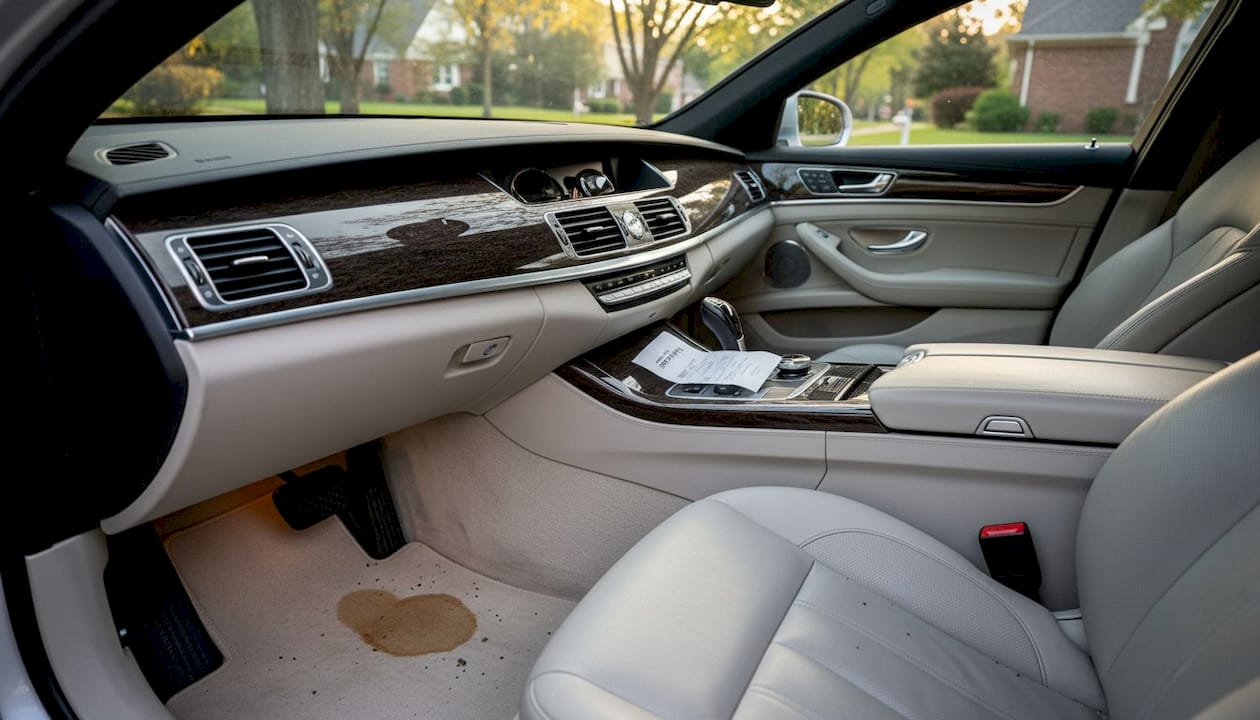
The most penalized car odors include cigarette smoke, mold and mildew, pet smells, food spills, gasoline, rotten eggs, burning rubber, exhaust, and sweet coolant. Each one tells a different story to a buyer.
Here is a quick breakdown of what each odor signals and how to spot it:
- Cigarette smoke: Yellowish film on windows, stale smell embedded in headliner and seat foam
- Mold and mildew: Musty smell strongest after rain or when AC runs, visible dark spots under mats
- Pet odors: Hair embedded in carpet, ammonia-like smell from urine in seat cushions
- Food spills: Sour or fermented smell from under seats and between cushions
- Gasoline: Sharp chemical smell near the trunk or floor, may indicate a fuel line issue
- Rotten eggs: Sulfur smell from a failing catalytic converter, requires mechanical repair
- Burning rubber: Smell near the engine bay, often from a slipping belt or overheating component
- Exhaust fumes inside cabin: Possible exhaust leak, a safety concern that must be fixed before sale
- Sweet coolant smell: Antifreeze leak from the heater core, often smells like maple syrup inside the cabin
| Odor | Buyer perception | Estimated value impact |
|---|---|---|
| Cigarette smoke | Neglect, health concern | Up to $1,540+ |
| Mold/mildew | Water damage, hidden issues | $500 to $1,000 |
| Pet odor | Heavy use, hygiene concern | $300 to $700 |
| Food spills | Poor maintenance | $200 to $400 |
| Mechanical odors | Safety risk, repair needed | Variable, often disqualifying |
Pro Tip: Mechanical odors like exhaust fumes or sweet coolant smell are not just resale problems. They are safety issues. Address these before anything else. A buyer who smells coolant inside your cabin will assume the worst, and they will be right to.
For tobacco smoke odor removal and permanent cigarette odor removal in luxury interiors, professional treatment is the only reliable path. Sprays and air fresheners mask the smell temporarily but do not eliminate the source.
Once you understand what creates these costly deductions, you will want a clear checklist for inspection.
Expert inspection strategies: Where and how to sniff out odors
Knowing what to look for is only half the job. You also need to know where these odors hide, because some of the most damaging ones are invisible until a buyer is already sitting inside your car.
Here is how professionals approach a thorough odor inspection before a luxury vehicle sale:
- Start with the headliner. Cigarette smoke and cooking fumes rise and get absorbed into the fabric above you. Press gently on the headliner and smell your hand. This is often the most telling test.
- Check seat cushions and foam. Pet urine, food spills, and mold can saturate foam layers that look perfectly clean on the surface. Press down firmly on each seat and note any smell that releases.
- Inspect the glove compartment and storage pockets. Food wrappers, spills, and moisture collect here and go unnoticed for months.
- Look under the seats and floor mats. Lift every mat. Check the carpet underneath for staining, moisture, or visible mold growth.
- Check sunroof drains. Clogged sunroof drains are one of the most common causes of hidden mold in luxury vehicles. Water backs up and soaks into the A-pillar trim and carpet.
- Run the air conditioning. Mold and bacteria in the evaporator core produce a musty smell that only appears when the AC is on. This surprises many sellers.
- Inspect under the hood and near the exhaust. Mechanical odors like gasoline, burning rubber, or coolant need to be traced to their source before the car is listed.
CPO inspections flag odors as defects and use many of these same steps. If your vehicle cannot pass a CPO smell check, it will not pass a serious buyer’s check either.
Pro Tip: 90% of car interiors use polyester fabric, which traps moisture and bacteria exceptionally well. Use a UV flashlight to spot biological stains invisible to the naked eye, and consider a moisture meter for carpets if you suspect water intrusion. For professional mildew odor detection, these tools make the difference between a clean bill of health and a costly surprise.
“Dealerships invest hundreds to avoid auction odor penalties. Private sellers who skip this step are leaving money on the table.”
For high-performance vehicles, super car odor removal requires an even more precise approach given the premium materials involved.
Now that you have learned where to look and how to identify problem odors, use this comparison table to plan your remedial actions.
Comparison table: Odor severity and impact on resale value
Not every odor demands the same urgency. This table helps you prioritize which issues to resolve first and understand how each one affects your final sale price.
| Odor type | Severity | Detection difficulty | Estimated dollar impact | Subjective or objective defect |
|---|---|---|---|---|
| Cigarette smoke | Very high | Easy | Up to $1,540 | Objective |
| Mold/mildew | High | Moderate | $500 to $1,000 | Objective |
| Pet odor | High | Easy | $300 to $700 | Subjective |
| Food/beverage | Moderate | Moderate | $200 to $400 | Subjective |
| Gasoline | High | Easy | Variable | Objective |
| Rotten eggs | Very high | Easy | Disqualifying | Objective |
| Burning rubber | Very high | Easy | Disqualifying | Objective |
| Sweet coolant | Very high | Moderate | Disqualifying | Objective |
| Exhaust in cabin | Very high | Moderate | Disqualifying | Objective |
Smoking is the single most value-destructive odor, with documented deductions up to $1,540. Mold and mildew follow closely, especially because they suggest water damage history.
Here is how to prioritize your remediation plan:
- Address first: Cigarette smoke, mold, and any mechanical odors (gasoline, rotten eggs, burning rubber, exhaust, coolant)
- Address second: Pet odors and food smells
- Final check: Run the AC and do a full re-inspection after treatment to confirm the odor is gone, not just masked
Subjective odors like pet smells and food are evaluated differently by each buyer. Objective odors like smoke and mechanical issues are universally penalized. Buyers and appraisers agree on those, and so do auction houses. For a green odor removal approach that eliminates rather than covers, eco-certified professional treatment is the most reliable option for luxury vehicles.
Our take: The often-overlooked edge cases and why luxury matters
Most sellers focus on the obvious. They address cigarette smoke if they smoked in the car, or pet odors if they had a dog. What they miss are the edge cases, and those are often the ones that kill a luxury sale.
Consider this: a car that sat in a garage with minor flooding two years ago may smell perfectly fine today. But the moment a buyer runs the AC, a faint mildew smell emerges from the evaporator. That smell, barely noticeable, is enough to make a luxury buyer question everything about the vehicle’s history.
CPO programs treat odors as subjective defects and polyester interiors trap bacteria in ways that basic cleaning cannot reach. Luxury buyers operate at a higher standard. They are not just buying transportation. They are buying an experience, and that experience starts with the scent of the cabin.
“Neutral scent, not perfumed, is the new luxury standard.”
A car that smells like an air freshener raises as many questions as one that smells like smoke. Buyers wonder what you are hiding. The goal is a completely neutral interior, one that smells like nothing at all. That is what a luxury interior specialist delivers, and it is what separates a clean bill of health from a negotiating liability.
Odor removal solutions for luxury car sellers
You have done the inspection. You know which odors need attention. Now the question is who you trust to eliminate them permanently before your vehicle goes to market.
At Master Odor Removal, we work exclusively with eco-friendly, green-certified methods. No ozone. No chlorine. Just proven techniques that remove odors at the molecular level, not just on the surface. Our team of odor removal specialists is available same or next day, which means you do not have to delay your listing. Whether you need odor removal done right for a single treatment or a full CPO-level remediation, we tailor every service to the specific demands of your vehicle. As a recognized luxury interior specialist, we guarantee a neutral, buyer-ready interior.
Frequently asked questions
What odors decrease luxury car resale value the most?
Cigarette smoke causes the largest deductions, with up to 7.7% value loss, followed by mold, mildew, and mechanical odors like gasoline, which often result in $300 to $1,540 in penalties.
How can I reliably detect hidden odors before selling?
Use a CPO-style inspection that covers seat cushions, sunroof drains, and under the carpets, since CPO checks target hidden odor defects and moisture traps that casual cleaning misses entirely.
Are professional odor removal services worth it for high-end vehicles?
Absolutely. Dealerships invest heavily in odor remediation because even minor scents trigger costly auction deductions and cause buyers to walk away from otherwise perfect vehicles.
What materials in my car might hold onto odors?
Polyester fabrics, which make up 90% of car interiors, trap moisture and bacteria deep in the fibers, making mold and musty smells far more persistent than they appear on the surface.
Can mechanical odors signal urgent repairs before sale?
Yes. Scents like exhaust inside the cabin, burning rubber, or sweet coolant may indicate dangerous repairs that must be resolved before the car is safe to list or drive.
Recent Comments