
TL;DR:
- Persistent odors in marine carpets stem from moisture trapped beneath the surface, fueling microbial activity that produces VOCs. Effective, lasting elimination requires deep penetration enzyme treatments combined with thorough drying and humidity control to prevent microbial regrowth. Professional eco-friendly solutions focus on moisture management, microbial suppression, and proper treatment protocols for durable results.
You clean your boat carpet thoroughly, let it dry, and within days that familiar sour, musty smell is back. This is one of the most frustrating problems yacht owners face, and the reason why odors persist in marine carpets has nothing to do with how hard you scrub. The real culprits are hidden deep in carpet backing and padding where moisture settles, microbes thrive, and no surface cleaning can reach. This guide explains exactly what is happening beneath your feet, and how to address it with treatments that are both permanent and safe for your vessel and the marine environment.
Table of Contents
- Understanding why marine carpet odors persist
- The role of mildew, mold, and organic residues in odor retention
- Why drying and humidity control are crucial to eliminating odors
- Effective eco-friendly treatment approaches for persistent marine carpet odors
- Common misconceptions and pitfalls when trying to eliminate marine carpet odors
- Why conventional odor-removal wisdom falls short in marine environments
- Discover expert eco-friendly odor removal solutions tailored for your yacht
- Frequently asked questions
Key Takeaways
| Point | Details |
|---|---|
| Hidden moisture causes odors | Moisture trapped deep in marine carpets fuels microbial growth that generates persistent musty smells. |
| Mildew and residues penetrate deeply | Mold and organic contaminants often reside far below the carpet surface, requiring extended treatments. |
| Thorough drying is essential | Inadequate drying and high boat humidity enable odor-causing microbes to thrive and odors to return. |
| Extended enzyme treatments work best | Eco-friendly enzyme products need long dwell times to break down deep organic odors effectively. |
| Avoid quick fixes and surface sprays | Treat odor as a depth problem requiring specialized cleaning coupled with moisture control for lasting results. |
Understanding why marine carpet odors persist
Marine carpets are not built like home carpets. They are engineered to handle wet feet, spray, and constant humidity, which means they are thick, layered, and designed to shed surface water. The problem is that water does not stop at the surface. It wicks downward into the backing, adhesive layer, and foam or rubber padding underneath. Once moisture reaches those layers, it is trapped in a low-airflow environment with organic material. That is a perfect incubator.
What follows is a biological process, not a cleanliness problem. Bacteria and fungi metabolize the organic matter in the carpet, releasing volatile organic compounds (VOCs) as a byproduct. Those VOCs are the smell. Moisture control is the key driver of odor persistence: even when the surface feels dry, deeper layers can stay wet long enough to keep generating odor. This is why so many standard cleaning attempts produce only temporary relief.
Here is what actually traps odors in marine carpets at the structural level:
- Multilayer construction: Backing, adhesive, and padding each absorb and hold moisture independently
- Low airflow beneath the carpet: Carpets glued or laid over boat decks have virtually no airflow underneath
- Organic residue accumulation: Fish blood, food particles, sweat, and sunscreen soak through fibers over time
- Prolonged dampness cycles: Boats go through repeated wet-dry cycles that never fully dry the deepest layers
- Fiber chemistry: Synthetic fibers common in damp carpet odor causes are not immune to microbial colonization once backing materials stay moist
Understanding this also explains why odors linger on boats in ways that baffle even experienced owners: it is a depth problem, not a surface problem.
The role of mildew, mold, and organic residues in odor retention
Mold and mildew are the primary biological engines behind persistent smells in boat carpets. They grow not on the carpet face you see but deep inside the backing and padding where moisture collects and light never reaches. The first sign is often a musty odor when you open the boat, and visible contamination is typically far deeper than the surface suggests. By the time you can smell it, the colony is well established.
The chemistry matters here. Mold and mildew release specific VOCs including geosmin and various aldehydes, which register in the human nose as that damp, earthy smell even at extremely low concentrations. Your nose is detecting parts per billion. No amount of air freshener overrides this at the source.
Organic residues complicate things further. Urine, fish slime, and saltwater-soaked food particles penetrate fibers and padding in ways that bonded cleaners cannot follow. For this type of contamination, enzymes need extended dwell time and the treatment must reach the full depth of penetration. Otherwise, uric acid crystals and organic residues below the surface continue releasing odor compounds.
Key biological factors driving marine carpets odor retention:
- Mold colonies in backing: Invisible to the eye but active and odor-producing 24 hours a day
- Mildew spore reactivation: Spores remain dormant when dry but re-activate as soon as humidity rises
- Uric acid persistence: Crystallizes in fibers and releases fresh odor when moisture is reintroduced
- Bacterial biofilm: A thin layer of bacteria and their waste products coats fibers and is resistant to standard cleaners
- Saltwater concentration: Salt draws moisture and provides a mineral substrate that encourages microbial growth
Pro Tip: If the smell intensifies on warm, humid afternoons after the boat has been closed, that is not residual odor. It is active mold and mildew reactivating with the humidity spike. That distinction tells you the treatment needed is biological, not cosmetic.
For deeper insight into how these hidden sources develop, the yacht mystery odor removal process specifically addresses microbial sources that standard inspections miss. Understanding why removing mildew odor from boats matters beyond aesthetics is also critical for protecting long-term vessel value.
Why drying and humidity control are crucial to eliminating odors
You can apply the best enzyme treatment available and still have the smell back within two weeks. The reason is almost always inadequate drying. If the carpet is not fully dried after treatment, remaining moisture allows microbial regrowth and odors return even after thorough cleaning. This is not a product failure. It is a moisture management failure.
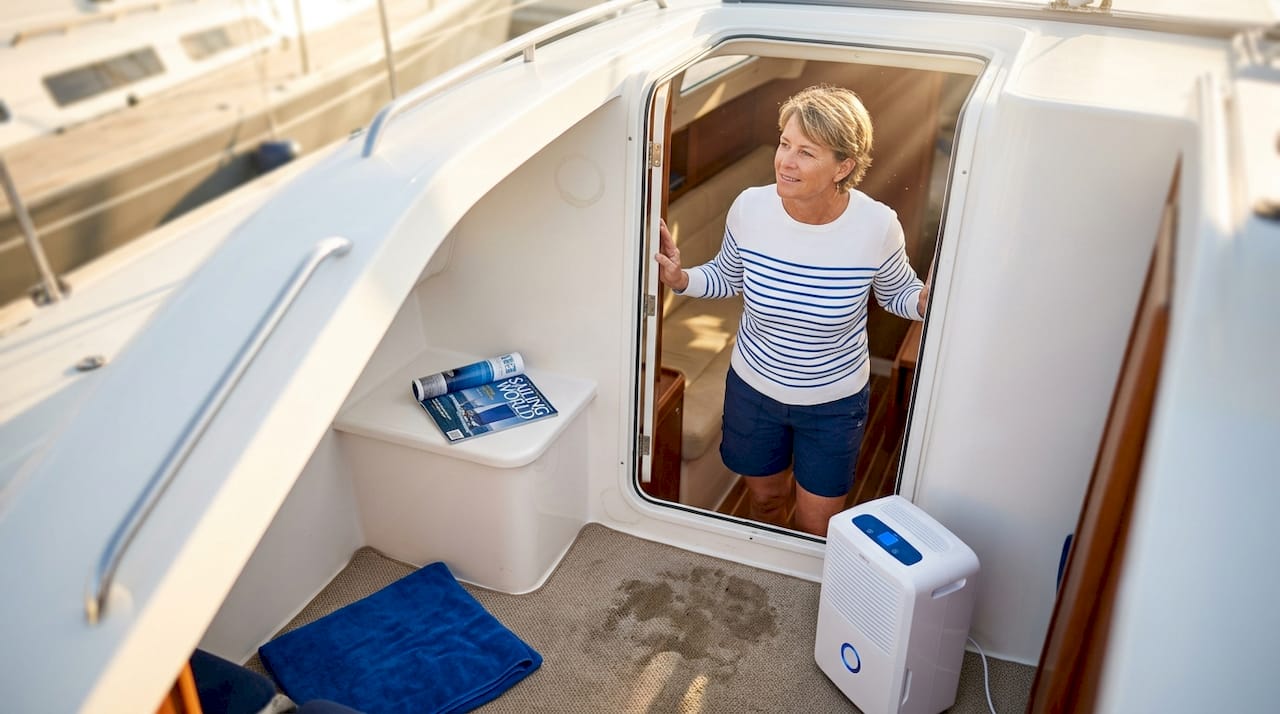
The humidity numbers are sobering. Mold and mildew can grow on virtually any surface when relative humidity exceeds 60%. Enclosed boat cabins can easily exceed 80% humidity on a summer afternoon, even when the boat is docked and not in use. That gap between 60% and 80% is where odors come back to life.
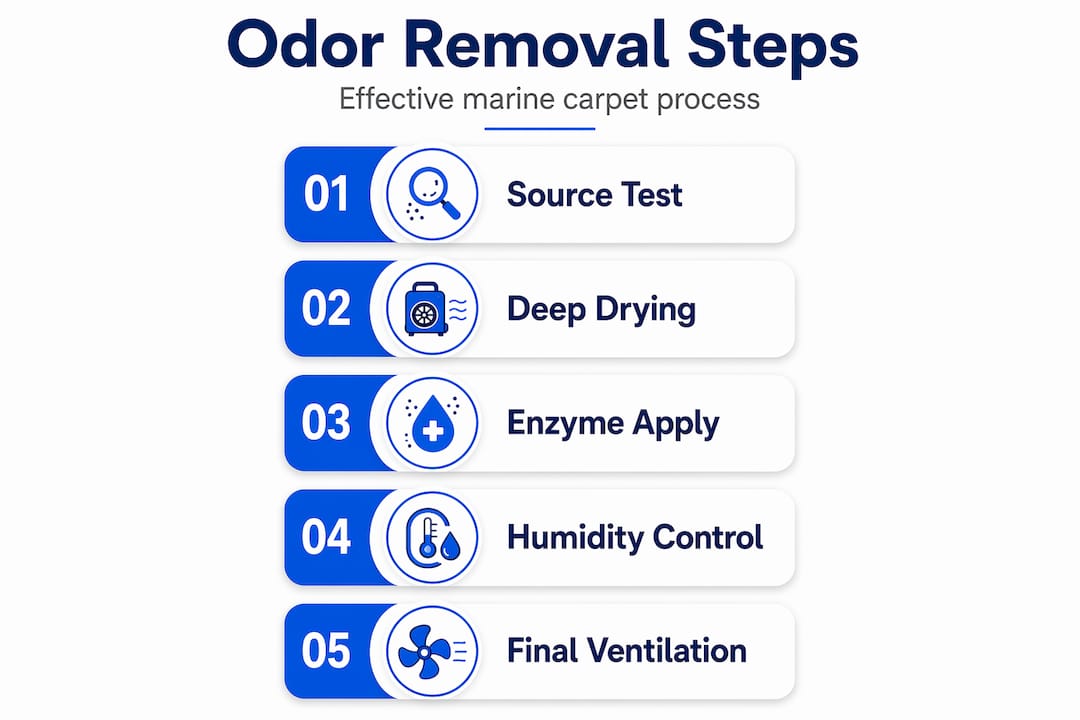
A practical drying and humidity control protocol should follow this sequence:
- Extract as much moisture as possible immediately after treatment using a wet vacuum with strong suction, working slowly in multiple passes
- Deploy fans directed at the carpet surface and beneath any removable sections for at least 8 hours
- Run a dehumidifier in enclosed cabin spaces targeting humidity below 50% during drying
- Leave hatches and ports open whenever conditions allow to maximize fresh airflow through the vessel
- Verify dryness with a moisture meter before declaring the job complete, checking backing layers, not just the surface
Marine carpets can feel completely dry to the touch within two hours while the backing retains 40 to 50% moisture content. A moisture meter is the only reliable way to confirm the job is done.
Routine ventilation when the boat is not in use is equally important. Boats that sit sealed between uses build up humidity rapidly from fibers, wood, foam, and residual water. Consistent airflow is the lowest-cost prevention tool available. Expert odor removal professionals always verify moisture levels before and after treatment for precisely this reason.
Effective eco-friendly treatment approaches for persistent marine carpet odors
Addressing persistent smells in boat carpets sustainably means choosing treatments that penetrate deeply, work biologically, and do not introduce harmful chemicals into a marine environment. That rules out chlorine-based bleaches and ozone treatments. It points squarely toward enzyme-based solutions with the right formulation and application method.
Here is a comparison of common treatment approaches and how they perform on deeply embedded marine carpet odors:
| Treatment method | Penetration depth | Eco-friendly | Odor recurrence risk | Notes |
|---|---|---|---|---|
| Surface spray and scrub | Surface only | Varies | High | Temporary masking only |
| Steam cleaning | Moderate | Yes | Moderate | Kills surface microbes; may not reach backing |
| Enzyme treatment (short dwell) | Moderate | Yes | Moderate | Insufficient contact time for deep contamination |
| Enzyme treatment (24-hour dwell) | Deep | Yes | Low | Most effective for embedded organic odors |
| Ozone treatment | Deep | No | Low | Harmful to marine materials; not recommended |
| Chlorine-based disinfectant | Surface | No | Moderate | Damages fibers and is toxic in marine environments |
For deeply embedded organic odors, effective enzyme action can require 24 hours or more of sustained contact, and sometimes multiple treatment cycles when contamination has reached the padding. The enzyme needs to remain active and moist against the substrate the entire time. This is why simply spraying and walking away rarely delivers permanent results.
Eco-friendly strategies that work for luxury yacht owners:
- Enzyme pre-treatment: Apply liberally, cover with plastic sheeting to maintain moisture and extend dwell time
- Multiple targeted cycles: Apply, extract, dry, evaluate, repeat for heavily contaminated areas
- Antimicrobial post-treatment: Apply a botanical-based antimicrobial after drying to suppress regrowth
- Ventilation integration: Build drying and airflow steps into every treatment cycle as non-negotiable
- Preventive enzyme maintenance: Monthly light enzyme application to high-traffic areas stops buildup before it becomes an odor source
Pro Tip: Covering treated carpet with a plastic sheet after enzyme application is not optional. It keeps the enzymes active by preventing evaporation. Without it, the enzyme dries out in two to three hours and stops working before it reaches the backing layer.
Understanding green odor elimination methods reveals that sustainable does not mean less effective. The right enzyme formulation with correct dwell time outperforms chemical treatments on organic odors. The superior odor removal process used by professionals combines all of these steps systematically rather than as one-off attempts.
Common misconceptions and pitfalls when trying to eliminate marine carpet odors
Most failed DIY odor treatments on boats share a common thread: they treat the symptom at the surface while the cause remains untouched below. Surface shampoos and quick sprays can remove visible staining while leaving embedded residues and moisture below. Once warm, humid conditions return, those residues reactivate and the smell is back.
These are the most common and costly mistakes yacht owners make when they try to tackle odors in marine carpets on their own:
- Using fragrance-based products: Air fresheners and scented sprays mask the VOCs briefly but do nothing to stop the biological process generating them
- Over-wetting the carpet during cleaning: Saturating the carpet without aggressive extraction drives more moisture into the backing and padding, making the problem worse
- Skipping the drying phase: The most common mistake. The treatment works, the odor is gone, but inadequate drying allows microbial growth to restart within days
- Using the wrong enzyme type: Not all enzyme formulations tackle the same residues. A protease-based enzyme for protein contamination is different from one targeting uric acid
- Single short-contact treatments: One spray, a 20-minute wait, and extraction does almost nothing for contamination that has been building for seasons
- Misidentifying the source: Treating carpet when the odor source is actually in the underlying foam padding or through a deck seam leads to wasted effort
Pro Tip: Before spending money on any treatment, perform a quick source test. Press a dry white cloth firmly into the carpet for 30 seconds, then smell the cloth. If the cloth picks up the odor clearly, the contamination is in the fibers. If not, lift a corner and smell the backing directly. This tells you exactly how deep the problem goes and whether surface treatment has any chance of working.
Effective carpet cleaning methods in professional settings always start with source identification before selecting a treatment protocol, and the same logic applies in marine environments. Working with odor removal specialists who understand marine-specific contamination patterns eliminates the trial-and-error cycle entirely.
Why conventional odor-removal wisdom falls short in marine environments
Most carpet odor advice was written for homes. Home carpets sit over concrete slabs or wooden subfloors with some airflow. They are not exposed to saltwater intrusion, closed-cabin humidity spikes, or organic contamination from bait buckets and fish cleaning. Taking advice designed for a living room and applying it to a yacht is one of the main reasons persistent odors signal trapped moisture or hidden mildew rather than just “dirty carpet.”
The mental reframe that actually helps luxury yacht owners is this: stop thinking about odors as a cleanliness problem and start thinking about them as a moisture-depth problem. The question is not “how do I clean this carpet?” It is “how do I eliminate all biological activity at every depth this contamination has reached?” That shift changes both your diagnosis and your treatment choices completely.
Boats also present unique challenges in terms of airflow. A home carpet dries in hours because a room has natural convection, heating, and air conditioning. A sealed boat cabin is essentially a humidity chamber. The same cleaning that would adequately address a home carpet odor will fall short on a marine carpet by a wide margin, simply because the drying physics are so different.
The investment case matters too. Yacht interiors represent significant value. A persistent mildew odor that surfaces during a showing or charter inquiry creates an impression that is hard to reverse. Connecting with luxury interior odor experts who understand both the science and the stakes of high-end marine environments is not an overreaction. It is the most efficient path to a permanent result.
Discover expert eco-friendly odor removal solutions tailored for your yacht
You now understand the science behind why odors persist, the biological mechanisms at work, and what genuinely effective treatment requires. The next step is working with professionals who bring the right tools, formulations, and process discipline to your specific vessel.

At Master Odor Removal, we specialize in permanent odor elimination for luxury marine environments using green-certified, enzyme-based treatments that never rely on ozone or chlorine. Our odor removal specialists assess contamination depth, match the right formulation to your carpet type, and integrate proper drying and humidity control as part of every treatment. Our eco-friendly odor elimination process is safe for your vessel, your family, and the surrounding marine ecosystem. We offer same or next-day availability because we know odors do not wait. Learn exactly how our superior odor removal process delivers results that hold.
Frequently asked questions
Why do marine carpets still smell after I clean them?
Odors often persist because moisture remains trapped deep in the carpet backing or padding, allowing mold and bacteria to continue producing smells even if the surface feels dry. Underlying layers can stay wet long enough to keep generating odor regardless of surface cleanliness.
How long should enzyme treatments be left on marine carpets for effective odor removal?
Effective enzyme treatments typically require up to 24 hours or more of sustained contact time to penetrate deeply embedded organic residues and break down odor-causing compounds. Effective enzyme action can require multiple cycles when contamination has reached the padding layer.
What role does boat humidity play in marine carpet odors?
High humidity above 60% fosters mold and mildew growth in marine carpets, producing persistent musty odors. Enclosed boats can exceed 80% humidity on summer afternoons, creating near-ideal conditions for microbial odor production even in a clean-looking cabin.
Can I prevent marine carpet odors with regular cleaning alone?
Regular cleaning helps but is not sufficient on its own. Without thorough drying and active humidity control, microbial regrowth and odors return after cleaning because the moisture driving microbial activity was never fully eliminated.
Are eco-friendly treatments effective for eliminating persistent marine carpet odors?
Yes. Eco-friendly enzyme-based treatments combined with complete moisture control are highly effective and safe for marine environments. Enzyme treatments with extended dwell time and proper penetration deliver permanent odor removal without introducing harmful chemicals into the marine ecosystem.
Recent Comments