
TL;DR:
- Pet odors on boats persist because urine residues become embedded in porous materials and reactivated by humidity and heat. Effective elimination requires deep physical extraction combined with enzymatic treatments that neutralize odor-causing compounds at their source. Relying solely on surface cleaning and fragrances often fails because it does not address the underlying chemical and microbial residues.
If you’ve scrubbed your yacht’s salon, sprayed a deodorizer, and still caught that unmistakable pet smell three days later, you’re not imagining things. Pet odors on boats behave differently than they do in homes, and the reasons go well beyond the surface. Enclosed spaces, porous luxury materials, and fluctuating marine humidity create the perfect conditions for odors to hide, evolve, and return. This guide breaks down why that happens and lays out what actually works for lasting odor elimination on high-end vessels.
Table of Contents
- Why boat pet odors persist beyond basic cleaning
- Hidden hot spots: Where odors take hold on boats
- Why surface cleaning fails: The chemistry of reactivation
- Eco-friendly solutions: Targeting the true source for lasting results
- What most boat owners get wrong about lingering pet odors
- Professional help for stubborn yacht and boat odors
- Frequently asked questions
Key Takeaways
| Point | Details |
|---|---|
| Odors persist in porous materials | Pet urine and biological messes soak into boat fabrics, carpet, and wood, staying below the surface. |
| Humidity reactivates hidden residues | Moisture and temperature changes release trapped odors even after the surface looks clean. |
| Surface cleaning is not enough | Only treatments that reach padding and subfloor remove the source and prevent future smells. |
| Eco-friendly solutions work best | Non-toxic enzyme treatments and deep extraction methods are safe for luxury vessels and effective long-term. |
| Professional help ensures results | Expert services use science-backed, material-safe processes for lingering or severe boat odor challenges. |
Why boat pet odors persist beyond basic cleaning
Most boat owners assume a thorough wipe-down and a good airing out will handle the job. The reality is that pet odors linger on boats mainly because urine and other biological messes become odor-causing residue locked inside porous materials, and boat humidity can continuously reactivate it. That’s not a cleaning problem. It’s a chemistry and environment problem.
Urine contains nitrogen compounds, specifically urea and uric acid, that bacteria break down over time into ammonia and other volatile organic compounds. These are the molecules your nose actually detects. Once they’re embedded in foam cushioning, marine carpet, or teak subfloor, no surface spray can fully reach them. The process of removing mystery odors on yachts often starts with understanding that what smells like “pet” on day one can morph into something musty and biological by week three, as microbial activity progresses.
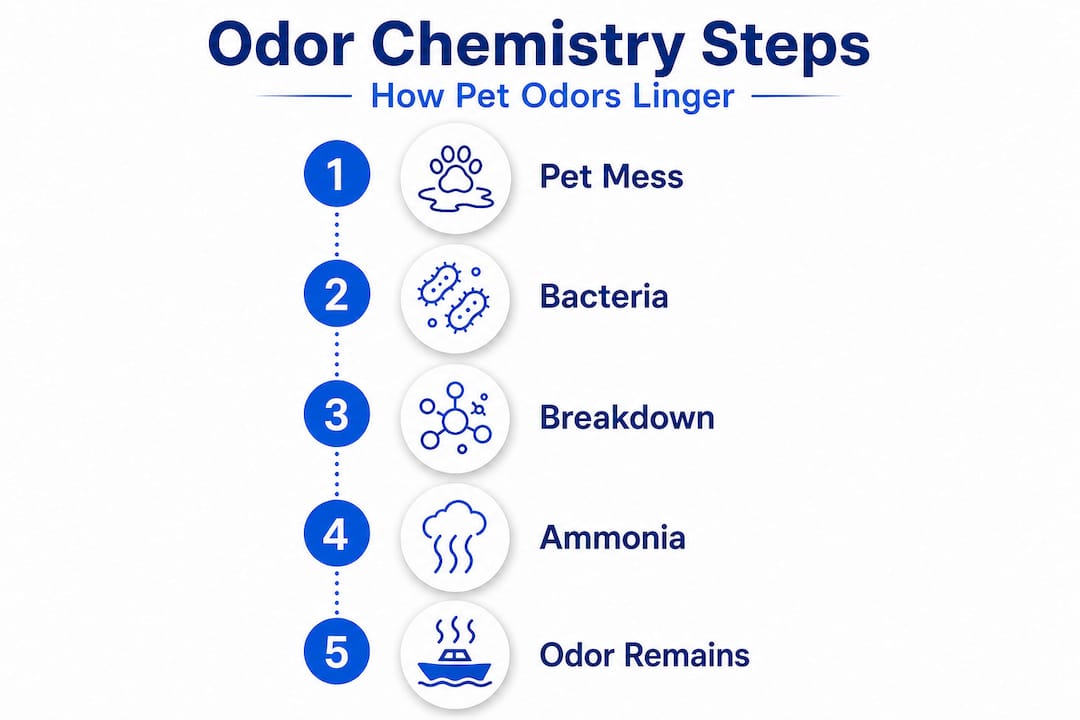
Boat environments compound this problem in two major ways. First, the heat and humidity cycles that vessels experience, especially in tropical or coastal climates, drive odor compounds back out of materials. When the sun heats up the cabin and humidity rises, those trapped residues warm up and release vapor. Second, persistent musty and biological smells often come from moisture trapped in enclosed, poorly ventilated areas and materials like foam, fabric, wood, and carpeting.
Here’s a quick breakdown of why different boat materials hold odors:
| Material | Why it traps odor | Difficulty to treat |
|---|---|---|
| Marine foam cushioning | High absorption, large surface area | High |
| Teak and hardwood | Porous grain absorbs liquids deeply | Very high |
| Synthetic marine carpet | Dense pile holds residue close to padding | High |
| Vinyl upholstery | Less porous, but seams and backing absorb | Medium |
| Fiberglass gelcoat | Relatively non-porous | Low to medium |
Key factors that keep odors alive in marine environments:
- Humidity above 60% reactivates dried urine residue in porous materials
- Poor cabin ventilation lets ammonia vapors build up and re-deposit
- Heat cycles from sun exposure drive volatile compounds back to the surface
- Narrow bilge spaces and sealed lockers trap moisture and microbial activity
- Wood substrates beneath carpet and upholstery act as deep reservoirs for residue
“The biological science behind lingering pet urine odors shows that uric acid crystals are nearly impossible to dissolve with water alone, binding tightly to porous surfaces and reforming when wet.”
Once you understand that you’re dealing with a living, reactive chemical process rather than a static stain, it becomes clear why a spray bottle and a cloth can’t finish the job.
Hidden hot spots: Where odors take hold on boats
Even experienced boat owners are often surprised by where the worst odors actually live. It’s almost never where the visible mess occurred. The science behind lingering pet urine odors confirms that liquid travels by capillary action, meaning it wicks horizontally and downward through materials before it ever dries.
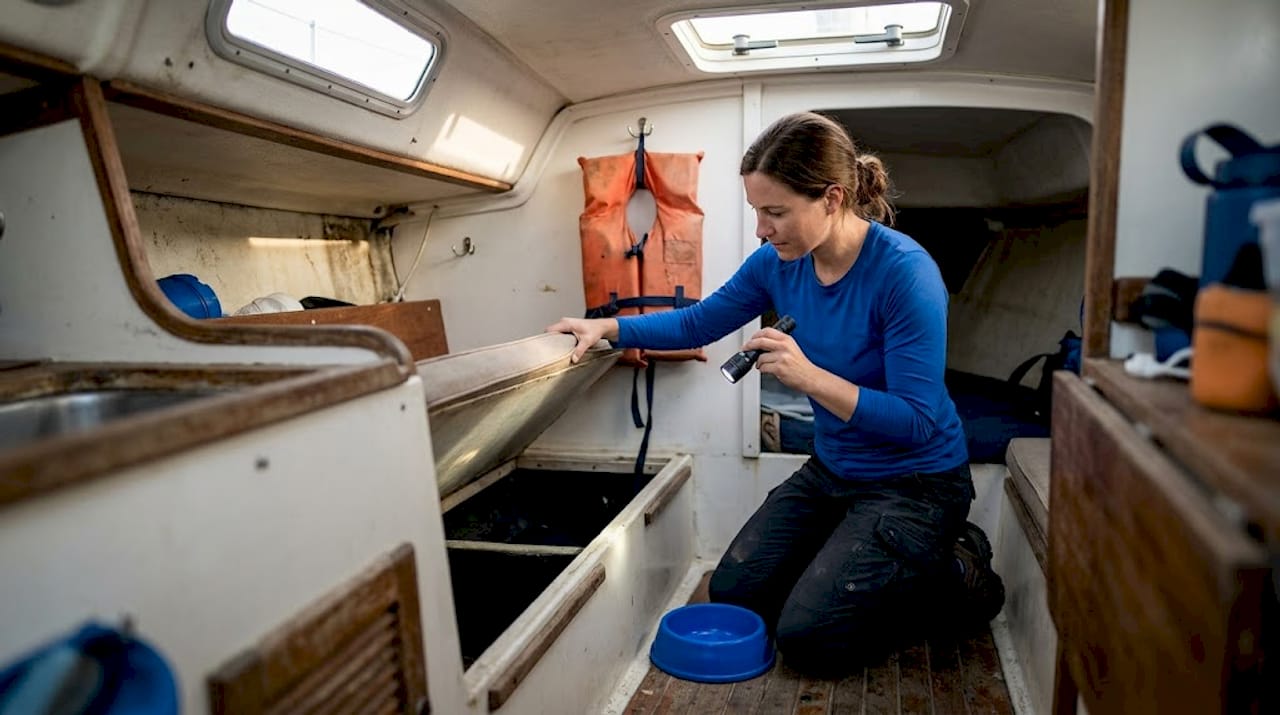
Moisture trapped under marine upholstery and carpet that often sits over wood or padding promotes mold and bacteria growth, which can extend odor well beyond what any spray can mask. This also means the odor source is almost always deeper than the visible surface.
The most common hidden hot spots on boats include:
- Under and within seat cushions: Foam compresses when a pet sits or lies down, creating direct contact between the foam core and any fluids. The cover fabric may look clean while the foam beneath is saturated.
- Wood substrates beneath carpet: Marine carpet often sits directly over marine plywood or teak planking. Urine wicks straight through the carpet backing and into the grain of the wood, where it feeds bacteria for months.
- Inside lockers and storage compartments: Low air circulation, darkness, and occasional moisture make lockers prime spots for microbial growth. A single accident that drains into a nearby locker can silently generate odor for an entire season.
- Under fixed seating and berths: Fluid spills and splashes pool in areas that rarely get cleaned. These spots often have zero airflow, which accelerates microbial breakdown.
- In bilge areas and structural voids: Any fluid that migrates to lower parts of the vessel through cracks or seams will settle in bilge areas and remain damp, creating long-term odor sources.
If the odor on your boat leans musty rather than sharply pet-like, check for mold and mildew in damp niches under cushions, inside lockers, and within carpet substrates, because urine residues are often accompanied by secondary microbial growth. For a deeper look at this overlap, our guide on removing mildew odor covers the distinction and treatment differences.
Use this sequential troubleshooting process to map the true odor source:
- Remove all cushions and inspect the upholstery backing and foam core with your nose close to the surface
- Lift carpet edges at corners and along walls to smell the padding and substrate beneath
- Open every locker and storage compartment and use a flashlight to check for discoloration or mold
- Inspect under fixed seating with a mirror and light source
- Follow the layout of the cabin to identify any low points where fluid could drain or pool
Following natural pet odor removal steps always begins with identifying the true source rather than treating the general area.
Pro Tip: Any area with limited airflow is a candidate for hidden odor, especially spaces where water vapor can condense overnight. If you can trap humidity there, so can the odor.
Why surface cleaning fails: The chemistry of reactivation
Here’s the part that frustrates most boat owners. You clean the visible area, it smells fine for a few days, and then the odor is back. This isn’t bad luck. It’s a predictable consequence of not reaching the padding or subfloor, where cleaning that stops short of the deep layer causes odor to return as the boat dries or humidity changes.
What actually happens in three stages:
- Wicking: When a pet has an accident on carpet or upholstery, the fluid doesn’t stay at the surface. It migrates downward and outward by capillary action, spreading several inches beyond the visible stain and soaking into the padding and substrate below.
- Drying and crystalizing: As the top layer dries, uric acid crystals form and become tightly bonded to the fibers and surfaces. These crystals are nearly odorless when dry, which explains why a boat can seem fine immediately after cleaning.
- Reactivation: When humidity rises or the boat is in the sun, the crystals dissolve again and resume releasing volatile ammonia compounds. This is why odors return on warm, humid days rather than dry, cool ones.
Biological breakdown, which experts describe as urine fermentation, creates volatile ammonia compounds that are the primary drivers of urine odor over time. Protocols that don’t neutralize at the source will fail, even if the air smells fresh right after cleaning. Masking fragrances make this worse by giving a false signal that the job is done, while the actual chemical process continues undisturbed beneath the surface.
The surface cleaning trap: Many boat owners use fragrance-heavy sprays that smell like citrus or lavender for days. The fragrance fades. The uric acid doesn’t. The next humid afternoon, the original odor returns often stronger than before because the microbial activity has continued uninterrupted. To truly diagnose yacht odor issues, you need to look past the pleasant fragrance and ask whether the source chemistry was ever actually addressed.
Understanding the right carpet cleaning approach means choosing methods that target the chemistry, not just the surface appearance.
Eco-friendly solutions: Targeting the true source for lasting results
Effective odor removal on luxury boats is a process, not a product. Targeted, source-focused cleaning means mechanical extraction combined with chemistry that targets the odor source directly, not just masking fragrances. The good news is that the most effective methods are also the safest for high-end marine fabrics and finishes.
Here is the complete sequential process for lasting eco-friendly odor removal on boats:
- Identify and expose the source. Remove cushions, lift carpet edges, and open lockers. You can’t treat what you can’t access.
- Extract mechanically before applying any chemistry. Use a wet vac or extractor to remove as much residue as possible from foam, carpet, and padding before introducing any treatment solution.
- Apply an enzyme or biological treatment. Enzyme-based cleaners work by breaking down the organic compounds that generate odor. They don’t mask; they consume the source material. Eco-friendly approaches should use source-directed biology and chemistry, specifically enzymes or urine treatments that inhibit fermentation, combined with thorough extraction and drying.
- Ensure deep penetration. Apply enough solution to match the original penetration depth of the contamination. If urine soaked two inches into foam, the treatment must reach two inches deep. A light spray on the surface treats only the surface.
- Allow dwell time. Enzyme solutions need time to work. Rushing this step is the most common reason DIY enzyme treatments fail. Follow product instructions, and in humid conditions, allow extra time.
- Extract again and dry thoroughly. After the dwell period, extract the solution and rinse. Then dry the materials as completely as possible. Any remaining moisture creates conditions for microbial regrowth.
- Improve ventilation during and after treatment. Open hatches, run fans, and use dehumidifiers if available. Browse eco-friendly cleaning supplies that are formulated for gentle use on luxury materials.
Pro Tip: Drying is not optional. Incomplete drying after enzyme treatment is the single biggest reason odors return. Use a dehumidifier in the cabin overnight after treatment and ventilate aggressively for the first 48 hours.
For a stepwise boat odor removal process that accounts for the specific challenges of marine environments, the approach above should be your baseline before calling in professional support.
What most boat owners get wrong about lingering pet odors
After working with luxury boat and yacht owners across a range of vessels and climates, the pattern we see most often is not a lack of effort but a misapplication of it. Owners spend hours cleaning surfaces, applying fragrance products, and airing out the cabin, then express genuine surprise when the odor returns by the next weekend. The fundamental error is treating odor as a sensory problem rather than a chemical one.
Fragrances don’t neutralize odor. They compete with it, and chemistry always wins. Odors reappear when the source remains, and true odor control means neutralizing odor-causing compounds at the molecular source. That’s not a philosophical position. It’s just how chemistry works.
Boats present a unique challenge that homes don’t. The combination of luxury materials that must be protected, confined spaces that are difficult to access, and a marine environment that cycles humidity and temperature daily creates a system that actively works against casual cleaning efforts. In a house, a bad day of humidity is an inconvenience. On a boat anchored in a warm harbor overnight, it’s a recurring trigger for odors you thought you’d already eliminated.
The second mistake is patience. Many boat owners expect results in hours. Enzyme treatments and deep cleaning processes require time, and rushing them produces incomplete results that look successful at first and fail within a week. Genuine odor elimination is measured in days, not minutes.
For owners of high-value vessels, the cost of repeated ineffective treatments, both in time and potential material damage from harsh chemicals, often exceeds the cost of professional intervention from the start. Working with expert marine odor removal insights means getting a process calibrated to your specific vessel’s materials and environment rather than a generic approach borrowed from household cleaning guides.
Professional help for stubborn yacht and boat odors
When DIY methods fall short, or when the odor source is too deep or too widespread to address with standard tools, the right call is specialized professional help.

Our team of boat odor removal specialists brings the chemistry, equipment, and marine-specific knowledge needed to address deep-seated pet odors in luxury vessels without compromising your fabrics, finishes, or materials. We use a green odor removal process that avoids ozone and chlorine treatments entirely, relying instead on safe, proven biological chemistry designed for high-end interiors. If you want to see the full framework we follow, our eco-friendly deodorization guide walks through every step. Same-day and next-day service is available, with guaranteed results you can verify before we leave.
Frequently asked questions
Why does pet urine odor sometimes return after the boat is thoroughly cleaned?
Odor returns when deep residues in porous materials are reactivated by humidity or heat, even after surface cleaning. Cleaning that doesn’t reach the padding or subfloor means uric acid crystals remain and redissolve when conditions change.
Are enzyme cleaners safe for luxury marine fabrics and finishes?
Enzyme cleaners can be safe if formulated for marine use, but always test in a small, hidden area first and rinse thoroughly after the dwell period. Source-focused cleaning chemistry that targets organic compounds is generally gentler on surfaces than harsh chemical alternatives.
How can I prevent pet odors from returning on my boat?
Remove odors at the source, extract and clean deeply, and ensure thorough drying after every cleaning session. Eco-friendly approaches using enzymes that inhibit fermentation, combined with complete extraction and drying, break the reactivation cycle.
What’s the difference between musty and pet odors on a yacht?
Musty odors result from moisture-driven microbial growth like mold and mildew, while pet odors are driven by urine breakdown and ammonia release. Persistent biological smells in enclosed, poorly ventilated boat spaces can combine both types, requiring treatment that addresses both sources simultaneously.
Recent Comments