
Luxury Home Odor Removal: Smells That Damage High-End Listings
Luxury home odor removal is essential when preparing high-end real estate for sale. A multimillion-dollar property may feature breathtaking architecture, designer furnishings, marble floors, and spectacular views. However, lingering tobacco smoke, pet urine, cooking, marijuana, or mystery odors can immediately change a prospective buyer’s impression.
At Master Odor Removal™, we specialize in luxury home odor removal for prestigious residences, waterfront estates, penthouses, and luxury condominiums nationwide. With more than 35 years of industry experience, our Green Certified Business uses a proprietary, source-focused odor neutralization process without ozone, chlorine dioxide, hydroxyl generators, or fragrance cover-ups.
LOOKS GOOD. SMELLS BAD.™
Our mission is to help luxury homeowners and real estate professionals present exceptional properties with neutral-smelling interiors, free from distracting odors.
Why Odor Matters in Luxury Real Estate
Luxury buyers expect more than beautiful finishes.
They expect the entire property to feel exceptional.
An unexplained odor can immediately raise questions:
Was someone smoking in the house?
Are there hidden pet urine problems?
Is there moisture somewhere?
Will I have to replace flooring or repaint?
Why didn’t the seller fix this before putting the home on the market?
Even when the property is visually immaculate, odor can create uncertainty.
That is why odor should be treated as part of preparing a luxury home for sale, not as an afterthought once prospective buyers begin commenting on it.
Cigarette & Tobacco Smoke Odor
Tobacco smoke is one of the most challenging odors in residential interiors because it can affect far more than the air.
Years of cigarette or cigar smoke can leave odor throughout walls, ceilings, flooring, cabinetry, closets, fabrics and other interior surfaces.
Simply painting the walls or cleaning the floors may not address the entire odor problem.
Master Odor Removal uses a specialized, source-focused process to neutralize stubborn tobacco odors throughout affected interior areas.
For sellers and real estate professionals, addressing smoke odor before showings begin can help prevent an otherwise beautiful home from being remembered for the wrong reason.
Professional luxury home odor removal addresses affected interior surfaces where persistent tobacco odors may remain after conventional cleaning.
Pet Urine Odor
A homeowner can become accustomed to an odor that a prospective buyer notices almost immediately.
Pet urine is a common example.
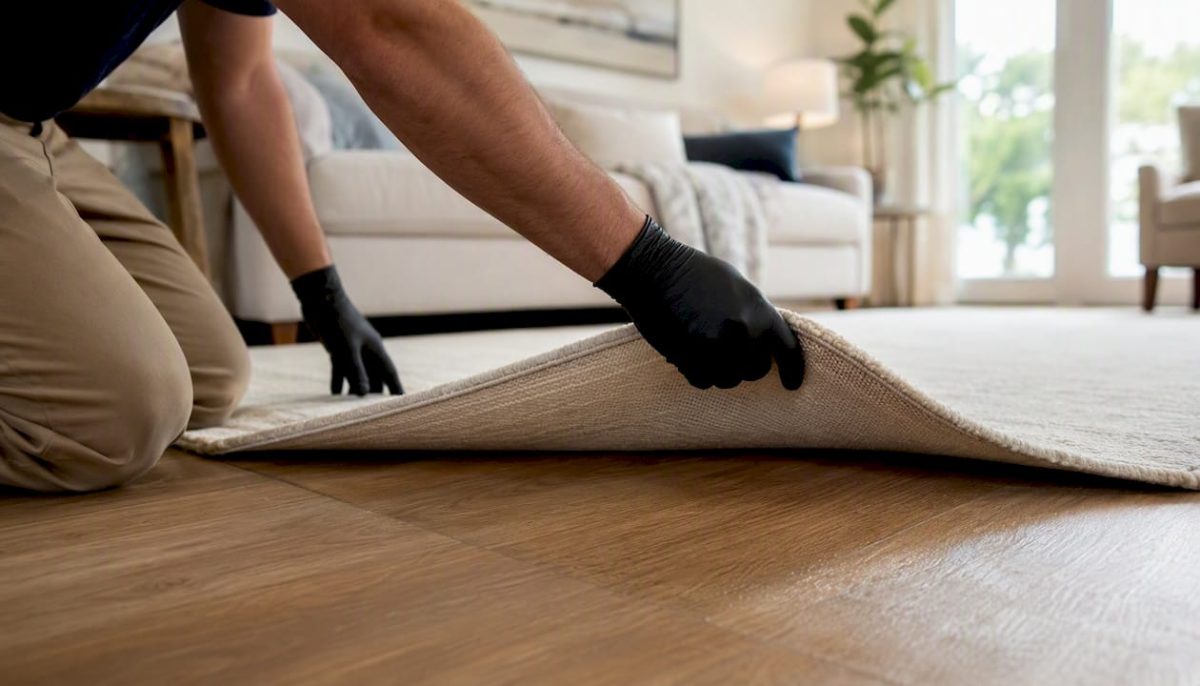
Urine can penetrate carpet, padding, flooring, grout and other porous materials. Surface cleaning may improve the appearance while leaving an underlying odor behind.
In a luxury property, even a relatively localized pet odor can change a buyer’s perception of how well the home has been maintained.
Professional pet urine odor removal focuses on locating and treating the affected areas rather than simply introducing another fragrance into the room.
Cooking Odors
Strong cooking odors can become embedded throughout a home, particularly when cooking has occurred regularly over many years.
Cabinetry, walls, ceilings and other surfaces can retain cooking-related odors even after a kitchen has been professionally cleaned.
This is particularly important when preparing a luxury property for market because buyers want to experience the home—not the previous owner’s lifestyle.
The goal should be neutral.
Luxury home odor removal is particularly important when pet urine has affected flooring, grout, or other interior materials.
Marijuana & Cannabis Odor
Persistent marijuana odor can also influence a buyer’s first impression of a property.
Like tobacco smoke, repeated indoor use can leave odor on surrounding surfaces and within enclosed areas.
Masking the smell with air fresheners or fragrances can create another problem: buyers may wonder what the seller is attempting to hide.
Professional odor removal addresses the odor problem itself.
Musty & Mystery Odors
One of the most concerning things a buyer can encounter is an odor nobody can explain.
A musty or mystery odor may cause buyers to assume there is a much larger problem—even when the actual odor source is relatively straightforward.
Master Odor Removal specializes in difficult interior odor problems.
We do not provide mold remediation. When an underlying maintenance, moisture, plumbing or other physical issue is responsible for an odor, that underlying problem should be corrected by the appropriate professional before odor treatment.
Once the source condition has been addressed, professional odor removal can focus on the remaining odor contamination.
Why Cleaning Doesn’t Always Remove the Odor
Cleaning and odor removal are not the same service.
A cleaning company is generally hired to remove visible dirt, residue and contamination.
A professional odor removal specialist is brought in when the property looks clean but still smells.
That distinction becomes particularly important in luxury real estate.
Owners may spend thousands of dollars on deep cleaning, painting, carpet cleaning and staging, yet an underlying odor can remain.
Master Odor Removal focuses specifically on the odor problem.
Looks Good. Smells Bad.™ describes exactly why this specialty exists.
No Ozone. No Chlorine Gas. No Fragrance Cover-Ups.
Master Odor Removal™ uses a specialized two-step molecular odor removal process designed to treat odor-affected interior surfaces directly.
We do not rely on ozone, chlorine gas or heavy fragrances to cover up stubborn odors.
Our objective isn’t to replace one smell with another.
Our objective is neutral.
Neutral is the New Scent Standard!™
Luxury Home Odor Removal Before Listing
The best time to discover an odor problem is before the first prospective buyer does.
Luxury homeowners, listing agents and real estate professionals should consider odor alongside staging, cleaning, photography and other pre-listing preparation.
If a home has a history of indoor smoking, pets, strong cooking odors or an unexplained persistent smell, addressing it before marketing begins can eliminate a potential objection before it ever reaches the buyer.
Master Odor Removal works with homeowners, real estate professionals and property managers to identify and neutralize difficult interior odors.
Scheduling luxury home odor removal before private showings helps eliminate a potential distraction for prospective buyers.
Experience With High-Value Properties
Luxury interiors require discretion, professionalism and respect for the property.
Master Odor Removal™ brings more than 35 years of professional odor removal experience to homes, condominiums, vehicles, yachts and commercial interiors.
Our source-focused process is particularly well suited to properties where maintaining the integrity and presentation of the interior is important.
As a Green Certified Business, we provide professional odor removal through local licensed professionals backed by our 100% Satisfaction Guarantee.
The Last Detail Before a Luxury Home Is Truly Market Ready
Luxury real estate is built around details.
Architecture matters.
Lighting matters.
Staging matters.
Photography matters.
And how the property smells matters.
A multimillion-dollar home shouldn’t smell like cigarettes, pets, last night’s dinner or the people who previously lived there.
It should smell like nothing.
Neutral lets the property speak for itself.
If your luxury property looks good but smells bad, contact Master Odor Removal™ before buyers begin walking through the door.
Neutral is the New Scent Standard!™
The six odors that most damage luxury listings are tobacco/smoke, marijuana, pet urine, mildew/mold, heavy cooked-food or grease smells, and persistent neighbor or retail intrusion odors. Any one of them can shorten showings, reduce offers, and extend time on market. Your immediate next step: schedule an objective smell audit by someone who has never been inside the property because sellers almost never smell what buyers do.
- Tobacco/smoke: Penetrates porous materials and HVAC systems; masking fails.
- Marijuana: Lingers in fabrics, millwork, and ductwork; carries stigma beyond the scent.
- Pet urine: Soaks through carpet, pad, and into subfloor; surface cleaning rarely reaches it.
- Mildew/mold: Signals hidden moisture damage; buyers treat it as a structural red flag.
- Cooked food/grease: Fish, deep-fry, and spice odors absorb into cabinetry and ventilation.
- Neighbor/retail intrusion: External sources (a restaurant, a specialty shop) can contaminate shared HVAC and lobbies.
Pro Tip: Before any showing, have someone who has never entered the property walk in cold and note every odor by room. Their first impression is exactly what a buyer experiences.
Key Takeaways
Unwanted interior odors are among the most controllable value-killers in a luxury listing, and professional remediation consistently outperforms DIY masking on both permanence and buyer confidence.
| Point | Details |
|---|---|
| Top odors to prioritize | Tobacco, marijuana, pet urine, mold, heavy food, and retail intrusion cause the most buyer resistance. |
| Nose blindness is real | Sellers cannot self-audit; always commission a cold-entry test by an outsider before listing. |
| DIY has hard limits | Pet urine, smoke, and mold require professional treatment once they reach porous materials or HVAC. |
| Schedule early | Book remediation at least two weeks before photography to allow treatment, airing, and a final audit. |
| Masterodorremoval | Provides green-certified, non-ozone odor elimination for luxury homes, vehicles, and hospitality venues with same or next-day availability. |
Table of Contents
- Which smells most damage luxury listings?
- How do you objectively audit a property for odors?
- DIY fixes vs. when you need a professional
- What professional eco-friendly odor removal actually does
- What to expect on timeline and cost
- Pre-listing odor checklist for agents and property managers
- What the field actually teaches you about odor and luxury listings
- Masterodorremoval handles luxury listings from assessment to clearance
- Sources
Which smells most damage luxury listings?
Tobacco smoke sits at the top of every experienced agent’s list, and for good reason. Smoke particles settle into porous materials and HVAC systems at a molecular level, which means simple airing or a candle does nothing permanent. In a $3M home with silk drapes and custom millwork, that contamination is expensive to address and impossible to hide.
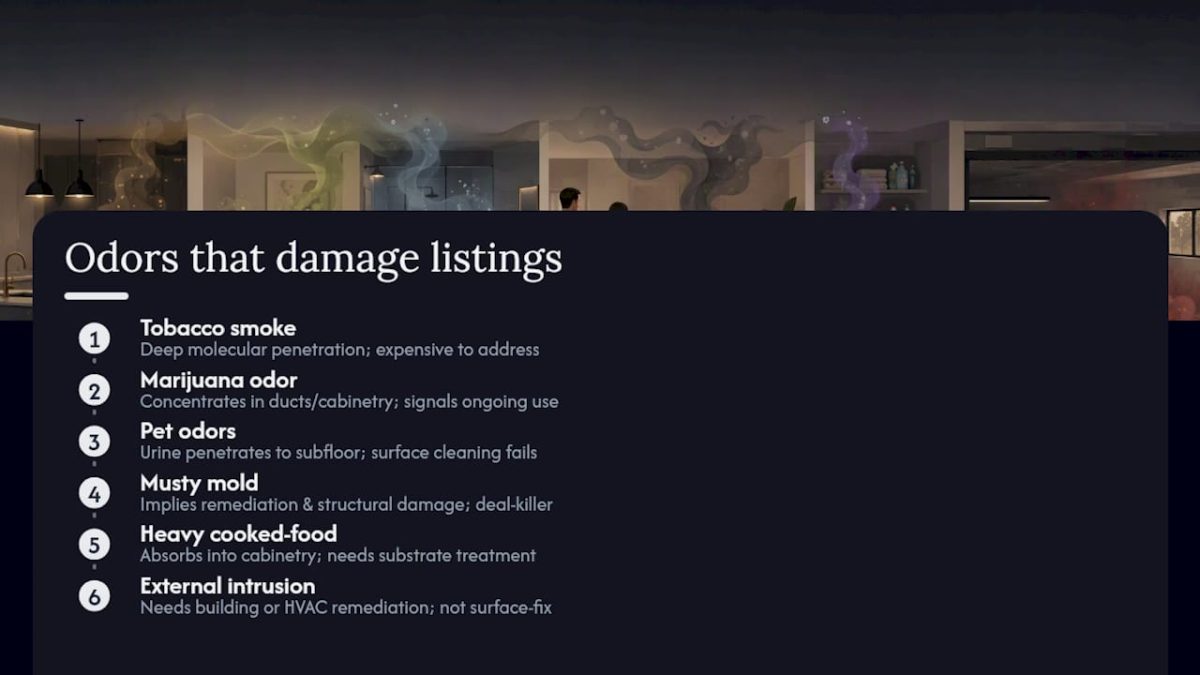
Marijuana odor is a close second. The smell is distinctive, polarizing, and tends to concentrate in the same concealed spaces as tobacco: inside HVAC ducts, behind built-in cabinetry, and in upholstered furniture. Buyers who don’t use it often associate the smell with ongoing use and question what else may have been overlooked in the property.
Pet odors are deceptive. A seller who has lived with a dog for five years genuinely cannot smell it anymore. Pet urine penetrates beneath carpet and pad into the subfloor, and no amount of surface cleaning reaches that layer. Buyers, however, detect it within seconds of entering.
Musty or mold odors carry the highest implied cost. Buyers don’t just smell mildew; they hear “remediation,” “structural damage,” and “inspection contingency.” A musty basement or a damp master bath can unravel a negotiation that was otherwise going smoothly.
Heavy cooked-food smells, particularly fish, deep-fry, and strong spices, absorb into cabinetry, range hoods, and soft furnishings. In a luxury kitchen with custom cabinetry, those odors can be nearly impossible to remove without targeted substrate treatment.
External odor intrusion requires building-level or HVAC-focused remediation, not surface treatment. That distinction matters when you’re advising a seller on scope and budget.
How do you objectively audit a property for odors?
Nose blindness is well-documented among sellers, which means your audit cannot rely on the seller’s perception. Use this sequence:
- Cold entry test. Have an outsider enter without prior exposure and document every odor by room, noting severity (faint, moderate, strong) and likely source.
- Room-by-room sensory sweep. Move from entry through kitchen, baths, bedrooms, garage, and any concealed spaces (crawl spaces, utility rooms). Record where odors intensify.
- HVAC vent check. Hold a clean cloth near each supply and return vent for 30 seconds. Odor on the cloth means the ductwork is a source or distribution point.
- Moisture meter readings. Use a pin-type moisture meter on walls, floors, and ceilings near baths, kitchens, and exterior walls. Readings above 16% in wood suggest active moisture that will produce mold odor.
- Concealed space inspection. Check under sinks, inside closets, behind appliances, and beneath any floating floors. These spaces trap odors that don’t register in open rooms.
- Third-party sensory panel or electronic nose screening. For high-value listings, a trained sensory panel or an electronic nose device provides objective, documented odor data that removes subjectivity from the conversation entirely.
A property that still registers odor after 48 hours of ventilation and surface cleaning has a persistent source. That is the threshold for professional remediation, not more DIY.
Our luxury home odor removal process begins with a professional evaluation of the odor and affected interior surfaces.
Pro Tip: Document every audit finding with photos, notes, and moisture readings. That paper trail supports your recommendation to the seller and protects you if odor complaints arise post-sale.
Statistic callout: Agents consistently report that buyers who detect odors during a showing submit fewer offers, request more inspection contingencies, and negotiate harder on price — even when the visible condition of the property is excellent.
Luxury home odor removal can also benefit penthouses, waterfront condominiums, and high-rise residences.
DIY fixes vs. when you need a professional
Short-duration odors from recent cooking, a trash can, or a single isolated incident are fair game for DIY. Entrenched odors are not.
| Odor Type | DIY Viable? | Professional Required? |
|---|---|---|
| Recent cooking (one-time) | Yes — ventilate, steam clean surfaces | No |
| Trash/waste bin | Yes — remove source, clean area | No |
| Light musty smell (single room, no moisture) | Partial — dehumidify, ventilate | If it persists after 48 hours |
| Pet urine in carpet | No — reaches subfloor | Yes — enzymatic treatment or replacement |
| Tobacco/smoke in porous materials | No — penetrates at molecular level | Yes — multi-phase treatment |
| Marijuana in HVAC/millwork | No | Yes |
| Active mold/mildew | No — health and liability risk | Yes — plus moisture remediation |
| Neighbor/retail HVAC intrusion | No | Yes — building-level solution |
Fast DIY steps agents can instruct sellers to do before showings:
- Remove all source items (litter boxes, pet bedding, ashtrays, trash).
- Wash all soft furnishings that can be laundered.
- Replace HVAC filters and wipe all visible vent covers.
- Run exhaust fans in kitchens and baths for several hours.
- Open windows on opposite sides of the property to create cross-ventilation.
Never recommend: masking sprays, plug-in air fresheners, or scented candles before a showing. Heavy fragrance makes buyers suspicious and signals that something is being hidden. Neutral is always the goal.
Require documented professional remediation before listing when you detect persistent smoke odor, any mold or moisture suspicion, or pet urine that has reached the subfloor.
Material safety matters. Ozone at high concentrations damages rubber seals, degrades leather, and can bleach certain fabrics. Chlorine-based treatments risk etching marble and corroding metal fixtures. For a property with $50,000 in custom drapery and Italian stone floors, the wrong method is a liability.
- Ask any vendor: Are your technicians licensed? Are your methods green-certified and free of ozone and chlorine?
- Request case study examples from comparable luxury properties.
- Confirm a satisfaction guarantee and same-day or next-day availability for urgent listings.
Pro Tip: During a bid, ask specifically: “What happens to my marble countertops and silk drapes during treatment?” A vendor who can’t answer that question precisely is not equipped for luxury interiors.
What to expect on timeline and cost
Primary cost drivers: odor severity, property square footage, material sensitivity, HVAC involvement, and whether structural components need replacement. Scheduling remediation well ahead of photography prevents last-minute delays.
- Severity: A light food odor costs a fraction of what full smoke remediation in a 5,000 sq. ft. home requires.
- HVAC involvement: Ductwork treatment adds time and cost but is non-negotiable when odor is distributed through the system. HVAC odor sources require dedicated mechanical cleaning before any interior treatment holds.
- Material sensitivity: Luxury finishes require slower, more careful application and longer dwell times.
Book professional remediation at least two weeks before photography. That window allows treatment, airing, and a final confirmation audit before the camera crew arrives.
Pre-listing odor checklist for agents and property managers
- Commission an outsider cold-entry smell audit and document findings by room.
- Remove all odor sources: pet items, ashtrays, trash, stored chemicals.
- Deep-clean all textiles: rugs, drapes, upholstered furniture, and bedding.
- Replace HVAC filters and wipe all supply and return vent covers.
- Inspect all moisture-prone areas with a meter; address any reading above 16%.
- Schedule professional carpet and upholstery cleaning for any soft surface with embedded odor.
- Treat HVAC ductwork if any vent test registers odor. See the upscale property odor maintenance list for an ongoing reference.
- Ventilate for 48 hours post-treatment and conduct a second cold-entry audit.
- If any odor persists, commission professional remediation before photography. Retain all receipts and treatment reports for the buyer’s file.
Documentation is not optional. Treatment receipts and inspection reports give buyers confidence and reduce post-closing disputes.
What the field actually teaches you about odor and luxury listings
The cases that surprise agents most are rarely the obvious ones. Tobacco in a penthouse is expected. What catches people off guard is the building-level intrusion: a specialty food retailer on the ground floor pushing odor through shared HVAC into a $4M unit, or a neighbor’s cooking habits saturating a shared wall in a boutique condo. In those situations, surface treatment in the unit accomplishes nothing. The fix is at the mechanical level, and it requires a professional who understands building systems, not just interior cleaning.
The other recurring surprise is how often sellers resist the audit. They’ve lived in the property for years; they genuinely don’t smell anything, and they interpret the suggestion as an accusation. The most effective approach is to frame it as a buyer-protection step, not a criticism. An objective audit protects the seller’s asking price. That framing usually ends the conversation quickly.
Masterodorremoval handles luxury listings from assessment to clearance
Persistent odor in a high-value listing is a negotiation liability. Masterodorremoval eliminates it permanently using green-certified, non-ozone, non-chlorine methods designed specifically for luxury interiors, vehicles, yachts, and hospitality venues. Licensed technicians assess the source, select the appropriate treatment (hydroxyl, thermal fogging, vapor-phase neutralization, enzymatic substrate work), and guarantee the result.

Same-day and next-day assessments are available for urgent listings. Masterodorremoval works with luxury real estate agents, property managers, auto dealerships, and hotel operators across the United States who need a documented, material-safe remediation they can stand behind with buyers. Visit the odor removal specialists page to book an assessment or get a same-day quote for your listing.
Sources
- Your home listing stinks! Here’s what to do about it
- How Odours Can Affect Your Home’s Sold Price
- Does Your Home Have a Smell? Here Is What Ventura County Sellers Need to Know | Edgar Limon
When advising sellers, cite inspection reports and treatment receipts directly. Documented remediation reduces buyer objections and supports your asking price in negotiations.
Recent Comments