
TL;DR:
- Even a subtle odor in luxury spaces can damage perceptions of quality and neglect management. Sustainable, enzyme-based, and molecular binding methods effectively neutralize odors at their source without synthetic fragrances or harmful VOCs. Proactive odor control aligns with regulatory standards, enhances brand image, and safeguards occupancy and reputation in high-end environments.
A single whiff of stale tobacco or lingering mildew in an upscale hotel suite, yacht cabin, or luxury showroom can cost you a client before you say a single word. Air quality is one of the most immediate signals your space sends, and in premium environments, even a subtle odor communicates neglect at a level that no amount of beautiful decor can override. What makes this challenge especially frustrating is that most businesses respond by reaching for air fresheners or scented sprays, which routinely make the problem worse. This guide breaks down why odor control is a non-negotiable business priority and shows you the proven, sustainable methods that actually deliver lasting results.
Table of Contents
- Why odor matters for luxury businesses
- Modern odor control technologies: what works and why
- Setting the standard: regulations and expectations for premium interiors
- Best practices for sustainable and immediate odor control
- Perspective: Why odor control is the hidden differentiator for luxury businesses
- Experience effortless, sustainable odor removal for your business
- Frequently asked questions
Key Takeaways
| Point | Details |
|---|---|
| Odor impacts luxury branding | Unwanted smells erode client trust and can diminish property value instantly in high-end environments. |
| Sustainable control works best | Evidence shows enzymatic and advanced absorption methods provide long-lasting, zero-residue results. |
| Regulatory standards are rising | Odor limits and compliance requirements are driving businesses to adopt superior solutions. |
| Proactive management is critical | Smart businesses combine rapid response with ongoing prevention and advanced technology. |
Why odor matters for luxury businesses
Luxury is a promise. Every surface, every detail, every interaction is meant to reinforce the same message: this space is exceptional. The moment a guest or client detects an unpleasant odor, that promise breaks. They don’t need to see peeling paint or a stained carpet. Their nose delivers the verdict instantly.
Odors signal neglect, and in high-end settings, the perception of neglect is as damaging as actual neglect. A prospective buyer walking through a luxury condo, a guest checking into a five-star suite, or a client sitting in a premium auto dealership showroom all form subconscious quality assessments based on scent within the first few seconds. Research on sensory perception and purchasing behavior consistently confirms that air quality influences both time spent in a space and willingness to spend money.
“In luxury environments, neutral and fresh air is not a bonus feature. It is a baseline expectation. When it’s missing, it becomes the only thing your guest remembers.”
Beyond brand image, odors carry real regulatory and compliance implications. Standards like those defined in AIJES-A0003-2019 set clear benchmarks: indoor odor standards specify a non-acceptance rate below 20 to 30 percent and an odor concentration at or below 10 for most interior environments. Falling outside these thresholds can trigger complaints, inspections, and reputational damage in regulated commercial settings.
The hazards of masking deserve special mention. Many property managers default to scented candles, plug-in diffusers, or heavily fragranced cleaning products. This approach does not eliminate the source of the odor. It layers fragrance on top of it, which often creates a new, more complex and more suspicious scent. Guests in luxury settings are particularly sensitive to artificial fragrances, and the combination of a bad odor with a synthetic cover-up is immediately recognizable and deeply unappealing. For a more thorough breakdown, consider identifying and managing indoor odors as a starting point for diagnosis before choosing any treatment.
Key reasons odors are especially damaging in luxury businesses:
- They undermine perceived quality before a single interaction occurs
- They suggest poor maintenance, which erodes trust and premium positioning
- They can trigger complaints, negative reviews, and regulatory scrutiny
- They lower occupancy rates and sale prices in real estate and hospitality
- They create liability in health-sensitive environments like spas, clinics, and private clubs
Modern odor control technologies: what works and why
Once you understand what’s at stake, the natural next question is what actually works. The answer requires moving past conventional thinking and focusing on methods that address the molecular source of odors rather than the sensory experience of them.
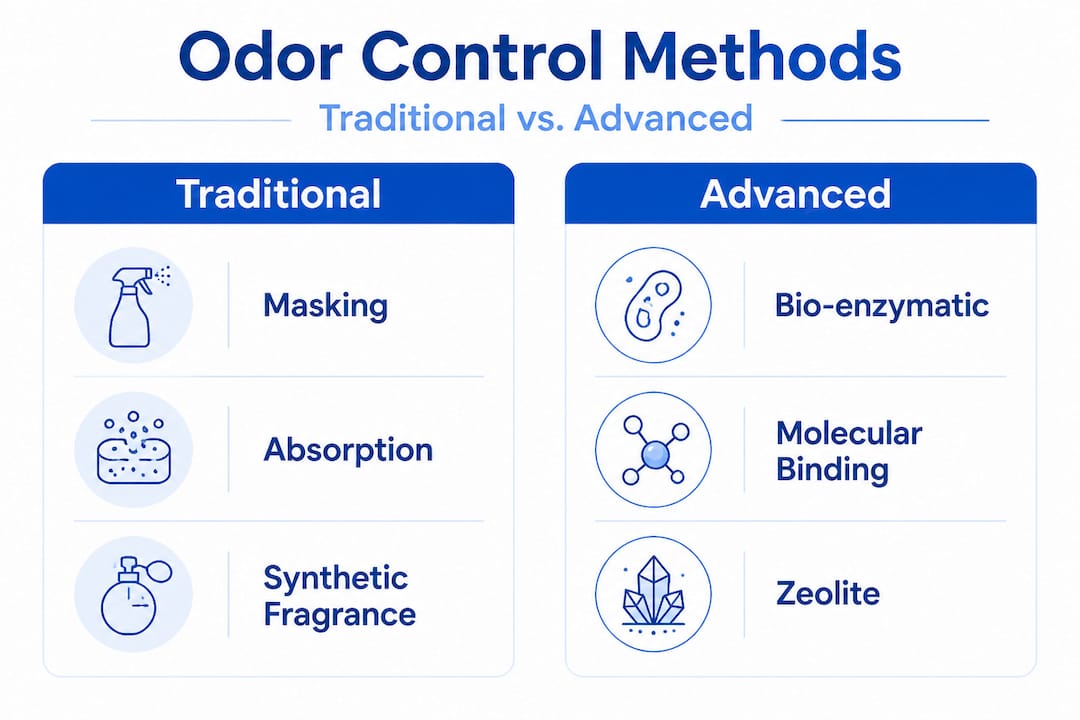
Enzymatic and bio-enzymatic cleaners are among the most effective tools available. These products introduce beneficial enzymes and microbes that digest the organic compounds responsible for odors, including pet waste, tobacco residue, food decomposition, and biological matter. A smarter approach to cleaning confirms that sustainable enzymatic cleaners continue digesting organic matter causing odors for up to 72 hours after a single application, unlike masking methods, which stop working the moment they dry. For luxury interiors where you want ongoing freshness between professional treatments, this residual activity is enormously valuable.
Molecular binding and advanced absorption represent another tier of technology. Zeolite, a naturally occurring mineral, adsorbs volatile organic compounds (VOCs) at the molecular level rather than covering them. Material property impact of removal technologies shows that zeolite additivation reduces VOCs by 89 percent, heated air purging achieves 78 percent reduction, and PEG extraction delivers 73 percent reduction, all without altering the physical properties of treated materials. That last point matters enormously for luxury interiors where furnishings, fabrics, leather seating, and architectural finishes are expensive and irreplaceable.
Compare the three primary approaches side by side:
| Method | Mechanism | Duration | Safety for luxury materials | Sustainability |
|---|---|---|---|---|
| Fragrance masking | Covers odor with stronger scent | Short term only | Potential VOC addition | Low |
| Enzymatic/bio-enzymatic | Digests odor-causing organic matter | Up to 72 hours post-application | High, water-based formulas | High |
| Molecular absorption (zeolite) | Binds VOC molecules structurally | Long lasting | Excellent, no material impact | High |
It is also worth noting the health dimension. The dangers of masking odors are well documented: synthetic fragrances add VOCs to the air, which can trigger respiratory irritation, headaches, and allergic reactions, particularly in guests with sensitivities. In a luxury environment where your clientele may include individuals with asthma, chemical sensitivities, or simply high expectations for air purity, this risk is unacceptable.
ESG alignment is another reason to invest in these advanced methods. Luxury brands and high-end property operators are under increasing pressure from investors, guests, and regulators to demonstrate environmental responsibility. Choosing eco-friendly odor neutralization solutions is not only better for occupant health, it directly supports your sustainability reporting and brand values.
Pro Tip: When evaluating any odor control product or service provider, ask specifically whether the method eliminates the odor source or only masks it. If the answer involves fragrance addition, that method is not appropriate for a luxury environment.
For a complete overview of what professional luxury odor removal looks like in practice, consider auditing your current vendor’s approach against these technology standards.
Setting the standard: regulations and expectations for premium interiors
Regulatory pressure on indoor air quality and odor management is not a future concern. It is a present reality shaping commercial property operations globally, and the pace of change is accelerating.
The bio-enzymatic odor control market reflects this shift directly. Bio-enzymatic odor control market growth is projected at a 9.0 percent CAGR, reaching $1.521 billion by 2032, driven specifically by regulatory demands in commercial sectors. The market doesn’t grow at that rate unless operators are actively required or strongly incentivized to upgrade their practices.
Odor-specific standards are also firming up. As noted earlier, indoor odor standards per AIJES-A0003-2019 define quantifiable thresholds that are being adopted and adapted in various forms across commercial building codes and health regulations. This means what was once a soft quality-of-experience concern is becoming a measurable compliance metric.
Key benchmark standards for luxury commercial interiors:
| Standard or benchmark | Threshold | Application |
|---|---|---|
| AIJES-A0003-2019 odor concentration | 10 or below | Commercial interiors, hospitality |
| Non-acceptance rate | Less than 20 to 30 percent | General commercial occupancy |
| VOC reduction (zeolite adsorption) | Up to 89 percent | Material treatment, finishes |
| ESG reporting expectations | No standard yet, but trending toward formalization | Luxury brands, REITs, hospitality groups |
Sustainable cleaning trends show that facilities managers in premium sectors are already shifting vendor contracts to require green-certified, non-toxic odor control. If your competitors adopt these standards and you haven’t, the gap becomes visible to discerning clients and institutional investors alike.
Best practices checklist for compliance and brand protection:
- Conduct a professional odor audit annually, or after any significant event such as renovation, flooding, or new tenancy
- Document your odor control protocols for regulatory review and ESG reporting
- Replace fragrance-based products with enzymatic or molecular binding alternatives
- Establish regular monitoring using air quality sensors for common VOCs and odor compounds
- Train maintenance and housekeeping staff on source identification before treatment
Being proactive about persistent odor signs in luxury properties is the most efficient way to stay ahead of both compliance requirements and guest complaints. Waiting until the problem is noticeable means it has already damaged your brand. You can also build a longer-term strategy around preventing odors sustainably to reduce the frequency and severity of interventions needed.
Best practices for sustainable and immediate odor control
Knowing the standards and the technology is valuable. Knowing exactly how to apply them in a luxury business context is what generates real results.
A smart odor management framework integrates source identification, evolution tracking, evaluation, and control using AI, sensors, and digital twins for proactive management in smart luxury buildings. That kind of infrastructure represents where premium property management is heading, and it is worth understanding the principles even if full smart building integration is not yet in your budget.
Here is a five-step approach that works across luxury settings, from boutique hotels to private clubs to upscale dealerships:
- Assess the space thoroughly. Walk through the entire interior with fresh air as your baseline. Note areas where odors are strongest, most persistent, or appear intermittently. Hiring a licensed professional for this step ensures objectivity and accuracy.
- Identify the source, not just the symptom. Tobacco odor embedded in HVAC ductwork behaves very differently from mildew in a subfloor. The source determines the correct treatment. Misdiagnosis is the number one reason odor problems persist after treatment.
- Choose a sustainable, source-specific method. Match the technology to the odor compound. Organic biological odors respond best to enzymatic treatments. VOC-heavy environments benefit from zeolite or molecular binding. Pet-related odors often require a combination. Follow these eco-friendly deodorization steps for guidance on matching method to problem.
- Monitor with smart tools. Install air quality sensors that flag VOC spikes and humidity increases, both of which precede detectable odor problems. Early alerts let you intervene before the smell becomes perceptible to guests. Evidence on long-lasting odor control supports the value of ongoing monitoring over periodic reactive treatment.
- Educate your team. Staff who understand why fragrance masking is harmful will not reach for the nearest air freshener when they detect a problem. Train housekeeping, maintenance, and front-of-house teams to report odors and follow protocol rather than improvise.
Pro Tip: The highest ROI in odor management comes from early intervention. A small source treated immediately costs a fraction of what a permeated fabric, HVAC system, or structural element will require after months of unchecked exposure.
Acting early also protects your occupancy rates and pricing power. A property or venue with a documented, consistent odor control program commands higher rates and suffers fewer vacancy penalties. The investment is not just operational. It is directly financial.
Perspective: Why odor control is the hidden differentiator for luxury businesses
Here is something most consultants won’t tell you directly: neutral, fresh air is the most undervalued luxury feature in any premium space. Guests notice an incredible view, exceptional furniture, and flawless service. They almost never consciously notice fresh air. But they immediately notice its absence.
This asymmetry creates a subtle trap. Because positive odor management goes unnoticed when done perfectly, many operators mentally deprioritize it. They invest heavily in what guests will photograph and review: finishes, amenities, experiences. Air quality falls to the bottom of the maintenance list until something goes wrong, at which point the damage to perception is already done.
The best-run luxury properties we have worked with treat odor control as a proactive pillar of their brand, not a reactive problem to solve. They schedule professional treatments before problems are detectable. They track air quality data alongside occupancy metrics. They see odor management as part of the same category as linen quality, lighting design, and music selection.
There is also a leadership argument here. Brands that embed odor removal guarantees for luxury properties into their service standards are signaling something important to their guests and their teams: we take invisible excellence seriously. That signal builds a culture of quality that extends far beyond air quality alone. The businesses winning in luxury right now are the ones who understand that every detail either reinforces the brand or quietly erodes it.
Experience effortless, sustainable odor removal for your business
You’ve invested in your space, your brand, and your guest experience. Don’t let an invisible problem undermine all of it.

At Master Odor Removal, we specialize in permanent, eco-friendly odor elimination for luxury interiors, from upscale showrooms and boutique hotels to yachts and high-end residential properties. We never use ozone or chlorine treatments. Our licensed professionals apply green-certified, science-backed methods that eliminate odor at the source and leave spaces genuinely neutral, not just fragranced. With same or next-day availability, getting started is simple.
Explore odor removal done right for a look at our full process, discover our green odor elimination for businesses program, or connect with our workplace odor removal specialists to schedule a professional assessment today. Your guests will never know the difference. That’s exactly the point.
Frequently asked questions
How quickly can sustainable odor removal methods work in luxury interiors?
Enzymatic and bio-enzymatic treatments begin working on contact and continue eliminating odors for 72 hours after a single application, making them both immediate and long-lasting compared to masking methods.
Are eco-friendly odor solutions effective for large commercial spaces?
Absolutely. Zeolite adsorption reduces VOCs by up to 89 percent across treated materials, and heated air purging achieves 78 percent reduction, making these methods highly effective even in large-scale environments without damaging finishes or furnishings.
What role do regulations play in odor management for luxury businesses?
Odor concentration limits and non-acceptance thresholds are enforceable benchmarks in many jurisdictions, and indoor odor standards per AIJES-A0003-2019 are increasingly being referenced in commercial building compliance and ESG reporting frameworks.
Why is masking with fragrances not recommended in luxury interiors?
Masking creates mixed odors and adds synthetic VOCs that can irritate sensitive guests. Molecular binding, enzymatic breakdown, or adsorption are far safer and more effective choices for environments where air purity is a brand standard.
Recommended
- Odor neutralization: eco-friendly solutions for luxury – Master Odor Removal
- Indoor odors: identify, compare & control for luxury homes – Master Odor Removal
- Professional Odor Removal: Luxury Eco-Friendly Solutions – Master Odor Removal
- Identify signs of persistent odors in luxury properties – Master Odor Removal
Recent Comments