
TL;DR:
- Pet odor issues in commercial properties involve complex risks, including chemical, biological, and structural damages that can affect occupants’ health. Proper diagnosis of ventilation problems and professional, source-focused treatments are essential for permanent resolution and cost-effective management. Masking solutions are ineffective long-term, while early intervention using eco-friendly methods prevents costly repairs and preserves tenant relationships.
Pet odor risks in commercial properties are more complex than most facility managers expect. You are not dealing with a single unit and a single tenant. You are dealing with scale, shared airflow systems, lease liability, and occupant health across dozens or hundreds of spaces. A single heavily contaminated suite can push odors into corridors, adjacent units, and HVAC zones throughout an entire floor. This article breaks down the specific risks you face, what causes them to escalate, and the strategies that actually resolve them rather than just masking the problem temporarily.
Table of Contents
- Key takeaways
- 1. The chemical and biological health risks of pet odors in commercial spaces
- 2. How ventilation problems turn one odor source into a building-wide complaint
- 3. The real financial and legal costs of letting pet odors go unmanaged
- 4. Practical strategies for managing pet odor risks in commercial settings
- 5. Comparing pet odor mitigation methods: what works for commercial properties
- My perspective on why commercial odor problems keep getting worse
- How Masterodorremoval helps commercial properties eliminate pet odors for good
- FAQ
Key takeaways
| Point | Details |
|---|---|
| Health risks are real | Pet ammonia and dander reduce indoor air quality and can trigger respiratory issues in occupants. |
| Ventilation drives spread | Pressure imbalances in HVAC systems push odors across multiple units, far from the source. |
| Liability costs are steep | Unresolved pet odor damage has led to remediation costs exceeding $54,000 in documented cases. |
| Source removal beats masking | Enzymatic cleaning and airflow correction outperform spray-based odor masking every time. |
| Professional treatment pays off | Early specialist intervention costs far less than lease disputes, tenant turnover, and structural damage. |
1. The chemical and biological health risks of pet odors in commercial spaces
Pet urine is not just a smell problem. It is a chemical and biological hazard that compounds over time in enclosed environments. When urine sits in porous materials like carpet, subfloor, or drywall, urea breaks down into ammonia gas. According to NIOSH exposure limits, safe thresholds sit at 25 ppm over an 8-hour period and 35 ppm short-term. In a poorly ventilated commercial space with sustained pet contamination, those thresholds become a real concern rather than a theoretical one.
Beyond ammonia, pet dander is classified by the EPA as a biological indoor pollutant alongside mold, bacteria, dust mites, and pollen. In commercial settings where foot traffic moves dander between spaces, people with asthma or allergies face elevated exposure compared to a single-family home.
There is also a mold dimension that most managers miss. Chronic urine saturation in porous materials promotes growth of Penicillium and Aspergillus, mold species that pose respiratory risks for immune-compromised occupants. Carpet backing, wood subfloor, and wall cavities are all vulnerable.
Key health risks to document and monitor in your properties:
- Ammonia gas accumulation in poorly ventilated suites
- Airborne pet dander spreading through shared HVAC systems
- Secondary mold growth in urine-saturated flooring or walls
- Allergic reactions and irritation reported by non-pet-owning tenants
- Worsened air quality for occupants with asthma or sensitivities
Pro Tip: If tenants in adjacent units report eye irritation, persistent headaches, or allergy flare-ups with no other clear cause, add pet odor contamination to your diagnostic checklist before ruling it out.
2. How ventilation problems turn one odor source into a building-wide complaint
This is the point where most facility managers underestimate what they are dealing with. The odor may originate in suite 204, but tenants in 206, 208, and the second-floor corridor are the ones filing complaints. That pattern almost always points to a ventilation and pressure issue, not just a localized odor source.
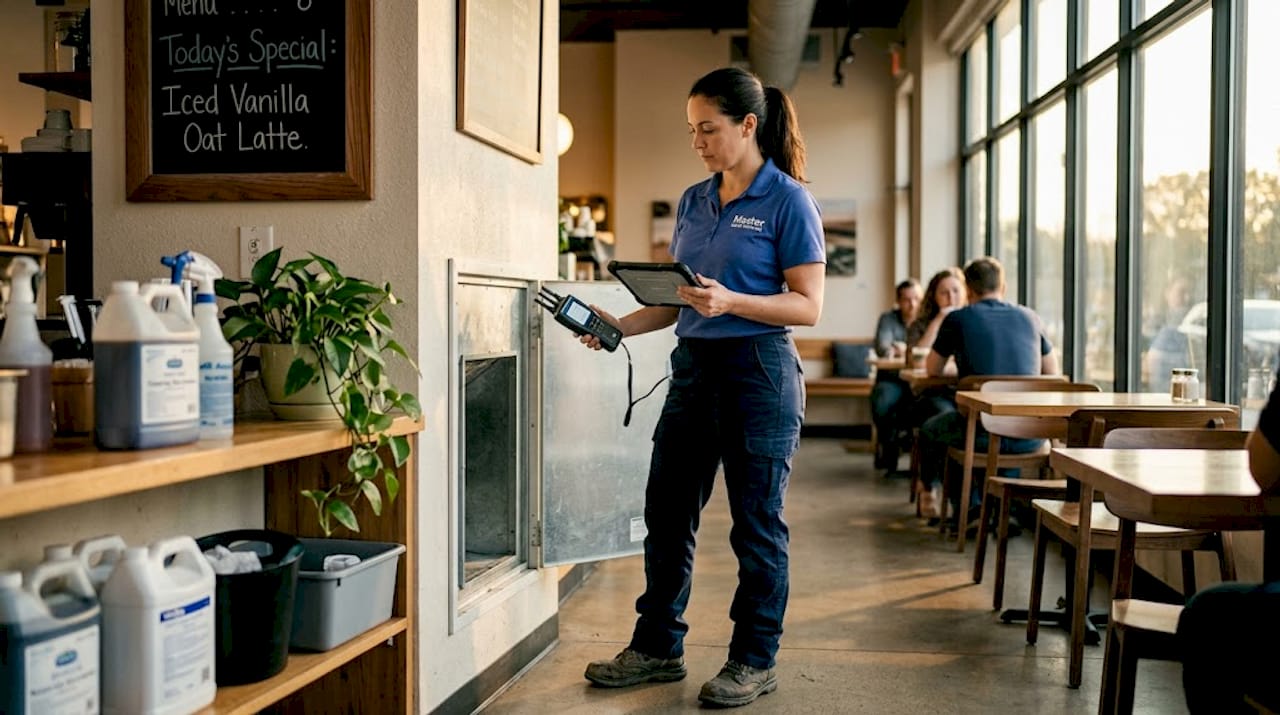
Research on multifamily and commercial buildings confirms that most odor complaints stem from airflow and pressure imbalances rather than the source itself. When exhaust and supply airflows are out of balance, odors migrate through gaps, door undercuts, and shared duct pathways to areas far from where the pet actually lives.
Here is how the cascade typically unfolds:
- Identify the pressure relationship. If a corridor is at neutral or negative pressure relative to a pet-occupied suite, odors flow outward into shared spaces continuously.
- Check the stack effect. In taller buildings, stack effect dynamics pull air upward through elevator shafts and stairwells, redistributing odors across multiple floors.
- Test at the door, not just in the room. Pressure testing at suite entry doors reveals whether the space is correctly positive or negative relative to the corridor.
- Map operational variables. Kitchen exhaust cycling, bathroom fans running inconsistently, and HVAC mode changes can all flip the odor migration path between morning and evening without any change in the odor source itself.
- Commission the system properly before treating surfaces. Balancing supply and exhaust resolves a large portion of odor transfer complaints. Surface cleaning alone will not fix a pressure problem.
The diagnostic work matters enormously here. Airflow verification should include measurements by floor, pressure relationships at doors, and performance checks through HVAC mode changes. Without that data, you are guessing.
3. The real financial and legal costs of letting pet odors go unmanaged
The financial exposure from unmanaged pet odor issues in commercial properties is not hypothetical. A documented case from British Columbia illustrates the scale precisely: a tenant who flushed large amounts of cat litter caused more than $54,000 in total damages, including a $50,000 insurance deductible, fines, and displacement costs for other units.
That case involved plumbing, but pet odor damage follows a similar financial logic. Saturated flooring requires full removal. Subfloor replacement in a commercial suite runs thousands of dollars before you even address the walls or HVAC components. Add lease termination proceedings, temporary relocation of other affected tenants, and legal fees, and a single neglected pet odor situation becomes a six-figure liability.
“The cost of early intervention is rarely more than a fraction of what you spend after the problem has penetrated the structure. The damage is not just to the building. It is to tenant relationships, lease renewals, and your property’s market reputation.”
From a retention perspective, the impact of pet odors on business performance is measurable. Tenants who experience persistent odors from neighboring units do not renew leases quietly. They leave and they tell people. For commercial landlords competing in markets where quality tenants have options, that reputation cost compounds faster than any single remediation bill.
4. Practical strategies for managing pet odor risks in commercial settings
Effective commercial pet odor management starts with accepting one principle: masking does not solve the problem. It delays it and often makes remediation more expensive by allowing contamination to penetrate deeper into materials while the surface temporarily smells acceptable.
Here is what actually works in commercial environments:
- Remove the source first. Enzymatic cleaners break down uric acid at the molecular level rather than coating it. Use them on carpet, subfloor, and any porous surface before applying any other treatment. Source-focused cleaning is the non-negotiable starting point.
- Correct ventilation before deodorizing. Deodorizing a space that still has a pressure imbalance pushing odors in from adjacent areas is a waste of money. Fix the airflow first.
- Upgrade filtration where HVAC is shared. The EPA recommends MERV 13 or higher filters along with proper air exchange rates as a primary strategy for reducing airborne biological pollutants, including pet dander.
- Set lease-level expectations proactively. Pet addendums that specify deep-cleaning requirements at move-out reduce disputes significantly. Include specific remediation standards rather than vague language about leaving the unit “clean.”
- Schedule periodic inspections in pet-permitted spaces. You do not want to discover the extent of contamination at lease end. Mid-tenancy walk-throughs give you time to intervene before damage penetrates structural materials.
- Engage licensed odor removal specialists for persistent cases. Professional pet odor removal services that use eco-friendly, non-ozone methods deliver lasting results without introducing secondary chemical risks to occupants.
Pro Tip: Before signing a contract with any odor remediation provider, ask specifically whether they use ozone generators or chlorine treatments. Both can damage materials and leave residual health risks in occupied commercial spaces.
5. Comparing pet odor mitigation methods: what works for commercial properties
Not every approach fits every situation. Here is a direct comparison to help you match the method to the problem.
| Method | Best for | Limitations | Commercial suitability |
|---|---|---|---|
| DIY enzymatic cleaning | Minor, surface-level contamination | Ineffective once contamination reaches subfloor or wall cavity | Low for chronic or large-scale issues |
| Masking sprays and air fresheners | Short-term odor suppression between treatments | Does not address source; odor returns quickly | Not recommended as a standalone solution |
| HVAC filtration upgrade (MERV 13+) | Airborne dander and odor particle reduction | Does not address surface contamination or structural saturation | High for shared-air commercial systems |
| Ventilation rebalancing and commissioning | Odor transfer between units and floors | Requires certified HVAC technician; time-intensive | High when pressure imbalances are confirmed |
| Professional eco-friendly remediation | Deep contamination, structural saturation, recurring complaints | Higher upfront cost | Very high; delivers permanent results without chemical residue |
| Ozone or chlorine treatments | Rapid deodorizing in vacant spaces | Health risks; material damage; not safe during occupancy | Low to moderate; avoid in occupied buildings |
The pattern that emerges is clear. Temporary methods handle temporary problems. When contamination has reached structural materials or when preventing pet odors in offices requires ongoing management across multiple units, professional remediation is the only approach that delivers a measurable and lasting outcome. Budget-wise, the comparison is straightforward: a professional treatment costs a defined amount. Repeat surface cleaning, tenant disputes, and structural replacement do not come with a ceiling.
My perspective on why commercial odor problems keep getting worse
I have seen the same pattern repeat across commercial properties of every size. The manager treats the symptom, the odor returns, they treat it again, and six months later they are dealing with subfloor replacement and a tenant dispute. The cycle is not a product of bad intentions. It is a product of misdiagnosis.
What most property teams overlook is the ventilation piece. Odor complaints are indicators of airflow problems as much as they are indicators of contamination. I have seen buildings where rebalancing the supply and exhaust resolved half the complaints without touching a single surface. The odor was real, but the distribution was a mechanical problem.
The second thing I hear consistently is resistance to professional remediation cost. That resistance almost always disappears the first time a manager goes through a lease dispute or a remediation project that runs four times what a specialist would have charged upfront. The long-term ammonia exposure risk in heavily contaminated, poorly ventilated commercial spaces is not something you resolve with a carpet cleaning crew. It requires someone who understands both the chemistry and the building dynamics.
My honest advice: get the ventilation diagnosed before you spend a dollar on deodorizing. Then bring in a specialist who uses science-backed, eco-friendly methods and will not introduce new chemical hazards into your building in the process of fixing the old ones.
— Master
How Masterodorremoval helps commercial properties eliminate pet odors for good

Pet odor issues in commercial properties require a level of expertise that goes beyond standard cleaning services. Masterodorremoval specializes in permanent odor elimination for commercial spaces, using green-certified methods that skip ozone and chlorine entirely. Whether you are managing a luxury office building, a multi-tenant retail property, or a high-end residential complex, the team brings same-day or next-day availability and licensed professionals who understand both the chemistry of odor sources and the building systems that spread them.
If you are ready to address the problem at the source, explore the full range of commercial odor removal services at Masterodorremoval, or see what proven odor elimination looks like when it is done right.
FAQ
What are the main health risks of pet odors in commercial buildings?
Pet odors in commercial spaces introduce ammonia gas from urine breakdown, airborne pet dander classified as a biological pollutant by the EPA, and secondary mold growth in saturated materials. All three can cause respiratory irritation and allergic reactions in occupants.
Why do pet odors spread beyond the unit where the pet lives?
Pressure imbalances in shared HVAC systems push odors from occupied suites into corridors and neighboring spaces. The stack effect in taller buildings amplifies this by pulling odors upward through vertical shafts.
How much can pet odor damage cost a commercial property owner?
Documented cases show total remediation costs can exceed $54,000 for a single unit, including insurance deductibles, structural repairs, fines, and tenant displacement. Early professional intervention costs a fraction of that.
Are masking sprays a viable solution for commercial pet odor problems?
No. Masking sprays suppress the smell temporarily without addressing the contamination source. Odor returns as the masking agent dissipates, and the underlying damage continues to worsen during that interval.
What is the most effective method for permanent pet odor removal in commercial properties?
Professional eco-friendly remediation that combines source removal, enzymatic treatment of contaminated materials, and ventilation correction delivers the most lasting results. MERV 13 filtration upgrades further reduce airborne dander in shared HVAC systems.
Recommended
- Why pet odors persist in rentals and how to fix them – Master Odor Removal
- Pet odor removal tips for hotels: keep rooms fresh – Master Odor Removal
- Top 9 ways to prevent odors in properties sustainably – Master Odor Removal
- Pet odor removal for property managers: eco-friendly solutions – Master Odor Removal
Recent Comments