
Most commercial building odor complaints trace back to a short list of predictable locations: restrooms, waste and compactor rooms, kitchens and break rooms, HVAC components, floor drains and P-traps, loading docks and garages, printing and maintenance rooms, carpets and upholstery, and recently renovated areas. Knowing where to look first cuts your diagnostic time significantly.
When a complaint comes in, three immediate actions will contain the problem and protect occupants while you investigate:
- Log the complaint — record the time, exact location, odor description (musty, sulfur, chemical, food/sour), intensity, and whether symptoms like headaches or eye irritation are present.
- Run a quick walkdown — walk the reported zone and adjacent areas with HVAC on and off to see whether the smell intensifies or disappears with airflow changes.
- Apply a short-term control — open windows or boost exhaust ventilation, run water through any nearby floor drains to replenish P-traps, and remove or isolate obvious waste sources.
Pro Tip: Before spending money on air sampling, spend 30 minutes mapping the complaint pattern on a floor plan. Clusters near one HVAC zone or one drain line almost always point to a single root cause.
Key Takeaways
The most effective approach to commercial building odor management combines a structured complaint log, targeted diagnostics using the Four Ps framework, source-specific fixes, and a preventive maintenance schedule that addresses HVAC, drains, and material selection before problems develop.
| Point | Details |
|---|---|
| Start with a complaint log | Record time, location, descriptor, intensity, and HVAC status for every complaint to reveal patterns. |
| Check P-traps and HVAC pans first | These two hotspots cause a disproportionate share of commercial odor complaints and are inexpensive to fix. |
| Ventilation alone is not enough | A 2026 MDPI review confirms ventilation cannot remove low-volatility odorants; source control is required. |
| Prioritize by safety and exposure | Sewer gas in occupied or client-facing areas is always immediate; storage-wing VOCs can wait for planned renovation. |
| Masterodorremoval for verified remediation | When source removal or professional treatment is needed, Masterodorremoval provides eco-friendly commercial services with post-treatment verification. |
Table of Contents
- Common Odor Hot Spots in Commercial Buildings — What to Check First in Each Area
- How to Detect and Map Odor Hot Spots Across Your Building
- Root-Cause Fixes and Quick Remedies for Each Hotspot
- Prevention and Maintenance: A Schedule and Design Controls
- When Odors Signal a Safety or Health Risk
- Tools and Tests Facility Teams Can Use for On-Site Triage
- A NIOSH Case Example: Persistent Chemical Odor from Carpet Adhesive
- How to Prioritize Fixes When Budget and Time Are Limited
- Why Reactive Odor Management Costs More Than You Think
- Professional Odor Removal for Commercial Properties
- Sources
Common Odor Hot Spots in Commercial Buildings — What to Check First in Each Area
EPA guidance identifies biological contaminants, cleaning products, HVAC systems, occupant activities, and attached garages as the primary indoor odor sources in commercial properties. Here is what each hotspot looks and smells like on a walkdown.
Restroom fixtures and drains. The typical descriptor is sour or sewage-like. Check for cracked wax seals at toilet bases, dried-out P-traps in floor drains, and grout lines that have absorbed urine. Turn off the exhaust fan briefly — if the smell intensifies, the drain is the source, not the air.
Trash rooms and compactors. Rotten or fermented odors. Look for liquid pooling under the compactor, organic residue on walls and floors, and inadequate negative pressure (the door should pull inward slightly when opened). Daily emptying and weekly deep cleaning are the baseline controls.
Kitchens and break rooms. Food and grease odors, sometimes sour from mop water. Check the grease trap, the drain under the sink, and the inside of the microwave. Mop water left in a bucket overnight is a surprisingly common culprit.
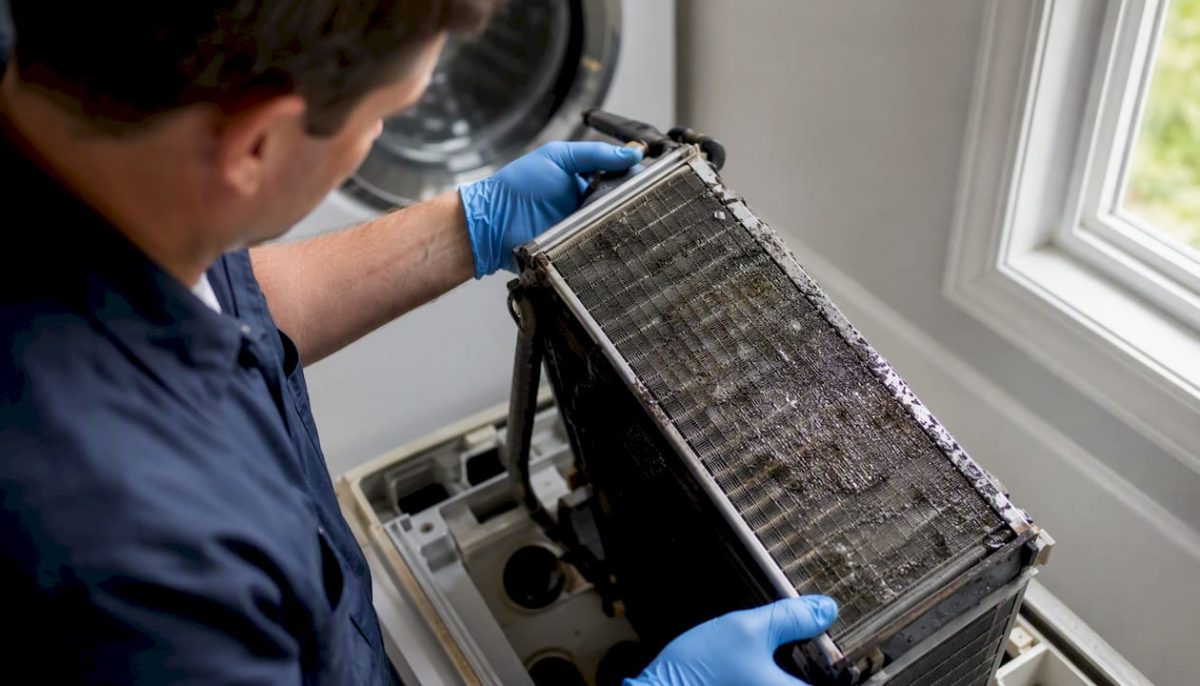
HVAC components. Musty or moldy smell that travels building-wide. Inspect the condensate drain pan for standing water, the evaporator coil for biological growth, and the air filters for loading. A musty smell that appears only when the air handler runs almost always points to the coil or pan.
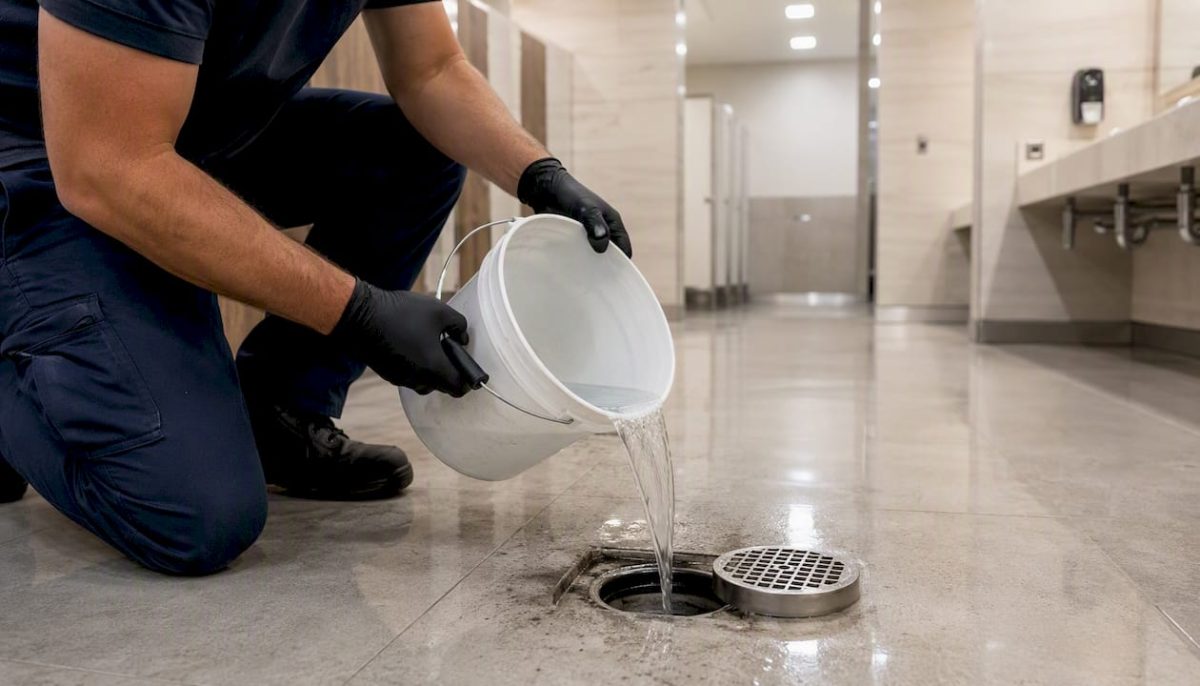
Floor drains and P-traps. Sulfur or sewer gas. Seldom-used drains in storage rooms, stairwells, and mechanical rooms lose their water seal through evaporation. Running water through them for 30 seconds restores the trap and eliminates the odor within minutes. Periodically flushing unused drains is one of the simplest preventive steps a facility team can take.
Loading docks and parking garages. Diesel exhaust and carbon monoxide. Check whether exhaust air from the garage is being drawn into the building through a nearby fresh-air intake. Pressure relationships matter here: the garage should be negative relative to occupied spaces.
Printing and maintenance rooms. Solvent or chemical odors from toner, inks, and cleaning agents. These rooms often lack dedicated exhaust, so VOCs accumulate and migrate through gaps in walls or ceiling tiles.
Carpets, upholstery, and adhesives. Chemical or musty odors that persist even after cleaning. Research confirms that carpets are a common indoor VOC source, and that low-level VOC exposures can produce nuisance odors and irritation even when concentrations fall below occupational exposure limits. Adhesives under older carpet are a particular concern.
Recently renovated areas. Sharp chemical or paint-like smell from off-gassing finishes, adhesives, and composite wood products. This typically peaks in the first two to four weeks and diminishes with ventilation, but poorly ventilated spaces can sustain elevated VOC levels for months.
Pro Tip: Differentiate odor categories during your walkdown: sulfur-like points to sewer gas or microbial activity; musty points to moisture and biological growth; solvent-like points to VOCs from materials or products; grease/food points to kitchen or waste sources. Each category has a different fix.
How to Detect and Map Odor Hot Spots Across Your Building
A structured diagnostic approach prevents wasted sampling costs and inconclusive results. Field guidance from FACS and Citadel EHS both emphasize that sampling is most useful when it is tied to a specific hypothesis, not used as a fishing expedition.
The diagnostic sequence:
- Intake and logging. Collect every complaint with: date and time, exact location, odor descriptor, intensity (1–5 scale), duration, HVAC status (on/off/changed), recent activities nearby (cleaning, renovation, deliveries), and whether occupants report symptoms.
- Pattern mapping. Plot complaints on a floor plan. Look for spatial clusters (one zone, one floor, one HVAC branch) and temporal patterns (mornings only, Mondays after a weekend shutdown, rainy days).
- Coordinated walkdown. Walk with a maintenance technician and, when possible, the occupant who reported the complaint. Use the Four Ps framework: People (who is affected), Pathways (how the odor travels), Pressures (which spaces are positive or negative), and Pollutants (what the likely source is).
- Smoke or tracer checks. A handheld smoke pencil reveals airflow direction at doors, grilles, and penetrations. This is the fastest way to confirm whether a smell is migrating from an adjacent space or coming from within the zone.
- HVAC on/off test. Turn the air handler off for 15 minutes. If the odor dissipates, the HVAC system is transporting it. If it intensifies, the source is local.
- Escalate to professional sampling when the source remains unidentified after two walkthroughs, when occupants report health symptoms, or when a solvent-like odor persists without an obvious material source.
Odor log template — record these fields for every complaint:
| Field | What to capture |
|---|---|
| Date and time | Exact timestamp, day of week |
| Location | Room number, floor, zone |
| Odor description | Musty, sulfur, chemical, food, exhaust |
| Intensity | 1 (faint) to 5 (overwhelming) |
| Duration | Continuous, intermittent, time of day |
| HVAC status | On, off, mode, recent changes |
| Recent activities | Cleaning, renovation, deliveries, new furniture |
| Symptoms reported | Headache, eye irritation, nausea |
Root-Cause Fixes and Quick Remedies for Each Hotspot
Short-term controls buy time and reduce occupant exposure. Definitive fixes address the source. The distinction matters because masking odors without removing the source is a cycle that erodes occupant trust.
Quick fixes by hotspot:
- Restrooms: Flush all floor drains, reseal toilet bases, increase exhaust fan runtime, and switch to low-odor cleaning products.
- Trash/compactor rooms: Empty daily, wash walls and floors weekly with an enzymatic cleaner, verify negative pressure is maintained.
- Kitchens/break rooms: Clean grease traps on schedule, replace mop water daily, check and clean the drain under the sink.
- HVAC: Drain and clean condensate pans, clean evaporator coils, replace filters on schedule, and verify drain lines are clear. A musty smell that returns within weeks of cleaning the coil usually means the drain pan is not fully draining.
- Floor drains/P-traps: Run water for 30 seconds in every seldom-used drain weekly. For drains that dry out quickly, a trap primer or mineral oil seal extends the interval.
- Loading docks/garages: Rebalance pressure relationships so the garage is negative relative to occupied floors, relocate fresh-air intakes away from exhaust zones.
- Printing/maintenance rooms: Add dedicated exhaust ventilation, store solvents in sealed containers, and schedule cleaning product use for end-of-day when occupancy is low.
- Carpets and adhesives: Steam clean as a first step. If the chemical odor persists after cleaning, NIOSH investigators recommend removing the carpet and adhesive entirely and running HVAC continuously during remediation.
- Renovated areas: Maximize fresh-air ventilation for at least 72 hours after work completion, delay occupancy when possible, and specify low-VOC materials in future renovation contracts.
When short-term fixes do not resolve the odor within one to two weeks, removal or repair is usually the right call. Persistent chemical odors from carpet or adhesive, collapsed or disconnected ductwork, and broken sewer traps all require physical intervention, not just cleaning.
Prevention and Maintenance: A Schedule and Design Controls
Reactive odor management costs more and disrupts more than a planned program. The EPA’s office building occupant guide recommends humidity control, cleaning schedules, and considering product emissions at procurement as foundational controls.
Recommended maintenance schedule:
| Task | Frequency |
|---|---|
| Restroom cleaning and drain flush | Daily |
| Trash/compactor room cleaning | Daily empty; weekly deep clean |
| HVAC filter inspection and replacement | Monthly inspection; replace per manufacturer spec |
| Condensate pan and drain line check | Monthly |
| Evaporator coil cleaning | Twice yearly (or per HVAC contractor guidance) |
| Floor drain flushing (seldom-used) | Weekly |
| Carpet and upholstery deep cleaning | Quarterly in high-traffic areas |
| Post-renovation airing and VOC check | 72 hours minimum before reoccupancy |
| Grease trap service | Per local code; typically monthly to quarterly |
Design controls that prevent odors from forming:
- Maintain negative pressure in odor-generating zones (trash rooms, kitchens, garages, printing rooms) relative to adjacent occupied spaces.
- Specify low-VOC paints, adhesives, and flooring products. The Carpet and Rug Institute’s Green Label Plus program and California’s CARB Phase 2 standard are reliable procurement benchmarks for low-emitting products.
- Keep relative humidity between 30% and 50% to suppress microbial growth. Humidity above 60% accelerates mold and bacterial activity in carpets, wall cavities, and HVAC components.
- Isolate high-odor zones with dedicated exhaust and sealed penetrations through walls and ceilings.
- Partner with a scheduled commercial cleaning service for odor-prone areas where daily in-house cleaning is not practical.
A 2026 systematic review in Buildings (MDPI) warns that ventilation alone often cannot remove low-volatility or strongly adsorbing odorants and recommends integrated source control plus smart sensing for proactive management. That finding should inform how you write your maintenance contracts: ventilation is a transport mechanism, not a remediation tool.
When Odors Signal a Safety or Health Risk
Most building odors are nuisances. Some are emergencies. Knowing the difference is the most important judgment call a facility manager makes.
Red-flag odors that require immediate action:
- Gas-like or rotten egg smell near mechanical rooms, utility chases, or gas-fired equipment: suspect a natural gas or hydrogen sulfide leak.
- Chemical burn or acrid smell with visible fumes or haze: possible combustion byproduct or chemical release.
- Persistent solvent fumes with occupant reports of dizziness, nausea, or headache: elevated VOC exposure requiring immediate ventilation and source investigation.
- Sewage smell throughout a floor (not just near one drain): possible sewer line break or widespread P-trap failure.
Escalation steps:
- If any occupant reports acute symptoms (dizziness, nausea, difficulty breathing), stop work in the affected area and evacuate immediately.
- Shut down ignition sources if a combustible gas is suspected. Do not operate light switches or elevators.
- Call 911 or your gas utility if a gas leak is suspected. Do not re-enter until cleared.
- For non-emergency but persistent chemical odors, engage a certified industrial hygienist (CIH) to conduct air sampling and interpret results.
- For HVAC-related odors that cannot be traced through a standard walkdown, call a licensed HVAC contractor to inspect coils, drain pans, ductwork, and pressure relationships.
Health Canada’s building guidance notes that odor perception varies significantly among occupants, so a single complaint about a strong chemical smell deserves the same initial triage as ten complaints about a mild musty odor.
Tools and Tests Facility Teams Can Use for On-Site Triage
On-site instruments help you confirm or rule out hypotheses before committing to lab sampling. They are not a substitute for professional analysis when health symptoms are present.
Useful instruments for facility-level triage:
- Handheld PID (photoionization detector) / VOC monitor: Detects total VOCs in real time. Useful for confirming elevated levels in a suspected zone and tracking concentration gradients toward a source. Entry-level units run roughly $300–$800; professional-grade PIDs start around $1,500.
- H2S / low-level sulfur detector: Identifies hydrogen sulfide from sewer gas or biological decay. Useful near drains, mechanical rooms, and waste areas.
- Smoke pencil or smoke tube: Visualizes airflow direction at doors, grilles, and wall penetrations. Costs under $50 and is one of the most useful tools for pathway tracing.
- Differential pressure gauge (manometer): Confirms whether a room is positive or negative relative to adjacent spaces. Critical for verifying that odor-generating zones are properly isolated.
- Moisture meter and infrared camera: Identifies hidden moisture in walls, ceilings, and under flooring — the precursor to microbial odors. Infrared cameras start around $300 for basic models.
When to escalate to lab sampling:
The Citadel EHS investigative framework recommends sampling only after you have formed a specific hypothesis. Random sampling produces results that are hard to interpret and easy to dismiss. Sample before and after a control measure to confirm it worked.
Targeted VOC speciation (identifying specific compounds, not just total VOC levels) is sometimes necessary when the odor descriptor is chemical or solvent-like and the source is not visually obvious. A TO-15 canister sample analyzed by a certified lab can identify the compound class and often point directly to a material category.
Pro Tip: Document HVAC mode, outdoor temperature, occupant activity level, and recent building events every time you take a reading. A spike that appears only on cold Monday mornings after a weekend setback tells a very different story than a constant elevated baseline.
A NIOSH Case Example: Persistent Chemical Odor from Carpet Adhesive
This case illustrates how the diagnostic workflow plays out in practice and why material removal sometimes cannot be avoided.
The complaint: Office workers in a Maryland building reported a persistent chemical odor following a carpet installation. Complaints included headache and eye irritation. The odor did not resolve after several weeks of increased ventilation.
Walkdown findings: The odor was strongest near the floor and concentrated in recently carpeted areas. It diminished near supply air grilles and intensified near return air pathways, suggesting the HVAC system was distributing it building-wide.
Sampling and source identification: Air sampling identified VOCs consistent with carpet adhesive and backing materials. Concentrations were below OSHA permissible exposure limits but above odor detection thresholds, which explains why occupants could smell and react to the air without the readings triggering a regulatory response.
NIOSH investigators concluded that the most effective remediation was removing the carpet and adhesive. They also recommended running the HVAC system continuously during and after removal, minimizing air fresheners (which can react with VOCs to form secondary irritants), and evaluating ventilation rates and pressure relationships.
— NIOSH HHE Report HETA-2011-0004-3128
Post-remediation: Complaints resolved after carpet and adhesive removal and a ventilation flush. The building team implemented a low-VOC material specification for future renovations.
Key learning points from this case:
- A complaint log that captured location, timing, and symptom patterns made it possible to form a testable hypothesis before sampling.
- Increasing ventilation reduced symptoms temporarily but did not eliminate the source. This aligns with the MDPI review finding that ventilation alone is insufficient for low-volatility odorants.
- Communicating clearly with occupants about the investigation timeline and interim controls reduced anxiety and maintained trust during the weeks between complaint and resolution.
Pro Tip: When occupants report both an odor and physical symptoms, document the symptoms separately from the odor complaint. Symptom data strengthens the case for material removal when a building owner or property manager is reluctant to authorize the cost.
How to Prioritize Fixes When Budget and Time Are Limited
Not every odor problem gets fixed this week. A simple priority framework helps you make the case for resources and sequence work logically.
Priority criteria:
- Occupant exposure and frequency: How many people are affected, how often, and for how long?
- Safety and regulatory risk: Does the odor indicate a potential health hazard or code violation?
- Business disruption: Does the odor affect client-facing spaces, lease renewals, or occupant retention?
- Cost and time to fix: Is this a $50 drain flush or a $15,000 carpet replacement?
Priority matrix:
| Scenario | Impact | Cost | Time to Fix | Priority |
|---|---|---|---|---|
| Sewer gas in lobby or reception | High (safety, client-facing) | Low to medium | Hours to days | Immediate |
| Musty HVAC odor building-wide | High (widespread, health) | Medium | Days | High |
| Chemical carpet odor in occupied office | High (symptoms reported) | High (removal) | Days to weeks | High |
| Stale carpet VOC in storage wing | Low (few occupants) | High | Weeks | Schedule with next renovation |
| Trash room odor (no migration) | Medium (localized) | Low | Hours | Routine maintenance |
Scenario guidance:
A sewer odor in a lobby is always immediate: it affects every visitor and occupant, the fix (P-trap or wax seal) is usually inexpensive, and the safety risk from sewer gas is real. A stale carpet VOC in a low-occupancy storage wing, by contrast, can reasonably wait for the next planned renovation cycle. Bundle that fix with flooring replacement to avoid paying for two mobilizations.
When a fix requires significant capital (duct replacement, full carpet removal), document the complaint log data, sampling results, and symptom reports to build the business case. A pattern of 40 complaints over three months is a more persuasive budget request than a verbal description of “ongoing odor issues.”
Why Reactive Odor Management Costs More Than You Think
The conventional wisdom in facilities management is to respond to odor complaints as they come in. That approach is more expensive than it looks.
Every emergency callout for a sewer odor or a chemical smell costs more than a scheduled drain flush or a quarterly HVAC coil cleaning. The labor is billed at premium rates, the disruption pulls staff from other work, and the occupant trust damage accumulates across complaints. A single unresolved odor complaint that escalates to a formal air quality investigation can cost multiples of what a preventive program would have cost over a year.
The reputational dimension is harder to quantify but just as real. Tenants and employees form lasting impressions from sensory experiences. A building that smells clean retains occupants; one that smells musty or chemical loses them to competitors. That dynamic shows up in lease renewals and employee satisfaction scores before it shows up in a maintenance budget.
The office space odor removal steps that matter most are not the dramatic ones. They are the weekly drain flush, the monthly condensate pan check, and the low-VOC specification written into the next renovation contract. Those three habits eliminate the majority of commercial building odor complaints before they become complaints at all.
The checklists and log templates in this article are designed to be adopted as standard operating procedure, not used once and filed away. A complaint log that runs for six months gives you pattern data that no single walkdown can provide. That data is what separates a facility team that manages odors from one that chases them.
Professional Odor Removal for Commercial Properties
When the diagnostic work points to a source that requires more than cleaning and ventilation adjustments, Masterodorremoval’s commercial odor removal services give facility managers a direct path from confirmed source to verified resolution.

The service process follows the same investigative logic this article describes: intake and complaint mapping, targeted on-site assessment, source remediation using green-certified methods (no ozone, no chlorine), and post-treatment verification. For urgent commercial sites, same-day or next-day availability is standard. Every treatment uses eco-friendly chemistry that is safe for occupied buildings and does not require extended downtime. For facility managers who need workplace odor removal handled quickly and documented for building records, Masterodorremoval offers both one-time treatments and ongoing maintenance contracts. Contact the team to schedule an assessment or get a quote for your property.
Sources
These authoritative sources support the investigation procedures, material guidance, and remediation recommendations throughout this article.
- HHE Report No. HETA-2011-0004-3128, Evaluating a Persistent Nuisance Odor in an Office Building – Maryland
- View indoors: odors (EPA guidance document)
- IEQ Odor Investigation Procedures & Tips in Buildings (FACS blog)
- Scientific review on VOCs and indoor environments (PMC article)
Recent Comments