
The most common top odor sources in offices are food and breakroom waste, restroom drains and dry P-traps, HVAC drip pans and ductwork, carpets and adhesive VOCs, and hidden moisture or mold. Before you reach for an air freshener, run three steps first: map the smell by walking the floor and noting where it intensifies, isolate the affected zone or close off the relevant HVAC zone, then remove the obvious source (spoiled food, full trash bins) and log the report with time, location, and odor description.
NIOSH/CDC occupational health evaluations and U.S. EPA indoor air quality guidance both confirm that masking odors without removing the source is not just ineffective — it often adds more chemicals to the air and obscures a genuine health hazard. The five most common culprits, in rough order of frequency:
- Food, trash, and breakroom appliances
- Restrooms, floor drains, and dry P-traps
- HVAC drip pans, filters, and ductwork
- Carpets, upholstery, and adhesive off-gassing (VOCs)
- Trash rooms, hidden moisture, and mold
When source removal and cleaning do not resolve the problem within 48–72 hours, escalate to lab sampling or a licensed, eco-certified contractor. Masterodorremoval operates as a green-certified professional option for persistent commercial odor cases.
Table of Contents
- 1. Food, trash, and breakroom appliances top the list
- 2. Restroom drains and dry P-traps release sewer gas
- 3. HVAC drip pans, filters, and ductwork spread odors building-wide
- 4. Carpets, upholstery, and adhesive VOCs create chemical odors
- 5. Trash rooms and centralized waste areas concentrate odors
- 6. Mold hidden in walls, ceiling tiles, and under flooring
- 7. Smoking, vaping, and tobacco residue penetrate surfaces
- 8. New construction, renovations, and building materials off-gas VOCs
- 9. Pest activity and animal waste
- 10. Cleaning chemicals and fragranced products add to the problem
- Comparison: common office odor sources at a glance
- How to investigate and confirm an office odor source
- The remediation hierarchy: what to do in order
- Chemical vs. biological odors: how to tell them apart
- When to call a professional odor-removal contractor
- Prevention policies and maintenance schedules that actually work
- Why masking fails and what neutralization actually means
- Your 24–72 hour response checklist after an odor report
- Key Takeaways
- Odor control is a facilities strategy, not a janitorial task
- Masterodorremoval handles what cleaning crews can’t
- Useful sources for facility managers
1. Food, trash, and breakroom appliances top the list
Food waste is the single most reported source of unpleasant scents in offices. The mechanism is straightforward: organic material decomposes, and HVAC circulation carries the smell across the floor. Breakroom refrigerators, microwaves, and trash receptacles are the three most common specific sources — and the most frequently cleaned incorrectly.
Swapping a trash liner does not clean the bin. Leaked liquids and food particles absorb into porous bin materials, and the bin body itself requires periodic deep sanitation to stop recurring odors. The same logic applies to microwave splatter and refrigerator drip trays: surface wipes miss the residue that actually smells.
Detection clues: Odor peaks mid-morning and after lunch. It localizes near the breakroom but travels through shared HVAC. Smell is sweet-sour or rotten.
Persistence indicator: Recurring weekly unless bin bodies and appliance interiors are cleaned on a schedule, not just wiped down.
2. Restroom drains and dry P-traps release sewer gas
Restroom odors that drift into adjacent hallways or open-plan areas usually trace back to one of two sources: inadequate ventilation exhaust or a dry P-trap in a floor drain. Dry P-traps allow sewer gases, including hydrogen sulfide, to vent directly into occupied space because the water seal has evaporated. This happens most often in drains that see infrequent use — a utility sink used once a month, a floor drain in a rarely accessed server room, or a restroom on a low-traffic floor.
Detection clues: Rotten-egg or sulfur smell, strongest near floor level. Odor appears intermittently, often after HVAC pressure changes. No visible moisture or staining.
Quick fix: Flush the drain with water to restore the P-trap seal. If the smell returns within days, the drain may need a trap primer or a mechanical seal.
Persistence indicator: Recurring until the drain is flushed on a regular schedule or a trap primer is installed.
3. HVAC drip pans, filters, and ductwork spread odors building-wide
An HVAC system that smells is an HVAC system that distributes the smell everywhere. Drip pans that collect condensate but are never drained or cleaned become standing water, which grows mold and bacteria. Clogged or overdue filters accumulate dust, mold spores, and organic debris. Ductwork that has never been cleaned can hold years of particulate buildup.
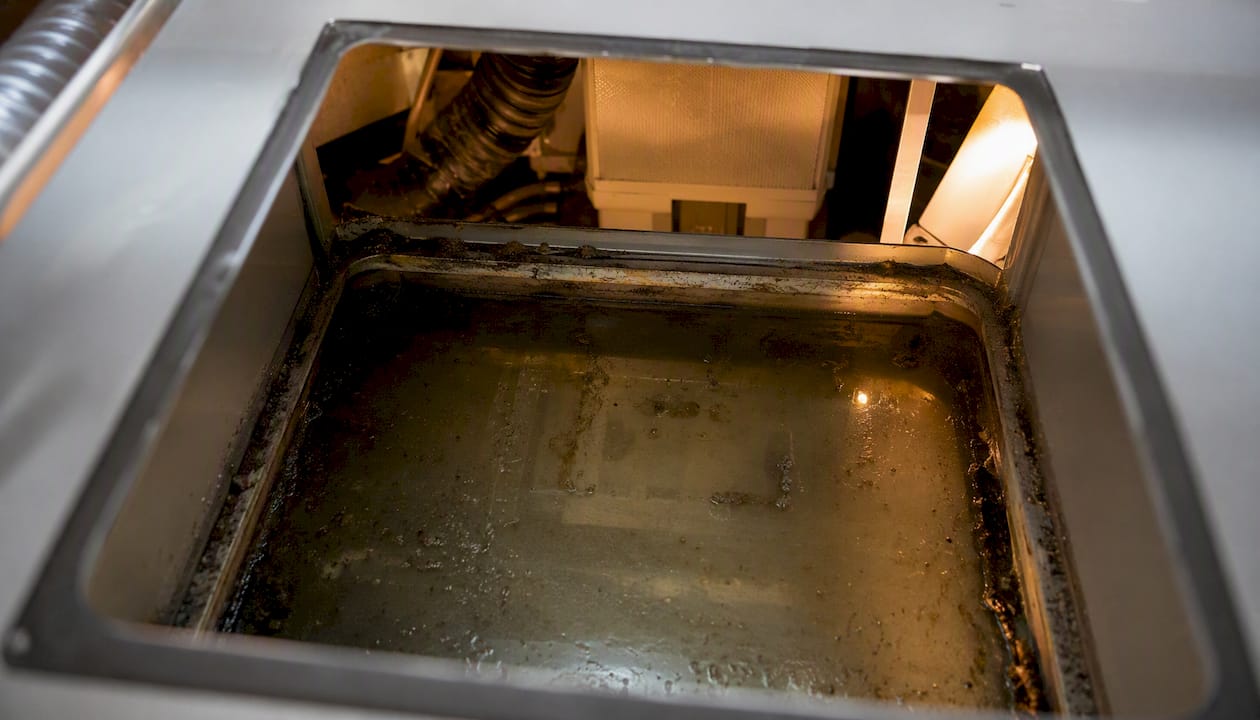
Detection clues: Musty or stale smell that appears when the system starts up, affects multiple zones simultaneously, and does not localize to one room. Smell may be worse on humid days.
Persistence indicator: Continuous until the drip pan is cleaned and drained, filters are replaced, and ductwork is inspected. This source is particularly stubborn because it recirculates the odor rather than concentrating it.
Pro Tip: Check drip pans during every scheduled HVAC filter change. A pan with standing water is a mold incubator — cleaning it takes ten minutes; remediating the resulting mold takes considerably longer.
4. Carpets, upholstery, and adhesive VOCs create chemical odors
Carpets absorb everything: food spills, moisture, foot traffic oils, and cleaning product residues. Older carpet backing and adhesives can also off-gas volatile organic compounds (VOCs) that produce a persistent chemical or solvent-like smell. NIOSH investigations have matched VOCs from carpet adhesive and backing to persistent office chemical odors in multiple occupational health evaluations — and in those cases, extraction cleaning often does not solve the problem.
Some VOCs have extremely low odor thresholds. 1-octanol, for example, has an odor threshold of 0.7 ppb — well below any occupational exposure limit, which means occupants can smell it clearly even when air sampling shows concentrations that appear safe on paper.
Detection clues: Sharp, solvent-like, or glue smell localized to carpeted areas. Odor does not respond to cleaning. Stronger in warm weather or after the HVAC system heats the space.
Persistence indicator: Continuous and worsening until the source material is removed or replaced.
5. Trash rooms and centralized waste areas concentrate odors
Centralized trash rooms, compactor areas, and recycling stations are high-intensity odor zones that often get overlooked in routine cleaning schedules. The combination of organic waste, cardboard, and warm temperatures creates conditions for rapid bacterial growth. If the trash room shares an HVAC return or has inadequate exhaust, the smell migrates to adjacent spaces.
Detection clues: Strong organic or fermentation smell near service corridors or loading areas. Odor intensifies on warm days. Nearby offices report intermittent smell that does not trace to the breakroom.
Persistence indicator: Recurring unless the room itself is deep-cleaned weekly, not just emptied.
6. Mold hidden in walls, ceiling tiles, and under flooring
Musty, damp smells are among the most frequently reported office air quality complaints, and they almost always indicate mold or mildew growth driven by moisture. The problem is that the mold is rarely visible. It grows behind drywall near plumbing penetrations, under carpet at slab level, inside ceiling tile systems above leaking pipes, and in HVAC insulation.
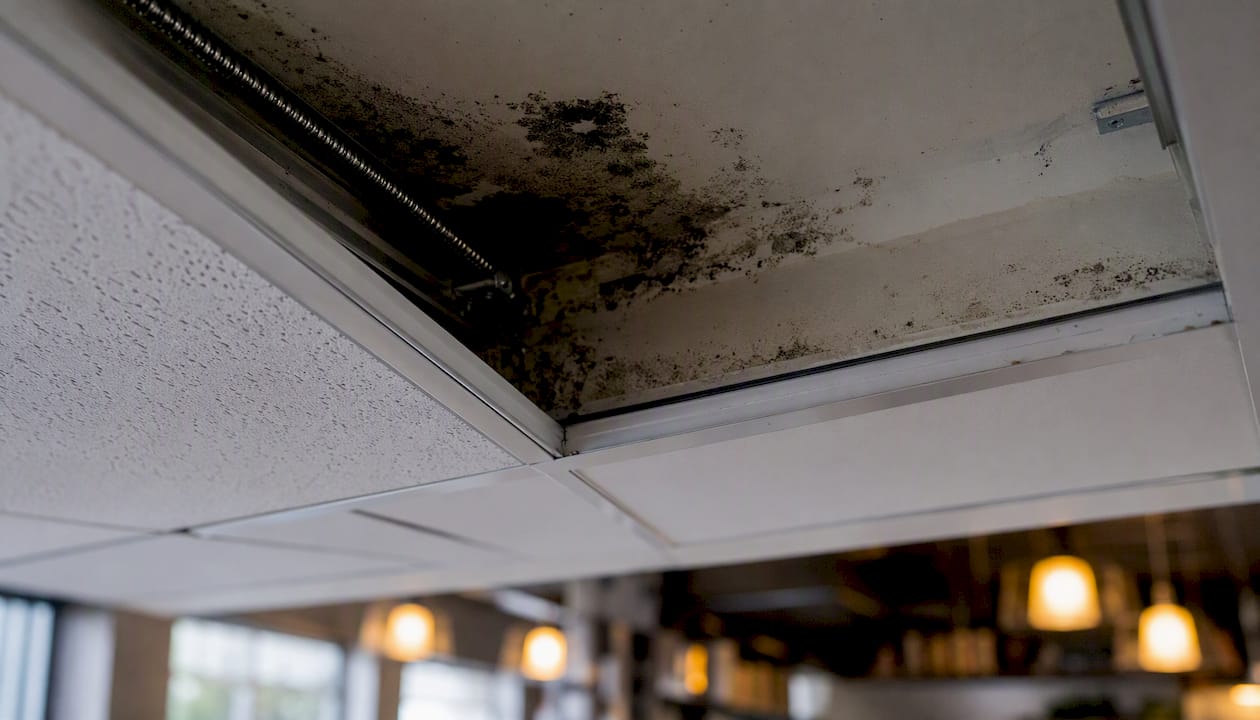
Surface cleaning does nothing for hidden mold. The moisture source has to be identified and repaired first; then the affected material needs removal or treatment.
Detection clues: Persistent musty smell that does not respond to cleaning. Smell worsens after rain or humidity spikes. Occupants report allergy-like symptoms (nasal congestion, eye irritation) that improve when they leave the building.
Persistence indicator: Continuous and potentially worsening until the moisture source is repaired and contaminated material is removed.
7. Smoking, vaping, and tobacco residue penetrate surfaces
Tobacco and marijuana smoke residue — sometimes called third-hand smoke — bonds to porous surfaces including drywall, ceiling tiles, carpet, and HVAC components. Vaping aerosols leave similar residues. In buildings where smoking occurred indoors historically, or in spaces adjacent to designated smoking areas, the smell can persist for months or years after the behavior stops.
Detection clues: Stale tobacco or sweet chemical smell that is strongest near windows, HVAC intakes, or in spaces with older finishes. Smell does not respond to surface cleaning or air fresheners.
Persistence indicator: Long-term unless affected surfaces are cleaned with appropriate neutralization methods or replaced. Standard janitorial cleaning will not remove embedded residue.
8. New construction, renovations, and building materials off-gas VOCs
New carpet, paint, adhesives, composite wood products, and furniture all off-gas VOCs during and after installation. This is a temporary source in most cases, but in poorly ventilated spaces or after large renovations, concentrations can be high enough to cause headaches, eye irritation, and persistent chemical smells for weeks. Formaldehyde from composite wood products is a specific concern.
Detection clues: Sharp chemical or “new building” smell that appears immediately after renovation or new furniture delivery. Strongest near the affected area, fades over time with ventilation.
Persistence indicator: Typically resolves within weeks with adequate ventilation, but adhesive-backed materials can off-gas for months.
9. Pest activity and animal waste
Rodent or insect infestations leave urine, feces, and in the case of rodents, decomposing carcasses inside wall cavities and ceiling spaces. The smell is distinctive — ammonia-like for active infestations, sweet-sickly for decomposition — and it does not respond to any cleaning that does not address the source.
Detection clues: Ammonia or sweet-decay smell localized to a wall cavity, ceiling space, or utility chase. Smell appears suddenly and intensifies. No visible moisture or mold.
Persistence indicator: Continuous until the infestation is resolved and affected material is cleaned or replaced.
10. Cleaning chemicals and fragranced products add to the problem
Cleaning products with strong fragrances, solvent-based floor cleaners, and aerosol deodorizers all add VOCs and particulates to office air. Ironically, some of the most common responses to office odor problems — spraying air freshener, applying heavy-scented cleaners — worsen indoor air quality by layering additional chemicals over an unresolved source.
Detection clues: Chemical or floral smell that appears after cleaning and fades within hours. Occupants report headaches or throat irritation specifically after cleaning routines.
Persistence indicator: Transient, but recurring if cleaning protocols are not adjusted.
Comparison: common office odor sources at a glance
| Source category | Typical odor description | Common mistaken diagnosis |
|---|---|---|
| Food/trash/breakroom | Sweet-sour, rotten, fermented | “Someone left food out” — bin body ignored |
| Dry P-trap/floor drain | Rotten egg, sulfur, sewer gas | Restroom ventilation failure |
| HVAC drip pan/ductwork | Musty, stale, moldy | General “building smell” |
| Carpet adhesive/backing (VOCs) | Solvent, glue, chemical | Old food or cleaning product |
| Hidden mold | Musty, damp, earthy | HVAC filter issue |
| Smoking/vaping residue | Stale tobacco, sweet chemical | Outdoor air infiltration |
| New construction/VOCs | Sharp chemical, “new building” | Paint or cleaning product |
| Pest/animal waste | Ammonia, sweet decay | Drain or sewer issue |
Pro Tip: The three most frequently missed infrastructure sources are dry P-traps in infrequently used drains, HVAC drip pans with standing water, and ceiling tiles above slow plumbing leaks. Check these before assuming the breakroom is the culprit.
How to investigate and confirm an office odor source
A structured investigation takes less time than a week of guessing. The workflow runs: map → isolate → inspect → verify → document.
Step 1: Odor mapping (0–2 hours)
Walk the floor with a simple odor log. Note the intensity on a 1–5 scale at each zone, the time of day, and whether the smell is stronger near supply vents, return vents, or specific rooms. Repeat the walk when the HVAC is off and again when it is running — this tells you whether the system is distributing a localized source or whether the source is in the ductwork itself.
Step 2: Occupant survey (same day)
A short five-question survey sent to affected floor occupants captures when the smell started, where it is strongest, what it smells like, and whether anyone has health symptoms. This data often points directly at the source category before any equipment is deployed.
Step 3: Visual inspection and basic field tools
| Tool | What it confirms | When to use |
|---|---|---|
| Moisture meter | Hidden moisture in walls, floors, ceiling tiles | Musty smell, suspected mold |
| Airflow smoke pencil | Airflow direction, duct leaks, P-trap seal status | Sewer gas, HVAC distribution questions |
| Portable VOC detector | Elevated VOC concentrations near materials | Chemical smell near carpet, new furniture |
| CO/CO2 monitor | Combustion gases, ventilation adequacy | Stale air, headaches, HVAC concerns |
Flush all infrequently used floor drains during the inspection. If the smell reduces noticeably within an hour, a dry P-trap was the source.
Step 4: When to escalate to lab sampling
Request laboratory air sampling when: the odor persists after source removal attempts, occupants report health symptoms (headaches, eye irritation, respiratory complaints), the smell is chemical or solvent-like and localizes to carpeted or recently renovated areas, or sewer gas is suspected. Standard lab panels for office investigations include a VOC screen, formaldehyde analysis, and hydrogen sulfide (H2S) measurement.
VOCs can produce detectable odors at concentrations far below occupational exposure limits. Some alcohol VOCs have odor thresholds as low as 0.7 ppb, which means a “clean” air sample by regulatory standards can still represent a real and persistent odor problem. Lab results confirm the compound class and guide the remediation method.
The remediation hierarchy: what to do in order
Skipping steps in this sequence is how offices end up spending money on treatments that do not work.
- Remove or contain the source. Pull spoiled food, deep-clean bin bodies, flush dry P-traps, repair leaks. No downstream step works until the source is gone.
- Targeted deep-cleaning or material removal. Clean affected surfaces with appropriate products. For carpet adhesive VOCs, NIOSH concluded that removing the carpet and adhesive was necessary — extraction cleaning alone did not resolve the problem.
- HVAC and ventilation correction. Replace filters, drain and clean drip pans, inspect ductwork, and increase per-person ventilation rates where possible. Increased ventilation reduces symptom prevalence even when VOC concentrations appear low.
- Targeted neutralization using eco-certified methods. For persistent biological or chemical odors after source removal, apply green-certified neutralization treatments. Vapor-based methods reach surfaces that sprays and wipes cannot. Avoid ozone generators and chlorine-based treatments in occupied or sensitive spaces.
- Professional remediation for persistent or confirmed chemical sources. When steps 1–4 do not resolve the odor within 72 hours, or when lab sampling confirms VOCs, formaldehyde, or H2S, engage a licensed contractor. For office space odor removal, the scope should include site assessment, written documentation, and post-treatment verification.
Practical case examples:
- Food odors in a breakroom: resolve with bin body sanitation, appliance deep-clean, and a weekly cleaning schedule. No professional treatment needed.
- Carpet adhesive VOCs: require material removal. Cleaning and neutralization are temporary measures at best.
- Sewer gas from dry P-trap: resolve with drain flushing and a trap primer. Cost is minimal; resolution is immediate.
- Hidden mold from a slow leak: requires leak repair, material removal, and targeted treatment. Professional assessment is appropriate.
Pro Tip: Document every action with date, cost, and outcome. This log becomes the evidence base for budget requests, vendor scope negotiations, and EH&S escalations. A facility manager who can show a documented remediation history gets faster approvals.
Chemical vs. biological odors: how to tell them apart
Getting this distinction right determines whether you call a cleaning crew or a contractor.
Chemical/VOC odors:
- Sharp, solvent-like, plastic, or glue scent
- Localized near new materials: carpet, furniture, paint, adhesives
- Do not respond to antimicrobial cleaning
- Stronger in warm conditions or when the HVAC heats the space
- May cause headaches or eye irritation at low concentrations
Biological/organic odors:
- Musty, sour, rotten, or ammonia-like
- Spread via HVAC or fabrics; not always localized
- Respond partially to cleaning but recur if the moisture or organic source is not removed
- Associated with visible or hidden moisture, pest activity, or organic waste
Standard antimicrobial cleaning will not remove a VOC source. The off-gassing material is still there; the cleaner just adds more chemistry to the air. Ventilation helps some VOCs by diluting concentrations, but it does not eliminate adhesive or backing degradation — the material continues to off-gas until it is removed.
Decision rules:
- Odor persists after thorough cleaning and 48 hours of increased ventilation → treat as potential VOC/chemical source, escalate to VOC testing
- Odor responds to cleaning but returns within a week → biological source with an unresolved moisture driver; inspect for hidden leaks or mold
- Odor is building-wide and tied to HVAC operation → ductwork or drip pan source; HVAC contractor scope
- Occupants report health symptoms → document, notify EH&S, and arrange lab sampling regardless of odor category
When to call a professional odor-removal contractor
Some odor problems are outside the scope of facility maintenance. Call a licensed contractor when:
- Occupants report health symptoms (headaches, respiratory irritation, nausea) linked to the odor
- The smell is building-wide or tied to HVAC distribution
- Source removal and cleaning have not resolved the odor within 72 hours
- Lab sampling confirms VOCs, formaldehyde, or H2S above odor threshold levels
- The suspected source is hidden mold, embedded tobacco residue, or adhesive off-gassing requiring material removal
- The odor recurs after multiple remediation attempts
A qualified contractor will conduct a site assessment and odor mapping, coordinate targeted air sampling and lab analysis, perform material removal or specialized neutralization using eco-certified methods, sanitize HVAC components, and provide before-and-after verification documentation.
Questions to ask any contractor before engaging:
- What certifications do you hold, and are your methods green-certified?
- Do you use ozone generators or chlorine-based treatments? (The answer should be no for occupied or sensitive spaces.)
- What does your post-treatment verification process look like?
- Will you provide written documentation of findings and actions taken?
- What is your escalation path if the first treatment does not resolve the odor?
Masterodorremoval’s workplace odor removal service uses eco-certified, non-ozone, non-chlorine neutralization methods with post-treatment verification — the standard any facility manager should require from a contractor. A formal odor assessment also creates documentation that protects the facility from liability if health complaints escalate.
Prevention policies and maintenance schedules that actually work
The EPA recommends occupant education and operational controls as the foundation of neutral indoor air in office buildings. That guidance translates into specific, enforceable policies.
Policy template items:
- Food storage: all food stored in sealed containers; refrigerators cleared and wiped weekly on a fixed day
- Breakroom protocols: microwave cleaned after each use; spills reported and cleaned within one hour
- Bin management: bin liners replaced daily in high-use areas; bin bodies deep-cleaned weekly
- Leak reporting: any water intrusion, drip, or moisture stain reported to facilities within 24 hours
- Fragranced products: personal air fresheners and heavily scented products restricted in shared spaces
- Smoking and vaping: prohibited within 25 feet of building intakes; designated areas positioned away from HVAC intakes
- Vendor material controls: new furniture, carpet, and adhesive products must meet low-VOC specifications; off-gassing period with increased ventilation required before occupancy
Maintenance schedule:
| Frequency | Task |
|---|---|
| Weekly | Deep-clean bin bodies; clean breakroom appliances (microwave, coffee machine, refrigerator drip tray) |
| Monthly | Flush all infrequently used floor drains to maintain P-trap seals |
| Quarterly | Inspect and clean HVAC drip pans; replace filters; check ceiling tiles above plumbing for staining |
| Annually | Material audit after any renovation; inspect carpet adhesive condition in high-traffic areas; review vendor material specifications |
For a broader set of sustainable prevention tactics, including procurement specifications for low-odor materials, the investment in prevention consistently costs less than a single professional remediation engagement.
Why masking fails and what neutralization actually means
Masking agents — air fresheners, sprays, plug-in diffusers — hide odors and add chemicals to the air. They do not remove the source, and many aerosol deodorizers introduce additional VOCs and fragrance compounds that worsen indoor air quality for occupants who are already reacting to the existing odor.
Why masking is the wrong tool:
- Adds fragrance VOCs on top of existing odor compounds
- Provides temporary relief that encourages delay in finding the actual source
- Can trigger reactions in occupants with fragrance sensitivities or asthma
- Obscures odor-intensity data that would otherwise help locate the source
Safe temporary measures while investigating:
- Increase fresh air ventilation to dilute concentrations
- Isolate the affected zone if the HVAC system allows zone control
- Remove obvious organic sources (trash, spoiled food) immediately
What true neutralization looks like: Green-certified methods attack odor molecules directly — through enzymatic breakdown of organic compounds, vapor-phase neutralization that reaches porous surfaces, or targeted chemical neutralization of specific compound classes. The standard for any professional treatment should include post-treatment air verification, not just a subjective “does it smell better?” check. Green-certified odor elimination avoids ozone and chlorine, which can themselves become indoor air quality hazards in occupied spaces.
Your 24–72 hour response checklist after an odor report
Immediate (0–4 hours) — Facility technician
- Receive and log the report: reporter name, location, time, odor description, and any health symptoms noted.
- Walk the affected area and complete an odor map (intensity 1–5 by zone, vent proximity, time of day).
- Remove obvious sources: empty and bag trash, remove spoiled food, flush nearby floor drains.
- Isolate the zone if HVAC zoning allows; increase fresh air intake.
- Note whether the smell is chemical/solvent or biological/organic for the initial diagnosis.
Short-term (within 24 hours) — Building engineer or facilities supervisor
- Inspect HVAC drip pans, filters, and ductwork serving the affected zone.
- Check ceiling tiles and walls near plumbing for moisture staining.
- Deploy a portable VOC detector or moisture meter if the odor category warrants it.
- Send a brief occupant survey to the affected floor.
- Document all findings with photos and equipment readings.
Follow-up (48–72 hours) — Facilities manager
- Review survey results and equipment data; confirm or revise the source hypothesis.
- If the odor persists after source removal and cleaning, escalate: notify EH&S, arrange lab sampling, or engage a licensed contractor.
- If health symptoms were reported, notify HR and EH&S regardless of odor resolution status.
- Update the odor log with actions taken, costs, and current status.
- Schedule follow-up inspection at 72 hours to confirm resolution.
Owner-assignment template fields: Reporter name / Location (floor, room, zone) / Initial odor description / Time first noticed / Health symptoms reported (Y/N) / Actions taken / Equipment used / Next-step recommendation / Assigned owner / Target resolution date.
Key Takeaways
The single most important principle in managing office odor problems is this: remove the source before applying any treatment, because masking an unresolved source delays resolution and often worsens indoor air quality.
| Point | Details |
|---|---|
| Identify and isolate first | Map the odor by zone and time of day before cleaning or treating anything. |
| Source removal beats masking | Air fresheners add VOCs and hide hazards; remove the source, then neutralize. |
| HVAC and drains are often missed | Drip pans, dry P-traps, and ductwork are high-impact sources that routine cleaning skips. |
| VOCs need different treatment | Chemical odors from adhesives or materials require removal or targeted neutralization, not antimicrobial cleaning. |
| Masterodorremoval for persistent cases | When source removal and cleaning fail within 72 hours, Masterodorremoval provides eco-certified, non-ozone professional remediation with post-treatment verification. |
Odor control is a facilities strategy, not a janitorial task
The conventional framing of office odor as a housekeeping problem undersells the actual risk. Research links poor odor conditions in workplaces to reduced confidence and impaired judgment — which means a persistent smell in a conference room is not just an annoyance; it is a measurable drag on the quality of decisions made there. Facility managers who treat odor control as a line item in the janitorial budget are solving the wrong problem. The real frame is operational risk: a building that smells affects retention, client perception, and liability exposure when health complaints arise.
The most underappreciated aspect of this is how quickly a localized source becomes a building-wide issue through HVAC distribution. A single dry P-trap or a neglected drip pan can generate complaints across three floors within hours. That scale of impact justifies the same structured response you would give a mechanical failure — documented, time-boxed, and escalated when it does not resolve on schedule. The facility managers who handle odor complaints best are the ones who have a written protocol before the complaint arrives, not the ones improvising with a can of air freshener.
Masterodorremoval handles what cleaning crews can’t
When source removal, deep-cleaning, and HVAC maintenance have not resolved the problem, the issue is almost always either a VOC-emitting material that needs removal or a biological source that requires professional-grade neutralization. That is exactly the scope Masterodorremoval covers.

The service includes a site assessment and odor mapping, targeted air sampling and lab coordination where needed, eco-certified vapor-based neutralization that reaches porous surfaces without ozone or chlorine, HVAC sanitation, and written before-and-after verification. For facility managers who need documentation for EH&S or procurement, that verification report is as important as the treatment itself.
Same-day and next-day availability means you are not waiting a week to resolve a complaint that is already affecting occupants. For persistent or building-wide office odor problems, commercial odor removal from a licensed, green-certified contractor is the responsible next step. Contact Masterodorremoval to schedule a site assessment and get a written scope before the problem compounds.
Useful sources for facility managers
These references are worth bookmarking for procurement briefings, EH&S documentation, and contractor vetting:
- EPA Office Building Occupants’ Guide to Indoor Air Quality — Covers occupant policies, operational controls, and IAQ investigation basics for commercial buildings.
- NIOSH/NIH: Evaluating a Persistent Nuisance Odor in an Office Building — Detailed case study of VOC identification from carpet adhesive, including lab sampling methodology and remediation conclusions.
- NIOSH HHE Report HETA-2011-0004-3128 — The Health Hazard Evaluation that concluded carpet and adhesive removal was necessary to resolve a persistent office VOC odor.
- NIOSH Indoor Environmental Quality — NIOSH’s full IAQ resource library, including investigation protocols and exposure guidance.
- Masterodorremoval: Workplace Odor Removal — Service overview for commercial and office odor removal engagements, including eco-certified methods and contact flow.
- Masterodorremoval: Office Space Odor Removal Steps for Facility Managers — Step-by-step procedural guide tailored to facility management teams.
Recent Comments