
TL;DR:
- Odor neutrality involves actively eliminating unwanted smells at their source to create a clean, inclusive environment. It is essential for customer satisfaction, staff well-being, and effective scent branding, as masking fragrances can worsen odors and trigger sensitivities. Implementing a systematic workflow of source identification, neutralization, ventilation, and ongoing monitoring assures durable odor control and enhances brand perception.
Odor neutrality in business is defined as the active elimination of unwanted smells at their source, rather than covering them with fragrances, to create a sensory environment that is clean, inclusive, and free of olfactory triggers. This practice sits at the intersection of sensory science, olfactory branding, and operational hygiene. The role of odor neutrality in business extends far beyond aesthetics. It directly shapes customer satisfaction, employee well-being, and brand perception. Systems like the AiroVive® neutralization platform have formalized this approach, treating neutralization as the non-negotiable baseline before any scent design is layered on top.
Why odor neutrality matters more than masking in customer-facing businesses
The distinction between neutralizing and masking is not semantic. It is the difference between solving a problem and hiding it. Indoor odor pollution drives acute symptoms including eye, nose, and throat irritation, headaches, and nausea. These are the conditions collectively associated with Sick Building Syndrome, a documented pattern of occupant complaints tied directly to poor indoor air quality. When your customers or staff experience these symptoms, they rarely connect them to your ventilation system. They connect them to your brand.
Masking odors with air fresheners or diffused fragrances introduces a second layer of complexity. Scent is processed by the limbic system, the part of the brain governing emotion and memory. This means a fragrance that feels pleasant to one customer may trigger anxiety, grief, or a physical reaction in another. The BACP’s 2026 viewpoint on scent in therapy and client-facing spaces explicitly recommends fragrance-free neutrality as the safer default, citing risks of uninvited olfactory triggers related to asthma and personal memory associations. That recommendation applies with equal force to hotel lobbies, dental offices, and retail floors.
Cultural variation compounds the problem further. Scent associations are not universal. A fragrance that signals cleanliness in one cultural context may signal something entirely different in another. Businesses serving diverse customer bases face a near-impossible calibration challenge when they rely on masking. Odor neutrality sidesteps that challenge entirely by removing the variable rather than trying to control it.
Key reasons masking fails where neutrality succeeds:
- Artificial fragrances can combine with existing odors to create new, often worse compound smells
- Scent sensitivity varies widely across individuals, particularly among those with asthma or chemical sensitivities
- Masking does not address the source, so odors return and intensify over time
- Fragrance overuse can signal to customers that something is being hidden, which erodes trust
Pro Tip: Survey your staff before your customers. Employees who spend eight hours in your space will notice odor problems long before a first-time visitor does. Their feedback is your earliest warning system.
How odor neutrality integrates with olfactory branding strategies
Olfactory branding, the deliberate use of scent to reinforce brand identity, is a legitimate and well-researched marketing discipline. Research shows that congruent scents increase dwell time by up to 40% and boost purchase intent. That is a meaningful commercial outcome. The critical word, however, is congruent. Scent must align with the brand’s identity and the customer’s expectations. When it does not, the same research confirms that an incongruent scent can perform worse than no scent at all.

This is where odor neutrality becomes the strategic foundation rather than the fallback. The AiroVive® system, for example, combines neutralization with fragrance design, treating neutralization as the essential first step before any designed scent is introduced. That sequencing matters. You cannot build a credible olfactory brand identity on top of residual food smells, damp carpet, or stale air. Neutrality clears the canvas.
| Approach | Best use case | Risk level |
|---|---|---|
| Odor neutrality only | Therapy rooms, medical offices, diverse retail | Low |
| Neutrality plus congruent scent | Hotels, luxury retail, branded hospitality | Medium |
| Scent without neutralization | No recommended use case | High |
| Masking with air fresheners | Temporary emergency only | High |
Pro Tip: If you are unsure whether a signature scent fits your brand, default to neutrality. A clean, odor-free space reads as professional and trustworthy across every industry and demographic.
The importance of odor neutrality as a baseline also protects your scent investment. A well-chosen signature fragrance diffused into a space that already smells of mildew or cleaning chemicals will not deliver its intended effect. Customers will perceive the combination, not the fragrance alone. Neutralization first guarantees that your scent strategy performs as designed.
What does an effective odor neutrality workflow look like?
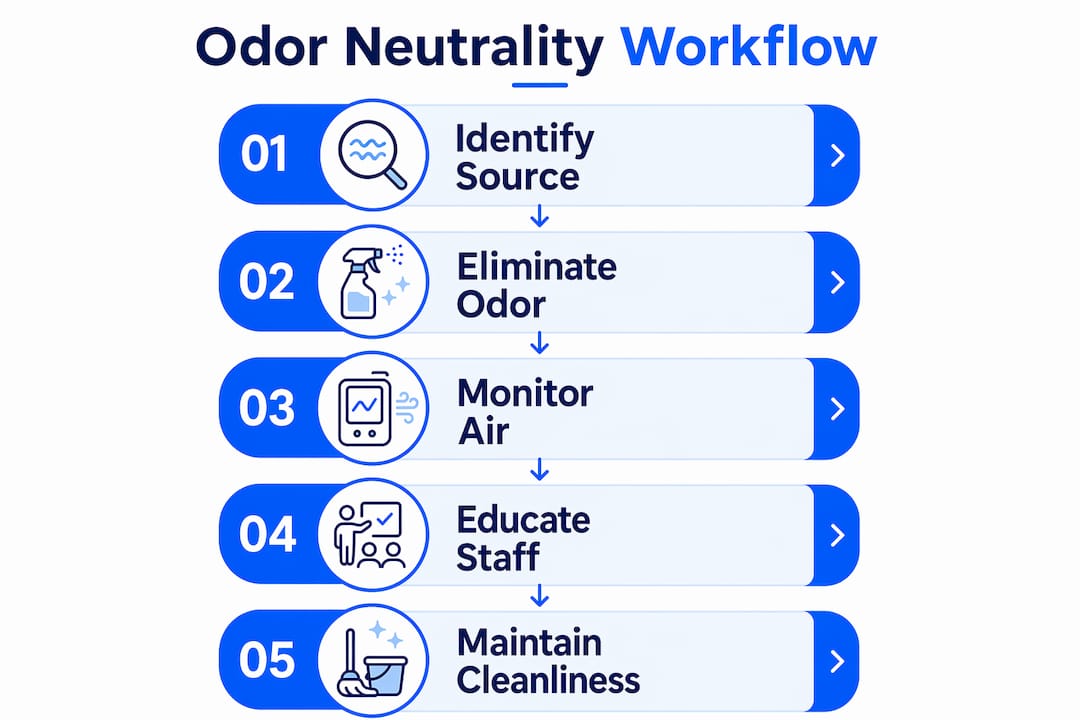
Odor neutrality is a workflow, not a product purchase. Effective neutrality requires source identification, neutralization at the source, and controlled management of olfactory inputs over time. Businesses that treat it as a one-time fix consistently see odors return within weeks.
Here is the operational sequence that works across industries from hospitality to therapy to commercial real estate:
Identify true odor sources. Moisture is the most common hidden source. Check HVAC systems, grout lines, upholstery, and subfloor materials. Waste disposal areas and staff kitchens are frequent secondary sources that are often overlooked in customer-facing odor audits.
Neutralize at the source, not in the air. Spraying fragrance into a room with a mold problem treats the symptom. Removing the mold treats the cause. Source-level neutralization uses enzymatic treatments, antimicrobial applications, or physical removal depending on the material involved.
Ventilate between customer interactions. Airing rooms between sessions and using air purifiers as neutral alternatives to fragrances is a documented best practice for maintaining comfort and safety. In therapy rooms and hotel suites, this means opening windows or running HEPA filtration for a minimum of 15 minutes between occupants.
Deploy air purification as a neutral tool. HEPA and activated carbon filters remove particulate matter and volatile organic compounds without introducing new scents. This is the correct tool for ongoing maintenance after source neutralization is complete.
Monitor and evaluate continuously. Odor conditions change with seasons, occupancy levels, and building age. Schedule quarterly odor audits, and create a simple feedback channel so customers and staff can flag issues before they become embedded problems. Masterodorremoval recommends treating odor monitoring the same way you treat fire safety checks: routine, documented, and non-negotiable.
Apply sector-specific protocols. A restaurant kitchen requires daily source neutralization of grease traps and exhaust systems. A therapy practice requires between-session ventilation and fragrance-free surfaces. A luxury hotel suite requires immediate odor removal after each checkout to protect property value and guest ratings.
The businesses that execute this workflow consistently report fewer customer complaints, higher perceived cleanliness scores, and reduced staff sick days. Neutral odor management reduces complaints, improves perceived cleanliness, and supports health compliance in commercial settings.
Common pitfalls in odor management and how to avoid them
Most businesses do not fail at odor neutrality because they ignore it. They fail because they substitute a simpler action for the right one. These are the patterns that consistently undermine odor management programs:
Overreliance on air fresheners. Automatic aerosol dispensers are the most common substitution. They create a cycle of masking that trains customers to associate your space with artificial fragrance rather than genuine cleanliness. When the dispenser runs empty, the underlying odor is often worse than before.
Ignoring cultural and personal scent associations. Smells are deeply tied to personal and cultural memories. A lavender diffuser that feels calming to one customer may trigger a grief response in another. Businesses serving multicultural or medically diverse populations carry the highest risk here.
Skipping ventilation between customers. Stale air accumulates body odor, breath, and volatile compounds from personal care products. Without active purging between interactions, these compounds layer and compound. This is particularly damaging in enclosed spaces like treatment rooms, fitting rooms, and vehicle interiors.
Underestimating dose sensitivity. Scent intensity and personal sensitivity vary widely across individuals, which means a fragrance level that seems subtle to your staff may be overwhelming to a customer with heightened olfactory sensitivity. Neutrality eliminates this calibration problem entirely.
Treating odor management as a one-time project. Odors are dynamic. New sources emerge, materials age, and occupancy patterns shift. Businesses that address odor once and consider the matter closed will face recurring problems within months.
Pro Tip: Install a simple anonymous feedback card or QR code survey asking customers one question: “How would you describe the air quality in our space today?” The data will tell you more than any internal audit.
Key takeaways
Odor neutrality is the most reliable foundation for customer experience management because it eliminates sensory risk, supports health compliance, and creates the clean baseline that any scent strategy requires to succeed.
| Point | Details |
|---|---|
| Neutrality beats masking | Masking compounds odors and introduces new sensory risks; source elimination is the only durable fix. |
| Congruence determines scent value | Brand-congruent scents can increase dwell time by up to 40%, but incongruent scents perform worse than no scent. |
| Workflow over product | Effective odor neutrality requires source identification, neutralization, ventilation, and ongoing monitoring. |
| Cultural sensitivity matters | Personal and cultural scent associations make fragrance-free neutrality the safest default for diverse audiences. |
| Dose sensitivity is real | Individual variation in scent perception means neutral environments carry far lower risk of negative customer reactions. |
Why I think most businesses are solving the wrong odor problem
After working with commercial spaces, hospitality venues, and luxury auto dealerships across a wide range of odor challenges, the pattern I see most often is not neglect. It is misdirection. Business owners invest in signature scent programs before they have addressed the baseline. They spend on diffusers and fragrance subscriptions while the HVAC system is circulating stale air and the upholstery is holding three years of absorbed odors.
The ethical case for neutrality is straightforward. You do not have the right to impose a scent on every person who walks through your door. Some of them have asthma. Some of them are in chemotherapy. Some of them carry a memory so tightly bound to a particular fragrance that encountering it unexpectedly will ruin their experience of your space regardless of how well-chosen that fragrance was. Neutrality is the respectful default.
The practical case is equally clear. A space that smells of nothing is universally perceived as clean. A space that smells of lavender is perceived as clean by some customers and as a cover-up by others. The neutral baseline wins on consistency alone.
What I have observed in practice is that businesses which commit to odor neutrality as an ongoing operational standard, rather than a one-time fix, see measurable improvements in customer return rates and staff retention. Clean air is not a luxury feature. It is a baseline expectation that your customers carry whether they articulate it or not. Treat workplace odor removal as a recurring operational line item, not a reactive emergency spend.
— Master
How Masterodorremoval helps businesses achieve true odor neutrality
Masterodorremoval specializes in permanent odor elimination for commercial spaces, hospitality venues, luxury auto dealerships, and high-end residential properties. Every service is built on source-level neutralization using eco-friendly, green-certified methods that avoid ozone and chlorine treatments entirely.

Whether you manage a boutique hotel, a therapy practice, or a commercial real estate portfolio, Masterodorremoval delivers same or next-day service backed by licensed professionals and a satisfaction guarantee. The approach addresses tobacco, mildew, pet, food, and smoke odors at their source, leaving interiors genuinely neutral rather than fragranced over. For businesses ready to treat odor management as the operational priority it deserves, explore professional odor removal services built specifically for commercial and premium environments. You can also review the full range of odor elimination services to find the right fit for your space.
FAQ
What is odor neutrality in a business context?
Odor neutrality is the active elimination of unwanted smells at their source rather than covering them with fragrances. It creates a sensory environment that is clean, inclusive, and free of olfactory triggers that could negatively affect customers or staff.
Why is odor neutrality better than using air fresheners?
Air fresheners mask odors temporarily without addressing the source, which allows underlying smells to compound over time. Neutralization removes the odor-causing compounds entirely, producing a durable result that masking cannot replicate.
How does odor neutrality affect customer behavior?
A neutral, odor-free environment is universally perceived as clean and professional, which supports customer comfort and trust. Research confirms that incongruent scents can perform worse than no scent, making neutrality the safer commercial default when scent fit is uncertain.
How often should businesses conduct odor audits?
Quarterly odor audits are the recommended minimum for most commercial spaces, with between-session ventilation protocols applied daily in high-turnover environments like treatment rooms, hotel suites, and vehicle interiors.
Can odor neutrality and scent branding coexist?
Yes. Systems like AiroVive® are designed to layer brand-congruent fragrances on top of a neutralized baseline. Neutralization must come first. Applying a signature scent to a space with unresolved odor sources will not deliver the intended brand effect.
Recent Comments