
TL;DR:
- Tobacco odor persists in hotel rooms due to VOCs embedding into surfaces and thirdhand smoke residue.
- Implementing full smoke-free policies and professional, sequence-based remediation methods can effectively eliminate odors and improve guest satisfaction.
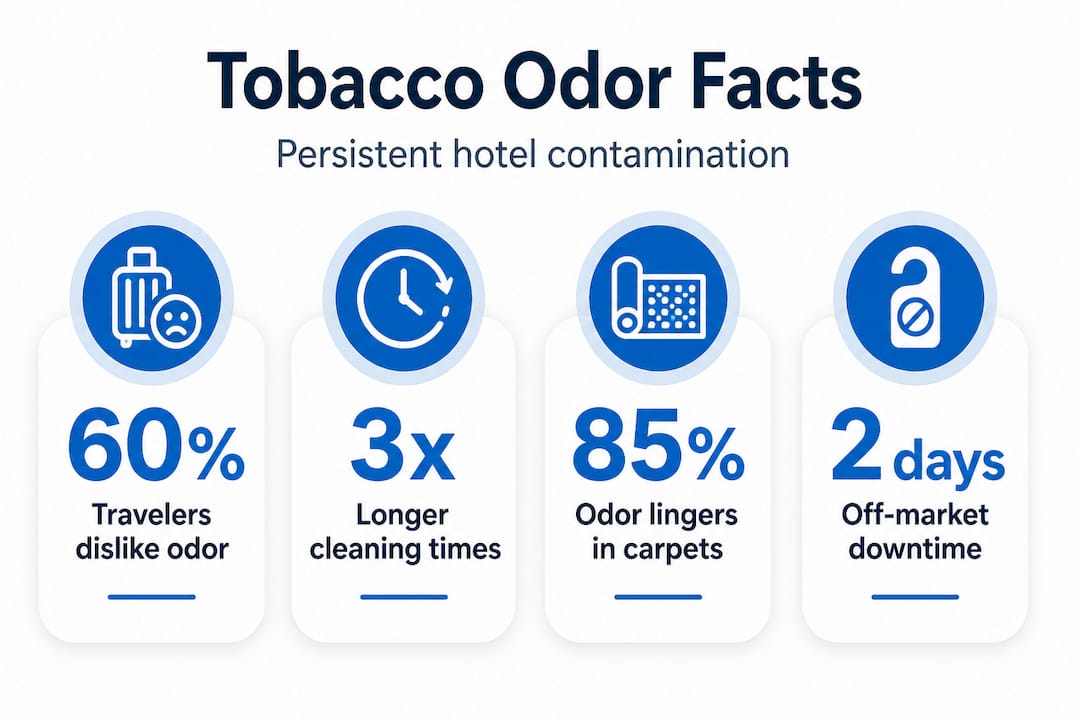
Tobacco odor is one of the most persistent and costly problems in hospitality. Over 60% of travelers report dissatisfaction when their room smells like smoke, according to an American Hotel and Lodging Association survey, and a single complaint can translate into a one-star review that reaches thousands of future guests. The damage goes beyond the guest experience. Rooms stay off-market longer, cleaning cycles run deeper, and staff spend hours managing a problem that standard housekeeping simply cannot solve. This article walks hotel and vacation rental operators through the science of tobacco odor, the real business consequences, and practical strategies that actually work.
Table of Contents
- The science behind tobacco odor persistence in hotels
- How tobacco odor shapes guest experience and reputation
- Partial bans vs. 100% smoke-free: What works and why
- Proven strategies for eliminating tobacco odor from hotel spaces
- Why most hotels underestimate the business case for going smoke-free
- Next steps: Partnering with experts for lasting solutions
- Frequently asked questions
Key Takeaways
| Point | Details |
|---|---|
| Tobacco odor lingers | VOCs and thirdhand smoke make tobacco odors persistent in hotel spaces even after cleaning. |
| Major business impact | Lingering odors lead to poor reviews, guest loss, and increased cleaning costs. |
| Partial bans are ineffective | Only 100% smoke-free policies reliably protect rooms and reputation. |
| Deep cleaning is required | Targeted cleaning of porous materials and professional treatment is needed for full odor removal. |
| Professional help pays off | Specialist services deliver long-term odor removal and bolster guest satisfaction. |
The science behind tobacco odor persistence in hotels
To understand the real challenge, let’s first look at what causes tobacco odor to cling to hotel rooms and why standard cleaning doesn’t solve it.
When a guest smokes inside a room, the combustion process releases hundreds of volatile organic compounds (VOCs). These are chemical gases that travel through the air and embed themselves into every surface they touch: walls, ceilings, carpet fibers, upholstery, drapery, and even the paint itself. Unlike a food smell that fades within hours, tobacco VOCs form chemical bonds with porous materials. They don’t just sit on the surface; they penetrate deep into the material matrix.
This is the core reason why opening a window or spraying air freshener does nothing meaningful. You’re only addressing the airborne portion, which represents a small fraction of the total contamination. The bulk of the odor is locked inside surfaces, slowly off-gassing back into the room air over weeks and months.
The phenomenon of thirdhand smoke (THS) makes this even more complex. Thirdhand smoke refers to the residue left on surfaces and in dust after a cigarette has been put out. It continues to release toxic compounds and odor molecules long after visible smoke has cleared. Guests walking into a room where someone smoked days earlier are still being exposed to this residue.
Soft furnishings are the worst offenders. Research shows that carpets and upholstery act as reservoirs holding 2 to 5 liters of trapped air per square meter, loaded with VOCs. The same research found that non-smoking rooms in smoking-allowed hotels contain nicotine levels averaging 0.87 µg/m², while smoker rooms can reach 100 to 10,000 µg/m². That “non-smoking room” your guest just checked into? It may already carry measurable tobacco contamination from shared HVAC systems and migrating particles.
“The assumption that designated smoking areas fully protect non-smoking spaces is not supported by the evidence. VOCs and nicotine particles migrate freely through ventilation systems and shared air pathways.” — Thirdhand Smoke Resource Center
| Surface type | Odor retention level | Difficulty to clean |
|---|---|---|
| Carpet and rugs | Very high | High |
| Upholstered furniture | Very high | High |
| Drapery and curtains | High | Medium |
| Painted walls and ceilings | Medium to high | Medium |
| Hard flooring | Low to medium | Low |
| HVAC ducts | High | Very high |
For practical tobacco odor removal tips that go beyond surface wiping, understanding this contamination map is the critical first step.
Pro Tip: During any odor remediation project, prioritize porous items first. Carpets, upholstery, and curtains hold the highest concentration of VOCs and will re-contaminate a freshly cleaned room if left untreated.
How tobacco odor shapes guest experience and reputation
Knowing how the odor persists, it’s clear why it becomes such a pain point for guests. Let’s see how that directly affects your bottom line.
The hospitality industry runs on reviews. A single negative experience, amplified through platforms like TripAdvisor, Google Reviews, or Booking.com, can suppress a property’s overall rating for months. Tobacco odor is one of the top triggers for those negative reviews. Over 60% of travelers report dissatisfaction with smoke odors, and a large portion of them follow up with public complaints. This matters because algorithm-driven booking platforms surface high-rated properties first. A lower star average doesn’t just hurt your pride. It directly reduces your visibility and reservation volume.
Beyond reviews, the operational costs are significant:
- Rooms with persistent smoke odors require extended turnover times, sometimes pulling inventory off-market for 24 to 48 hours
- Staff must repeat cleaning cycles, increasing labor costs per room
- Frequent guest complaints raise the rate of refunds and service recovery gestures
- Long-term surface damage from tobacco residue accelerates furniture replacement schedules
- Insurance claims related to smoke damage can affect premium rates
The revenue loss compounds quickly. A room priced at $150 per night taken off-market for two extra days per month represents $3,600 in lost annual revenue per room. Multiply that across a property with multiple affected rooms and the number becomes difficult to ignore.
| Property type | Avg. complaint rate | Avg. room recovery time | Guest satisfaction impact |
|---|---|---|---|
| Smoke-free hotel | Low | Standard turnover | High |
| Mixed-policy hotel | Moderate to high | Extended (24 to 48 hrs) | Moderate |
| Smoking-allowed rental | High | Very extended | Low |
Understanding common hotel odor problems helps operators see that tobacco is just one part of a broader guest experience challenge, but it’s consistently among the most damaging.
The experience of operators who have shifted to fully smoke-free environments confirms what the data suggests. Properties that have adopted and enforced clean-air policies report fewer guest escalations, faster room turnovers, and measurably higher ratings over time. The eco-friendly odor removal results seen across luxury hotel environments show this isn’t just theory. It’s a documented operational advantage.
Partial bans vs. 100% smoke-free: What works and why
But are partial bans a good compromise, or do they leave your property and guests exposed? Here’s what the evidence says.
The appeal of a partial ban is understandable. You want to accommodate smoking guests without alienating the non-smoking majority. The logic seems fair. In practice, it fails consistently.
The primary problem is air migration. Tobacco VOCs do not respect the boundaries of a designated smoking wing or floor. HVAC systems, elevator shafts, and door gaps all serve as pathways for contaminated air to spread throughout a property. Studies show that non-smoking rooms in smoking hotels consistently fail to protect guests from thirdhand smoke exposure, making partial policies largely ineffective as a guest protection measure.
The second problem is masking. Many properties on partial bans rely heavily on air fresheners, scented candles, or plug-in diffusers to manage odor perception. This approach is fundamentally flawed. Masking agents like candles and sprays don’t remove VOCs from surfaces or air. They layer a competing scent on top of the problem. Guests with chemical sensitivities or allergies often react just as badly to heavy fragrances as to the underlying odor, leaving the operator with a different complaint but the same rating consequence.
True odor elimination requires molecular neutralizers, products or treatments that chemically break down or bind to odor-causing compounds rather than masking them.
“Spraying fragrance over tobacco residue is the hospitality equivalent of painting over mold. The problem is still there. You’ve just added another layer.” — Master Odor Removal
Here’s a direct comparison of the two policy approaches:
Numbered breakdown of policy options:
- Partial smoking ban: Allows smoking in designated rooms or areas; requires constant deep-cleaning rotation; generates persistent cross-contamination risk; demands higher staff hours; produces moderate to high complaint volumes
- Full smoke-free policy: Eliminates source contamination entirely; simplifies cleaning protocols; reduces staff workload per room; produces lower complaint volumes; supports better long-term property ratings
Transitioning to a full smoke-free policy does require upfront investment: signage, updated booking policies, a one-time deep remediation of all previously contaminated rooms, and clear enforcement protocols. For guidance on the THS removal process in rentals, the approach is similar across property types.
Pro Tip: If a full transition feels abrupt, start by designating your highest-rated, most-booked room category as permanently smoke-free. Document the impact on reviews and complaint rates over 90 days. The data will make the case for expanding the policy far better than any internal argument can.
Proven strategies for eliminating tobacco odor from hotel spaces
Once you’ve committed to an effective policy, here’s how to tackle odors already present in your property, methodically and thoroughly.
Effective tobacco odor elimination is a sequenced process. Skipping steps or substituting quality products with cheaper alternatives consistently produces incomplete results. Here’s how it should be approached:
Step-by-step remediation framework:
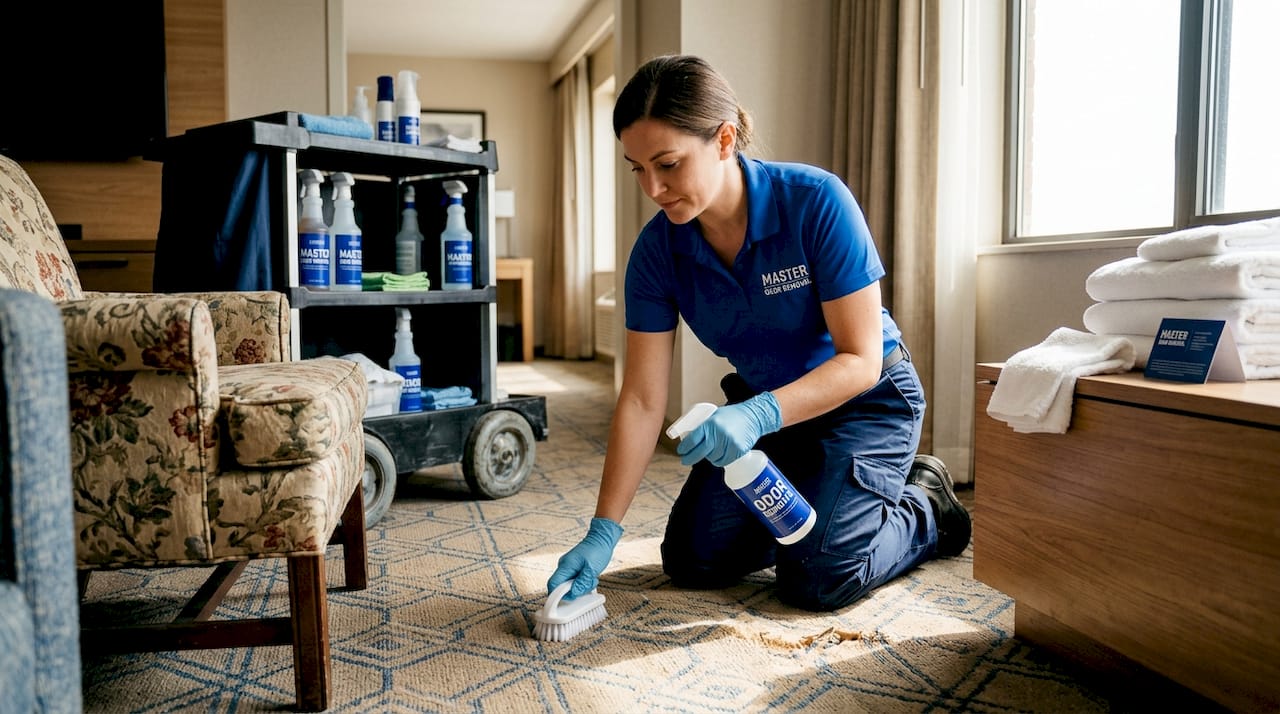
- Remove and isolate porous items first. Carpets, upholstered furniture, curtains, and bedding hold the highest VOC concentration, as carpet and upholstery research confirms. These items need direct treatment, not just surface wiping.
- Clean all hard surfaces with appropriate agents. Walls, ceilings, and hard flooring may appear clean but carry nicotine film. A thorough wash with VOC-neutralizing cleaners is essential before any repainting or refinishing.
- Address the HVAC system directly. Filters need replacement. Ducts and coils need cleaning. Leaving a contaminated HVAC system in place after remediating a room is one of the most common reasons odors return within days of treatment.
- Apply molecular neutralizers throughout the space. This is where the science matters. Products that chemically bind to or break down odor molecules are far more effective than enzyme-based or scent-based products.
- Allow adequate dwell time and airing. After treatment, rooms need ventilation time before they’re returned to service. Rushing a room back into inventory before treatments have fully acted is a common shortcut that undermines the entire process.
- Repaint if needed. In rooms with heavy long-term tobacco use, nicotine has often penetrated paint layers. Cigarette tar buildup in paint can continue off-gassing even after surface cleaning. Sealing primer followed by fresh paint is sometimes the only complete solution.
For best-practice guidance on each of these stages, the tobacco odor removal process provides detailed guidance for hospitality environments.
Pro Tip: Build odor audits into your standard room inspection cycle. Train housekeeping staff to flag any unusual smell during routine checks, not just after a smoking guest complaint. Catching contamination early keeps the scope of remediation manageable and prevents a single problem room from affecting adjacent spaces.
Why most hotels underestimate the business case for going smoke-free
Stepping back, let’s reconsider why many properties, despite the evidence, avoid decisive action on tobacco odors.
The most common reason isn’t ignorance. It’s a short-term cost calculation that misses the full picture. Operators look at the cost of a professional remediation project, or the logistics of updating a smoking policy, and weigh that against the perceived revenue risk of losing smoking guests. The math seems to favor inaction.
That calculation is wrong, and it’s wrong in a specific, measurable way.
The hidden costs of inaction compound over time in ways that aren’t obvious in a single quarter’s budget review. Guest loyalty is the biggest one. A traveler who checks into a room smelling of tobacco doesn’t just leave a negative review. They stop booking with you. Repeat guests are the most profitable segment of any hotel’s customer base, and they’re also the most sensitive to environment quality. When they find a cleaner alternative, they move on permanently.
Staff dynamics are another underappreciated factor. Housekeeping teams who are repeatedly assigned to heavily contaminated rooms experience higher rates of burnout and turnover. The cost to recruit, hire, and train a replacement housekeeper is often cited at 30 to 50 percent of that role’s annual salary. Multiply that across a team and the tobacco problem starts looking very expensive very quickly.
Research confirms that non-smoking rooms in smoking hotels fail to protect guests from thirdhand smoke exposure. This creates a liability dimension that many operators haven’t fully considered. As awareness of thirdhand smoke health effects grows among the traveling public, properties that fail to address it may face increased pressure from guests, travel agencies, and eventually regulators.
The operators who have made the shift describe something consistent: the first 90 days of a full smoke-free policy feel like a transition. After that, the operational load noticeably drops. Fewer complaint escalations. Faster room turnover. More confident staff. Better reviews. The momentum builds in one direction. Understanding the full range of hotel odor risks is a good starting point for any operator ready to make that case internally.
Next steps: Partnering with experts for lasting solutions
Taking action is easier and more cost-effective than most operators realize.
If your property has rooms that already carry tobacco odor, the strategies above outline the right approach. But executing deep remediation well requires the right products, the right sequencing, and genuine expertise. That’s where professional support changes the outcome.

Master Odor Removal works directly with hotel operators and vacation rental managers to permanently eliminate tobacco odors using eco-friendly, green-certified methods. No ozone. No chlorine. No shortcuts. Our hotel odor removal services are available same or next day, and every project is backed by our satisfaction guarantee. Whether you’re remediating a single room or transitioning an entire property to smoke-free, our odor removal specialists bring the tools and experience to get it done right the first time. Reach out today to schedule a property assessment and stop letting tobacco odor cost you guests, reviews, and revenue.
Frequently asked questions
How quickly can tobacco odors be removed from a hotel room?
With professional products and methods, noticeable odor reduction can occur within a few hours, but full elimination typically requires one or more deep-cleaning sessions depending on how heavily the room was contaminated and how long the odor has been present.
Do air fresheners or candles remove tobacco odor for good?
No. Masking agents like candles and sprays don’t destroy the VOCs responsible for persistent odors. They only add a competing scent on top of the problem, which fades quickly and leaves the underlying contamination untouched.
Is there a business advantage to adopting a smoke-free policy?
Yes. Smoke-free hotels consistently show higher guest satisfaction, fewer complaints, and lower long-term maintenance costs. Over 60% of travelers report dissatisfaction when rooms smell of smoke, making this a direct driver of rating and revenue performance.
Are non-smoking rooms in smoking hotels free of tobacco residue?
No. Research shows that non-smoking rooms average 0.87 µg/m² of nicotine contamination even in smoking-allowed hotels, because VOCs and thirdhand smoke particles migrate freely through shared HVAC systems and building air pathways.
Recommended
- How to Neutralize Tobacco Smell: Proven Home Guide – Master Odor Removal
- Common hotel odors: Identify and eliminate them for guests – Master Odor Removal
- Tobacco Odor Removal – Master Odor Removal
- Tobacco Smoke and Marjuana Smoke Odor Removal in Homes and Airbnbs – Master Odor Removal
- Mattress Odor Removal | Eliminate Smells at the Source
Recent Comments