
The single highest-impact move you can make this week is upgrading your central air handling unit (AHU) filters to MERV 13, deploying at least one correctly sized portable HEPA purifier near the main entrance, and placing a CO2 and PM2.5 sensor in the lobby’s highest-occupancy zone. Those three actions address the EPA’s three core IAQ strategies: source control, ventilation, and filtration. Everything else in this guide builds on that foundation.
Start here, in this order:
- Check your current HVAC filters. If they are MERV 8 or below, stage an upgrade to MERV 11 or 13 where your fan capacity allows.
- Place a portable HEPA purifier (sized by CADR to the lobby’s square footage) within 10 feet of the main entrance doors.
- Set up a CO2 and PM2.5 spot monitor during your next two peak check-in periods. Log the readings.
- Audit your cleaning product inventory. Pull any aerosol-based products used in the lobby and replace them with low-VOC pump-spray alternatives.
- Walk the lobby during a busy period and note any visible dust on diffusers, musty odors near HVAC vents, or guest-facing complaints logged in the past 30 days.
Quick signals that demand immediate action:
- CO2 readings above 1,000 ppm during occupied hours
- PM2.5 spikes above 12 µg/m³ (the EPA’s annual standard for fine particulates)
- Visible dust accumulation on supply diffusers or return grilles
- Persistent odors that return within hours of cleaning
- Guest complaints mentioning stuffiness, chemical smells, or headaches
Key Takeaways
| Point | Details |
|---|---|
| Start with filtration | Upgrade lobby AHU filters to MERV 13 and deploy HEPA purifiers near entrances for immediate PM2.5 reduction. |
| Monitor in real time | CO2 above 1,000 ppm and PM2.5 above 12 µg/m³ are the two thresholds that should trigger immediate ventilation or purifier response. |
| Control humidity | Keep relative humidity between 35–55% to prevent mold growth and eliminate the most common source of musty lobby odors. |
| Source control first | Switch to low-VOC cleaning products, enforce smoking distance rules, and schedule heavy cleaning during low-traffic hours. |
| Masterodorremoval for embedded odors | When odors persist despite in-house fixes, Masterodorremoval provides eco-friendly, verified professional remediation with same- or next-day availability. |
Table of Contents
- Why hotel lobbies are uniquely difficult for indoor air quality
- Immediate steps you can take this week to improve lobby air
- What filter ratings actually mean and where to apply upgrades
- How to bring in and manage outdoor air correctly in a lobby
- HVAC maintenance, duct cleaning, and humidity controls
- Choosing, sizing, and placing portable air purifiers for lobby comfort
- Control humidity to prevent mold and improve guest comfort
- Source control: cleaning products, fragrances, kitchen emissions, and smoking policy
- Real-time monitoring: CO2, PM2.5, humidity sensors and BAS integration
- Write an IAQ plan and train staff on what to do
- Practical odor fixes and when to hire a professional
- Typical costs and realistic timelines for the main interventions
- Daily, weekly, monthly, and annual IAQ maintenance checklist
- IAQ in hotels is infrastructure, not housekeeping
- When persistent lobby odors need professional eco-friendly remediation
- Sources
Why hotel lobbies are uniquely difficult for indoor air quality
A hotel lobby is one of the most IAQ-hostile spaces in any building. The combination of high foot traffic, revolving doors, mixed-use functions, and variable occupancy creates pollutant loads that swing dramatically throughout the day.
Every time the main entrance opens, outdoor air rushes in. In urban markets, that means diesel exhaust, particulate matter from idling buses, and ozone from traffic. In suburban properties, it can mean pollen, pesticide drift, or wildfire smoke during fire season. The lobby has no buffer unless you have a vestibule or air curtain in place.
Indoor sources compound the problem. Housekeeping carts loaded with aerosol cleaners, carpet extractors running during morning turnover, kitchen exhaust migrating through service corridors, and laundry VOCs traveling through shared HVAC zones all contribute. New furniture and renovated finishes off-gas volatile organic compounds for weeks after installation. HVAC drip pans that are not cleaned on schedule become mold incubators, and that mold spore load ends up in the supply air; for insights on improving filtration and cleanliness, see how detailing improves air quality in cars How Detailing Improves Air Quality in Cars.
The key pollutants to track in a lobby:
- CO2: A proxy for occupancy and ventilation adequacy. Above 1,000 ppm, guests start to perceive air as stale.
- PM2.5: Fine particulate matter from traffic, cooking, and cleaning. Linked to respiratory irritation at sustained exposures.
- Relative humidity (RH): Too high encourages mold; too low causes dry-air complaints and static. Target: 35–55%.
- VOCs: Off-gassing from furnishings, cleaning products, and renovation materials. Harder to measure without dedicated sensors but worth tracking after renovations or deep cleans.
Stat to know: Real-time monitoring of CO2, PM2.5, and humidity enables automated HVAC interventions based on actual occupancy rather than fixed schedules, cutting both stale-air complaints and energy waste.
The transient nature of lobby occupancy is what makes it so tricky. A lobby that holds 10 people at 7 AM can hold 80 at 9 AM during group checkout. A fixed ventilation schedule built around average occupancy will underserve peak loads and over-ventilate during quiet periods, wasting energy and potentially pulling in more outdoor pollutants than necessary.
Immediate steps you can take this week to improve lobby air
Short-term fixes do not require capital approval. Most can be done within 72 hours.
1. Inspect and upgrade filters where compatible.
Pull your current filters and check the MERV rating printed on the frame. MERV 8 catches larger dust and pollen but misses most PM2.5. MERV 11 captures finer particles; MERV 13 captures the bulk of PM2.5 and is the current standard many operators are moving toward. Before swapping, confirm your AHU’s fan can handle the increased static pressure. A staged upgrade, starting with the lobby AHU only, is safer than a property-wide swap.
2. Deploy a portable HEPA purifier near the entrance.
HEPA filters capture at least 99.97% of airborne particles down to 0.3 microns. For a lobby entrance zone of roughly 400–600 square feet, look for a unit with a CADR (Clean Air Delivery Rate) of at least 200–250 cfm. Brands like Alen and Honeywell both offer commercial-grade units with verified AHAM CADR ratings and Energy Star certification, which matters for 24/7 operation.
3. Start logging CO2 and PM2.5 during peak periods.
You cannot manage what you do not measure. A basic CO2 and PM2.5 monitor costs $150–$400 and gives you the baseline data you need to justify larger investments to ownership.
4. Switch cleaning routines immediately.
Schedule heavy lobby cleaning (carpet extraction, floor stripping) for low-traffic windows, ideally between midnight and 5 AM. During operating hours, switch from aerosol sprays to damp-wipe methods with low-VOC products. Run supply fans at normal speed for at least 30 minutes after any chemical cleaning to flush residual VOCs.
Pro Tip: After any significant cleaning event, check your CO2 and VOC readings 30 minutes later. If VOC levels are still elevated, extend the post-cleaning ventilation cycle before guests return to the space.
What filter ratings actually mean and where to apply upgrades
MERV (Minimum Efficiency Reporting Value) is the ASHRAE standard scale for rating air filter performance. It runs from 1 to 20. Here is what the ranges mean in practical terms for a lobby:
| MERV Rating | What It Captures | Typical Application |
|---|---|---|
| MERV 1–7 | Large dust, pollen, carpet fibers | Residential, pre-filters only |
| MERV 8 | Dust mite debris, mold spores, larger PM | Minimum for commercial HVAC |
| MERV 11 | Fine dust, pet dander, PM2.5 partial | Good baseline for hotel common areas |
| MERV 13 | Most PM2.5, bacteria, smoke particles | Recommended for lobbies and common areas |
| HEPA equivalent | 99.97%+ of particles ≥0.3 microns | Cleanrooms, portable units; rarely in central AHUs |
HEPA is not a MERV rating. Central HVAC systems rarely use HEPA-grade media because the pressure drop would overwhelm most commercial fans. That is exactly why portable HEPA units are the right tool for lobby spot treatment, while MERV 13 in the central AHU handles the building-wide load.
Many operators now install MERV 13 or higher filters in common areas specifically to reduce fine particulate loads in urban markets where outdoor PM2.5 is consistently elevated.
Retrofit considerations:
- Measure your filter frame dimensions before ordering. Gaps around an undersized filter frame let unfiltered air bypass the media entirely.
- Check your AHU’s rated static pressure before upgrading. A jump from MERV 8 to MERV 13 can increase resistance by 0.1–0.3 inches of water column, which may reduce airflow on older fans.
- Stage upgrades across zones. Upgrade the lobby AHU first, monitor fan performance for two weeks, then proceed to other zones.
Pro Tip: Calendar-based filter replacement is risky in high-traffic lobbies. A filter that looks “new” by the calendar may be loaded with particulates after a busy convention week. Install a magnehelic gauge or digital pressure-drop monitor on your lobby AHU and replace filters when pressure drop exceeds the manufacturer’s threshold, not just when the calendar says so.
How to bring in and manage outdoor air correctly in a lobby
Outdoor air is your cheapest ventilation resource, but it is not always clean. Managing when and how much you bring in is one of the most underused hotel lobby clean air tips.
When outdoor air helps:
- Low outdoor PM2.5 (check AirNow.gov for your local readings before opening dampers wide)
- Mild weather with low humidity, reducing the latent load on your HVAC
- Morning hours before traffic peaks in urban locations
When to reduce outdoor air intake:
- Wildfire smoke events (AQI above 100 for PM2.5)
- Heavy traffic or bus idling directly outside the entrance
- High outdoor humidity that would push indoor RH above 55%
Demand-controlled ventilation (DCV) uses CO2 sensors to modulate outdoor air dampers automatically. When CO2 climbs above 800–1,000 ppm, the system opens dampers to bring in more fresh air. When the lobby empties, dampers close back down. This approach, recommended by design and ventilation guidance for hotel lobbies, prevents the energy waste of over-ventilating an empty lobby while keeping occupied periods fresh.
Intake placement matters more than most managers realize. Avoid placing fresh-air intakes downwind of bus drop-off zones, smoking areas, loading docks, or kitchen exhaust stacks. The Florida Green Lodging Program’s IAQ best practices specifically flag this: outdoor smoking areas, idling bus stops, and delivery zones placed upwind of intakes are a direct diesel and smoke infiltration path into lobby air.
Air curtains at main entrances reduce infiltration when doors open. A properly sized air curtain can cut the volume of outdoor air entering the lobby by a significant margin during peak door-cycling periods. Vestibules do the same job passively and are worth the capital cost in high-traffic properties.
Pro Tip: If your property is in a city with frequent air quality alerts, subscribe to EPA’s AirNow email alerts for your zip code. When PM2.5 is forecast above 35 µg/m³, switch your AHU to recirculation mode and rely on your MERV 13 filters and portable HEPA units rather than pulling in outdoor air.
HVAC maintenance, duct cleaning, and humidity controls
Most lobby IAQ failures trace back to deferred maintenance, not missing equipment. A well-maintained HVAC system with MERV 11 filters outperforms a neglected system with MERV 13 filters every time.
Core maintenance intervals:
- Filter inspection: Weekly visual check in high-traffic lobbies; replace or clean on pressure-drop trigger, not calendar date.
- Coil cleaning: Evaporator coils should be cleaned at least twice per year. Dirty coils reduce heat transfer efficiency and become biofilm breeding grounds.
- Drip pan inspection and cleaning: Monthly. Standing water in drip pans is the most common source of mold odors in lobby supply air.
- Duct inspection: Annually for visible contamination; hygienic duct cleaning when inspection reveals visible mold, heavy debris, or pest evidence.
Signs that ducts or AHUs need hygienic cleaning:
- Musty or earthy odor from supply diffusers that persists after coil and drip pan cleaning
- Visible mold growth inside access panels
- Dust discharge from diffusers shortly after filter replacement
- Occupant complaints that correlate with HVAC operation
Humidity control is inseparable from HVAC maintenance. State green lodging guidance recommends maintaining indoor humidity between 35% and 55% to prevent mold growth and occupant discomfort. In humid climates, this means your cooling coils must be sized and operating correctly to dehumidify supply air, not just cool it. Check condensate drain lines monthly for blockages.
Maintenance log requirements:
- Date and technician name for every filter change, with pre- and post-replacement pressure-drop readings.
- Coil cleaning records with before/after photos.
- Drip pan inspection log with any standing water noted and corrective action taken.
- Any unusual odors or guest complaints linked to HVAC operation, with follow-up actions.
Pro Tip: Tie your filter replacement records to your property management system’s work order module. When a guest complaint about air quality comes in, you want a timestamped maintenance log to reference, not a sticky note on the mechanical room door.
Choosing, sizing, and placing portable air purifiers for lobby comfort
Portable air purifiers are the fastest path to measurable lobby IAQ improvement when central HVAC upgrades are pending budget approval. They are also the right tool for spot treatment of problem zones that central systems cannot reach efficiently.
Sizing rules:
The key metric is CADR, measured in cubic feet per minute (cfm). To achieve approximately 4–5 air changes per hour (ACH) in a lobby zone, calculate the zone’s volume (length × width × ceiling height in feet) and divide by 12–15 to get the minimum CADR you need. A 500-square-foot entrance zone with 12-foot ceilings (6,000 cubic feet) needs a CADR of roughly 400–500 cfm for 4 ACH. One large unit or two medium units placed strategically will cover that zone.
Placement best practices:
- Main entrance: One unit within 10–15 feet of the primary door, positioned to draw air from the door zone without obstructing foot traffic.
- Reception desk cluster: One unit near the check-in counter, where guests stand for extended periods and staff spend entire shifts.
- Seating alcoves: One unit per significant seating cluster, especially if near windows or exterior walls.
- Avoid: Placing units in the center of circulation paths, behind furniture, or against walls where airflow is blocked.
Noise is a real constraint in front-of-house spaces. Units like the Alen BreatheSmart line and Honeywell’s commercial HEPA series both publish noise levels in decibels at each fan speed. For a lobby, look for units that run below 50 dB at their working speed. During peak check-in hours, running units at medium speed rather than maximum keeps noise acceptable while still delivering meaningful air cleaning.
Portable purifiers are a cost-effective bridge while you plan central HVAC upgrades. They are not a permanent substitute for proper filtration and ventilation, but they deliver measurable PM2.5 reduction within hours of deployment.
Pro Tip: Look for AHAM-verified CADR ratings and Energy Star certification when selecting units. AHAM verification means the CADR number was independently tested, not just self-reported by the manufacturer.
Control humidity to prevent mold and improve guest comfort
Humidity is the IAQ variable most managers underestimate until they have a mold problem.
Common moisture sources in hotel lobbies:
- Condensation on cold supply air diffusers during humid weather
- Wet umbrellas and rain gear brought in by guests
- Kitchen steam and dishwasher exhaust migrating through service corridors
- Laundry facilities venting improperly into shared HVAC zones
- Blocked condensate drain lines causing overflow into ceiling plenums
A coil running at reduced efficiency because of fouling will cool the air but not dehumidify it adequately. Clean the coil, check the refrigerant charge, and verify that the condensate drain is clear.
Portable dehumidifiers are a short-term fix for isolated moisture problems, such as a lobby area near a pool entrance or a vestibule that floods with humid outdoor air during summer. Size them to the zone’s volume and empty or drain them daily.
Humidity target: Maintaining indoor relative humidity between 35% and 55% is the threshold recommended by state green lodging IAQ guidance to prevent mold growth and keep guests comfortable year-round.
Source control: cleaning products, fragrances, kitchen emissions, and smoking policy
The EPA frames source control as the first priority in any IAQ improvement program, ahead of ventilation and filtration. The logic is straightforward: a pollutant you never generate does not need to be filtered out.
Cleaning products and fragrances:
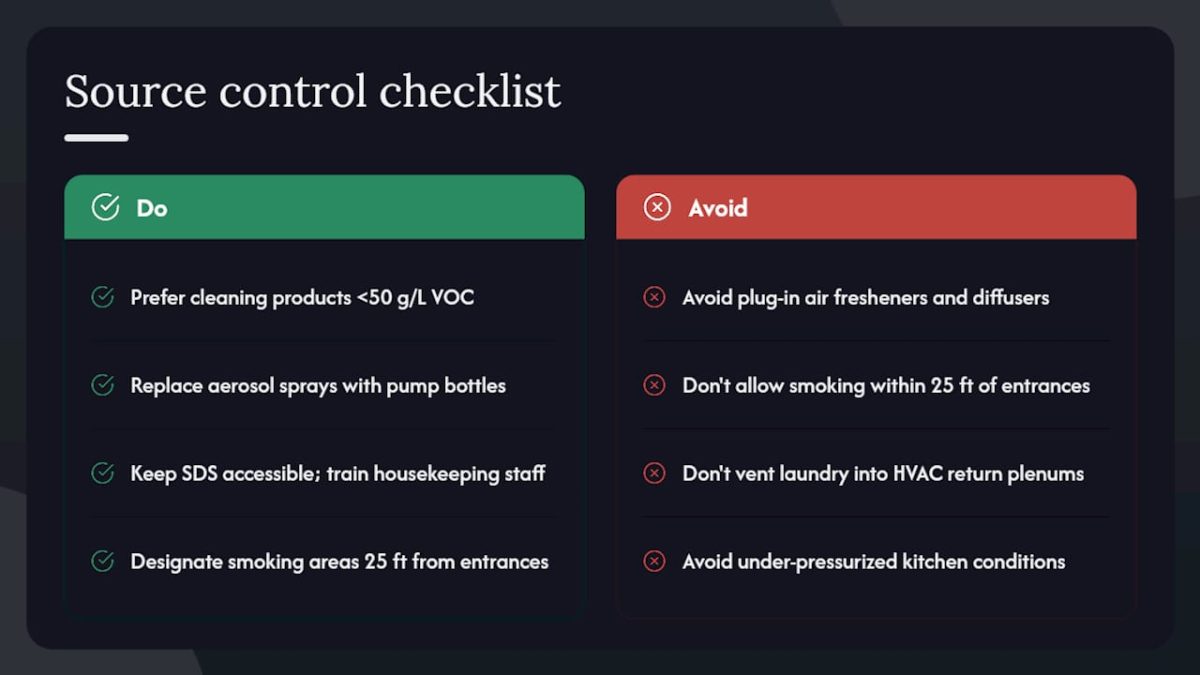
Switch your lobby cleaning program to low- or zero-VOC products. VOCs from cleaning products, paints, and adhesives cause acute symptoms including headaches and nausea at elevated concentrations, and lobbies are enclosed spaces where those concentrations can build quickly. Replace aerosol sprays with pump-spray bottles or pre-moistened wipes. Keep Safety Data Sheets (SDS) accessible for every product used in the lobby, and train housekeeping staff to check them before using any new product.
Scent diffusers and plug-in air fresheners are a source control problem disguised as a solution. Many commercial fragrance products contain phthalates and other VOCs. If your brand standard requires a signature scent, use a cold-air diffusion system with essential-oil blends that have been tested for VOC content, and keep concentrations low.
Kitchen and laundry emissions:
Verify that kitchen exhaust hoods are operating at design capacity and that makeup air is balanced. An under-pressurized kitchen will push cooking odors and grease-laden air into adjacent corridors and lobbies. Laundry facilities should vent directly to the exterior, not into shared HVAC return plenums.
Smoking policy:
Designate outdoor smoking areas at least 25 feet from any entrance, fresh-air intake, or operable window. Post clear signage. Enforce the policy consistently, because a single guest smoking within 10 feet of the main entrance can push detectable particulate and VOC levels into the lobby within minutes.
Pro Tip: When evaluating new cleaning products for the lobby, ask your supplier for the product’s VOC content in grams per liter. Products below 50 g/L are generally considered low-VOC for cleaning applications. This single procurement criterion can cut your lobby’s chemical VOC load significantly without changing your cleaning protocols.
Real-time monitoring: CO2, PM2.5, humidity sensors and BAS integration
Sensor-driven IAQ management is where the biggest operational gains are. Moving from reactive complaints to proactive data changes how your team responds to air quality problems.
What to monitor and where:
| Sensor Type | Recommended Location | Actionable Threshold |
|---|---|---|
| CO2 | 4–5 feet high, near peak occupancy zone (check-in desk, seating cluster) | >800 ppm: increase ventilation; >1,000 ppm: maximum outdoor air |
| PM2.5 | Near main entrance and return air grille | >12 µg/m³ sustained: activate portable purifiers; >35 µg/m³: close outdoor dampers |
| Relative Humidity | Central lobby and near HVAC supply | <35% or >55%: adjust HVAC set points or deploy dehumidifier |
| VOC (optional) | Near renovation zones or post-cleaning | Elevated baseline: extend post-cleaning ventilation cycle |
Connecting sensors to your building automation system (BAS) or building management system (BMS) turns data into automatic responses. When CO2 crosses 1,000 ppm, the BAS opens outdoor air dampers. When PM2.5 spikes, it can trigger portable purifier activation or switch the AHU to recirculation. This shift from fixed schedules to occupancy-driven control reduces both stale-air complaints and energy costs.
Calibrate CO2 sensors every 6–12 months using a known reference gas or a factory calibration kit. PM2.5 sensors should be cleaned and verified against a reference instrument annually. Log all calibration events in your maintenance records.
Pro Tip: Export your sensor data to a simple spreadsheet weekly and review it before your monthly engineering meeting. Patterns, such as CO2 spiking every Tuesday at 10 AM during group check-in, are invisible without a log but obvious once you see the trend line.
Write an IAQ plan and train staff on what to do
An IAQ plan does not need to be a 40-page document. It needs to be specific enough that a new housekeeping supervisor can read it and know exactly what to do on their first shift.
Core IAQ plan elements:
- Objectives: Specific, measurable targets (CO2 below 1,000 ppm during occupied hours; RH 35–55%; no persistent odor complaints).
- Metrics and monitoring: Who checks sensors, how often, and where readings are logged.
- Responsibilities: Named roles, not just job titles. Engineering owns HVAC maintenance; housekeeping owns cleaning product compliance; front desk owns guest complaint logging.
- Escalation path: What triggers a call to an HVAC contractor versus an internal fix.
- Vendor and contractor rules: Approved cleaning product list, filter specifications, and approved IAQ contractors.
Daily and weekly staff actions:
- Morning walkthrough (before 7 AM): check supply diffusers for dust, note any odors, confirm portable purifiers are running.
- Check CO2 and PM2.5 readings at the start of peak check-in and check-out windows.
- Housekeeping coordinator confirms that only approved low-VOC products were used in the lobby during the previous 24 hours.
- Weekly: engineering inspects filter condition and logs pressure-drop reading; housekeeping reviews any guest air quality complaints from the past week.
Guest communication:
If you have real-time IAQ sensors, consider a small lobby display showing current CO2 and PM2.5 readings. Guests increasingly notice and appreciate this transparency, particularly post-pandemic. Keep messaging factual: “Current air quality: Good. CO2: 680 ppm.” Avoid marketing language on the display.
Pro Tip: Embed IAQ checks into your existing pre-shift inspection form rather than creating a separate checklist. A check that lives inside a workflow people already do gets done. A standalone IAQ form gets skipped.
Practical odor fixes and when to hire a professional
Most lobby odors have a traceable source. Find the source, eliminate it, and the odor goes away. The problem is when the source is embedded in materials, HVAC systems, or building structure.
In-house fixes that work:
- HVAC coil and drip pan cleaning resolves the majority of musty or earthy odors from supply air.
- Targeted portable HEPA purifiers with activated carbon filters address residual smoke and VOC odors in specific zones.
- Replacing heavily soiled soft furnishings (lobby sofas, rugs) that have absorbed years of foot traffic odors.
- Reviewing and eliminating synthetic fragrance products that mask odors rather than removing them.
For a broader look at common hotel odor sources and elimination workflows, the pattern is consistent: source identification first, then targeted treatment.
Red flags that indicate a professional is needed:
- Tobacco or smoke odor that returns within 24–48 hours of cleaning, indicating the compound has penetrated porous surfaces.
- Mold smell from supply air despite clean coils and drip pans, suggesting contamination deeper in the duct system.
- Chemical off-gassing odor persisting more than two weeks after a renovation, pointing to materials that need encapsulation or removal.
- Pet odor in lobby areas adjacent to pet-friendly rooms, where dander and urine compounds have migrated through shared HVAC.
What to expect from a professional odor remediation service:
A credible provider will start with an inspection, not a treatment. They should identify the source, propose a targeted method, and provide written documentation of the treatment and post-treatment verification. Ask these questions before hiring:
- What specific method do you use, and does it involve ozone or chlorine? (Both can leave residual chemical issues and are not appropriate for occupied hospitality spaces.)
- Can you provide before-and-after air quality readings?
- Do you carry liability insurance and any green or eco-certification?
- What is your guarantee if the odor returns within 30 days?
Typical costs and realistic timelines for the main interventions
Budget planning is where good IAQ intentions stall. Here is a realistic cost and timeline framework for the interventions covered in this guide.
| Intervention | Typical Cost Range | Timeline | Priority |
|---|---|---|---|
| Filter upgrade (MERV 11–13, lobby AHU) | $50–$100 per filter set | 1–3 days | High / immediate |
| Portable HEPA purifier (commercial grade) | $400–$700 per unit | 1–7 days | High / immediate |
| CO2 + PM2.5 sensor kit | $150–$600 per sensor | 1–7 days | High / immediate |
| Low-VOC cleaning product switch | $0–$200 incremental | 1–2 weeks | High / immediate |
| BAS sensor integration | $2,000–$5,000 per zone | 4–12 weeks | Medium / short-term |
| HVAC coil and drip pan cleaning | $500–$2,000 per AHU | 1–2 weeks | High / short-term |
| Professional duct cleaning (lobby zone) | $1,000–$3,000 | 2–4 weeks | Medium / as needed |
| Professional odor remediation | $800–$2,000 | 1–5 days | As needed |
| Air curtain installation | $1,000–$5,000 | 2–6 weeks | Medium / capital |
Staging guidance:
- Start with filter upgrades, portable purifiers, and sensor deployment. These three actions cost under $2,000 combined for most lobbies and deliver measurable results within days.
- Schedule HVAC coil cleaning and drip pan service during the next low-occupancy window, typically a weekday morning.
- Plan BAS integration and air curtain installation as capital projects for the next budget cycle.
- Keep the lobby fully operational during all short-term interventions. For duct cleaning or major HVAC work, schedule overnight or early-morning windows and use portable purifiers to maintain air quality during the work period.
Daily, weekly, monthly, and annual IAQ maintenance checklist
Daily (assign to morning housekeeping supervisor and engineering on-call):
- Visual check of all supply diffusers and return grilles for dust accumulation or discoloration.
- Confirm all portable HEPA purifiers are powered on and running at the correct speed setting.
- Odor walkthrough: note any unusual smells near HVAC vents, restrooms, or seating areas.
- Check drip pan access panel on lobby AHU for standing water.
- Log any guest air quality complaints from the previous 24 hours.
Weekly:
- Engineering inspects lobby AHU filter and records pressure-drop reading.
- Housekeeping coordinator confirms cleaning product compliance (no unapproved aerosols used in lobby).
- CO2 and PM2.5 spot check during peak check-in window; log readings.
- Review portable purifier filter indicator lights; replace pre-filters if indicated.
Monthly/quarterly:
- Full sensor calibration check; compare CO2 sensor reading against a reference or known outdoor baseline.
- HVAC coil visual inspection; schedule cleaning if fouling is visible.
- Humidity control review: compare average RH readings to the 35–55% target and adjust set points if needed.
- Pressure-drop audit across all lobby AHU filters; replace any that exceed manufacturer threshold.
- Review maintenance log for any recurring issues (repeated drip pan water, recurring odor complaints) and escalate to contractor if pattern persists.
Annual:
- Full duct inspection with borescope camera; schedule hygienic cleaning if contamination is found.
- HVAC performance test: measure supply air temperatures, airflow volumes, and static pressure against design specs.
- Review and update the written IAQ plan, including vendor contracts and approved product list.
- Test CO and radon levels if the lobby is at or below grade, or if combustion equipment is nearby. The EPA recommends testing for radon in ground-floor and below-grade spaces, particularly in regions with elevated geological radon potential.
Pro Tip: A two-hour inspection cycle for public restrooms adjacent to the lobby and a twice-daily lobby walkthrough before morning and evening peaks are the operational cadence that catches IAQ issues before guests do. Build both into your pre-shift checklist, not a separate form.
IAQ in hotels is infrastructure, not housekeeping
Most hotel IAQ programs fail not because managers lack information but because accountability is fragmented. Engineering owns the HVAC. Housekeeping owns the cleaning products. Procurement owns the furnishings. Nobody owns the air.
The properties that get this right treat IAQ as infrastructure, the same way they treat fire safety or elevator maintenance. There is a written plan, named owners for each metric, a maintenance log that gets reviewed monthly, and a budget line that does not disappear when occupancy drops. The investment pays back in guest satisfaction scores, staff retention (housekeeping staff are the most exposed to poor lobby air), and brand protection. A single viral guest review about a “chemical smell” or “musty lobby” can cost more in lost bookings than a year of sensor subscriptions and filter upgrades.
The other thing most articles get wrong: they treat odor management as separate from IAQ management. They are the same problem. A lobby that smells stale or chemical has an IAQ problem, whether the sensor readings confirm it or not. Guest perception is the real metric, and it is shaped by both measured pollutants and unmeasured odor compounds that sensors do not always catch. That is why source control, professional remediation for embedded odors, and real-time monitoring all belong in the same operational plan.
When persistent lobby odors need professional eco-friendly remediation
Filtration upgrades and cleaning protocol changes handle the majority of hotel lobby IAQ issues. But when tobacco smoke, mold, pet compounds, or post-renovation off-gassing have bonded to porous surfaces, no amount of filter swapping will resolve the problem.

Masterodorremoval specializes in exactly this scenario: persistent odors in hospitality environments that have resisted standard cleaning. The approach is inspection-first, treatment-second, with eco-friendly, green-certified methods that use no ozone and no chlorine, so the lobby is safe for guests and staff immediately after treatment. Every service includes post-treatment verification and written documentation, which matters when you need to show ownership or a health inspector that the problem was actually resolved, not just masked.
For hotel managers dealing with embedded smoke odors, mold smells after a water event, or chemical off-gassing after a renovation, Masterodorremoval offers same- or next-day service for commercial properties. The commercial odor removal service covers lobbies, common areas, and adjacent spaces as a single treatment scope.
Before hiring any odor remediation provider, ask for proof of green certification, a written treatment plan, and post-treatment air quality readings. Masterodorremoval provides all three. Contact the team directly to schedule an inspection and get a scope-specific quote for your property.
Sources
The following authoritative references provide the standards, guidance, and technical specifications referenced throughout this guide.
- How to Enhance Indoor Air Quality in Hotels
- Improving Indoor Air Quality — EPA
- Florida Green Lodging Program Best Management Practice: Indoor Air Quality
- Hotel indoor air quality management
- Volatile organic compounds (VOCs) | American Lung Association
Recent Comments