
A single room with light smoke exposure typically runs $200 to $1,200 to treat. Multi-room jobs land between $600 and $3,600, and whole-house or fire-related remediation climbs to $2,000 to $12,000 or more, according to Bob Vila’s cost breakdown. The reason costs swing so widely isn’t just square footage alone. It’s whether smoke has soaked into ductwork, drywall, and fabric, or stayed on the surface. Get a walkthrough inspection before you assume the low end applies to you.
Key Takeaways
Smoke odor removal cost depends far more on whether HVAC ducts and porous materials were treated than on the square footage of the affected space.
| Point | Details |
|---|---|
| Know your price band | Minor jobs run $200 to $1,200, multi-room $600 to $3,600, whole-house $2,000 to $12,000 or more. |
| Duct cleaning is often mandatory | Skipping HVAC treatment when smoke traveled through vents is the top cause of repeat odor within months. |
| Multi-stage treatment beats one-and-done | Clean, deodorize, and seal or repaint in sequence rather than expecting a single pass to fix set-in smoke. |
| Insurance covers events, not habits | Fire-related smoke damage is typically covered; years of cigarette odor usually is not. |
| Choose a licensed, green-certified provider | Masterodorremoval skips ozone and chlorine, uses occupant-safe methods, and offers same or next-day inspections. |
Table of Contents
- Smoke Odor Removal Cost by Scenario
- What Actually Drives the Price Up or Down
- Which Removal Method Costs What?
- Can You Remove Smoke Odor Yourself First?
- Does Homeowners Insurance Cover Smoke Damage?
- What a Licensed, Green-Certified Inspection Looks Like
- What the Cost Data Actually Tells You
- Ready to Get an Exact Quote?
- Frequently Asked Questions
- Sources
Smoke Odor Removal Cost by Scenario
Most homeowners want to know one thing first: which price band fits their situation? Here’s how the ranges actually break down once you factor in scope and severity.
A single room hit by a short-term event, like a grease fire or brief smoking, usually costs a moderate amount for focused deep cleaning plus deodorization passes. If the smell has not penetrated deeply into walls or carpet, costs tend to be on the lower side.
Multi-room jobs get pricier fast. Once smoke has traveled through a hallway or shared HVAC return, costs for three or more rooms often fall into a higher range, according to HomeGuide’s remediation cost data. This is where duct cleaning typically becomes standard.
Whole-house remediation after a structure fire or years of heavy indoor smoking sits at $2,000 to $12,000 and up. Angi’s national data puts the average smoke remediation job near $3,000, but that number hides enormous variance. A single-story ranch with light odor costs far less to treat than a two-story home where smoke has migrated into every supply vent.
A few things shift these numbers regardless of size:
- Homes in humid climates (the Gulf Coast, the Southeast) often need extra dehumidification steps that add to labor time.
- Older homes with plaster walls or original hardwood tend to trap odor more stubbornly than newer drywall construction.
- Vacant properties awaiting sale usually get treated faster and cheaper since there’s no furniture or personal belongings to work around.
Regional labor rates matter too. A job quoted at $1,500 in a smaller Midwest market might run $2,200 for the same scope in a coastal metro. Treat every figure here as a planning range, not a quote, and confirm with a local inspection before budgeting a final number.
What Actually Drives the Price Up or Down
Two houses with identical square footage can get wildly different quotes for smoke odor removal cost, and the gap almost always comes down to a handful of specific factors contractors price line by line.
Smoke chemistry and material porosity. Soot particles bond chemically with fabric, drywall, and unsealed wood. HomeAdvisor’s restoration guidance notes that surface wiping does almost nothing once smoke has penetrated porous materials. That’s the difference between a $300 cleaning and an $1,800 remediation with sealing.
HVAC and duct involvement. If smoke traveled through your return air system, expect duct cleaning added to the estimate at $150 to $800, per American Family Insurance’s cost data. Skip this step and the smell often returns within weeks, because every time the furnace kicks on it recirculates residue coating the ducts.
Other line items that show up on itemized quotes:
- Carpet replacement when deodorizing fails: roughly $785 to $2,805+ depending on square footage and material.
- Repainting with a stain-blocking primer: $400 to $3,000, scaling with the number of rooms and ceiling height.
- Access complexity: attics, finished basements, and multi-level homes take longer to treat and often carry a labor surcharge.
Our guide to tobacco smoke residue removal walks through how deeply nicotine and tar bind to interior surfaces compared to other odor sources.
Pro Tip: Ask any contractor for a written, itemized quote before work starts. A vague one-line “smoke treatment” estimate almost always means duct cleaning or sealing will show up as a surprise add-on later.
Which Removal Method Costs What?
Contractors rarely rely on one technique. Most jobs combine two or three methods, and knowing what each one costs helps you sanity-check a quote instead of just trusting the total.
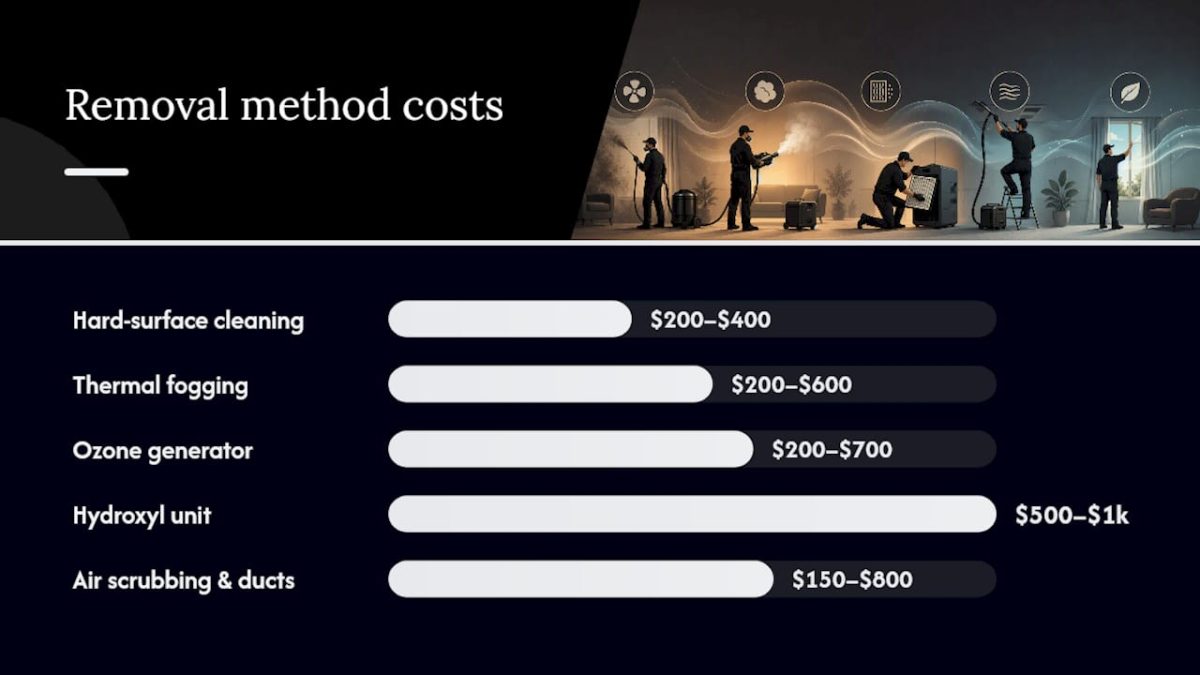
Hard-surface deep cleaning covers walls, cabinets, hard flooring, and trim using enzymatic or solvent-based cleaners. This runs $200 to $400 or more and forms the baseline of almost every job, according to HomeGuide’s per-method breakdown.
Thermal fogging treats fabric, upholstery, and textiles that cleaning solutions can’t reach. A heated fog carries deodorizing agents into the same fibers where smoke particles settled, and it typically costs $200 to $600 per room or area.
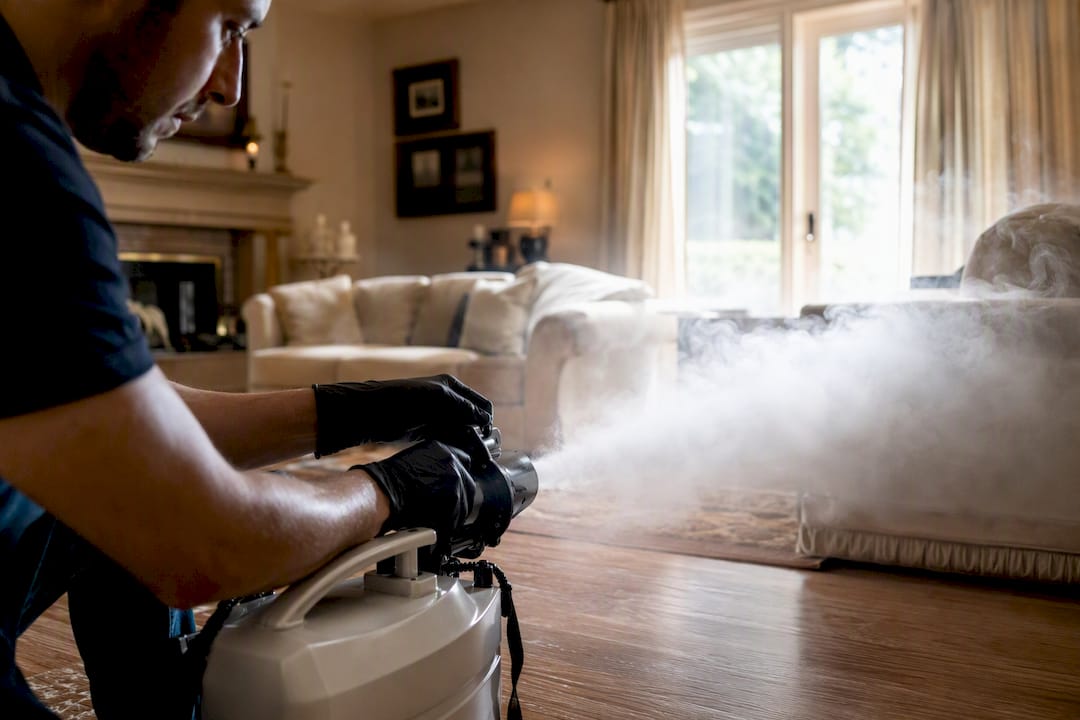
Ozone generators and hydroxyl units handle airborne and deeply embedded odor. Ozone runs $200 to $700 but requires the space to be unoccupied during treatment because it’s a lung irritant at effective concentrations. Hydroxyl generators cost closer to $500 to $1,000 but can run safely with people and pets present, which matters if you can’t vacate the property for a few days.
Air scrubbing with HEPA filtration and duct cleaning round out most professional scopes, adding $150 to $800 depending on ductwork length and access.
The pattern worth remembering: clean first, deodorize second, seal or repaint last if needed. Skipping a stage to save money almost always means paying for a callback later, a point echoed across multiple industry sources tracking smoke remediation cost data. If your case involves a mix of surfaces, our page on smoke and marijuana odor removal across property types breaks down how method selection changes between cars, homes, and rentals.
Can You Remove Smoke Odor Yourself First?
Light, recent smoke odor sometimes responds to DIY effort, and trying the cheap route first is reasonable if the smell is mild.
- Wash hard surfaces with a vinegar-water solution or an enzymatic cleaner, then air out the space for 48 hours.
- Replace HVAC filters immediately. A clogged, smoke-saturated filter recirculates odor every time the system runs.
- Rent a portable air scrubber for a moderate daily cost to knock down lingering airborne particles.
Where DIY runs out of road: set-in smoke has usually bonded chemically with drywall and fabric fibers, and consumer-grade cleaners can’t break that bond. Watch for these red flags:
- The smell returns within a day or two of cleaning.
- You see visible soot staining on walls or ceilings.
- Odor is noticeable near vents or when the furnace or AC cycles on.
Any one of those means it’s time to call a professional rather than buy another bottle of odor spray.
Does Homeowners Insurance Cover Smoke Damage?
Insurance typically covers smoke remediation when it follows a covered event, like a kitchen fire or a neighboring structure fire, but not long-term cigarette odor from years of indoor smoking. Check your deductible before assuming coverage helps; a $1,000 deductible on a $1,500 job barely moves the needle.
Budget for follow-on costs insurance may or may not cover in full:
- Repainting and sealing: $400 to $3,000
- Carpet replacement: $785 to $2,805+
- HVAC repair or duct replacement: $300 to $1,200+
Document all damage with photos and get itemized contractor estimates. Adjusters respond far better to a line-item quote than a lump-sum number.
What a Licensed, Green-Certified Inspection Looks Like
Master Odor Removal’s technicians are licensed professionals who use green-certified methods and skip ozone and chlorine treatments entirely, relying instead on approaches safe for occupied homes and pets. That distinction matters more than most homeowners realize going in, since ozone requires evacuating the property and chlorine-based products can damage finishes and fabrics.
A typical engagement follows a consistent sequence:
- Inspection to map how far smoke has traveled through HVAC and porous surfaces.
- Targeted deep cleaning of affected materials.
- Deodorization matched to the material type and severity.
- A follow-up check to confirm the odor hasn’t resurfaced.
Pro Tip: A licensed inspection often catches HVAC contamination homeowners miss entirely, which is exactly the kind of oversight that turns a $600 job into a $2,000 repeat visit. Same-day and next-day scheduling is available for urgent cases like a pending home sale or a vehicle detail appointment, and treatments are tailored for luxury interiors through Master’s sustainable workflow for high-end assets.
What the Cost Data Actually Tells You
The conventional advice out there treats smoke odor removal like a single service with a single price tag. That’s misleading. The real driver isn’t the size of the house, it’s whether anyone addressed the HVAC system and porous materials during the first treatment. Skip that step to save $200 upfront, and you’re often looking at a second job within a year.
Homeowners consistently underestimate how much duct contamination alone accounts for repeat odor complaints. If you’ve had one treatment fail already, that’s the first place to look, not another round of the same surface cleaning that didn’t work the first time.
My honest read: pay for the inspection before you pay for the treatment. A $150 to $300 assessment that tells you exactly how far the smoke traveled is worth more than a discount quote that skips the diagnosis and guesses at scope. Green-certified methods aren’t just an environmental preference here either. Being able to stay in your home or keep pets in the space during hydroxyl treatment, instead of vacating for ozone, is a practical cost saver most people never factor into their budget.
Ready to Get an Exact Quote?
Every range in this guide gets more precise once someone actually walks your property. Masterodorremoval is the alternative to guessing at a DIY fix or hiring a contractor who skips the HVAC inspection: licensed technicians, green-certified methods with zero ozone or chlorine, and treatments built around your specific materials instead of a one-size-fits-all spray-and-hope approach.

Same-day and next-day availability means you’re not waiting a week just to find out what stage your problem is at. Whether you’re dealing with a single room, a full house, or a luxury interior with irreplaceable finishes, request an itemized odor removal estimate and get a real number instead of a guess. If you’re weighing timelines for a move-in date or a sale closing, check how long odor removal typically takes before you book, then reach out to schedule your inspection.
Frequently Asked Questions
How much does it cost to remove smoke smell from a house?
Whole-house smoke odor removal typically costs $2,000 to $12,000 depending on severity, according to Angi’s national cost data, while a single affected room usually runs $200 to $1,200.
How much does it cost to remove smoke smell from a car?
Car interior smoke treatment generally falls between $150 and $500, since the enclosed space is smaller but often requires fabric-penetrating methods like thermal fogging for upholstery and carpet.
Does homeowners insurance pay for smoke odor removal?
Insurance usually covers smoke remediation tied to a covered fire event, but it typically excludes long-term odor from habitual indoor smoking. Check your policy’s deductible before assuming full coverage.
Can I remove smoke odor myself without hiring a professional?
Light, recent odor sometimes responds to vinegar cleaning, filter replacement, and a rented air scrubber for $100 to $300. Set-in smoke that has bonded with drywall or fabric usually needs professional-grade deodorization.
How long does professional smoke odor removal take?
Small rooms often finish in a single day, while whole-house jobs with duct cleaning and multiple deodorization passes can take three to seven days depending on scope and material replacement needs.
Sources
- Professional Cigarette Smoke Smell Removal: What to Expect
- How Much Does Smoke Remediation Cost? 2026 Data | Angi
- How Much Does Smoke Remediation Cost? (2026)
- Smoke damage repair & restoration cost guidance | HomeAdvisor
- How much is smoke remediation? | American Family Insurance
Recent Comments