
Use this checklist to vet, brief, and verify a professional eco-friendly odor-removal treatment for any commercial or hospitality property. The goal is permanent elimination using non-ozone, non-chlorine methods — not fragrance masking.
Quick sign-off checklist for on-site managers:
- Source identified and documented before any chemistry is applied
- Active waste, contaminated materials, and charred debris removed first
- Porous surfaces (carpet, upholstery, drapery) deep-cleaned or extracted
- HVAC/PTAC units inspected, coils cleaned, filters upgraded
- Targeted neutralization with approved, non-ozone formulations
- Activated carbon adsorption deployed for gaseous odor molecules
- Post-treatment olfactory walkthrough under normal HVAC operation
- Written warranty and signed client acceptance form in hand
Tick these eight items and you have a defensible, complete remediation on record.
Key Takeaways
Permanent commercial odor elimination requires source removal, material extraction, HVAC treatment, and adsorption in sequence — no single step and no fragrance alone produces a durable result.
| Point | Details |
|---|---|
| Inspect before treating | Require an odor map, moisture readings, and a written scope before any chemistry is applied. |
| Follow the correct sequence | Source removal → deep cleaning → HVAC/PTAC → neutralization/adsorption → verification. |
| Activated carbon is non-negotiable | HEPA removes particulates; only activated carbon adsorbs gaseous odor molecules. |
| Collect all compliance documents | SDSs, certificate of insurance, method statement, and signed verification form are required on every job. |
| Masterodorremoval | Licensed, green-certified provider offering non-ozone, non-chlorine remediation with a written guarantee and same- or next-day availability. |
Table of Contents
- What does a commercial building cleaning checklist cover for odor removal?
- Step-by-step treatment your crew should follow on-site
- What safety and compliance documents should you collect?
- How do you verify the job actually worked?
- What timelines and costs should you expect?
- What questions should you ask providers before hiring?
- Why green-certified methods matter more than most managers realize
- Masterodorremoval delivers permanent odor elimination for commercial properties
- Sources
What does a commercial building cleaning checklist cover for odor removal?
A proper commercial odor-removal checklist starts where most contractors skip: the inspection. Before any product touches a surface, the provider should hand you a written scope built from a structured site walk.
According to IEQ odor investigation standards, a reliable evaluation is a reverse-engineering process that includes building history, occupant interviews, pathway analysis, and hypothesis testing. That means your contractor should be asking staff when the smell first appeared, whether it tracks with the HVAC cycle, and whether it concentrates in specific zones.
What the pre-service inspection must include:
- Odor map: strongest locations, secondary zones, and any HVAC-linked spread patterns
- Timeline: when first reported, whether it is constant or intermittent
- Material inventory: carpet, upholstery, drapery, drains, HVAC/PTAC units, waste rooms, kitchens, and any recent water or fire damage
- Moisture meter readings on damp walls, subfloor, or ceiling tiles
- HVAC run-state observation: does the odor intensify when the system runs?
- Photo evidence of all problem areas before work begins
- Recommended treatment by area with an estimated timeline and disruption plan
Pro Tip: Require a “containment sketch” for any fogging or deep-treatment work. This diagram shows which adjacent spaces will be sealed or protected during application — without it, you have no way to verify the crew contained the chemistry.
Biofilm formation in drains, HVAC units, and sanitary areas is one of the most common drivers of persistent odors in hospitality settings. Moisture is the primary enabler. A contractor who skips moisture checks during the inspection is already working blind.
Step-by-step treatment your crew should follow on-site
The correct sequence is: source removal → material cleaning and extraction → HVAC/PTAC treatment → targeted neutralization and adsorption → verification. Any contractor who skips straight to fogging is masking, not remediating.
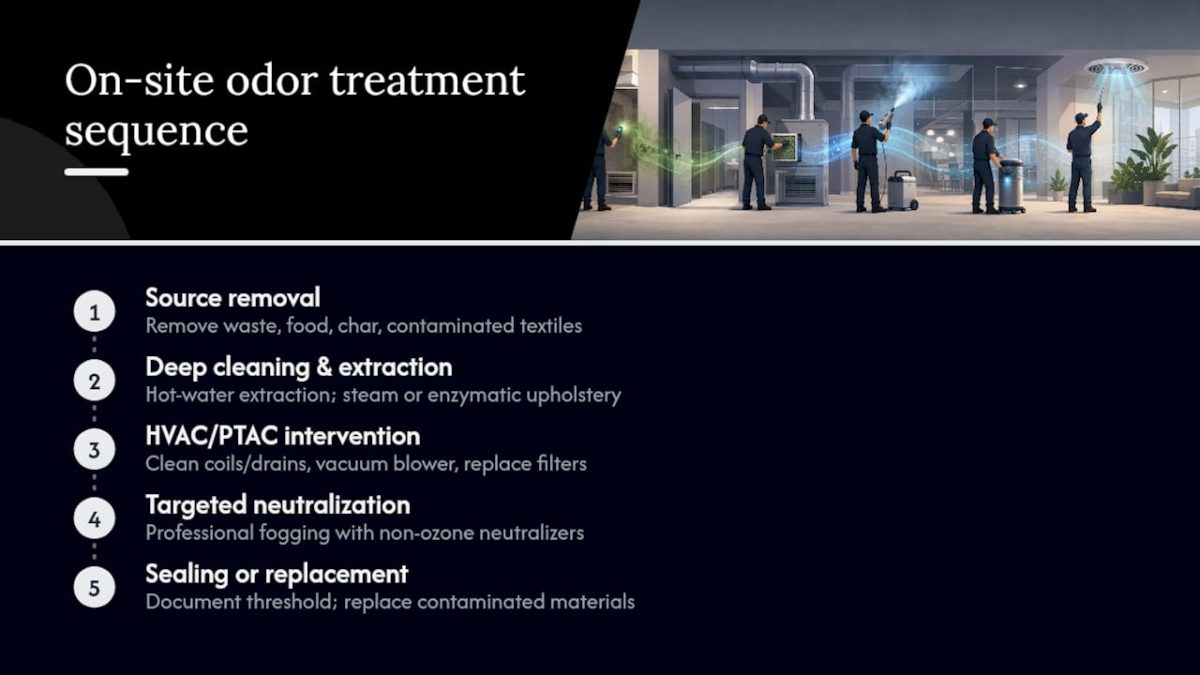
Step 1 — Source removal. Collect and remove active waste, food residues, charred materials, and contaminated textiles. Document chain-of-custody for any disposed items if your facility requires it.
Step 2 — Deep cleaning and extraction. Hot-water extraction for carpets, steam or enzymatic treatments for upholstery. Porous materials absorb volatile organic compounds and re-emit them long after the apparent source is gone, so surface cleaning alone rarely holds. Irreparably contaminated pad or insulation comes out.
Step 3 — HVAC/PTAC intervention. Clean coils and drain pans, vacuum blower wheels, verify cabinet interiors, and replace filters. Paired HEPA and activated carbon filtration is the standard: HEPA captures particulates, but activated carbon is what adsorbs gaseous odor molecules — HEPA alone will not touch them.
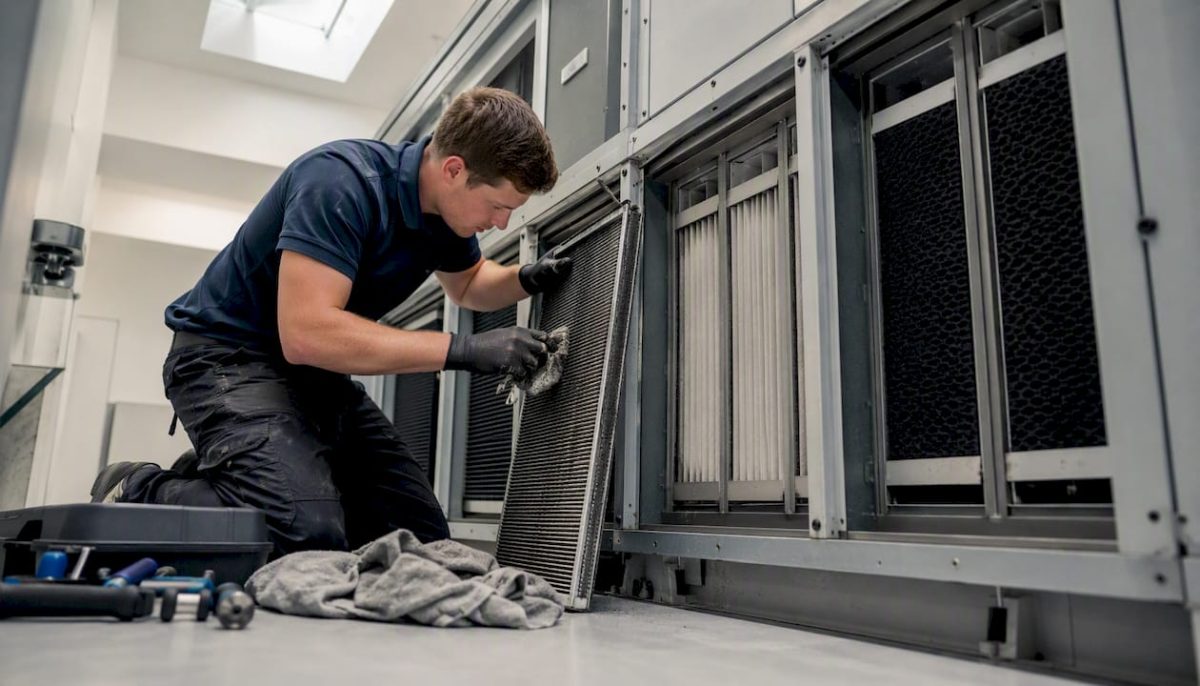
Step 4 — Targeted neutralization. Professional fogging with approved, non-ozone neutralizers reaches voids and fiber interiors that surface cleaning misses. Smoke remediation specifically requires HEPA vacuuming, wet cleaning, fogging into voids, and sometimes sealing or material replacement when residues persist. Avoid ozone generators and uncontrolled chlorine treatments in occupied or luxury interiors.
Step 5 — Sealing or replacement. When a material holds contamination after full treatment, document the threshold and replace rather than re-fog. Repeated fogging without replacement is a common failure mode, especially for smoke-saturated carpet pad or drapery lining.
Pro Tip: Require the crew to photograph each treated area and list every chemistry used — brand name and formulation — on the job ticket. That record protects you in any future audit or warranty dispute.
What safety and compliance documents should you collect?
Insist on safety data sheets (SDSs), proof of licensing and insurance, and a written method statement before any work begins. These are not optional paperwork — they are your legal protection if a guest or employee reports an adverse reaction.
Documents to collect before work starts:
- SDS for every product the crew will apply
- Certificate of insurance (general liability and workers’ compensation)
- Written scope of work and method statement
- Containment sketch for any fogging application
- Before photos of all problem areas
Documents to collect at job completion:
- After photos matched to before photos by location
- Completed verification checklist signed by the lead technician
- Written warranty terms with duration and coverage scope
- Job ticket listing all chemistries, concentrations, and dwell times
For chemistry compliance: confirm that formulations are non-ozone and non-chlorine where specified. When a provider makes biological or antimicrobial claims, ask for EPA registration numbers or manufacturer technical data to back them up.
Store all job tickets, warranties, and complaint logs by room or zone. For hotels and multi-unit properties, a recurring-problem room needs its own file so you can track whether treatments are holding.
How do you verify the job actually worked?
Verification starts with an olfactory walkthrough under normal HVAC operation — fan running, outside air at its standard setting. That condition matters because odors that hide when the system is off often reappear the moment airflow resumes.
Immediate post-treatment checks:
- Olfactory walkthrough of all treated areas with HVAC running
- Spot checks of treated surfaces for residue or re-emission
- Moisture re-checks on any previously damp materials
- HVAC run-state verification: confirm filters are seated and coils are dry
- Portable activated-carbon scrubbers in high-risk zones if needed
For objective verification, pre/post filter weight logs and change records are practical and defensible. Third-party IAQ sampling for VOCs is an option in high-stakes situations, but results need professional interpretation — use it selectively.
A 48–72 hour follow-up window catches rebound events that reveal incomplete source removal or hidden moisture. For high-risk areas — tobacco-saturated rooms, kitchens with grease buildup, or spaces with prior water damage — add a 30-day recheck to the warranty terms.
Maintenance plan to prevent recurrence:
- Scheduled drain and trap cleaning (monthly in kitchens and wet areas)
- Filter-change cadence for HEPA and activated carbon units (per manufacturer spec, not calendar convenience)
- Documented linen and soft-furnishing replacement cycles
- Complaint-tracking log by room with date, odor type, and action taken
For a full odor-free workspace maintenance schedule, build these items into your facility maintenance rounds rather than treating them as one-off responses.
What timelines and costs should you expect?
Cost and timeline are driven by four variables: source intensity, material replacement needs, HVAC complexity, and square footage. Get those four scoped before you approve any estimate.
Typical time frames:
- Single-room treatment (light to moderate odor): 4–8 hours including dwell and ventilation
- Multi-room or stack treatments: same-day per unit or 1–3 days
- Large-system remediation with HVAC work: several days to a week
Cost drivers to check on every quote:
- Labor hours by phase (inspection, cleaning, fogging, verification)
- Equipment: foggers, HEPA scrubbers, activated carbon units
- Material removal and disposal fees
- HVAC access, coil cleaning, and filter upgrades
- After-service verification and follow-up visits
Layered remediation combining deep cleaning, HVAC intervention, and adsorption delivers more durable odor control than single-step or fragrance-only approaches. The upfront cost is higher, but repeat-service calls drop significantly. A fragrance-only treatment that needs redoing every 60 days costs more over a year than a single thorough remediation.
Require itemized estimates. A lump-sum quote with no line items is a red flag — you cannot verify what you are paying for or hold the contractor to a specific scope.
What questions should you ask providers before hiring?
Start by requesting a written scope that lists the exact steps the contractor will take: documented source removal, deep-cleaning methods, HVAC work, and verification. If they cannot produce that in writing before the job, they are not ready to do the job.
Essential questions:
- Are you licensed and insured? (Request certificates before scheduling.)
- What specific chemistries and concentrations will you use on each surface type?
- Can you provide SDSs for every product before work begins?
- Do you guarantee results, and what does the warranty cover and for how long?
- Are your methods green-certified and free of ozone and chlorine?
- Can you provide references from hospitality or luxury-property jobs?
Red flags that should stop the hire:
- Reliance on fragrance sprays or scent diffusers as the primary treatment
- Refusal to share SDSs or a written method statement
- Recommendation to use ozone generators in occupied or sensitive spaces
- No written warranty or guarantee
- Vague claims about “instant permanent” results with no documented process
- No prior experience with commercial or hospitality properties
A reliable odor-management strategy begins with source identification and correction — repairs, cleaning, ventilation — and uses neutralization equipment only after source control is complete. Any provider who leads with the fogger is selling you the shortcut.
Why green-certified methods matter more than most managers realize
Licensed technicians who work in hospitality and luxury interiors favor source removal and adsorption over masking for a practical reason: fragrances can trigger complaints in sensitive venues just as reliably as the original odor. A guest who reports a “chemical smell” after treatment is a liability, not a success.
Smoke residue in luxury textiles is a good example of where this plays out. The instinct is to fog repeatedly until the smell is gone. The better call, when residue is deeply embedded, is selective component replacement — pull the drapery lining or carpet pad, replace it, and treat the substrate. Repeated fogging without replacement often fails because the chemistry cannot penetrate deeply enough to reach all the bound residue.
Masterodorremoval’s approach is built around licensed professionals, green-certified chemistry, and documented experience with hospitality and luxury properties. The combination of non-ozone, non-chlorine methods with a structured verification process is what separates a permanent result from a temporary fix.
Masterodorremoval delivers permanent odor elimination for commercial properties
When a room needs to be back in service fast and the result has to hold, Masterodorremoval provides eco-friendly, non-ozone, non-chlorine professional odor elimination for commercial buildings, hotels, offices, and hospitality interiors. Same- or next-day availability, licensed professionals on every job, and a written satisfaction guarantee mean you are not waiting or guessing.

Every engagement includes a written scope, SDSs for all products used, before-and-after documentation, and a post-service verification checklist delivered with the invoice. One-time remediation or ongoing maintenance contracts are both available. To request a site inspection and itemized quote, visit the commercial odor removal page or reach out directly to schedule.
Sources
- Hygieneforum
- How commercial odor control Supports Cleaner and More Comfortable Properties – Lightningidea
- How to Get Rid of Odor in Commercial & Hospitality Spaces
Recent Comments