
TL;DR:
- Musty odors in hotel basements result from MVOCs produced by mold and bacteria growing in high humidity conditions. Addressing moisture sources like leaks, seepage, and condensation is essential before applying odor control measures. Regular inspections and moisture management prevent recurrent basement odors and enhance guest satisfaction.
Musty smell in hotel basements is defined by the presence of microbial volatile organic compounds (MVOCs), gases released when mold, mildew, and bacteria break down organic materials in damp, poorly ventilated spaces. Hotel basements are particularly vulnerable because they combine cool concrete surfaces, limited airflow, and constant moisture exposure from plumbing, laundry operations, and ground seepage. The EPA and ASHRAE both set indoor relative humidity targets at 30–50% RH. When basement humidity climbs past 60%, biological growth accelerates and musty odors intensify sharply. Understanding the root causes is the first step toward protecting guest experience and facility hygiene.
What causes musty smell in hotel basements at the biological level?
The musty odor guests and staff detect is not mold itself. It is MVOCs becoming volatile as mold, mildew, and bacteria metabolize organic materials like wood framing, drywall paper, stored cardboard, and dust. These gases are detectable by the human nose before any visible mold colony appears on a surface. That is why a basement can smell strongly musty with no obvious discoloration on walls or floors.

Different mold species produce distinct MVOC profiles, which is why musty odors vary in character. Aspergillus and Penicillium species produce earthy, soil-like smells. Stachybotrys (commonly called black mold) tends toward a heavier, more pungent odor. The variation matters for diagnosis: a sharp, acrid smell often signals a different species or a secondary source like sewer gas rather than typical basement mold.
Humidity above 60% RH is the critical biological trigger. Mold spores germinate within 24–48 hours of sustained exposure to that threshold. Below 50% RH, most mold species cannot complete their growth cycle. This is why ASHRAE Standard 62.1 and EPA guidance both target the 30–50% RH range as the safe operating band for occupied buildings.
- MVOCs are the actual odor compounds, not mold spores themselves.
- Germination threshold: sustained RH above 60% for 24–48 hours.
- Odor precedes visibility: smell appears before surface mold is visible.
- Species variation: different molds produce different odor profiles.
- ASHRAE and EPA standard: 30–50% RH for occupied indoor spaces.
Pro Tip: Install a data-logging digital hygrometer in your basement and set an alert at 55% RH. Catching the rise before it hits 60% gives you a window to act before mold germination begins.
What moisture sources drive moldy odors in hotel basements?
Excess moisture enters hotel basements through several distinct pathways, and identifying the correct one determines the right fix.
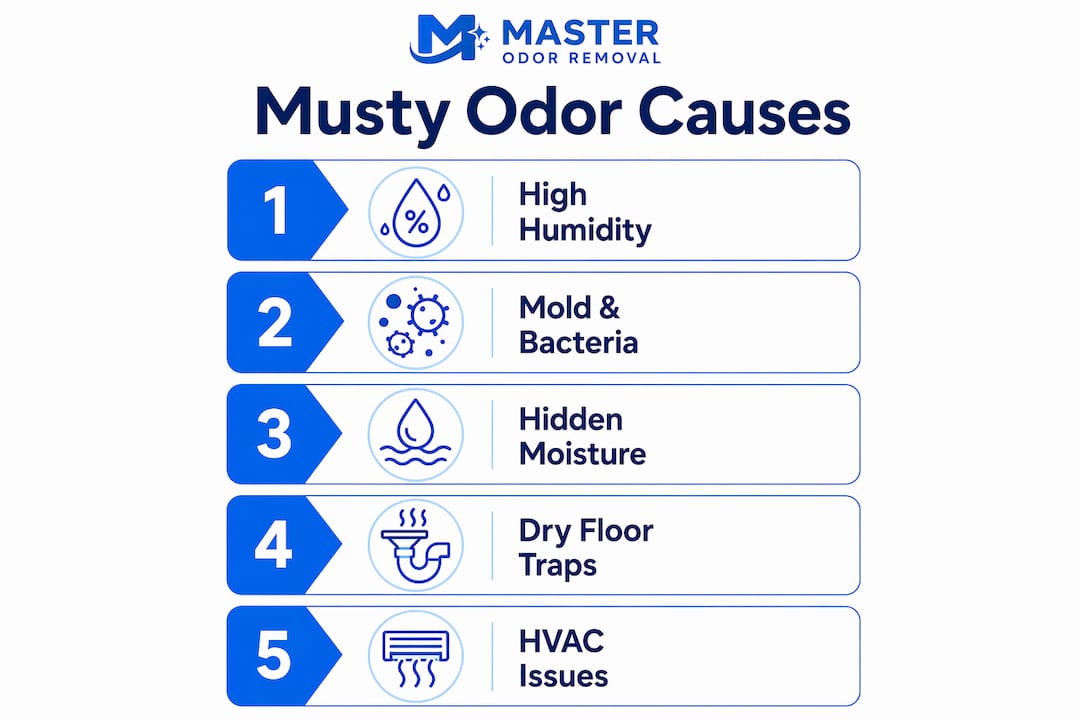
Condensation on cool concrete. Warm, humid air contacts basement walls and floors that stay around 50–55°F. Moisture deposits on cold surfaces create a continuously damp film that feeds mold growth. This is the most common cause in summer months when outdoor humidity is high.
Foundation seepage and cracks. Hydrostatic pressure from saturated soil forces water through porous concrete and hairline cracks. Poor exterior drainage and negative soil grading (ground sloping toward the building) worsen this significantly.
Clogged gutters and downspouts. When gutters overflow, water saturates the soil directly against the foundation. This is a structural drainage problem that no amount of interior dehumidification will correct.
Trapped moisture in materials. Fiberglass insulation, drywall, stored linens, cardboard boxes, and unfinished wood framing all absorb and hold moisture. Once saturated, these materials become long-term mold substrates even after surface humidity drops.
Slow plumbing leaks. A dripping pipe fitting behind a wall can saturate framing and insulation for months before detection. The leak is often too slow to pool visibly but sufficient to sustain mold growth.
Dry floor drain traps. Infrequently used floor drains lose their water seal, allowing sewer gases to enter the basement. This is a distinct odor source but is frequently misidentified as mold.
| Moisture source | Primary cause | Typical fix |
|---|---|---|
| Condensation | Warm air on cool surfaces | Dehumidification, insulation |
| Foundation seepage | Hydrostatic pressure, cracks | Waterproofing, exterior grading |
| Plumbing leaks | Pipe fittings, joints | Leak detection, repair |
| Dry floor drains | Evaporated P-trap water | Refill trap with water |
| Stored materials | Absorbed ambient humidity | Remove, dry, or discard |
Seasonal weather patterns amplify all of these sources. Spring snowmelt and summer humidity spikes are the two periods when hotel maintenance teams should increase inspection frequency.
How do you diagnose the source of musty odors in hotel basements?
Effective diagnosis requires measurement, not guesswork. Start with a digital hygrometer and take readings in at least four locations: near the HVAC unit, at the perimeter walls, near any floor drains, and at the center of the space. Readings above 60% in any zone confirm a moisture problem in that area.
Visual inspection follows measurement. Look for efflorescence (white mineral deposits on concrete walls), bubbling or peeling paint, and any soft or discolored drywall. These are reliable indicators of water moving through or condensing on surfaces. Efflorescence specifically signals active seepage rather than condensation.
For hidden dampness, a pinless moisture meter is the right tool. Press it against drywall, wood framing, or insulation to detect elevated moisture content without cutting into walls. Readings above 16% moisture content in wood framing indicate conditions favorable for mold growth.
The foil tape test distinguishes condensation from seepage. Tape a 12-inch square of aluminum foil to a suspect wall, seal all edges, and leave it for 24 hours. Moisture on the exposed (room-facing) side confirms condensation from humid air. Moisture behind the foil confirms water seeping through the wall. The fix for each is completely different.
- Digital hygrometer: measure RH in multiple zones, flag anything above 60%.
- Visual signs: efflorescence, peeling paint, soft drywall, visible staining.
- Pinless moisture meter: detect hidden dampness in walls and framing.
- Foil tape test: identify condensation vs. active seepage.
- Odor intensity mapping: walk the space and note where the smell peaks. The strongest zone is closest to the growth source.
- HVAC check: inspect condensate pump reservoirs and drain lines for biofilm.
- Floor drain check: pour water into each drain to confirm the P-trap is sealed.
Pro Tip: Do your odor intensity walk-through early in the morning before HVAC systems have been running for hours. Fresh air circulation from overnight operation can dilute and redistribute odors, making the source harder to locate.
| Diagnostic tool | What it detects | Action threshold |
|---|---|---|
| Digital hygrometer | Relative humidity | Above 60% RH |
| Pinless moisture meter | Material moisture content | Above 16% in wood |
| Foil tape test | Condensation vs. seepage | Moisture on either side |
| Visual inspection | Surface damage, efflorescence | Any visible sign |
| Odor intensity walk | Growth zone location | Strongest odor zone |
What are the hidden causes of persistent musty smells in hotel basements?
Some basement odor sources resist standard inspection because they are inside systems, not on surfaces. HVAC condensate pump reservoirs accumulate stagnant water and develop biofilm that spreads musty odors through the ductwork and into connected spaces. A basement that smells fine at floor level but has a persistent odor near supply vents often points directly to this source.
Dry floor drain traps are the most commonly misdiagnosed cause of basement odors in hotels. When a P-trap dries out, sewer gas enters the space. Sewer gas smells different from mold: it has a sulfurous, rotten-egg quality rather than an earthy, damp character. Refilling the trap with water resolves the odor immediately if that is the source. Many facilities spend money on mold remediation when a cup of water would have solved the problem.
Uninsulated rim joists (the framing at the top of the foundation wall where the floor system meets the concrete) create cold perimeter zones where warm interior air condenses. This is a structural cold bridge that generates continuous moisture along the entire perimeter of the basement. The resulting mold growth hides behind insulation or inside wall cavities where it is rarely inspected.
Hidden microbial growth inside wall cavities, beneath flooring, and behind baseboards produces MVOCs that travel through gaps and penetrations into the open basement air. The growth itself may be completely invisible during a standard visual inspection. This is why odor persistence after surface cleaning almost always signals a hidden reservoir.
- HVAC condensate pumps: biofilm in reservoirs spreads odors through ducts.
- Dry P-traps: sewer gas mimics mold odor; fix costs nothing.
- Uninsulated rim joists: cold bridges create perimeter condensation.
- Hidden wall cavity growth: invisible mold produces detectable MVOCs.
- Micro-leaks: slow drips saturate materials without visible pooling.
Pro Tip: Smell the air directly at HVAC supply registers and compare it to ambient basement air. If the odor is stronger at the register, the source is inside the system, not on the basement surfaces.
What are the effective remediation steps to remove musty smell from hotel basements?
Remediation must follow a specific sequence. Skipping steps wastes money and allows odors to return.
Fix active water intrusion first. Dehumidifiers alone cannot resolve musty odors when liquid water is actively entering the space. Address foundation cracks, improve exterior grading, and clear gutters before any other step.
Correct exterior drainage. Soil should slope away from the building at a minimum grade. Downspout extensions should discharge water at least 6 feet from the foundation.
Seal and insulate rim joists. Use rigid foam board cut to fit between floor joists at the perimeter, sealed with spray foam. This eliminates the cold bridge and stops perimeter condensation.
Refill all floor drain traps. Pour water into every floor drain in the basement. For drains that dry out repeatedly, add a small amount of mineral oil to slow evaporation.
Service HVAC condensate pumps. Clean the reservoir with a diluted bleach solution, flush the drain line, and inspect for biofilm. Schedule this as a quarterly maintenance task.
Deploy dehumidification after fixing sources. Target below 50% RH consistently. A properly sized commercial dehumidifier with a direct drain connection is more reliable than a portable unit with a collection bucket. Improving indoor air quality through balanced ventilation and air exchange accelerates drying and reduces MVOC concentration.
Increase air exchange. Mechanical ventilation that brings in conditioned outside air and exhausts stale basement air reduces MVOC buildup. Check that humidity management through HVAC is calibrated for basement zones specifically, not just upper floors.
Conduct routine inspections. Schedule monthly hygrometer readings and quarterly visual inspections. Log results so seasonal trends become visible over time.
Pro Tip: After completing remediation, place an activated carbon air purifier in the basement for two weeks. It will absorb residual MVOCs from materials that absorbed odors during the mold growth period, accelerating the return to neutral air.
Sustainable odor prevention practices integrated into routine maintenance schedules are more cost-effective than reactive remediation after guest complaints.
Key Takeaways
Musty smell in hotel basements originates from MVOCs produced by mold and bacteria thriving above 60% RH, and fixing it requires addressing the moisture source before applying any odor control measure.
| Point | Details |
|---|---|
| MVOCs cause the odor | Mold and bacteria release volatile gases detectable before visible growth appears. |
| 60% RH is the trigger | Sustained humidity above 60% causes mold germination within 24–48 hours. |
| Diagnose before treating | Use hygrometers, moisture meters, and the foil test to identify the exact moisture source. |
| Hidden sources are common | Dry P-traps, HVAC condensate pumps, and rim joist condensation are frequently overlooked. |
| Fix water first | Dehumidifiers fail when active water intrusion or hidden mold reservoirs remain unaddressed. |
What I’ve learned from hotel basement odor cases that most guides miss
After working through dozens of commercial odor cases in hospitality properties, the pattern I see most often is this: maintenance teams reach for the dehumidifier before they have confirmed where the moisture is actually coming from. The dehumidifier runs, the humidity reading drops, and the smell persists. Then the assumption shifts to mold remediation, which can cost thousands of dollars. In several cases, the actual source was a dry floor drain or a condensate pump reservoir that had never been cleaned.
The signs of persistent odors in a facility are almost always present weeks before a guest complaint surfaces. The problem is that maintenance staff adapt to the smell through repeated exposure. A structured inspection protocol with logged hygrometer data removes that subjective bias entirely.
The other thing most guides understate is the rim joist problem. In older hotel buildings, uninsulated rim joists create a continuous cold perimeter that generates moisture year-round. Addressing this single detail has resolved persistent basement odors in properties where every other remediation step had already been completed. It is not glamorous work, but it is often the final piece.
Ongoing vigilance matters more than any single remediation event. A basement that is inspected monthly and maintained below 50% RH will not develop a recurring odor problem. One that is only addressed after a guest complaint will cycle through the same issues repeatedly.
— Master
Masterodorremoval’s approach to hotel basement odor problems
Hotel basements present odor challenges that generic cleaning services are not equipped to resolve. Masterodorremoval specializes in commercial odor removal for hospitality environments, applying science-backed, eco-friendly neutralization methods that address the biological source of the odor rather than masking it with fragrance.

Masterodorremoval’s licensed professionals diagnose the specific MVOC profile present, identify the moisture source driving growth, and apply green-certified treatments that are safe for occupied commercial spaces. The company does not use ozone or chlorine, which means no downtime risk for hotel operations. Same-day and next-day service availability means odor problems get resolved before they affect guest reviews. For hotel operators who need a permanent fix rather than a temporary cover-up, Masterodorremoval delivers results that hold.
FAQ
What causes musty smell in hotel basements specifically?
Musty smell in hotel basements is caused by MVOCs released by mold, mildew, and bacteria growing in damp conditions above 60% relative humidity. Hotel basements are especially prone because of cool concrete surfaces, limited ventilation, and multiple moisture sources including plumbing, laundry, and ground seepage.
Why does my hotel smell musty even after cleaning?
Cleaning surfaces does not remove hidden mold inside wall cavities, beneath flooring, or inside HVAC condensate pump reservoirs. If the moisture source is still active, mold regrows and MVOCs return regardless of surface cleaning.
How do I tell if the smell is mold or sewer gas?
Mold produces an earthy, damp odor. Sewer gas has a sulfurous, rotten-egg character. Pour water into all floor drains to refill P-traps. If the odor disappears within minutes, the source was a dry drain trap, not mold.
Can a dehumidifier eliminate musty basement odors?
A dehumidifier controls ambient humidity but cannot fix active water intrusion or remove existing mold colonies. It is a maintenance tool, not a remediation solution. Fix the water source first, then use dehumidification to maintain RH below 50%.
How often should hotel basements be inspected for moisture?
Monthly hygrometer readings and quarterly visual inspections are the minimum standard for hotel basement moisture management. Increase frequency during spring and summer when outdoor humidity and snowmelt create peak moisture loading conditions.
Recent Comments