
TL;DR:
- Smoke odor in cars is caused by semi-volatile organic compounds that bond to interior surfaces and recirculate through the HVAC system. Complete removal requires treating all contaminated surfaces, including the evaporator core, duct walls, and headliner, with professional-grade methods. Visible smoke signals mechanical failure, while embedded odor persists unless treated systemically by experts.
Smoke odor in car vents is defined by the chemical adhesion of semi-volatile organic compounds (SVOCs) to HVAC components, fabrics, and foam inside your vehicle’s cabin. These compounds do not simply float away when you open a window. They bond to every porous surface the air touches, and your HVAC system recirculates them every time you turn on the fan. Understanding why smoke embeds in car vents is the first step toward treating the problem correctly, because surface cleaning alone will never reach the source.
What smoke compounds cause odor to stick inside car vents?
Thirdhand smoke is the primary culprit behind persistent smoke odor in vehicle interiors. It is not the visible cloud you see during smoking. It is the sticky chemical film that remains on every surface after the smoke clears, containing over 250 different chemicals including nicotine, tar, formaldehyde, and acetaldehyde. That number matters because each compound behaves differently, with some evaporating quickly and others bonding permanently to materials.
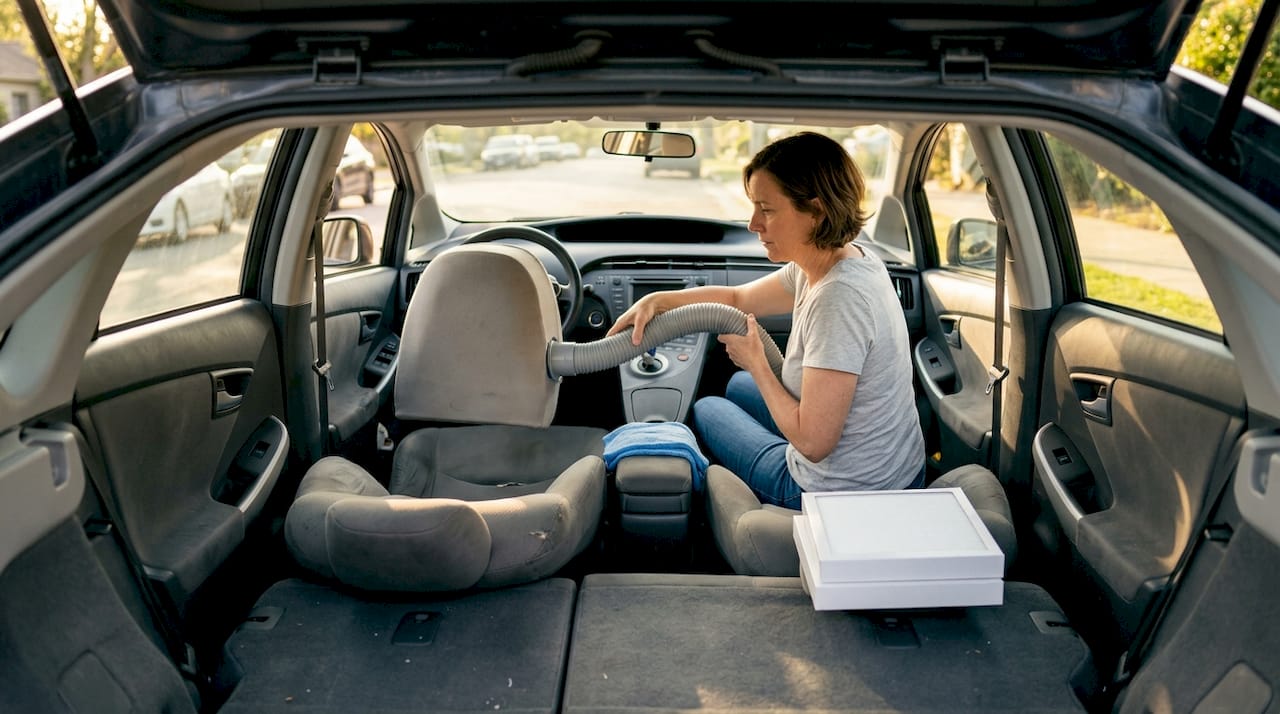
SVOCs are the most problematic class within that chemical mix. They are semi-volatile, meaning they shift between a gas phase and a surface-bound phase depending on temperature and airflow. When your car heats up on a summer afternoon, these compounds off-gas from seat foam, carpet backing, and duct walls back into the cabin air. When the temperature drops, they re-deposit onto surfaces. This cycle repeats indefinitely without targeted treatment.
The materials inside your car make the problem worse. Foam padding, woven fabrics, and the fibrous media inside your cabin air filter all have high surface areas that trap SVOCs efficiently. Plastics and vinyl absorb nicotine and tar into microscopic pores. Even the evaporator core, a dense aluminum fin structure inside your HVAC box, collects residue from every cubic foot of air that passes through it.
The health implication is real. Thirdhand smoke residue is not just an odor problem. The chemicals trapped in your car’s interior continue to off-gas into the air you breathe every time you drive, creating ongoing exposure even when no one is actively smoking.
- Nicotine bonds with nitrous acid in the air to form tobacco-specific nitrosamines, which are known carcinogens
- Aldehydes (formaldehyde, acetaldehyde) irritate the respiratory tract and are classified as hazardous air pollutants
- Tar compounds create the oily, yellow-brown film visible on windows and plastic trim
- Polycyclic aromatic hydrocarbons (PAHs) embed in fabric fibers and resist standard cleaning agents
How do car ventilation systems trap and spread smoke odor?
Car HVAC systems act as odor incubators because every component that moves or conditions air also collects residue. The blower motor pulls cabin air across the evaporator core, where smoke particles deposit on the fins. The ducts carry that air to every vent in the car, coating the duct walls with a thin layer of residue over time. When you run the fan after a surface cleaning, the system reintroduces odor from areas you never touched.
The cabin air filter is often the first place car owners look, and replacing it is a necessary step. But the filter only captures particulate matter. SVOCs in gas phase pass straight through it and continue into the duct system. A fresh filter in a contaminated HVAC system will smell like smoke within days because the surrounding ductwork keeps releasing compounds into the airstream.
Pro Tip: Switch your HVAC to recirculation mode during any professional deodorization treatment. Closed-loop recirculation forces the treatment agent through the entire ventilation system, including the evaporator box and all duct branches, rather than pulling in fresh outside air that dilutes the treatment.
The table below compares how different HVAC components contribute to odor retention and what each requires for effective treatment.
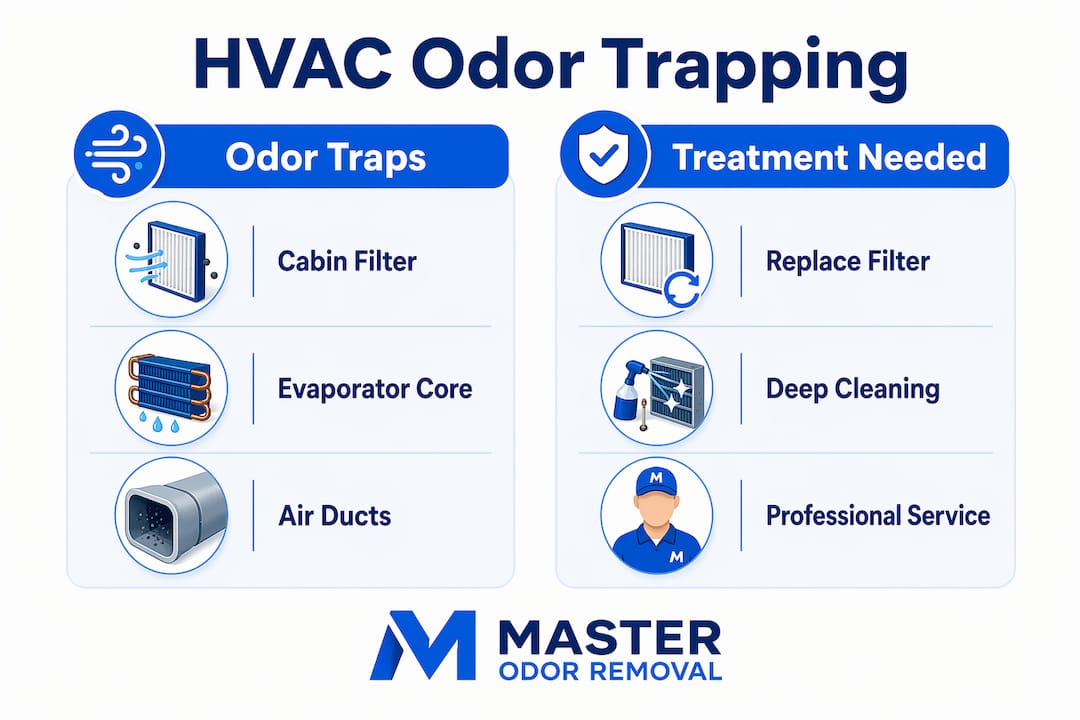
| HVAC Component | How it traps odor | Treatment required |
|---|---|---|
| Cabin air filter | Captures smoke particles, becomes a secondary odor source | Full replacement |
| Evaporator core | Collects residue on aluminum fins, off-gases with heat | Chemical foaming treatment |
| Blower motor housing | Accumulates film on fan blades and housing walls | Professional duct cleaning |
| Duct walls | Absorb SVOCs into plastic and foam insulation | Deodorizing agent application |
| Vent grilles | Surface residue reintroduced with airflow | Manual cleaning plus deodorizer |
For a deeper look at how HVAC airflow spreads odors through a vehicle, the mechanics go well beyond what most car owners expect.
What causes visible smoke from car vents vs. embedded odor?
Visible smoke or mist coming from your vents is a completely different problem from embedded smoke odor, and confusing the two leads to the wrong response. Visible vent smoke signals a mechanical or electrical failure that needs immediate attention, not an odor treatment.
The most common mechanical causes of visible smoke from vents include:
- Blower motor failure: When the blower motor overheats, its housing or wiring can melt and produce smoke that exits through the vents
- Coolant leak: Coolant dripping onto hot engine components creates white smoke that can enter the cabin through the HVAC fresh air intake
- Refrigerant leak: A refrigerant leak hitting a hot surface produces a sharp-smelling mist that exits through the dashboard vents
- Electrical short: Wiring faults near the HVAC box can cause insulation to burn, sending acrid smoke into the cabin
White or light gray mist from vents is usually harmless. It is moisture condensation forming when cold, humid air hits the warm vent outlet, especially on a hot day with the AC running hard. This disappears within seconds and carries no odor.
Dark or acrid smoke is never normal. If smoke from your vents comes with a burning smell, unusual heat, or strange noises, stop the vehicle and get a diagnostic inspection. Experts recommend treating any smoke accompanied by heat spikes or sounds as a potential electrical or engine emergency. Odor removal is irrelevant until the mechanical issue is resolved.
The key distinction for car owners: embedded smoke odor has no visible component. You smell it, but you see nothing. Visible smoke means something is burning or leaking right now.
How to effectively remove smoke odor embedded in car vents
Air fresheners mask smoke odor for hours. They do not remove it. The chemical residue stays bonded to your interior surfaces, and the moment the fragrance fades, the smoke smell returns. Effective car vent smoke removal requires a systematic approach that targets every odor reservoir in the vehicle.
Odor removal specialists confirm that a systematic multi-surface approach targeting headliner, seats, carpets, and HVAC vents together is the only method that achieves lasting results. Treating one area while leaving others contaminated guarantees the odor returns.
The full professional process follows this sequence:
- Replace the cabin air filter. This removes the primary particulate reservoir and prevents the new filter from being immediately contaminated by downstream residue.
- Clean and treat the evaporator core. A foaming evaporator cleaner is sprayed into the fresh air intake with the fan running, coating the fins and draining residue through the condensate drain.
- Treat the full duct system. A professional-grade deodorizing agent is introduced with the HVAC in recirculation mode, reaching every branch of the duct network.
- Hot water extract upholstery and carpets. Steam and hot water extraction lifts smoke oils from seat foam and carpet backing that surface wiping cannot reach.
- Clean the headliner carefully. The headliner retains up to 50% of cabin smoke odor and must be treated with a low-moisture method because its adhesive is heat-sensitive and aggressive cleaning causes permanent sagging.
- Apply a closed-loop odor neutralizer. With all windows closed and the HVAC in recirculation, a neutralizing agent circulates through the entire cabin, chemically breaking down remaining SVOCs rather than masking them.
Pro Tip: Before any DIY attempt, check whether your car’s headliner shows yellowing or a faint oily sheen near the dome light. That discoloration is thirdhand smoke residue. If it is present, the headliner needs professional treatment. Scrubbing it with a wet cloth risks dissolving the adhesive and permanently damaging the fabric.
For car owners who want to address the problem between professional appointments, replacing the cabin filter, wiping hard surfaces with an enzyme-based cleaner, and leaving an open container of activated charcoal in the car overnight are reasonable interim steps. They reduce the odor load but do not eliminate the embedded residue. The eco-friendly removal workflow used by professionals goes several layers deeper and produces results that last.
Quitting or reducing smoking also matters for long-term freshness. Resources on replacing the smoking habit can support car owners who want to prevent the problem from recurring after treatment.
Key Takeaways
Smoke odor embeds permanently in car vents because SVOCs chemically bond to HVAC components, fabrics, and foam, and the ventilation system continuously recirculates them until every contaminated surface is treated.
| Point | Details |
|---|---|
| SVOCs drive the problem | Over 250 chemicals in thirdhand smoke bond to porous materials and off-gas repeatedly with heat. |
| HVAC systems spread the odor | Evaporator cores, blower housings, and duct walls all collect residue and reintroduce it with every fan cycle. |
| Visible smoke is a separate issue | Mist or smoke from vents signals a mechanical fault, not an odor problem, and needs immediate diagnosis. |
| Headliner holds the most odor | The headliner retains up to 50% of cabin smoke odor and requires careful, low-moisture professional treatment. |
| Full-system treatment is required | Lasting removal demands filter replacement, duct cleaning, hot water extraction, and closed-loop neutralization together. |
What I have learned treating smoke-saturated car interiors
After working on hundreds of smoke-saturated vehicles, the pattern I see most often is this: the car owner cleaned the seats, replaced the air freshener, and called it done. Then they turned on the heat in october and the smell hit them like the car had never been touched. That is not a cleaning failure. That is a targeting failure.
The two most overlooked odor reservoirs are the headliner and the evaporator core. Most detailers never touch either one. The headliner sits directly above every breath you take in the car, and it absorbs smoke like a sponge over years of exposure. The evaporator core sits inside a sealed box behind the dashboard, and residue bakes onto its fins every time the system runs. Neither of these responds to spray-and-wipe methods.
Climate matters more than most car owners realize. A vehicle parked in a hot garage in July will off-gas SVOCs aggressively, making the smell worse than it was in winter. That same vehicle treated in cooler weather may seem fine until the first hot day brings the odor back. Treatment needs to account for temperature-driven off-gassing, which is why professional closed-loop neutralization works better than any passive method.
My strongest advice: get a professional assessment before spending money on DIY products. A trained specialist can identify which surfaces are still actively releasing compounds and build a treatment plan that addresses all of them in the right order. Skipping that step usually means spending more money over time, not less.
— Master
Persistent smoke odor in your car calls for professional treatment
Smoke odor that survives multiple cleaning attempts is not a sign that removal is impossible. It is a sign that the treatment has not reached the right places yet.

Masterodorremoval specializes in deep HVAC and interior treatments that target every odor reservoir in your vehicle, from the evaporator core to the headliner, using eco-friendly, green-certified methods that contain no ozone or chlorine. The team is available for same or next-day service, and every treatment is backed by a satisfaction guarantee. If the smoke smell in your car keeps coming back, the professional odor removal process at Masterodorremoval is built to end that cycle for good. You can also review the full range of premium odor treatments to find the right fit for your vehicle.
FAQ
Why does smoke smell come back after cleaning my car?
Smoke odor returns because surface cleaning does not reach the HVAC ducts, evaporator core, or seat foam where SVOCs are chemically bonded. The ventilation system reintroduces residue from untreated areas every time the fan runs.
Can replacing the cabin air filter eliminate smoke smell?
Replacing the cabin air filter removes one odor source but does not fix the problem. SVOCs in gas phase pass through the filter and remain in the duct system, headliner, and upholstery.
Is white mist from car vents dangerous?
White mist is usually harmless condensation from the AC system. Dark or acrid smoke from vents signals a mechanical failure such as a blower motor fault or coolant leak and requires immediate inspection.
How long does smoke odor last in a car without treatment?
Smoke odor in an untreated vehicle can persist for years. SVOCs continue to off-gas from embedded surfaces with every temperature cycle, meaning the smell does not fade on its own.
What is the most effective method for car vent smoke removal?
The most effective method combines HVAC filter replacement, evaporator core treatment, hot water extraction of upholstery, headliner cleaning, and closed-loop odor neutralization targeting all surfaces simultaneously.
Recent Comments