
TL;DR:
- Pet urine causes persistent odors because uric acid crystals embed deep into flooring and resist water-based cleaning.
- Damage severity varies by flooring porosity, with carpet and hardwood absorbing urine more deeply than tile or sealed vinyl.
Pet urine damages flooring odor by depositing uric acid crystals deep into porous materials, where they bind to fibers, wood, grout, and subfloor layers and resist conventional cleaning. This process, known in professional remediation as uric acid salt contamination, explains why a floor can smell clean for days and then reek again after rain. The odor is not a surface problem. It is a structural one. Understanding how uric acid behaves in different flooring types, why common cleaning products fail, and what enzymatic treatment actually does gives you a real path to permanent odor removal rather than temporary masking.
How does pet urine cause persistent odors in flooring?
Uric acid crystallizes and becomes water-insoluble once it dries inside porous flooring materials. That insolubility is the core problem. Standard mop water, dish soap, and even commercial floor cleaners cannot dissolve these crystals because they are chemically designed to repel water-based solutions.
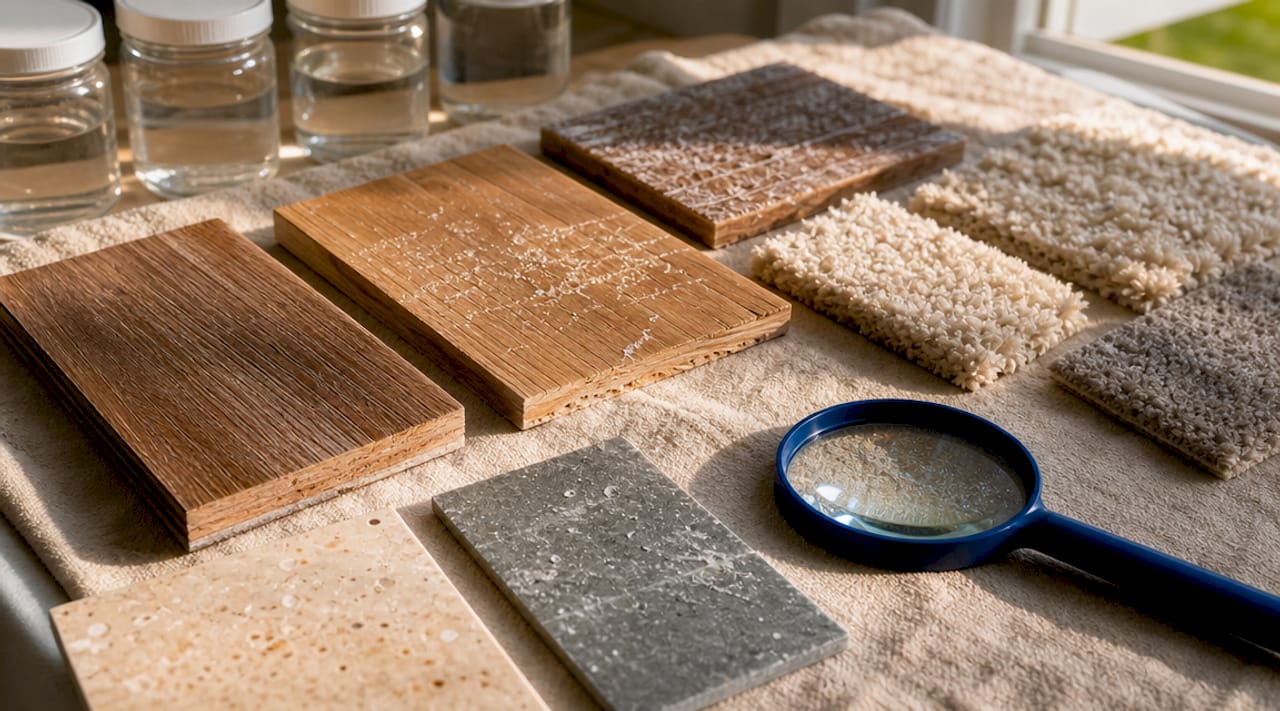
The odor cycle works like this: uric acid crystals sit dormant in carpet fibers, wood grain, or grout pores. When humidity rises or moisture contacts the area, the crystals partially dissolve and release ammonia and mercaptans, the compounds your nose registers as that sharp, unmistakable smell. This is why humidity reactivates dried crystals, causing odors to return weeks after a floor appears clean.
Bacteria compound the problem significantly. Urine contains proteins and organic compounds that bacteria metabolize over time, producing additional odor byproducts. The longer urine sits untreated, the larger the bacterial colony and the more complex the odor chemistry becomes.
Visible stains represent only a fraction of total contamination. The majority of uric acid residue wicks laterally and vertically into backing, padding, and subfloor layers that no surface treatment reaches.
- Uric acid is water-insoluble and resists most household cleaners
- Moisture and humidity trigger odor release from dormant crystals
- Bacteria metabolize urine proteins and generate ongoing odors
- Surface stains are visible indicators of a much deeper contamination zone
How does pet urine damage vary across flooring types?
The severity of pet urine flooring damage depends entirely on how porous and absorbent the material is. Denser, sealed surfaces resist penetration. Open, fibrous, or jointed surfaces absorb urine rapidly and hold it at depth.
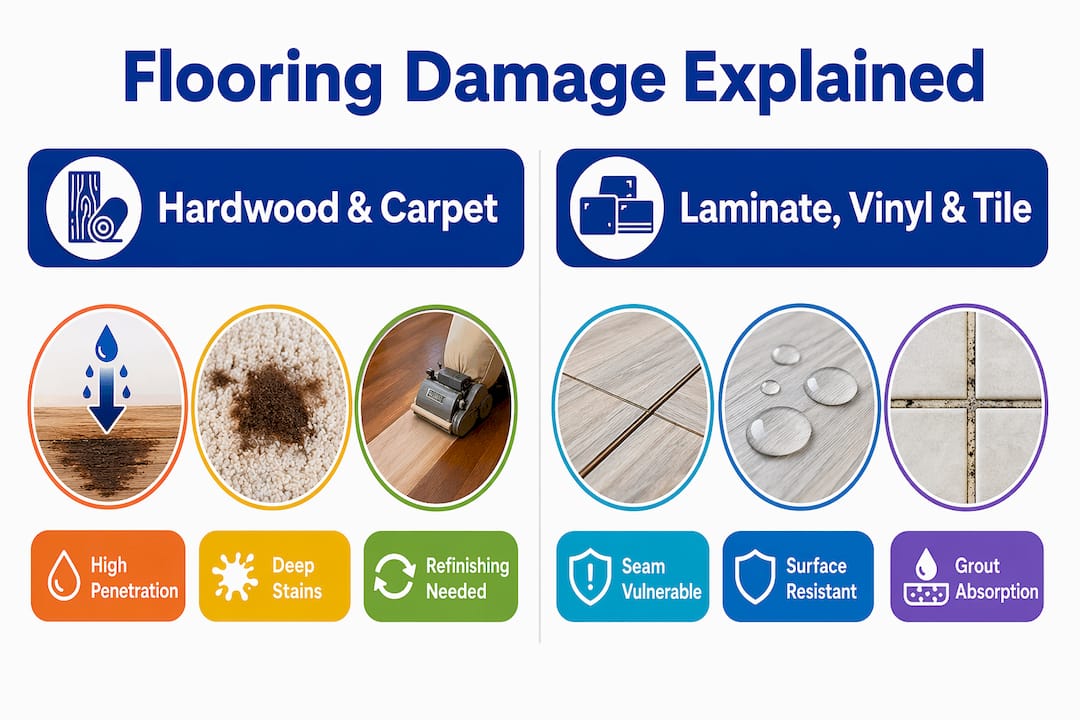
Hardwood floors absorb urine through the finish and into the wood grain itself. Urine acidity breaks down protective finishes and penetrates wood fibers, causing discoloration, warping, and long-term structural weakening. The darkness of a stain on hardwood directly indicates penetration depth. Light gray staining may respond to refinishing. Dark black staining typically signals ammonia penetration deep enough to require board replacement.
Carpet is the most deceptive flooring type. The visible stain on carpet fibers is the smallest part of the contamination. Urine flows through fibers into the backing, then saturates the padding below, and in many cases reaches the subfloor. Odor trapped in padding is the primary reason carpet smells persist after surface cleaning.
Laminate and vinyl plank flooring appear water-resistant but have vulnerable seams. Urine seeps through seams and expansion gaps, reaching the adhesive layer and the core material underneath. Once the core swells or the adhesive fails, the floor requires replacement regardless of odor treatment.
Tile surfaces resist urine absorption, but grout does not. Grout is porous and absorbs urine readily, holding uric acid crystals and bacteria in its matrix. Sealed grout resists this, but most residential grout is not adequately sealed or maintained.
| Flooring type | Penetration risk | Primary damage | Remediation approach |
|---|---|---|---|
| Hardwood | High | Finish breakdown, warping, staining | Enzymatic treatment, sanding, sealing, or board replacement |
| Carpet | Very high | Fiber, backing, padding, subfloor saturation | Deep enzymatic treatment, padding replacement |
| Laminate/vinyl plank | Moderate | Seam infiltration, core swelling, adhesive failure | Seam sealing, panel replacement |
| Tile | Low | Grout absorption, staining | Grout cleaning, resealing, or regrout |
| Subfloor (all types) | High | Structural saturation, persistent off-gassing | Enzymatic treatment, odor sealing barriers |
Why do traditional cleaning methods fail to remove pet urine odors?
Most homeowners reach for the wrong tools first, and the damage compounds with each failed attempt. Understanding why common methods fail is as important as knowing what works.
Steam cleaning without enzyme pre-treatment actively worsens the problem. Heat sets protein stains and reactivates uric acid salts, temporarily intensifying the odor and driving contamination deeper into the material. Steam cleaning has a legitimate role in the process, but only after enzymatic treatment has broken down the uric acid.
Ammonia-based cleaners are counterproductive. Ammonia-based products reinforce ammonia compounds already present in urine, which perpetuates the odor chemistry rather than neutralizing it. These products also signal to pets that the area is an acceptable bathroom location, increasing the likelihood of re-soiling.
Surface-only cleaning misses the contamination entirely. Products that do not reach urine wicked into backing and subfloor leave dormant uric acid crystals that off-gas later. Spraying a carpet surface and blotting it dry addresses perhaps 10% of the actual contamination zone.
Baking soda and vinegar combinations neutralize surface odors temporarily but do not break down uric acid crystals at a molecular level. The odor returns within days as humidity reactivates the untouched crystals below.
Enzymatic cleaners work differently from every product listed above. They contain biological enzymes that digest uric acid, proteins, and bacteria at a molecular level, converting them into water and carbon dioxide. The result is permanent elimination rather than temporary masking.
Pro Tip: Never rinse an enzymatic cleaner before the dwell time is complete. Premature rinsing stops the breakdown process mid-cycle and leaves partially digested uric acid that can still off-gas. Allow a minimum of 10 to 15 minutes of contact time, and up to 30 minutes for older or deeper stains.
What are the best practices for removing pet urine odor from flooring?
Effective odor removal matches treatment depth to contamination depth. That principle, more than any specific product, determines whether the odor comes back.
- Saturate, do not spray. Enzymatic cleaner must reach every layer the urine reached. For carpet, apply enough product to wet the backing and padding, not just the surface fibers. A light mist treats 10% of the problem.
- Allow full dwell time. Enzymatic cleaners require 10 to 30 minutes of contact time to digest uric acid compounds. Older or heavily soiled areas benefit from extended contact and a second application.
- Replace padding when necessary. Padding that has been repeatedly soiled or that retains odor after enzymatic treatment cannot be cleaned back to neutral. Replacement is the only reliable solution.
- Treat the subfloor directly. When carpet and padding are removed, apply enzymatic cleaner directly to the subfloor and allow it to dry completely before installing new flooring. Skipping this step transfers the odor problem to new materials.
- Apply an odor sealing barrier after treatment. Products like VaporLock seal residual odors from deep-set contamination after enzymatic treatment, preventing off-gassing from substrates that cannot be fully cleaned.
- Dry thoroughly. Complete drying after enzymatic treatment prevents mold growth and stops moisture from reactivating any remaining crystals. Use fans, dehumidifiers, or open windows to accelerate drying. Walking on wet treated areas compresses fibers and slows the process.
For hardwood specifically, light staining may respond to enzymatic treatment followed by sanding and refinishing. Darker stains signal deeper ammonia penetration, and in those cases, board replacement combined with subfloor sealing is the practical path forward. You can find eco-friendly pet odor solutions that address both surface and subfloor contamination without harsh chemicals.
Pro Tip: Use a UV black light in a darkened room to map the full contamination zone before treating. Urine fluoresces under UV light, revealing spots that are invisible in normal lighting. Treating only the visible stain while leaving adjacent contamination guarantees odor relapse.
How to prevent future pet urine flooring damage and odors
Prevention costs far less than remediation. A single accident treated within minutes causes a fraction of the damage that a dried, set stain causes after 24 hours.
- Act within minutes, not hours. Blot fresh urine immediately with paper towels, then apply an enzymatic cleaner to the spot before the uric acid has time to crystallize. Speed is the single most effective prevention strategy.
- Use protective mats or runners in areas where pets spend the most time, particularly near doors, sleeping areas, and feeding stations. Washable, waterproof-backed mats are far easier to clean than flooring.
- Seal grout annually. Grout sealer applied once a year dramatically reduces urine absorption in tiled areas and makes cleanup faster and more complete.
- Control indoor humidity. Keeping indoor humidity below 50% reduces the frequency and intensity of odor reactivation from any residual uric acid crystals. A whole-home dehumidifier or portable unit in problem rooms makes a measurable difference.
- Establish consistent bathroom routines for pets. Regular outdoor access, especially after meals and sleep, reduces accident frequency. For cats, maintaining clean litter boxes reduces the likelihood of inappropriate elimination on flooring.
- Monitor for early signs of damage. Discoloration, soft spots in hardwood, or a faint ammonia smell in a specific area are early indicators. Catching damage early keeps remediation manageable. Explore pet-friendly odor maintenance ideas to build a routine that keeps floors protected long-term.
Key takeaways
Pet urine odor persists because uric acid crystals bind deep into flooring materials and resist water-based cleaning, requiring enzymatic treatment matched to the full depth of contamination for permanent removal.
| Point | Details |
|---|---|
| Uric acid is the root cause | Crystals bind deep into flooring and release odor when moisture reactivates them. |
| Flooring type determines damage severity | Carpet and hardwood absorb urine deepest; tile and sealed vinyl resist better. |
| Common cleaners make it worse | Ammonia products and steam cleaning without enzymes intensify odor rather than removing it. |
| Treatment depth must match contamination depth | Saturate enzymatic cleaner to reach backing, padding, and subfloor for lasting results. |
| Prevention is faster and cheaper | Immediate cleanup with enzymatic cleaner stops uric acid from crystallizing and causing long-term damage. |
What I’ve learned after years of treating floors homeowners gave up on
Most homeowners I work with have already tried three or four products before calling. The frustration is real, and it is completely understandable. What they could not have known is that every surface-only attempt was treating the symptom while leaving the cause untouched.
The single most common mistake I see is underestimating contamination depth. A urine spot the size of a dinner plate on carpet can saturate a padding area twice that size and leave a subfloor stain larger still. The physics of liquid wicking through layered materials means the contamination spreads outward and downward simultaneously.
I have also seen homeowners replace carpet, install new flooring over an untreated subfloor, and call me six months later wondering why the new floor smells. The subfloor was the source the entire time. New materials absorb the off-gassing from below and carry the odor forward. Treating the subfloor before any new installation is non-negotiable.
UV inspection changes everything for clients who are skeptical about the extent of their problem. When I walk through a room with a black light and they see five or six contamination zones they had no idea existed, the conversation about treatment scope becomes much easier. The chemistry does not lie, and neither does the light.
Patience matters too. Deep, old stains may require two or three enzymatic treatment cycles before the odor fully resolves. That is not a product failure. It is the biology of breaking down years of accumulated uric acid and bacterial activity. Expect the process to take time, and do not rush the drying phase.
— Master
When professional treatment is the right call

Some pet urine odor problems are beyond what any DIY product can fully resolve, particularly when contamination has reached the subfloor, when multiple pets have used the same area over months or years, or when flooring replacement is being planned and the subfloor needs certified treatment before new materials go down.
Masterodorremoval uses professional-grade enzymatic treatments designed to penetrate every contamination layer, combined with green odor elimination methods that are safe for families, pets, and the environment. No ozone. No chlorine. Just proven chemistry applied at the right depth and dwell time. If you are a homeowner or renter dealing with odors that keep coming back, see what professional odor removal looks like when it is done correctly the first time.
FAQ
What makes pet urine odor so hard to remove?
Pet urine contains uric acid that crystallizes into water-insoluble compounds deep inside flooring materials. These crystals release odor when moisture reactivates them, making the smell return even after the surface appears clean.
Does steam cleaning remove pet urine odor from carpet?
Steam cleaning without enzymatic pre-treatment worsens pet urine odors by reactivating uric acid salts with heat. Always apply an enzymatic cleaner with full dwell time before any steam cleaning step.
How long does enzymatic cleaner need to sit on a urine stain?
Enzymatic cleaners require a minimum of 10 to 15 minutes of contact time, and up to 30 minutes or more for older or deeper stains. Rinsing before the dwell time ends stops the breakdown process and allows odor to return.
When does carpet padding need to be replaced?
Carpet padding that has been soaked by urine multiple times or that retains odor after thorough enzymatic treatment cannot be cleaned back to neutral and must be replaced. Treating the subfloor directly before installing new padding is critical to prevent odor transfer.
Can pet urine permanently damage hardwood floors?
Yes. Urine acidity breaks down the protective finish on hardwood and penetrates wood fibers, causing discoloration, warping, and structural damage. Light staining may respond to refinishing, but dark black staining typically indicates deep ammonia penetration that requires board replacement.
Recommended
- Pet odor elimination: Eco-friendly solutions for fresher homes – Master Odor Removal
- Eliminate Pet Odors: Eco-Friendly Solutions for a Fresh Home – Master Odor Removal
- Pet Odor Risks in Commercial Properties: Key Facts – Master Odor Removal
#SmokeOdorRemoval
#CigaretteOdorRemoval
#CigarOdorRemoval
#MarijuanaOdorRemoval
#WeedSmellRemoval
#PetOdorRemoval
#CatUrineOdorRemoval
#DogOdorRemoval
#MustyOdorRemoval
#MoldOdorRemoval
#MildewOdorRemoval
#HVACOdorRemoval
#AirConditioningOdorRemoval
#VehicleOdorRemoval
#AutoOdorRemoval
#LuxuryVehicleOdorRemoval
#YachtOdorRemoval
#BoatOdorRemoval
#CondoOdorRemoval
#HomeOdorRemoval
#RentalPropertyOdorRemoval
#AirbnbOdorRemoval
#LuxuryHomeOdorRemoval
#OdorRemoval
#OdorElimination
#OdorRemovalExperts
#LuxuryOdorRemoval
#NeutralIsTheNewScentStandard
#MasterOdorRemoval
#TobaccoOdorRemoval
#SmokeDamageRestoration
#IndoorAirQuality
#LuxuryAutos
#LuxuryHomes
#LuxuryYachts
#PropertyManagement
#AutoDetailing
#RealEstateProfessionals
#PreOwnedVehicles
#VehicleReconditioning
#HomeImprovement
#AirbnbHost
#YachtLife
#BoatLife
#PetOwners
#CommercialCleaning
#GreenCertified
#SouthFloridaBusiness
#MiamiHomes
#FortLauderdaleHomes
#BocaRatonHomes
#PompanoBeachBusiness
#OneAndDoneOdorRemoval
Recent Comments