
TL;DR:
- Interior freshness depends on eliminating contamination at the molecular level rather than masking scents. VOCs, biological growth, and material off-gassing from new or contaminated spaces cause persistent odors that surface cleaning cannot fully address. Professional, eco-friendly treatments focusing on source removal and proper material choices provide lasting freshness in luxury, auto, and hospitality environments.
That familiar “new car smell” or the lavender plug-in masking your vacation rental’s last guest? Neither one signals a clean interior. They signal a covered-up problem. True interior freshness has nothing to do with fragrance, and everything to do with what’s happening at the molecular level inside your upholstery, foam, and ventilation systems. This guide walks through where contamination actually starts, why it stubbornly returns after cleaning, and what eco-conscious, science-backed removal really looks like for luxury homes, auto dealerships, and hospitality properties.
Table of Contents
- What causes interior odor contamination?
- How odors persist and worsen over time
- Material choices and their impact on indoor odor
- Best practices for eco-friendly odor removal and prevention
- What most guides miss about odor contamination and true freshness
- Elevate your spaces with expert, eco-friendly odor solutions
- Frequently asked questions
Key Takeaways
| Point | Details |
|---|---|
| Hidden sources drive odors | Most interior odors start from emissions and biological contamination in hidden materials. |
| Material choice matters | Low-VOC and well-sealed materials greatly reduce long-term odor risks. |
| Eco solutions are effective | Plant-based and enzyme cleaners work for bio-odors and are safer for people and guests. |
| Prevention beats masking | Removing odor sources and preventing contamination is more effective than masking with fragrance. |
| Professional help amplifies results | Complex or persistent odors require expert intervention for complete and lasting freshness. |
What causes interior odor contamination?
Now that we’ve established the problem runs deeper than surface scents, let’s explore where these odors really start.
Most people assume odors come from visible sources: a spilled drink, a pet, or a smoker. The reality is more complicated. VOC and SVOC emissions from polyurethane foams, plastics, adhesives, and textiles are the primary source of contamination in new interiors, and the levels are highest when the materials are fresh. Temperature and poor ventilation dramatically accelerate these emissions. A vehicle parked in direct sunlight can reach internal temperatures of 140°F or higher, turning the cabin into a chemical pressure cooker.
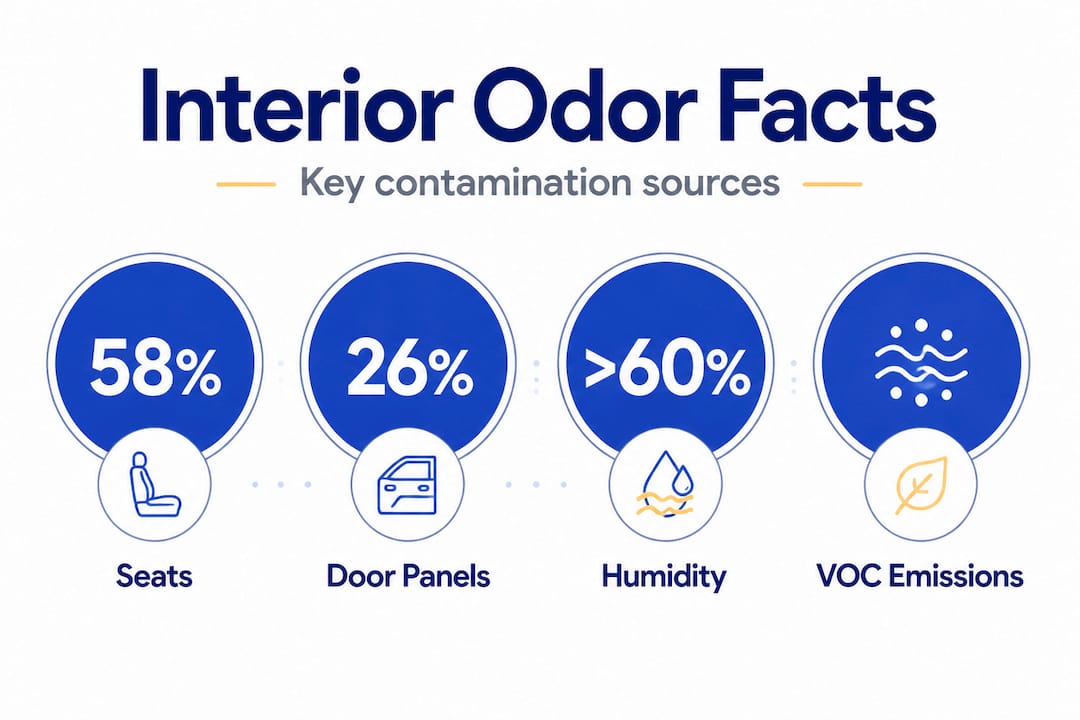
In vehicle interiors specifically, the data tells a clear story. Seats and door panels account for 58% and 26% of key odor substances respectively, based on chemical mass balance analysis. Together, those two components drive 84% of the odor profile in a typical vehicle cabin. That means deodorizing only the carpets or headliner, which is what many detailing services do, misses the vast majority of the actual problem.
Beyond chemistry, biological sources add a second layer of contamination. Humidity above 60% creates favorable conditions for mold and mildew growth inside upholstery and padding. Spills that are blotted but not properly extracted can feed bacteria for weeks. In hospitality settings, the accumulation of skin cells, hair, food residue, and body oils across hundreds of guest stays produces a distinct, persistent odor profile that no amount of linen changing will address alone.
| Odor source category | Primary location | Common trigger |
|---|---|---|
| VOC/SVOC off-gassing | Seats, door panels, foam | High temp, low ventilation |
| Biological contamination | Padding, carpet backing | Spills, humidity above 60% |
| Mold and mildew | HVAC, AC evaporator | Moisture, poor airflow |
| Tobacco and smoke residue | Headliner, vents, walls | Repeated exposure |
| Pet dander and urine | Carpet, upholstery, crevices | Direct contact, absorption |
For dealerships managing pre-owned inventory, following a pro vehicle odor workflow is critical because the seat and door panel issue means a full-material approach is non-negotiable. Spot treatments simply don’t resolve what research confirms is a systemic problem.
Understanding the source breakdown also matters for luxury homeowners and hospitality operators. A newly renovated hotel suite or a recently remodeled home office may actually have higher initial odor contamination than an older space, purely due to fresh materials off-gassing. Green-certified odor removal addresses these sources without adding harmful chemicals that would compound the VOC load already present.
How odors persist and worsen over time
Understanding the sources is just the beginning. In practice, why do some odors linger or even worsen despite cleaning efforts?
The answer lies in the difference between surface cleaning and source elimination. Off-gassing from new materials is an ongoing process that can continue for months or even years in poorly ventilated environments. A freshly detailed vehicle that smells “clean” after a spray treatment will often return to its original odor profile within days, because the underlying material is still releasing compounds.
Liquid spills are particularly insidious. When milk, juice, or vomit contacts a vehicle seat or hotel carpet, the visible portion gets wiped away. But liquids wick downward through fabric, into foam backing, and sometimes into the structural layer beneath. Once organic material reaches that depth, bacterial growth produces butyric acid, which creates the sour, dairy-like smell that defies repeated surface cleaning. AC evaporator mold is another persistent culprit in vehicles, where warm, moist air passing over a contaminated coil distributes spores and odor compounds throughout the cabin every time the air conditioning runs.
Here’s why odors typically escalate rather than fade on their own:
- Moisture cycling causes organic matter to dry, rehydrate, and release odor compounds repeatedly with seasonal humidity changes.
- Temperature spikes reactivate dormant VOCs and accelerate bacterial metabolism in contaminated padding.
- HVAC recirculation spreads localized contamination throughout an entire space or vehicle interior.
- Fragrance layering from air fresheners adds new chemical compounds that can react with existing contaminants, sometimes producing stranger secondary odors.
- Delayed treatment allows bio-contamination to colonize deeper layers where surface products cannot penetrate.
“A space that smells faintly off after cleaning is almost always a sign that the source hasn’t been removed. The odor cycle will continue until the underlying contamination is physically extracted or neutralized.”
Pro Tip: If a freshened space starts to smell worse after getting wet or on a humid day, that’s a reliable indicator that biological contamination is present in a subsurface layer and requires removing tough odors at the source level, not the surface.
The comparison between masking and eliminating is stark when you look at real results over time:
| Approach | Immediate result | 30-day outcome | 90-day outcome |
|---|---|---|---|
| Air freshener / fragrance spray | Odor masked | Returns fully | Often worse |
| Surface cleaning only | Reduced initially | Partial return | Dependent on humidity |
| Enzyme treatment to source | Neutralized | Minimal recurrence | Stable if re-exposure avoided |
| Professional extraction + eco treatment | Eliminated | Fresh baseline maintained | Lasting with prevention |
Material choices and their impact on indoor odor
Now that we understand why some odors linger, let’s see how choosing the right materials upfront can prevent future problems.
Material selection is one of the most underrated factors in long-term odor management. For luxury auto dealerships specifying new inventory trim packages, for hospitality operators selecting flooring and furnishings, and for homeowners renovating living spaces, the materials chosen today directly determine how manageable odor control will be for years afterward.
Low-VOC materials produce fewer emissions and create a substantially lower baseline odor burden, especially in enclosed, climate-controlled spaces like vehicle cabins and hotel rooms. This isn’t just about initial freshness. It also means that when biological contamination does occur, the chemical background noise is lower, making diagnosis and targeted treatment much easier.
New material installations present a specific challenge: terpene off-gassing. Terpenes are naturally occurring volatile compounds found in wood products, certain textiles, and adhesives. Research shows that terpene emissions can be reduced by 71 to 89% through proper surface sealing or painting during installation. For a high-end home renovation or a luxury vehicle refurbishment, this single step can prevent months of ongoing odor complaints.
Key material and treatment considerations for each environment:
- Luxury homes: Choose low-VOC paints, sealed wood products, and natural fiber textiles with chemical-free processing. Seal new subfloor materials before installing carpet.
- Auto dealerships: Request interior trim and adhesive specifications from suppliers and prioritize components with published emission certifications.
- Hospitality properties: Use low-VOC flooring adhesives, mattress encasements that prevent deep contamination, and moisture-resistant padding under carpets.
- All settings: Keep indoor humidity consistently below 60% relative humidity to suppress mold, mildew, and bacterial growth in porous materials.
For biological odors already present, enzyme-based and plant-based cleaners are the most effective and environmentally responsible option. These products work by breaking down organic compounds at the molecular level rather than coating them with fragrance or oxidizing them with chemicals that create secondary pollutants.
Pro Tip: When evaluating any odor removal product for a luxury or hospitality setting, check whether the formula is biodegradable and carries third-party green certification. If a product relies heavily on fragrance to signal “clean,” it’s almost certainly a masking agent rather than a true elimination solution. The safer alternatives to ozone consistently outperform quick-fix approaches in high-end environments where guest health and material preservation matter.
One note on ozone treatments: they are sometimes marketed as powerful odor eliminators and, in specific circumstances, they can be effective. However, ozone is a strong oxidizer that can degrade rubber seals, leather, and certain plastics. More importantly, it poses real respiratory risks to occupants, workers, and pets. Any legitimate protocol should treat ozone as a last resort for vacant spaces only, never as a routine solution in environments where people live, work, or stay.
Best practices for eco-friendly odor removal and prevention
Choosing materials wisely sets the stage, but how do you tackle contamination once it appears and ensure lasting results?
A reliable, eco-responsible odor removal process follows a logical sequence that prioritizes source removal above all else. Skipping steps or jumping straight to treatment products almost always produces incomplete results.
Step-by-step odor removal protocol:
- Identify the source. Before applying any treatment, physically locate the contamination. In vehicles, this means checking beneath seats, in door panel cavities, and inside the HVAC system. In homes and hospitality spaces, it includes checking subfloor moisture, HVAC filters, and behind baseboards in high-humidity rooms.
- Remove the contamination physically. Extract spill residue, replace heavily saturated padding if necessary, and clean HVAC components. Odor compounds cannot be neutralized effectively if the source material is still present.
- Apply targeted eco solutions. Use enzyme-based treatments for biological odors, plant-based degreasers for food and oil residue, and specialized neutralizers for smoke and tobacco. Allow proper dwell time for enzyme products to complete the breakdown process.
- Improve ventilation during and after treatment. Fresh air exchange accelerates off-gassing of residual compounds and reduces humidity that would encourage regrowth.
- Address deep porous contamination with extraction. Carpet padding and HVAC systems require enzyme dwell time followed by mechanical extraction. Smoke contamination specifically needs source material sealing before any surface treatment will hold.
Routine maintenance strategies for year-round freshness:
- Schedule quarterly HVAC filter replacements in hospitality properties and inspect AC evaporators in vehicles seasonally.
- Use moisture absorbers or dehumidifiers in enclosed spaces where ventilation is limited, such as storage areas and vehicle interiors during humid months.
- Address spills within the first hour, using extraction rather than blotting, to prevent wicking into subsurface layers.
- Rotate air purification with HEPA and activated carbon filtration to capture both particulates and gaseous odor compounds continuously.
For eco-friendly smoke removal, the sequence above is critical because smoke residue penetrates porous surfaces and bonds at a molecular level. Painting over smoke-stained walls or simply cleaning upholstery surfaces will not address the compounds that have migrated into drywall, foam, and insulation. Source sealing must precede surface treatment for any lasting result.
What most guides miss about odor contamination and true freshness
With those best practices in mind, here’s a hard-won perspective that industry guides rarely share on true interior freshness.
The fragrance industry has done an extraordinarily effective job convincing property owners, dealership managers, and hospitality operators that “clean” has a smell. It does not. A genuinely remediated interior is neutral. It doesn’t smell like vanilla, ocean breeze, or fresh linen. If you’re walking into a space and thinking “it smells clean,” you’re smelling a product, not the absence of contamination.
This matters because the fragrance-equals-clean assumption leads to real, costly mistakes. A luxury dealership that uses scent diffusers in pre-owned vehicles is actively concealing contamination from buyers, not solving it. A vacation rental operator who books back-to-back stays relying on air fresheners is compounding odor layers until a guest complaint forces the issue. A homeowner who repeatedly buys new plugin refills is paying for ongoing masking of a problem that one professional treatment could permanently resolve.
The other myth worth challenging directly is the idea that ozone is a powerful, professional-grade solution. We encounter this constantly. Direct odor removal services outperform passive ozone treatments precisely because ozone doesn’t remove contamination. It oxidizes some of it and masks the rest with a distinctive “clean” smell that fades within days while the underlying source remains untouched. For smoke odor removal in particular, ozone is widely misunderstood as a solution when it is, at best, a temporary suppressor.
Real, lasting freshness in any luxury or commercial environment requires three things working together: physical source removal, scientifically validated eco-safe treatment targeted to the specific contamination type, and a prevention strategy that keeps conditions unfavorable for recontamination. One-size-fits-all approaches don’t work because a tobacco-contaminated vehicle cabin requires a completely different protocol than a mold-affected HVAC system or a pet-saturated carpet layer. The environments, materials, and contamination profiles are too different. Tailored, professional workflows are not a luxury upgrade. For high-value spaces and high-stakes guest experiences, they are the baseline requirement.
Elevate your spaces with expert, eco-friendly odor solutions
If you’ve made it this far, you understand that interior freshness is a science, not a spray. Complex, persistent odor issues in luxury vehicles, high-end homes, and hospitality properties require professional expertise that goes well beyond what any off-the-shelf product can deliver.

Master Odor Removal specializes in permanent odor elimination for exactly these environments. Every treatment is built on eco-responsible, green-certified methods with no ozone and no chlorine, protecting both your guests and your materials. With same or next-day availability and protocols tailored to each specific contamination profile, we deliver what matters most: a genuinely neutral, fresh interior that stays that way. When you’re ready to move from guessing to certainty, explore how Odor Removal Done Right works in practice. You can also learn why we’re recognized as luxury interior odor specialists and review our commitment to green odor elimination for every project we take on.
Frequently asked questions
What’s the main source of odors in new cars and homes?
The primary sources are VOC and SVOC emissions from foams, plastics, adhesives, and textiles, with levels highest in new interiors and worsened by heat and poor ventilation.
Are air fresheners effective for interior odor contamination?
No. Air fresheners only add fragrance on top of existing contaminants and do nothing to break down or remove the underlying odor source.
When is it safe to use ozone for odor removal?
Ozone should only be used in vacant spaces and with careful precautions due to respiratory risks and potential damage to rubber, leather, and plastic materials.
How can I remove sour dairy or musty odors from car interiors?
These odors typically result from bacterial growth and AC mold caused by spills or moisture buildup, and they require deep extraction combined with targeted enzyme treatments to fully neutralize.
What’s the eco-friendliest method to prevent future odors?
Select low-VOC materials, use plant-based enzyme cleaners for any biological spills, and keep indoor humidity consistently below 60% to prevent the conditions that allow contamination to take hold.
Recommended
- Science-backed eco-friendly odor elimination: 4 key steps – Master Odor Removal
- Odor removal guarantees: How luxury properties stay fresh – Master Odor Removal
- Eco-friendly deodorization: Expert steps for luxury properties – Master Odor Removal
- Indoor odors: identify, compare & control for luxury homes – Master Odor Removal
Recent Comments