
TL;DR:
- True odor neutralization chemically renders odors inactive, unlike masking products that only cover smells.
- Advanced methods like zinc ricinoleate, cyclodextrin, and enzymatic treatments provide permanent, eco-friendly results.
- Professional odor removal prioritizes science-based, occupant-safe techniques to achieve genuine freshness in high-end properties.
Spraying a cloud of lavender mist over a pet odor or a lingering smoke smell is not odor control. It is odor theater. The scent fades within hours, the original problem remains, and your tenants, guests, or buyers notice. For commercial property managers and discerning homeowners, that gap between perception and reality carries real financial and reputational consequences. True odor neutralization is a chemical process, not a fragrance choice, and understanding the difference is what separates properties that feel genuinely fresh from those that just smell like they are trying. This guide breaks down the science, compares the methods, and gives you a clear framework for choosing solutions that actually work.
Table of Contents
- Odor neutralization versus masking: Why the difference matters
- How odor neutralization works: Key scientific mechanisms
- Permanent results versus quick fixes: Performance, safety, and eco considerations
- Choosing the right odor neutralization strategy for your space
- Why ‘neutral’ is the new luxury: What most guides overlook
- Professional odor neutralization services: Immediate, luxury-grade solutions
- Frequently asked questions
Key Takeaways
| Point | Details |
|---|---|
| Neutralization beats masking | Only true neutralization removes unwanted odors at the molecular level, not just covering them up. |
| Understand the science | Knowing about chemical, enzymatic, and encapsulation mechanisms helps you choose safe and lasting solutions. |
| Eco matters for luxury spaces | Plant-based, residue-free neutralizers ensure both safety and sustainability for high-end properties. |
| Choose the right method | Match neutralization type to your property’s occupancy, speed, and ecological requirements for best results. |
| Pro service is fastest | Professionals offer immediate, guaranteed neutralization for demanding environments. |
Odor neutralization versus masking: Why the difference matters
Most products marketed as odor eliminators are, in practice, masking agents. They introduce a stronger or more pleasant scent to distract from the offensive one. The moment the fragrance dissipates, the original odor molecule is still present, still active, still detectable. For a standard household, that might be a minor annoyance. For a luxury apartment, a boutique hotel suite, or a commercial property between tenants, it is a liability.
True neutralization is categorically different. As odor neutralization science confirms, the process chemically alters, encapsulates, or adsorbs odor molecules, specifically volatile organic compounds (VOCs), to render them undetectable. The odor is not hidden. It is deactivated. That distinction is the foundation of every premium odor removal protocol.
Here is a quick comparison to make this concrete:
| Feature | Masking agents | True neutralizers |
|---|---|---|
| Mechanism | Fragrance overlay | Chemical deactivation |
| Duration | Hours | Permanent or long-lasting |
| Residue | Fragrance buildup | Residue-free options available |
| Eco profile | Often synthetic | Plant-based options exist |
| Safe for occupants | Usually | Depends on method |
What true neutralizers accomplish that masking agents never can:
- They break the molecular bond that creates the odor signal.
- They work on sulfur-based, nitrogen-based, and organic odor compounds.
- They leave no competing scent behind, which is critical in high-end environments.
- They address the source, not the symptom.
“A space that smells like nothing is a space that communicates total cleanliness. A space that smells like air freshener communicates that someone tried.”
For property managers overseeing multiple units or hospitality venues with rapid turnover, effective odor removal techniques that deliver permanent results are not a luxury. They are an operational necessity. The cost of re-treating a unit because a masking product wore off is always higher than investing in a method that works the first time.
How odor neutralization works: Key scientific mechanisms
Advanced odor elimination relies on five distinct mechanisms. Each has a specific use case, a specific safety profile, and a specific performance ceiling. Knowing which one to deploy, and when, is what separates professional results from DIY disappointment.
Here is how the five primary mechanisms work in practice:
- Chemical binding. Zinc ricinoleate, derived from castor oil, physically binds to odor molecules, particularly sulfur and nitrogen compounds, and prevents them from volatilizing into the air. It does not add scent. It simply removes the odor signal at the molecular level.
- Encapsulation. Beta-cyclodextrin data shows this ring-shaped molecule traps VOCs inside its cavity structure, locking odor compounds away from your olfactory receptors. It is particularly effective for complex organic odors.
- Oxidation. Ozone and hydroxyl radical generators break odor molecules apart through oxidation. Ozone is fast and powerful but carries serious safety restrictions for occupied spaces. Hydroxyl generators are slower but safe for use while people are present.
- Enzymatic breakdown. Biological enzymes digest the organic matter that produces odors, such as urine proteins, food residue, and mold byproducts. This method eliminates the source rather than the symptom.
- Adsorption. Activated charcoal and zeolite physically capture odor molecules on their porous surfaces. Think of it as a molecular sponge. Highly effective for ambient air treatment and ongoing maintenance.
| Mechanism | Best for | Occupant safe? | Eco-friendly? |
|---|---|---|---|
| Zinc ricinoleate | Surfaces, fabrics | Yes | Yes |
| Beta-cyclodextrin | Complex VOCs | Yes | Yes |
| Ozone | Vacant spaces only | No | Moderate |
| Enzymatic | Organic sources | Yes | Yes |
| Adsorption | Air maintenance | Yes | Yes |
The principle of neutral over scent layering is what drives the shift toward these science-based methods in premium property management. Staying current with plant-based neutralizer advances ensures you are always working with the safest and most effective options available.
Pro Tip: If a product’s label lists “fragrance” as a primary active ingredient, it is a masking agent, not a neutralizer. Look for zinc ricinoleate, cyclodextrin, or enzyme cultures as the functional components.
Permanent results versus quick fixes: Performance, safety, and eco considerations
Once you understand how neutralization works, the next question is which method delivers the best combination of speed, safety, and environmental responsibility. Not all neutralizers are equal, and the wrong choice in a high-end property can create new problems while solving old ones.
Ozone is the most aggressive option. It oxidizes odor molecules rapidly, often within a few hours. However, ozone risks explained are significant: it degrades rubber seals, discolors fabrics, and is harmful to lungs. It must only be used in fully vacant, sealed spaces. Any provider recommending ozone for an occupied property is cutting corners at your expense.

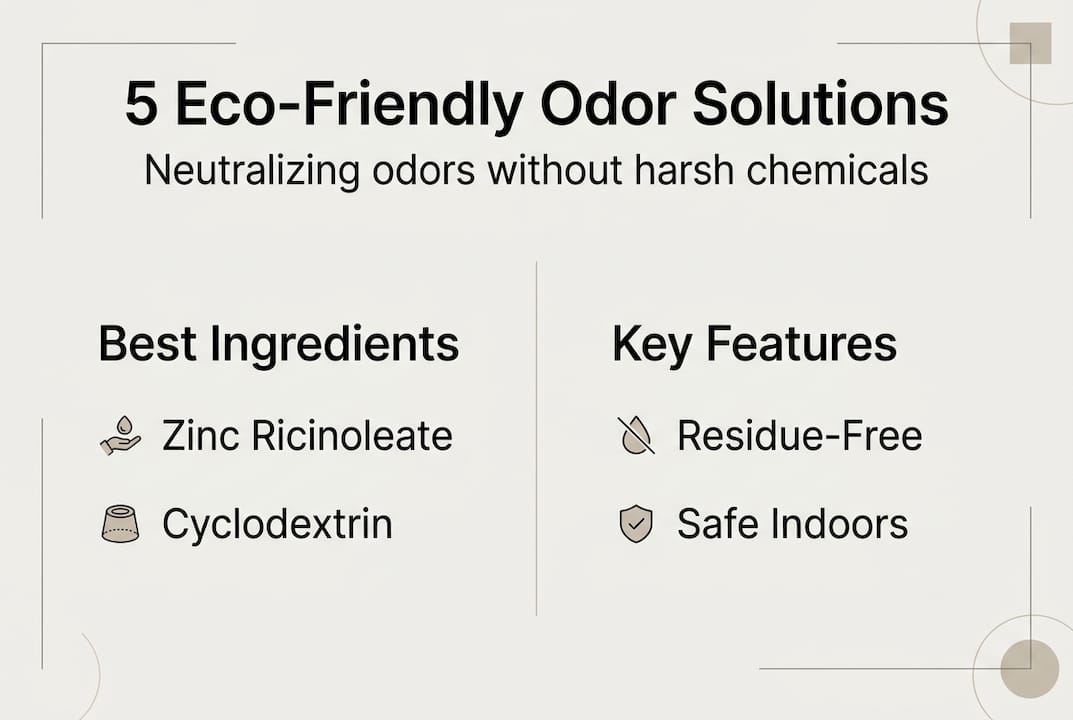
Zinc ricinoleate and beta-cyclodextrin represent the gold standard for eco-friendly luxury options. Both are plant-derived, biodegradable, residue-free, and broad-spectrum. They work on the widest range of odor types without introducing new chemicals into the environment.
Key performance benchmarks to know:
- Neutralizer effectiveness varies significantly by odor type. Zinc ricinoleate performs best on sulfur and nitrogen odors. Cyclodextrin handles complex VOC mixtures.
- Empirical testing shows advanced odor reduction in 24 hours using cyclodextrin combined with adsorption and mild oxidation, while ozone achieves faster results but with documented safety drawbacks.
- Enzyme-based products require 24 to 72 hours to fully digest organic matter but leave zero chemical residue.
What makes a neutralizer genuinely eco-friendly:
- Plant-based active ingredients with no synthetic VOCs introduced during treatment.
- Biodegradable formulation that breaks down naturally after application.
- No ozone or chlorine in the treatment process.
- Third-party green certification from a recognized environmental body.
Pro Tip: Ask any service provider for their Safety Data Sheet (SDS) before treatment. A legitimate eco-friendly neutralizer will have an SDS that lists plant-derived actives and shows low toxicity ratings across all exposure categories.
Choosing the right odor neutralization strategy for your space
With clear evidence on what works and why, the practical question becomes: which strategy fits your property’s specific needs? The answer depends on surface type, odor source, occupancy status, and your timeline.
Start by diagnosing your situation:
- Surface odors (carpets, upholstery, walls): Zinc ricinoleate sprays applied directly to the material are the most effective first step.
- Airborne odors (HVAC-distributed smells, smoke, mildew): Hydroxyl generators or activated charcoal filtration systems address the air column directly.
- Organic sources (pet urine, food decay, mold): Enzymatic treatments must be applied to the source material before any surface or air treatment.
- Time constraints: If you need results within hours for a showing or event, professional hydroxyl treatment is the fastest occupant-safe option.
Checklist for evaluating any neutralizer product or service:
- Does the label list a functional active ingredient (zinc ricinoleate, cyclodextrin, enzymes, or activated charcoal)?
- Is the product certified by a recognized eco or green body?
- Does the provider avoid ozone and chlorine treatments?
- Can the provider supply before-and-after documentation or a satisfaction guarantee?
- Is same-day or next-day service available for urgent property needs?
For premium results, sustainable odor prevention protocols recommend combining surface sprays using zinc ricinoleate with air neutralization via hydroxyl generators for occupied spaces, and reserving ozone strictly for vacant properties. This layered approach covers every odor pathway simultaneously.
Greenwashing is a real risk in this category. Products that claim to be “natural” but list synthetic fragrance as the primary ingredient are masking agents in eco packaging. For workplace odor solutions or luxury residential settings, the stakes are too high to rely on marketing claims alone. Verify the chemistry, not just the label design.
Why ‘neutral’ is the new luxury: What most guides overlook
Here is the perspective most odor control guides miss entirely: in premium property management, a detectable scent, any scent, is a red flag. The instinct to make a space smell pleasant is understandable, but it signals to sophisticated clients and guests that something needed to be covered up. True luxury is the absence of odor, not the presence of a better one.
We have worked in enough high-end environments to know that the most discerning guests do not comment on how good a space smells. They comment on how clean it feels. That feeling comes from genuinely neutral air, not from a diffuser working overtime.
Eco credentials are increasingly non-negotiable for this client segment. High-end buyers and tenants are asking about chemical exposure, VOC levels, and treatment methods before they sign anything. A property that can document green-certified, ozone-free, occupant-safe odor removal has a measurable competitive advantage. Luxury property freshness is no longer just about aesthetics. It is a verifiable standard that sophisticated clients expect and will pay a premium to access.
The managers and homeowners who understand this are setting a new benchmark, one where science replaces spray bottles and neutral is the highest possible standard.
Professional odor neutralization services: Immediate, luxury-grade solutions
For those ready to upgrade their property’s air experience, the right partner makes all the difference. Understanding the science is step one. Executing it correctly, at scale, in occupied or high-turnover properties, requires professional-grade equipment, certified products, and licensed technicians who can guarantee results.

Master Odor Removal delivers odor removal done right with same or next-day availability, zero ozone or chlorine treatments, and a satisfaction guarantee that backs every service. Our green odor elimination protocols use only eco-certified, plant-based actives, meeting the highest standards expected by luxury real estate, hospitality, and commercial property clients. If you manage properties where first impressions are everything, explore our eco-friendly luxury odor neutralization services and see what genuinely neutral air feels like.
Frequently asked questions
Is odor neutralization safe for occupied spaces?
Most modern methods like zinc ricinoleate and hydroxyl generators are fully safe for occupied spaces. Ozone is the exception and should only be used in completely vacant areas due to respiratory and material safety concerns.
What is the most effective eco-friendly odor neutralizer for luxury apartments?
Plant-based zinc ricinoleate and beta-cyclodextrin sprays are the top choices: biodegradable, residue-free, and highly effective across a wide range of odor types without introducing any synthetic chemicals.
How quickly can professional odor neutralization show results?
Advanced treatments using cyclodextrin and adsorption can reduce odors within 24 hours, while professional hydroxyl generator treatments show measurable improvement even faster in occupied spaces.
How do I know if a product is a true odor neutralizer or just a masking agent?
Check the active ingredients. Real neutralizers list zinc ricinoleate, enzymes, or cyclodextrin. If the label only lists fragrance or perfume as the functional component, it is a masking agent regardless of how it is marketed.
Recommended
- Odor neutralization: eco-friendly solutions for luxury – Master Odor Removal
- ODORS CAN BE NEUTRALIZED WITH SCIENCE – Master Odor Removal
- Next-day odor removal: Fast, eco-friendly luxury solutions – Master Odor Removal
- Master Odor Removal – Neutral is the New Scent Standard! – Master Odor Removal
- 5 Natural Ways to Freshen the Air Inside Your Home
- Odor Investigation Checklist: Document Smells and Report to Hazmat Cleanup
Recent Comments