
Most wildfire smoke odor can be cleared out if you act fast: seal the house, run a HEPA and activated-carbon air cleaner, swap every HVAC filter, and deep-clean or pull out anything porous that absorbed smoke. The lingering smell usually comes from volatile organic compounds (VOCs) soaked into drywall, carpet, and fabric, not just leftover ash. If air quality outside is still hazardous, wear an N95 while you clean and follow local evacuation guidance before anything else.
TL;DR:
- Using a combination of HEPA filters and activated carbon in air cleaners is essential to remove both smoke particles and VOC odors effectively.
- Sealing the house tightly and avoiding ozone-based devices during active smoke conditions minimizes indoor pollutant infiltration and prevents worsening air quality.
- HVAC filters should be upgraded to MERV 11-13, and ductwork may need professional cleaning if soot has entered the system, especially if odors worsen after system operation.
- Porous materials like drywall, insulation, and carpets absorb VOCs that off-gas for weeks or months, often requiring replacement rather than cleaning.
- Persistent smoke odor after thorough DIY cleaning indicates deep-seated contamination, and professional, eco-certified remediation is often necessary for complete removal.
Table of Contents
- Why Wildfire Smoke Smell Lingers in a House
- Sealing Up and Sheltering in Place During Active Smoke
- HVAC and Ductwork: Filters, Settings, and When to Call a Pro
- Choosing a Portable Air Cleaner That Actually Removes the Smell
- Cleaning Hard Surfaces, Carpets, and Porous Materials Room by Room
- Getting Smoke Smell Out of Clothes, Bedding, and Delicate Fabrics
- When to Stop DIY and Call a Restoration Professional
- How Long Does Wildfire Smoke Smell Actually Take to Fade?
- Building a Smoke-Ready Home Before the Next Fire Season
- What a Professional Green Odor-Removal Visit Actually Involves
- A Pro’s Quick 24 to 72 Hour Checklist
- Get a Professional Inspection From Masterodorremoval
- Sources
- FAQ
Why Wildfire Smoke Smell Lingers in a House
Two different things happen when smoke gets into a home, and confusing them is why so many cleanup attempts fail. The first is particle pollution, mostly PM2.5, the fine soot you can sometimes see settled on windowsills or ceiling fans. The second is VOCs, gas-phase chemicals like benzene and polycyclic aromatic hydrocarbons that ride along in smoke and don’t behave like dust at all.
Vacuuming and wiping surfaces handles the particles. It does almost nothing for VOCs, because those compounds don’t sit on top of materials, they soak into them. Research from CIRES shows VOCs can off-gas from contaminated surfaces for weeks to months after exposure, which explains why a house can look spotless and still smell like a campfire three weeks later.
Where VOCs tend to concentrate:
- Drywall and unpainted wood, both surprisingly porous at a molecular level
- Insulation inside walls and attics, which acts almost like a sponge for smoke gases
- Carpet padding and upholstery foam
- Fabric fibers in curtains, bedding, and clothing
This matters beyond nose comfort. Prolonged exposure to smoke-derived VOCs and fine particulate indoors can aggravate asthma, trigger headaches, and stress the cardiovascular system, with children, older adults, and anyone with existing respiratory or heart conditions facing the highest risk.
Sealing Up and Sheltering in Place During Active Smoke
The first hour after you notice smoke infiltration matters more than anything you do the following week. Every window and exterior door needs to close, and stay closed, along with any fresh-air intake on your HVAC system. If your system has a recirculate or “return air” only setting, use it. The EPA advises keeping the house sealed and avoiding devices that generate ozone, since some marketed “odor eliminators” actually make indoor air quality worse.
Here’s a practical order of operations once the house is sealed:
- Pick one interior room, ideally without windows facing the fire, as your clean room.
- Run a portable air cleaner with both HEPA and activated carbon media in that room, continuously, on its highest safe setting.
- Move sensitive household members, especially kids and anyone with asthma, into that room as much as possible.
- Check an air quality app or AirNow before opening any door or window, even briefly.
- Keep a stocked supply box nearby: N95 or KN95 masks, spare HVAC filters, spare carbon filter inserts, and basic cleaning supplies.
If local officials issue an evacuation order, leave. No air cleaner setup replaces that judgment call, and no amount of sealing helps once flames are close enough to threaten structural safety.
Pro Tip: A HEPA filter alone won’t touch the smoky smell. You need activated carbon in the mix too, since carbon is what actually adsorbs the gas-phase compounds causing the odor.
HVAC and Ductwork: Filters, Settings, and When to Call a Pro
Your HVAC system is either helping or actively spreading smoke odor through the house, and the setting that decides which one is often overlooked. Set the fan to “On” instead of “Auto” during and after a smoke event. That keeps air constantly cycling through the filter instead of only running when heating or cooling kicks on, which matters because a filter can only clean air that actually passes through it.
Filter selection matters just as much as run time:
- MERV 11 to MERV 13 filters catch a much higher share of fine smoke particles than the standard MERV 8 filter most systems ship with.
- Check that your blower can actually handle a higher MERV rating without straining, since some older systems choke on denser filter media.
- Replace disposable filters immediately after a smoke event, then again regularly until the smell is gone, a cadence PBS News reports is standard practice among cleanup professionals.
- A whole-house HVAC filter targets particles well but does little for VOCs, so pair it with a portable HEPA plus carbon unit in main living spaces.
Ductwork is the part homeowners forget. If soot got pulled into the return air before you sealed the house, it’s now coating the inside of your ducts, and every time the system runs, it’s reintroducing that residue into your air. Signs you need a professional duct inspection include a smoky smell that gets worse right after the HVAC kicks on, visible soot near vent covers, or an odor that persists even after every filter has been replaced and every room deep-cleaned. A qualified HVAC-focused remediation service can inspect and treat ductwork directly, which is not a DIY job for most homeowners.
One more warning worth repeating: skip anything marketed as an ozone generator or ionizer for odor removal. CIRES researchers note these devices can create their own indoor air quality problems even as they mask smoke smell, and the EPA explicitly recommends against them.
Choosing a Portable Air Cleaner That Actually Removes the Smell
HEPA filtration and activated carbon do two completely different jobs, and a device with only one of them will leave you half finished. HEPA traps particles as air passes through a dense mesh. Activated carbon adsorbs gas-phase VOCs onto its surface, where the compounds get chemically trapped rather than just filtered out. CIRES specifically recommends the HEPA-plus-carbon combination as the consumer standard for tackling both particles and the odor-causing gases at once.
Sizing matters more than most buyers realize:
- Check the unit’s Clean Air Delivery Rate (CADR) against your room’s square footage. A unit rated for a 200 square foot bedroom will underperform badly in an 800 square foot open living area.
- Run it continuously on the highest setting the room can tolerate noise-wise during an active smoke event, then step down once outdoor air quality improves.
- A DIY Corsi-Rosenthal box, built from box fans and furnace filters, works well for particle removal and is a legitimate low-cost option the EPA has documented. It does nothing for VOCs, so pair it with a carbon-equipped unit if odor, not just haze, is your main complaint.
- Skip anything advertising “ozone technology” or “ionic odor elimination” as its primary mechanism. These claims routinely mislead buyers about what the device is actually doing to your air.
Cleaning Hard Surfaces, Carpets, and Porous Materials Room by Room
Cleaning order matters as much as cleaning products here. Wet-wipe hard surfaces before you vacuum anything, working top to bottom so soot from ceilings and shelves doesn’t resettle on floors you already cleaned. A mild soap solution or a standard household surface cleaner works fine. Never combine cleaning products, since mixing something like vinegar with bleach can generate hazardous fumes, a caution the Los Angeles Times detailed in its post-fire cleanup coverage.
Textiles and soft surfaces need a different approach:
- Sprinkle baking soda on carpets, rugs, and upholstery, let it sit for several hours, then vacuum thoroughly with a HEPA-filter vacuum so you’re not just resuspending the particles you’re trying to remove.
- Heavily saturated carpet or upholstery usually needs steam cleaning or a professional cleaning service rather than a home vacuum pass.
- Wear an N95 or KN95 mask, gloves, and eye protection while doing any of this, guidance PBS News emphasizes specifically to avoid re-inhaling disturbed soot.
- Drywall and insulation have real cleaning limits. Surface wiping can remove some residue, but if VOC odor keeps returning from a wall or attic space, the insulation behind it may need replacement rather than repeated cleaning.
Ventilate the room once outdoor air quality allows, ideally after the wet-cleaning stage and before you’re done for the day.
Getting Smoke Smell Out of Clothes, Bedding, and Delicate Fabrics
Fabric holds onto smoke odor more stubbornly than almost anything else in the house, and the biggest mistake homeowners make is reaching for the dryer too soon. Heat sets residual VOCs into fabric fibers instead of releasing them, which can turn a two-wash problem into a permanent one.
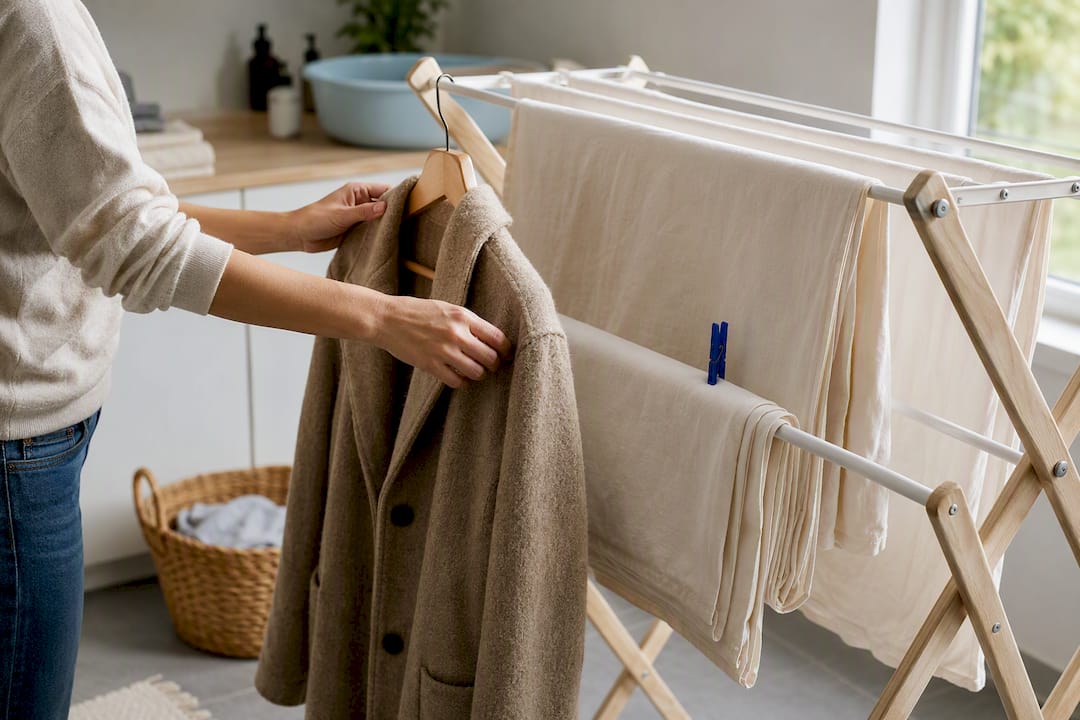
Wash smoky clothing and bedding with regular detergent plus a cup of white vinegar or a half cup of baking soda added to the wash cycle. Repeat the wash, sometimes two or three times, checking the smell after each cycle rather than assuming one pass is enough. Only run the dryer once the odor is genuinely gone.
For delicate or high-value pieces, a wool coat, a silk dress, anything dry-clean only, skip home laundering entirely and take it to a professional cleaner experienced with smoke or fire restoration. Standard dry cleaning solvents combined with specialized deodorizing processes recover items that home washing would either damage or fail to fully deodorize.
If outdoor air quality has returned to a safe range, air-drying on a line finishes the job better than a dryer ever could, letting residual odor escape rather than baking in.
When to Stop DIY and Call a Restoration Professional
Some warning signs mean it’s time to bring in a professional rather than keep repeating the same cleaning steps. Persistent odor after a genuinely thorough cleaning pass is the biggest one. Others include household members reporting headaches, coughing, or throat irritation that improves when they leave the house, or visible soot deep inside ductwork, wall cavities, or attic insulation.
A responsible remediation service typically handles:
- A full inspection to locate where VOCs and soot residue are concentrated
- Targeted cleaning of surfaces a homeowner can’t easily reach
- HVAC and duct treatment to stop recirculation
- Adsorption and neutralization using carbon-based or enzymatic media rather than ozone
Before hiring anyone, ask what methods they use, whether their process is ozone-free, and what certifications their technicians carry. A reputable provider will walk you through realistic expectations rather than promising an instant, guaranteed fix on the first visit.
How Long Does Wildfire Smoke Smell Actually Take to Fade?
Light, brief smoke exposure typically clears in days to about two weeks with consistent filtration and cleaning. Heavy smoke saturation, the kind that follows nearby structure fires or weeks of hazardous air, can take months, and some porous materials may need outright replacement rather than cleaning.
Heat speeds up VOC off-gassing, so smell often feels worse on hot afternoons even without new exposure, a pattern CIRES research confirms. Recirculating HVAC systems, homes with a lot of carpet and upholstery, and areas near widespread structure loss all tend to take longer. Track progress by noting whether the smell fades between cleanings and whether symptoms like headaches or coughing ease up, not just whether one particular room smells clean today.
Building a Smoke-Ready Home Before the Next Fire Season
Preparation before smoke ever arrives saves you weeks of cleanup later. A short seasonal routine handles most of it:
- Weatherstrip doors and windows, and check that fresh-air dampers on your HVAC system can be closed manually when needed.
- Seal obvious gaps around attic access points and crawlspace vents where outside air sneaks in.
- Keep a filter-change calendar and stock spare HVAC filters plus carbon inserts for your portable air cleaner before smoke season starts, not during it.
- Assemble an emergency clean-room kit now: N95 masks, extra filters, and basic cleaning supplies staged in one place.
- Schedule an HVAC professional check-up before peak fire season each year to catch duct or seal issues while there’s still time to fix them.
What a Professional Green Odor-Removal Visit Actually Involves
A responsible eco-certified remediation visit follows a fairly consistent sequence: inspection to map where smoke residue and VOCs have concentrated, targeted cleaning of affected surfaces, adsorption treatment using carbon-based media to pull remaining VOCs out of the air and materials, neutralization of what’s left, and a follow-up check to confirm the smell hasn’t returned.
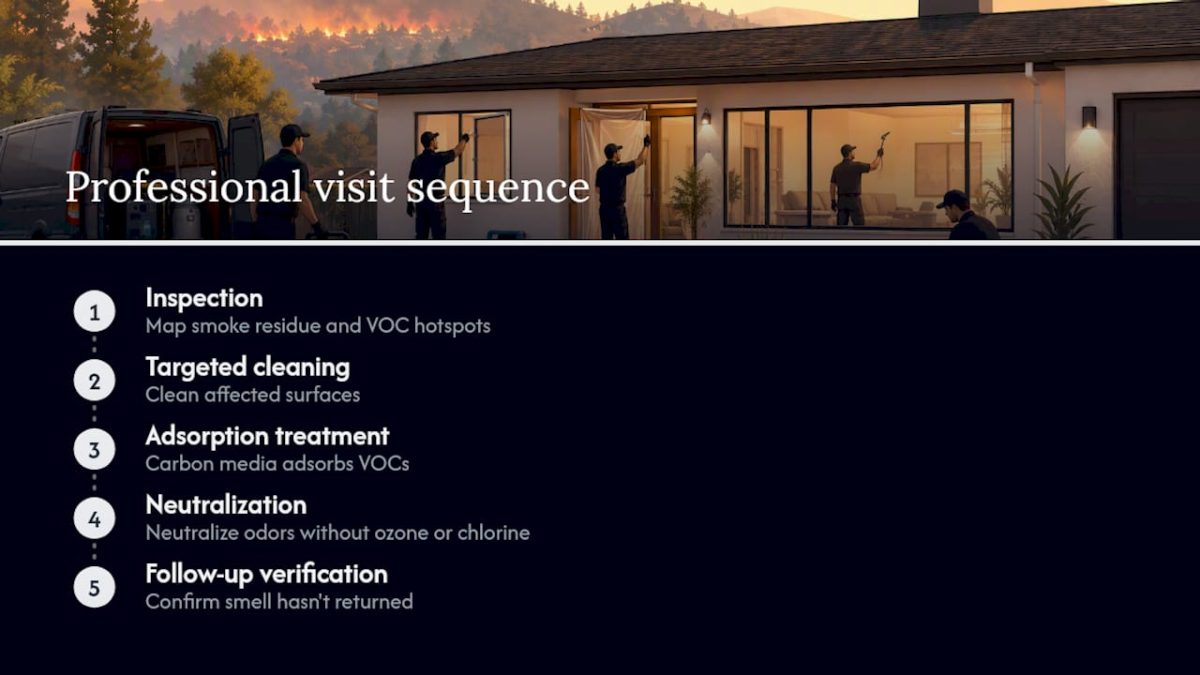
Non-ozone, non-chlorine methods matter here for a real reason, not just marketing language. Ozone and chlorine treatments can leave homes needing to be vacated during treatment and can create their own indoor air quality risks, while adsorption-based methods work without displacing the household or introducing new chemical exposure. Masterodorremoval’s green-certified approach follows that safer path, which matters most for households with kids, older adults, or anyone managing a respiratory condition.
A Pro’s Quick 24 to 72 Hour Checklist
The first three days set the tone for everything after. Seal the house immediately, run HEPA plus carbon filtration in one clean room, swap every HVAC filter, and start wet-cleaning hard surfaces before touching carpets. Wear an N95 while cleaning, and stop the DIY approach the moment symptoms show up in anyone at home or the smell won’t budge after a real cleaning pass. That’s the point to call in an inspection rather than keep guessing.
— Master
Get a Professional Inspection From Masterodorremoval
If you’ve sealed the house, run the air cleaner, replaced every filter, and the smell is still there after a genuine cleaning effort, that’s not a sign you did it wrong. It’s a sign the smoke reached places a vacuum and a spray bottle can’t fix, deep inside insulation, ductwork, or carpet padding. Professional services handle exactly that gap with eco-certified, non-ozone, non-chlorine treatment methods built for homes, not just vehicles and commercial spaces.

A typical visit starts with an inspection to find where VOCs and soot are actually concentrated, followed by targeted adsorption and neutralization treatment rather than a surface-level mask job, similar to how UK drivers diagnose vehicle odors for effective removal. You can see what a full service visit looks like on the odor removal service page, and if you’re wondering how long a job like this usually takes, that’s covered directly on the odor removal timeline page. If your home still smells like smoke after your own cleanup, request an inspection and get a straight answer on what it will take to fix it for good.
Sources
- Wildfires and Indoor Air Quality (IAQ) | EPA
- How to mitigate post-fire smoke impacts in your home | CIRES
- Does your home reek of wildfire smoke? Here’s how to get rid of it — safely | Los Angeles Times
FAQ
Why does my house smell like smoke after a wildfire?
Smoke particles and VOCs settle into porous materials like drywall, carpet, and insulation, then slowly release those compounds back into the air for weeks or even months.
Why does my house smell like smoke but there’s no fire?
Distant wildfire smoke can infiltrate through gaps around windows, doors, and HVAC intakes even when you never see flames nearby, leaving VOC residue behind on surfaces long after the smoke clears outside.
How long does it take for wildfire smoke smell to leave a house?
Light exposure often clears in days to about two weeks with consistent cleaning and filtration, while heavy smoke saturation can take weeks to months and sometimes requires replacing contaminated materials.
How do you get rid of wildfire smoke smell in a house fast?
Seal the house, run a portable air cleaner combining HEPA and activated carbon continuously, replace every HVAC filter, and wet-clean hard surfaces before vacuuming carpets and upholstery with a HEPA vacuum. If the odor persists after a genuine cleaning effort, a professional inspection from a service like Masterodorremoval can target VOC reservoirs a DIY approach can’t reach.
Recent Comments