
Open all doors, pull out all trash, run the fan on fresh-air mode for five minutes, do a quick vacuum of seats and floor mats, and drop an activated charcoal sachet under each seat. Those five steps handle the majority of everyday car odors before you spend a dollar on anything else. The decision rule for calling a pro is simple: if the smell is embedded smoke, long-term mildew, soaked padding, or HVAC-evaporator mold, stop DIYing and book a professional.
- Open all doors and windows for at least five minutes to flush stale air
- Remove all trash, food wrappers, and wet items immediately
- Vacuum seats, floor mats, and crevices with a crevice tool
- Wipe hard surfaces with a damp microfiber cloth
- Place activated charcoal sachets under each seat
Pro Tip: Never run an ozone generator yourself. Consumer Reports warns that ozone is hazardous if inhaled and can damage rubber trim — it belongs strictly in the hands of a trained professional working in an empty, properly ventilated vehicle. Cabin air filter replacement is one of the highest-value maintenance steps you can take for keeping car interior fresh.
Key Takeaways
Eliminating a car odor permanently means removing the source first, then freshening — every other approach is temporary.
| Point | Details |
|---|---|
| Source removal comes first | Use enzyme cleaners for biological odors, charcoal for absorption, and extraction for embedded particles before adding any freshener. |
| Cabin filter is often the culprit | Replace every 12,000–15,000 miles or annually; a fouled filter re-seeds the cabin with odors every time the fan runs. |
| Ozone requires professional oversight | Consumer Reports warns ozone is hazardous if inhaled and can damage trim; never use a generator in an occupied or unventilated vehicle. |
| Seasonal maintenance prevents buildup | Deep-clean at season changes, dry mats after rain, and ventilate weekly to stop odors from embedding in fabric and foam. |
| Masterodorremoval for persistent problems | Licensed professionals use eco-friendly, non-ozone methods with documented inspection for smoke, mildew, and HVAC odors that DIY can’t resolve. |
Table of Contents
- What are the best same-day vehicle freshness tips?
- How do you deep-clean a car interior to remove stubborn odors?
- Why does your HVAC smell and how do you fix it?
- How do you treat smoke, pet, mildew, and food odors specifically?
- How long does new-car smell last and how do you preserve it?
- When should you hire a professional for car odor removal?
- Why prevention beats repeated fixes every time
- Masterodorremoval handles what DIY can’t reach
- Sources
What are the best same-day vehicle freshness tips?
Speed matters here. Rank these by how much time you have.
Under 5 minutes: Open all four doors, pull the floor mats out, shake them, and toss any trash. That alone cuts roughly half of everyday odors because most come from decaying food particles or damp fabric sitting in a closed space.
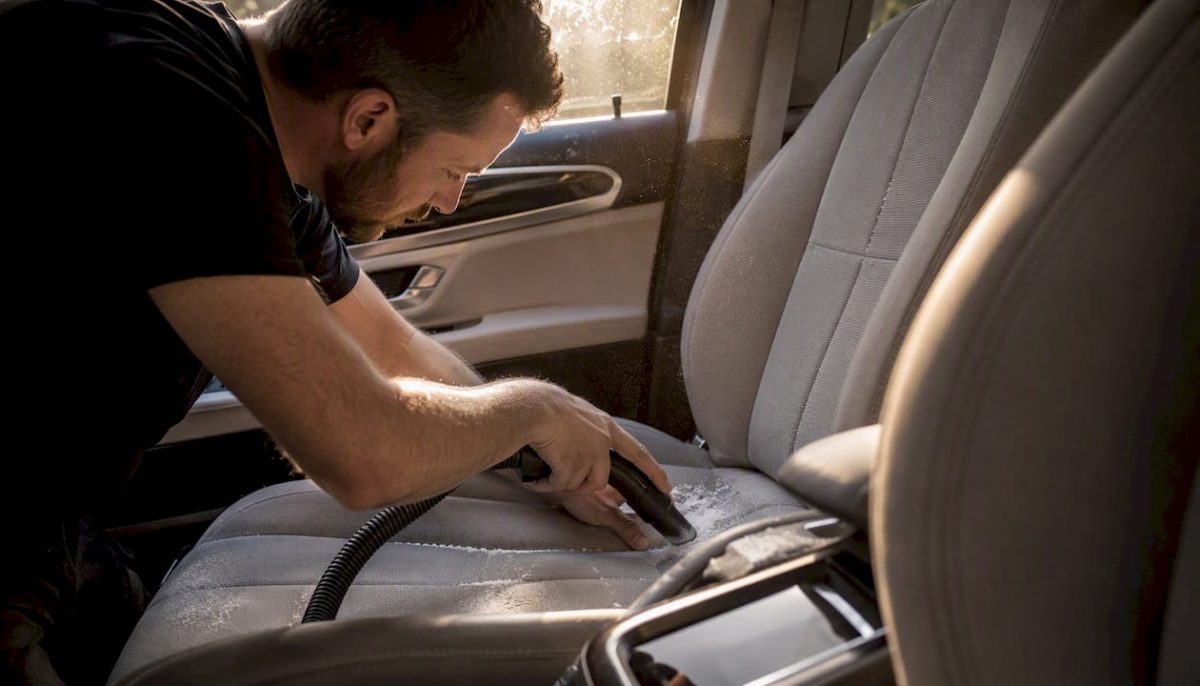
5–20 minutes: Run a handheld or car vacuum across every seat seam, under the seats, and along the carpet edges. Sprinkle baking soda on fabric seats and mats, let it sit ten minutes, then vacuum it up. Baking soda and activated charcoal work by adsorbing odor molecules rather than covering them, which is why AgeFresh recommends them over plug-in air fresheners that can irritate airways.
20–60 minutes: Wipe every hard surface (dashboard, door panels, console, cupholders) with an all-purpose cleaner and microfiber cloth. Replace or air out the cabin filter if it looks gray or smells musty. Leave a charcoal sachet in the trunk overnight.
Keep a small kit in your glovebox: one microfiber cloth, a travel-size all-purpose spray, a trash bag, and a charcoal sachet. That kit turns a 30-second spill into a 3-minute fix instead of a week-long smell.
Pro Tip: You stop noticing your own car’s smell within minutes of getting in — that’s olfactory adaptation. Ask a passenger to confirm whether the odor is gone. Their nose is the most reliable test you have.
Quick actions mask odors when the source is still present. If the smell returns within 24 hours, something is still off-gassing or decaying. That’s when you move to a full deep clean.
How do you deep-clean a car interior to remove stubborn odors?
A technician-style deep clean follows a strict sequence. Skipping steps, especially drying, is how mildew gets introduced during a cleaning job meant to remove it.
- Empty the car completely. Remove floor mats, seat covers, and any loose items from the trunk and under seats.
- Map the odor zones. Smell vents, under seats, the trunk well, and headliner separately. AutoDetailPedia recommends isolating the strongest zones before applying any product so you match the right tool to the right spot.
- Vacuum thoroughly. Use a crevice tool on every seam, under the seat rails, and along the carpet edges. Most lingering odors hide in debris trapped in seams.
- Clean mats separately. Scrub with an upholstery brush and an appropriate cleaner, then let them dry completely outside the car before reinstalling.
- Shampoo and extract upholstery and carpets. A hot-water extractor (rentable at most hardware stores) pulls embedded particles out of foam and fiber. For biological odors — pet urine, vomit, sweat — use an enzyme cleaner and allow full dwell time before extraction.
- Clean the headliner carefully. Use a lightly dampened cloth and a gentle cleaner. Over-saturating the headliner causes it to sag and traps moisture that breeds mildew within days.
- Wipe plastics, console, and cupholders. A degreaser handles food residue; an all-purpose cleaner handles dust and skin oils.
- Replace the cabin air filter. A fouled filter re-seeds the cabin with trapped particles every time the fan runs.
- Ventilate and dry. Leave doors open or park with windows cracked until every surface is dry to the touch. Moisture trapped in mats or carpets is a primary cause of musty smells that return after cleaning.
The two-stage logic CarCareTruth lays out is the right frame: eliminate the source with a mechanism-matched product first, then add a freshener only after the source is gone. Freshener on top of an active odor source is just a more expensive version of the problem.
Why does your HVAC smell and how do you fix it?
The evaporator coil sits behind your dashboard and stays damp after every AC cycle. That moisture collects dust, pollen, and microbial growth. When the fan kicks on, it blows that smell directly into the cabin. Consumer Reports notes that a locker-room smell from the vents is a reliable sign of evaporator condensation and microbial buildup.
Quick checks:
- Turn the fan to max on fresh-air mode and smell each vent individually
- Pull the cabin filter and inspect it (gray, compressed, or smelly = replace it)
- Check the AC condensate drain under the car — a blocked drain keeps the evaporator wet
| Filter / Component | Suggested Replacement Cadence |
|---|---|
| Cabin air filter | At manufacturer-recommended intervals for replacement |
| AC evaporator treatment | When musty smell appears at startup |
| Sunroof and AC drains | Inspect annually; clear if blocked |
AgeFresh confirms the 12,000–15,000-mile or annual interval for cabin filters. Proper HVAC filter maintenance applies the same principle to home systems: a clogged filter doesn’t just reduce airflow, it becomes an odor source itself.
A DIY AC disinfectant spray (foamed into the intake with the fan running) handles mild evaporator odor. Structural mold inside the HVAC housing requires professional remediation — spraying more product into an active mold colony typically makes the problem worse, not better.
How do you treat smoke, pet, mildew, and food odors specifically?
Each odor type has a different mechanism, so the fix has to match.
Smoke: Tar and soot embed in the headliner foam, seat cushions, and HVAC ducting. Shampoo all fabric surfaces, replace the cabin filter, and wipe every hard surface. Whole-cabin oxidizing treatment (ozone or similar) can reach embedded particles in foam, but only under professional oversight. DIY ozone use in a closed car is a health hazard.
Pet and urine: Enzyme cleaners break down the uric acid crystals that cause the smell. Apply generously, allow the full dwell time listed on the product (usually 10–15 minutes), then extract with a wet-vac. One pass rarely finishes the job on heavily soaked carpet padding. Call a pro if the padding beneath the carpet is saturated — extraction alone won’t reach it.
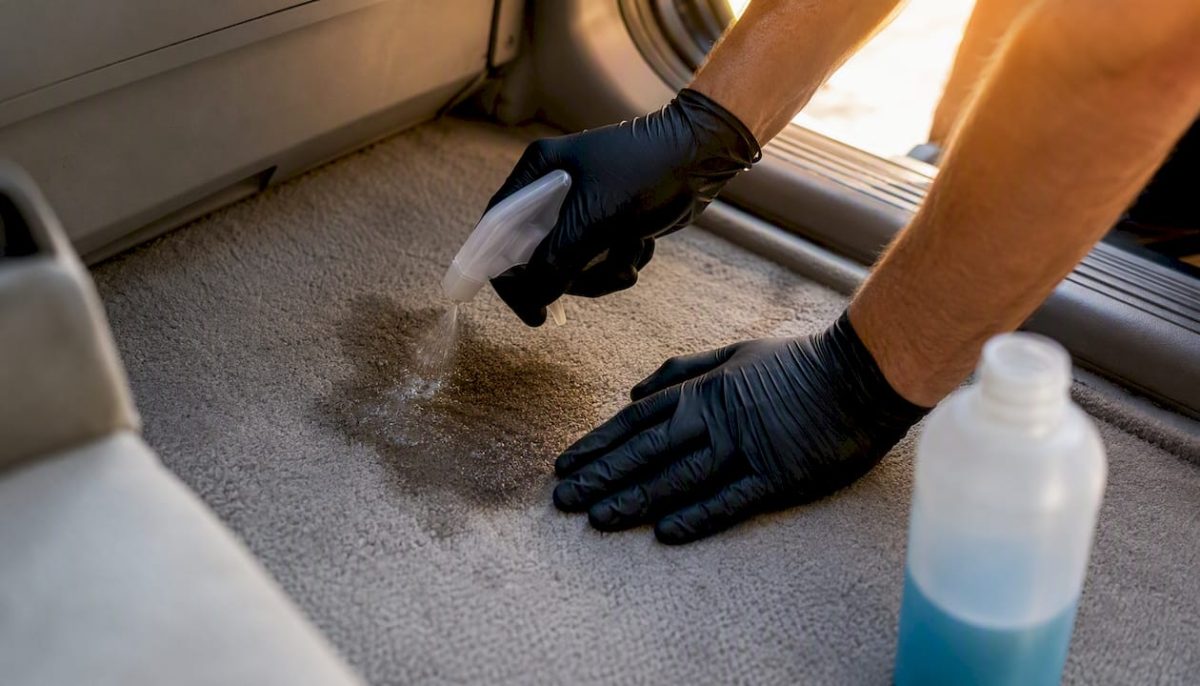
Mildew and mold: Find the moisture source first. Common culprits are a blocked sunroof drain, a leaking door seal, or a wet mat left in place. Treat the HVAC evaporator if vents smell musty. Structural dampness in the floor padding requires professional commercial odor removal with moisture detection equipment.
Food and grease: Spot-clean immediately with a degreaser, then shampoo the upholstery. For food odors in vehicles, eco-friendly enzyme-based degreasers work without leaving a chemical smell behind. The real fix is removing the food source within hours, not days.
Body odor and sweat: Deep-clean all fabric surfaces and use charcoal adsorbents for ongoing maintenance. Seat covers help if the problem recurs with a specific driver.
How long does new-car smell last and how do you preserve it?
AutoZone explains that new-car smell comes from VOCs off-gassing from plastics, adhesives, and leather. It typically lasts a few weeks to a couple of months, fading faster in hot climates where heat accelerates off-gassing. You can’t stop it from fading, but you can stop other smells from replacing it.
Daily habits:
- Remove trash every time you exit the car
- Avoid eating messy or strong-smelling food inside
- Wipe the dashboard and console weekly with a dry microfiber cloth
Seasonal checklist:
- Deep-clean at the start of wet season (fall) and dry season (spring)
- Replace the cabin filter annually or at 12,000–15,000 miles
- Pull mats after rain and let them dry before reinstalling
- Ventilate the car for 10 minutes after it’s been parked in heat
Maintenance schedule:
- Weekly: remove trash, quick wipe of hard surfaces
- Monthly: vacuum seats and carpets, check for spills under seats
- Quarterly: full interior wipe-down, inspect cabin filter, check trunk for moisture
Synthetic fragrances don’t maintain freshness — they layer on top of whatever is already there. Charcoal sachets and good ventilation do more for long-term freshness than any hanging air freshener.
When should you hire a professional for car odor removal?
Some problems are structurally beyond what a vacuum and enzyme cleaner can fix. Here’s how pros approach them.
- Odor mapping: A licensed technician identifies the strongest odor zones (vents, under seats, trunk well, headliner) before touching anything.
- Moisture detection: Professionals use moisture meters to find wet padding that looks dry on the surface.
- Targeted treatment: Hot-water extraction for upholstery, HVAC deep clean for evaporator mold, enzyme application for biological odors, and targeted oxidizing cycles for embedded smoke.
- Padding and headliner assessment: When padding is saturated or the headliner has absorbed smoke, replacement is sometimes the only permanent fix.
- Verification: A pro job ends with a dry-touch check and a ventilation period before the vehicle is returned.
Pro Tip: Consumer Reports cautions that ozone generators, while effective at reaching hidden odor sources, are hazardous if inhaled and can degrade rubber and trim. Reputable professionals use ozone only in empty vehicles with strict safety protocols — or choose non-ozone alternatives entirely, as Masterodorremoval does with its eco-friendly vehicle odor workflow.
Typical professional vehicle odor removal in the US ranges from around $150 for a basic interior treatment to $500 or more for severe smoke, flood damage, or luxury interiors requiring padding replacement. The higher cost is justified when DIY attempts have already failed or when the vehicle’s resale value is at stake.
Why prevention beats repeated fixes every time
The most common mistake car owners make is reaching for an air freshener when they should be reaching for a trash bag. Masking an odor source doesn’t neutralize it — it just makes the car smell like lavender and something else. Every professional who works in vehicle odor removal will tell you the same thing: the clients who need the least intervention are the ones who ventilate regularly, remove trash daily, and replace their cabin filter on schedule.
What professionals bring beyond tools is diagnostic skill. A trained technician can tell the difference between evaporator mold and a wet mat in under two minutes. That distinction changes the entire treatment plan. Green-certified methods matter here too: non-ozone, non-chlorine approaches protect the vehicle’s interior materials and the technician’s health, not just the client’s nose. When you’re evaluating a professional service, ask specifically whether they use ozone and whether their process is documented. Those two questions separate thorough operators from ones who spray and hope.
Masterodorremoval handles what DIY can’t reach
When the smell comes back after your third attempt, the source is somewhere you haven’t reached yet — saturated padding, evaporator mold, or smoke embedded in the headliner foam. That’s the gap Masterodorremoval fills.

Masterodorremoval’s vehicle odor removal service covers full diagnostic inspection, upholstery extraction, HVAC treatment, and cabin filter service using green-certified, non-ozone methods. Same-day and next-day appointments are available. Licensed professionals handle the odor mapping and treatment so you get a documented result, not a guess. For luxury interior odor neutralization or persistent smoke and mildew that has resisted multiple DIY attempts, book an inspection directly at masterodorremoval.com.
Sources
- How to Rid Your Car of Odors and Smells – Consumer Reports
- Best Car Odor Eliminator: Kill the Smell, Then Freshen · CarCareTruth
- How to keep the new car smell – AutoZone
- Why Cars Smell and How to Keep Yours Fresh After 40 · AgeFresh
- What’s That Smell? How to Identify and Eliminate Bad Odors from Your Car – AutoDetailPedia
Recent Comments