
TL;DR:
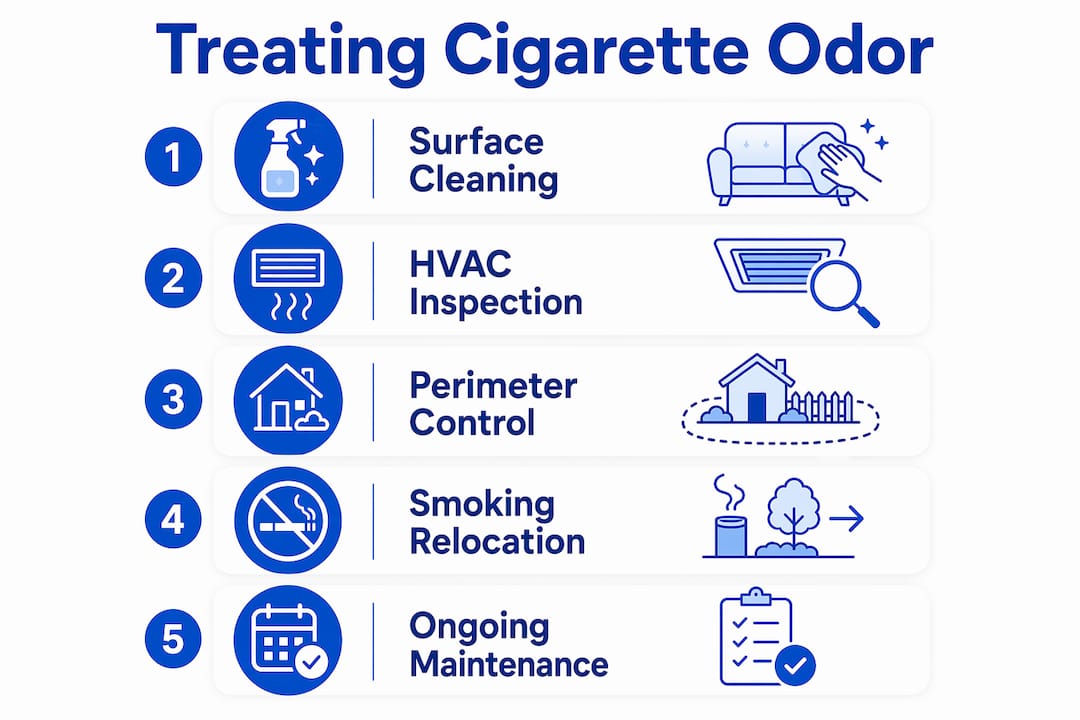
- Treating cigarette smell at building entrances requires removing surface residue, protecting the HVAC intake, and installing perimeter controls. Commercial properties need surface deep-cleaning, HVAC inspection, and long-term repairs to prevent odor recurrence. Professional odor removal ensures permanent results using eco-friendly, licensed methods that address underlying system issues.
To treat cigarette smell near a building entrance, do three things immediately: stop smoke from entering the air system, remove nicotine residue from every surface it has touched, and protect your HVAC fresh-air intake from pulling contaminated air inside. Most property managers address one of these and wonder why the smell keeps coming back. All three have to move together.
Start here:
Sweep up cigarette butts and empty exterior ash receptacles daily
Place activated charcoal absorbers in sheltered spots near the vestibule
Keep lobby doors closed to create a buffer zone between outside and inside air
Identify where your fresh-air intake is located relative to the smoking zone
Check for visible nicotine staining on walls, trim, and door frames near the entrance
If the smell returns within 24 hours of cleaning, the source pathway has not been addressed. That is when surface chemistry, HVAC inspection, and possibly a licensed professional become necessary.
Pro Tip: Before spending money on dispensers or sprays, locate your building’s fresh-air intake. If it sits within 20 feet of where people smoke, every other fix is temporary.
Table of Contents
- 1. Quick fixes you can put in place today to reduce entrance odor
- 2. How to remove thirdhand smoke residue from entrance surfaces
- 3. Which building systems to inspect and fix to stop HVAC from reintroducing smoke
- 4. Perimeter design options that stop smoke before it reaches the door
- 5. When the smell keeps coming back: signs you need a professional
- 6. A repeatable maintenance schedule to keep the entrance odor-free
- Key Takeaways
- What property managers often get wrong about entrance odor
- Masterodorremoval handles entrance cigarette odor for commercial properties
- Useful sources
1. Quick fixes you can put in place today to reduce entrance odor
Short-term measures will not eliminate smoke odor permanently, but they buy time and reduce tenant complaints while you plan deeper work. The goal is to cut the concentration of airborne particles and remove the loose surface deposits that keep off-gassing.
Sweep the entrance area and pressure-rinse hard surfaces near the door. Cigarette residue clings to concrete, brick, and metal, and smoke particles penetrate porous surfaces quickly, so even a light rinse removes the top layer of loose contamination. Empty exterior butt cans every morning, not every few days. A full ash receptacle is an active odor source sitting six feet from your door.
Activated charcoal absorbers placed in sheltered spots near the vestibule work without fragrance. Leave them in place for several days and replace them when they stop absorbing. Baking soda in open containers works similarly for low-traffic periods. Neither is a cure, but both reduce ambient concentration while you work on the real fix.
Move the designated smoking spot as far from the entrance as the property allows. Add clear signage and a covered ash urn at the new location. Tenants generally comply when the alternative spot is convenient and clearly marked.
Operationally, run vestibule fans to create slight positive pressure so outside air is pushed away from the door rather than drawn in. Keep entry doors closed between uses. These two steps alone can cut how much smoke-laden air drifts into the lobby.
Pro Tip: Masking sprays are a finishing touch, not a starting point. Applying fragrance to a residue-saturated surface can react and produce a worse combined odor. Clean first, neutralize second, add fragrance last — if at all.
2. How to remove thirdhand smoke residue from entrance surfaces
Thirdhand smoke is the sticky, yellowish residue that nicotine and combustion byproducts leave on walls, trim, door frames, mats, and upholstery after the visible smoke has cleared. It keeps off-gassing for weeks or months, which is why an entrance can smell like cigarettes even when no one has smoked near it recently. Masking products and simple spray air fresheners do not touch this layer. You need surface chemistry.
Deep-clean sequence for commercial entrances:
- Remove all textiles: entrance mats, upholstered seating, fabric wall panels. Launder what can be laundered; replace what cannot.
- HEPA vacuum all hard surfaces, working top to bottom. Slow passes matter here — rushing leaves particles behind.
- Degrease walls, trim, door frames, and ceilings with an appropriate commercial cleaner. Eco-friendly enzymatic or plant-based degreasers break down nicotine compounds rather than just lifting surface dirt.
- Wipe down with a dedicated odor neutralizer after degreasing. Fragrance-only sprays are not neutralizers — look for products that chemically break down odor compounds.
- Mop hard floors with a neutralizing solution, not a scented cleaner.
- Treat porous materials (grout, unsealed concrete, wood trim) with a penetrating encapsulant if degreasing alone does not hold.
What to replace rather than clean:
- Carpet pad that has absorbed years of residue rarely cleans out fully. Replace it.
- Ceiling tiles with visible yellowing have absorbed enough nicotine that cleaning is rarely cost-effective.
- Upholstered lobby furniture near the entrance should be replaced if steam cleaning does not remove the odor after two attempts.
Schedule this work during off-hours. A commercial entrance is a high-traffic area, and wet surfaces plus cleaning chemicals create both safety and tenant-relations issues during business hours. Professional remediation for cigarette odor at entrances requires this full sequence: deep cleaning of sticky nicotine residue first, then application of professional-grade neutralizers. Skipping the degreasing step and going straight to a spray is the single most common reason the smell comes back.
3. Which building systems to inspect and fix to stop HVAC from reintroducing smoke
Your HVAC system can undo every surface-cleaning effort in a matter of hours. If the fresh-air intake is located near a smoking zone, the system continuously pulls smoke into ducts and distributes it throughout the building. This is the most common reason entrance odor persists after thorough cleaning.
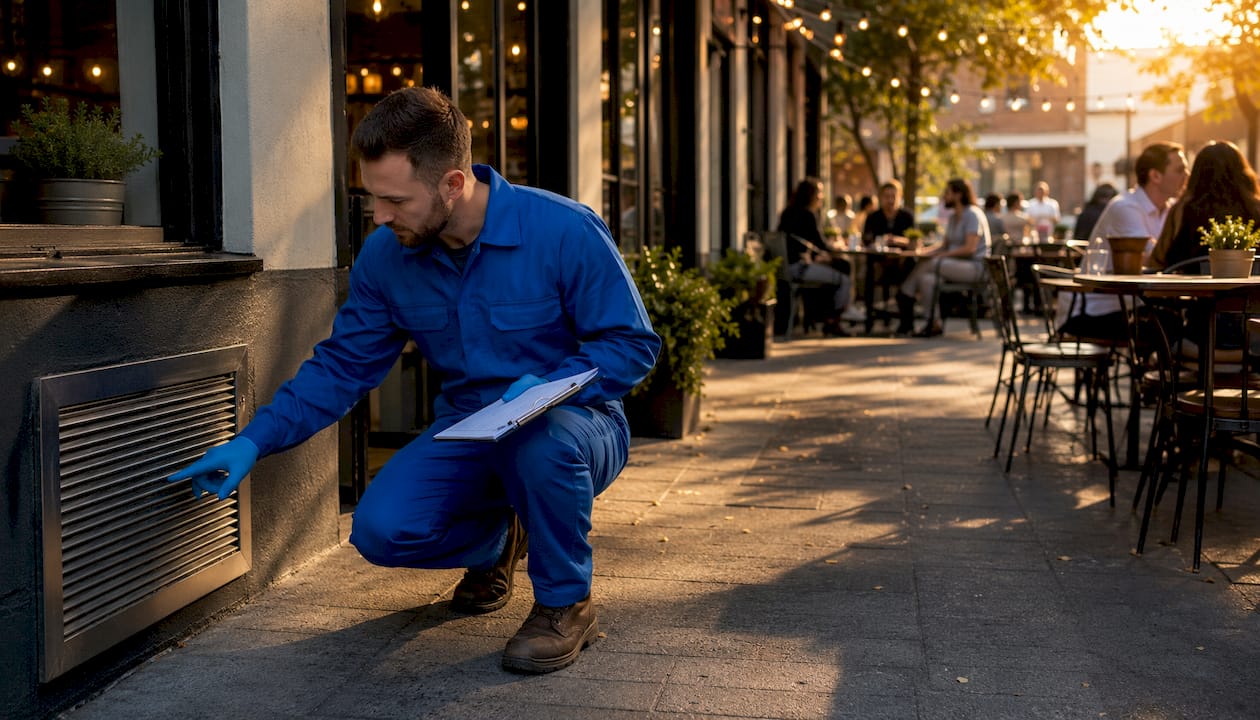
Inspection checklist:
| System Component | What to Look For | Action |
|---|---|---|
| Fresh-air intake location | Within 20 feet of smoking area | Relocate or add pre-filter |
| Return grille near entrance | Nicotine film, discoloration | Clean grille, inspect duct behind it |
| Air filters | Saturation, brown/yellow discoloration | Upgrade to MERV-13 or higher with activated carbon media |
| Evaporator coil | Oily residue, reduced airflow | Schedule coil decontamination |
| Drain pan | Sludge, odor at pan level | Clean and treat with enzymatic solution |
| Duct lining | Visible residue, persistent smell after coil cleaning | Duct cleaning with targeted oxidizing or enzymatic chemistry |
MERV-13 filters capture fine particles effectively, and adding activated carbon media or dedicated carbon cartridges addresses the volatile organic compounds (VOCs) that carry cigarette odor. Standard fiberglass filters do not touch VOCs at all.
Deep contamination in HVAC coils, drain pans, and duct linings requires combined treatment: duct cleaning plus evaporator coil decontamination using oxidizing or enzymatic chemistries that break down odor compounds rather than coating them. This is specialist work. Schedule it separately from routine filter changes.
Air purifiers with HEPA filtration capture particles, while activated carbon media adsorbs odors. They are useful supplements in the lobby, but they do not remove embedded surface residues and cannot compensate for a contaminated HVAC system. Treat them as a layer of support, not a replacement for the work above.
One critical safety note: ozone generators are sometimes marketed as a fast odor fix. In occupied buildings, ozone at effective concentrations is a respiratory irritant and poses real health risks. Avoid them. Eco-friendly enzymatic and plant-based neutralizers achieve permanent results without the hazard.
4. Perimeter design options that stop smoke before it reaches the door
The most effective long-term strategy shifts the problem from remediation to prevention. Once you have cleaned surfaces and addressed the HVAC, the goal is to keep smoke from reaching the entrance in the first place.
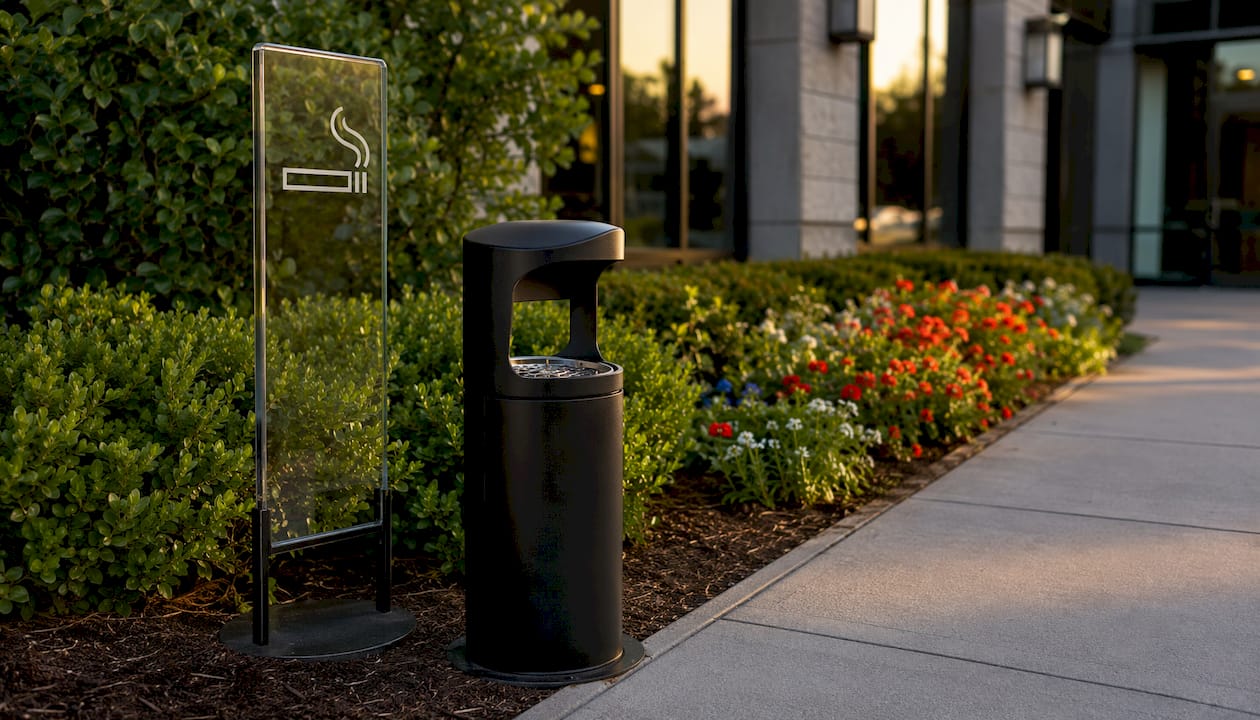
Designated smoking area relocation is the highest-impact single change. Move the smoking zone to a location sufficiently far from the entrance, downwind when possible, and equipped with a covered ash urn. Clear signage and a direct path to the new location improve compliance significantly.
| Perimeter Solution | How It Works | Best Fit | Maintenance |
|---|---|---|---|
| Air curtain (door-mounted) | High-velocity air stream blocks outdoor air from entering | Entrances with high foot traffic | Annual motor inspection |
| Misting neutralizer (gate-type) | Sprays plant-based deodorizer on clothing as people enter | Buildings with shared smoking rooms near entrance | Weekly refill check |
| Outdoor odor dispenser | Timed release of neutralizing mist near entrance | Low-to-medium traffic entrances | Refill per traffic volume |
| Covered ash urn (relocated) | Concentrates butts and residue away from door | All properties | Daily emptying |
Gate-type misting neutralizers work by treating smoke that clings to clothing before it is tracked inside. This is a meaningful distinction: the odor is neutralized at the perimeter, not managed after it has already entered the lobby.
For dispensers, high-traffic sites may require weekly refills. A unit set on a 15-minute interval in a busy lobby can exhaust its supply faster than the scheduled maintenance visit. Build refill checks into your weekly walkthrough, not your monthly one.
Check local ordinances before installing any perimeter system. Many U.S. municipalities have specific rules about smoking distances from building entrances, and some jurisdictions require posted signage. Compliance with those rules is a prerequisite, not an afterthought.
5. When the smell keeps coming back: signs you need a professional
Some entrance odor problems are beyond what a maintenance team can resolve with cleaning supplies and dispenser units. Knowing when to escalate saves time and avoids repeated failed attempts.
Call a licensed odor-removal professional when:
- Tenants report the smell daily despite regular cleaning
- Visible nicotine staining returns within days of wiping surfaces
- The HVAC system is distributing odor to floors above the entrance
- DIY degreasing and neutralizing have not held for more than a week
- The smell is present even when no one has smoked near the entrance recently
What professional remediation includes:
- Full inspection of surfaces, HVAC components, and air pathways
- Surface chemistry treatment using professional-grade neutralizers that chemically break down nicotine compounds
- Evaporator coil decontamination and drain pan treatment
- Targeted encapsulation of porous materials that cannot be replaced
- Follow-up verification using before-and-after VOC measurement or odor panel assessment
For entrance-specific remediation, expect a timeline of one to two days depending on the extent of surface contamination. Full-suite HVAC remediation alongside surface work typically runs two to three days. Cost ranges vary by building size, contamination level, and market, so get a written scope of work before committing.
Questions to ask any vendor before booking:
- Are your technicians licensed and trained in odor chemistry?
- Do you use ozone or chlorine treatments? (The correct answer is no.)
- Can you provide before-and-after VOC readings or a smell verification protocol?
- Do you offer a satisfaction guarantee?
- What is your availability for same-day or next-day service?
Masterodorremoval uses licensed technicians, green-certified chemistry with no ozone and no chlorine, and provides measurable before-and-after results with same or next-day availability for commercial clients.
6. A repeatable maintenance schedule to keep the entrance odor-free
One-time remediation only holds if it is followed by a consistent maintenance cadence. Entrance areas accumulate residue and odor continuously, so the schedule has to match the traffic.
Daily:
- Empty exterior ash receptacles and butt cans
- Sweep entrance area; spot-mop if needed
- Check dispenser units for function and supply level
Weekly:
- Refill outdoor dispenser units and misting systems
- Wipe door frames, handles, and trim with a neutralizing solution
- Inspect entrance mats; launder or replace if saturated
- Log any tenant odor complaints with date, location, and staff initials
Monthly:
- Deep-spot-clean walls and trim near the entrance
- Check HVAC return grilles for visible residue
- Replace activated charcoal absorbers
- Review complaint log and flag recurring patterns
Quarterly:
- Schedule HVAC filter inspection and replacement (more frequently if filters saturate early)
- Inspect fresh-air intake for proximity issues or debris
- Assess whether any surface materials need replacement rather than continued cleaning
For workplace odor maintenance programs, a simple log with five fields covers most needs: date, task completed, staff initials, any observations, and next scheduled date. Keep it posted near the maintenance closet or in a shared digital folder so the escalation path is clear when a complaint comes in that the team cannot resolve.
When a tenant reports persistent odor that the maintenance log shows has been addressed multiple times without resolution, that is the escalation trigger. Route it to building management and initiate a professional inspection rather than scheduling another round of the same cleaning.
Key Takeaways
Treating cigarette smell at a building entrance requires three simultaneous actions: remove surface residue, protect the HVAC intake, and install perimeter controls that stop smoke before it enters.
| Point | Details |
|---|---|
| Start with the HVAC intake | If the fresh-air intake sits near the smoking zone, every other fix is temporary until that is addressed. |
| Clean before you neutralize | Degrease nicotine residue from all surfaces first; applying fragrance to contaminated surfaces worsens the odor. |
| Match maintenance to traffic | High-traffic entrances need daily ash removal and weekly dispenser refills, not monthly checks. |
| Know the escalation triggers | Persistent daily complaints, returning nicotine staining, or HVAC-distributed odor all warrant a licensed professional. |
| Masterodorremoval for commercial sites | Licensed technicians, green-certified chemistry with no ozone or chlorine, and same or next-day availability for entrance remediation. |
What property managers often get wrong about entrance odor
The conventional approach to cigarette smell at a building entrance is to add fragrance. A dispenser goes up near the door, a cleaning crew sprays something after complaints, and the problem is considered managed. It is not managed. It is masked, and masking on top of nicotine residue often produces a combined smell that tenants find worse than the original.
The shift that actually works is from scent management to chemical decontamination. Nicotine is a sticky, oily compound that bonds to surfaces at a molecular level. You cannot spray over it. You have to break it down. That requires the right chemistry applied in the right sequence, not a stronger air freshener.
There is also a tendency to treat the entrance as an isolated problem when it is usually a symptom of a building-system issue. The HVAC intake placement, the location of the smoking area relative to prevailing wind, the absence of a perimeter barrier — these are the real variables. Fix them, and the entrance stays clean with normal maintenance. Ignore them, and you are cleaning the same surfaces every week indefinitely.
The properties that solve this permanently are the ones that treat it as an infrastructure problem, not a housekeeping problem. That framing changes what gets budgeted, who gets called, and how long the fix actually lasts.
Masterodorremoval handles entrance cigarette odor for commercial properties

Persistent cigarette smell at a building entrance is a commercial odor removal problem that requires licensed technicians, the right surface chemistry, and HVAC expertise — not another round of spray and hope. Masterodorremoval provides permanent, eco-friendly odor elimination using green-certified methods with no ozone and no chlorine, with same or next-day availability for commercial sites including office buildings, hotels, and multi-tenant properties.
The service covers surface decontamination, professional-grade neutralization, and follow-up verification so you have measurable proof the problem is resolved, not just temporarily quieted. Every job comes with a satisfaction guarantee. Contact Masterodorremoval to schedule an inspection or book a same-day service visit for your property.
Useful sources
| Source | What It Covers | Best For |
|---|---|---|
| Oklahoma State University Extension: Removing Smoke Odor | Deep-cleaning sequence for smoke-contaminated surfaces; activated charcoal use; pressure washing exterior surfaces | Deep-clean protocols and surface treatment guidance |
| Home Depot: How to Get the Smoke Smell Out of a House | Particle behavior, surface penetration, masking vs. neutralizing | Background on why masking fails and what permanent removal requires |
| Cleaners Hub: Tobacco Odour Neutraliser Guide | Commercial-grade neutralizers, dispenser maintenance cadence, refill schedules | Dispenser planning and commercial neutralizer selection |
| Sania Service: How Smoke Smell Gets Inside AC Ducts | HVAC intake placement, coil contamination, duct cleaning scope | HVAC inspection and remediation planning |
| Maid Cleaning Nashville: How to Remove Cigarette Smell | HEPA + activated carbon air purifiers, textile removal, ventilation tactics | Air-cleaning supplement selection and quick DIY checks |
| LC Heating & Air: How to Clean Air Conditioner Vents | Practical vent-cleaning steps for building owners | HVAC vent maintenance and cleaning procedures |
| Masterodorremoval: Commercial Odor Removal | Professional entrance and facility odor remediation services | Property managers ready to hire a licensed professional |
Recent Comments