
Yes, most skunk smell in a car can be neutralized, and you don’t need to gut the interior to do it. The compounds that make skunk spray so brutal are sulfur-based molecules called thiols, and thiols break down through oxidation, not through air fresheners or wishful thinking.
The single most effective first move is mixing a hydrogen peroxide, baking soda, and liquid dish soap solution in proper proportions, then applying it to whatever got hit, whether that’s a tire, a wheel well, or fabric. Mix it fresh. Use it immediately. This combination oxidizes the thiol molecules and physically breaks them apart, which is chemically different from anything a can of aerosol deodorizer can do.
Full removal takes three separate zones of attack:
- Exterior: tires, wheel wells, undercarriage, exhaust
- Interior: upholstery, carpet, mats, hard trim
- HVAC: cabin air filter and vent intake
Skip the HVAC step and the smell keeps coming back every time you run the fan. Skip the exterior step and you’ll keep tracking oils back into the cabin on your shoes.
TL;DR:
- Proper treatment requires neutralizing skunk oil on exterior surfaces, interior fabrics, and HVAC systems, with each zone needing specific cleaning techniques.
- Using a fresh peroxide, baking soda, and dish soap mixture on affected areas is essential, as it oxidizes and breaks down sulfur-based thiols that cause the smell.
- Immediate action within the first hour—ventilating, rinsing, and applying the neutralizer—is crucial to prevent the odor from penetrating deeply into fabrics and plastics.
- Replacing the cabin air filter with a charcoal-impregnated one and treating the HVAC system prevent recurring odors when the fan is active.
- Persistent smells after DIY efforts often indicate saturation in seat foam or HVAC components, requiring professional deep-cleaning with eco-certified methods.
Table of Contents
- Skunk Smell In Car: The First 60 Minutes Matter Most
- How Do You Clean Skunk Smell Out Of Upholstery And Carpet?
- Cleaning Skunk Oil Off Tires, Wheel Wells, And The Undercarriage
- Why Does My Car Still Smell Like Skunk After Cleaning?
- When Should You Call A Professional Odor Removal Service?
- How Do You Know The Smell Is Actually Gone?
- Key Takeaways
- What Most Advice Gets Wrong About Skunk Odor
- Get Skunk Odor Fully Removed Without The Guesswork
- Sources
Skunk Smell In Car: The First 60 Minutes Matter Most
What you do in the first hour determines whether this is a weekend project or a two week ordeal. Skunk oil is a thick, oily secretion, and the longer it sits, the deeper it penetrates plastic, rubber, and fabric fibers. Work through this sequence in order.
- Ventilate immediately. Open every door and window. Skunk spray contains volatile compounds that irritate eyes and throat in an enclosed space, so don’t seal yourself in with it.
- Put on gloves and eye protection before touching anything the skunk oil contacted. It’s an irritant, not just a smell.
- Set the HVAC to recirculate for a few minutes to stop pulling outside air through the intake, then shut the blower off entirely. Running fresh-air mode now just feeds contaminated air straight into your ducts.
- Pull everything loose out of the car. Floor mats go outside on pavement, not on your lawn. Bag any fabric items that got sprayed directly, they need separate treatment or disposal.
- Pressure-rinse the wheel wells and undercarriage before you touch them with any chemical. Mechanical removal of the bulk oil has to happen before neutralization works, the same way you’d rinse a greasy pan before scrubbing it.
- Mix your peroxide neutralizer in an open container, right before you use it. Combining hydrogen peroxide, baking soda, and dish soap triggers a chemical reaction that releases oxygen gas. Seal that mixture in a spray bottle or jar and you’ve built pressure with nowhere to go. Sponge or spray it on affected exterior surfaces, let it sit five to ten minutes, then rinse.
Pro Tip: Keep the peroxide mixture in the sun for a minute before you toss out the leftovers, if there’s fizzing, that’s the oxygen reaction working as intended, not a sign anything went wrong.
This checklist alone typically knocks out 70 to 80 percent of the surface odor, according to detailing professionals who document the sequence step by step. What’s left after this hour is usually trapped inside fabric, carpet padding, or the HVAC system, and that requires the more careful work in the sections below.
How Do You Clean Skunk Smell Out Of Upholstery And Carpet?
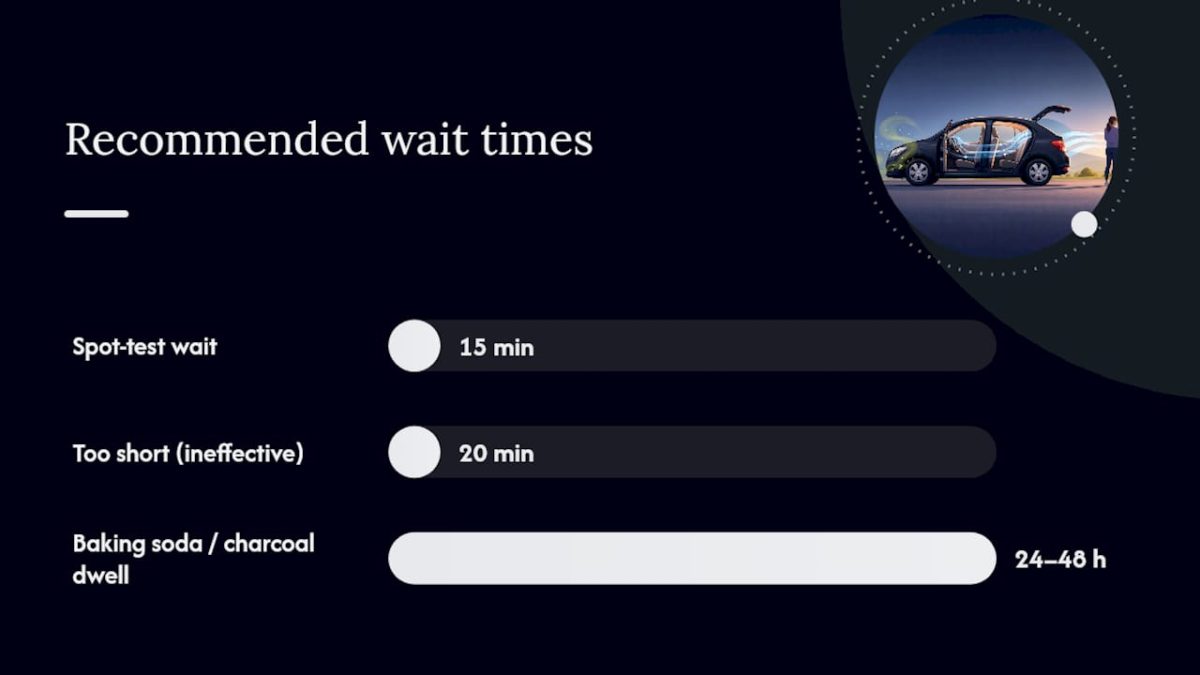
Test first, clean second. Dab a small amount of your peroxide mixture on a hidden patch of fabric, like under a seat or inside a door pocket, and wait 15 minutes to check for discoloration. Hydrogen peroxide is a mild bleaching agent, and dark or dyed upholstery can lighten unevenly if you skip this step.
Once you’ve confirmed it’s safe, here’s the actual technique:
- Dab, don’t scrub. Professional detailers consistently warn that aggressive scrubbing pushes oily skunk contaminants deeper into fabric fibers instead of lifting them out. A clean cloth pressed and lifted repeatedly does more good than a stiff brush.
- Use the peroxide mix or an enzymatic cleaner on fabric seats, carpet, and mats. Enzymatic cleaners work by breaking down organic compounds biologically rather than chemically, which makes them a gentler option for delicate upholstery.
- Sprinkle baking soda liberally across carpet, seats, and mats after the wet treatment dries. Baking soda absorbs odor molecules through simple chemistry, sodium bicarbonate is mildly alkaline and binds with acidic odor compounds. Activated charcoal works on the same absorption principle and handles a broader range of odors.
- Let it sit 24 to 48 hours, then vacuum thoroughly. This dwell time matters. Pull the baking soda up after twenty minutes and you’ve barely started the absorption process.
- Wipe hard surfaces (dashboard, door panels, plastic trim) with a 1:1 vinegar and water solution as a final pass, then dry everything completely with a microfiber towel. Trapped moisture in a closed car is its own odor problem waiting to happen.
Here’s the harder truth: if the skunk spray reached the seat foam underneath the fabric or soaked into the headliner, sprinkling baking soda on top isn’t going to reach it. Foam absorbs and holds onto odor compounds the way a sponge holds water, and no amount of surface treatment pulls it back out. That level of saturation usually means professional extraction equipment or, in bad cases, replacing the affected foam and material entirely.
Cleaning Skunk Oil Off Tires, Wheel Wells, And The Undercarriage
The exterior work matters as much as anything you do inside the cabin, because skunk oil sprayed near the wheels doesn’t stay near the wheels. It gets flung around by tire rotation, tracked into wheel wells, and baked onto hot components every time you drive.
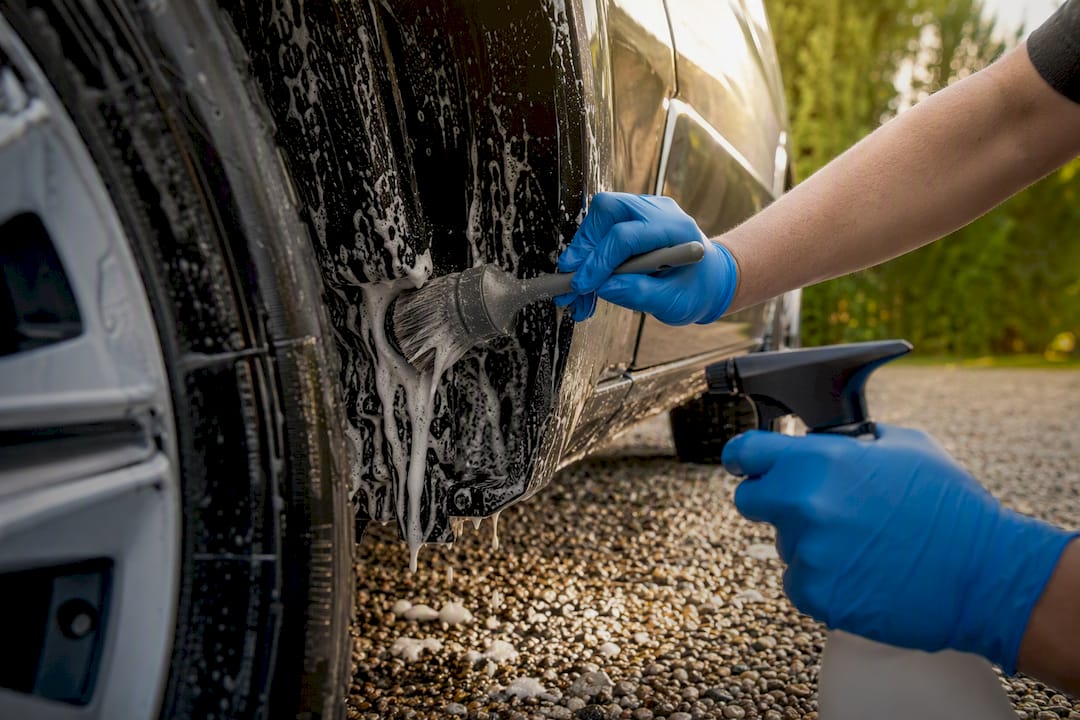
Start with a pressure washer or a strong hose setting to blast away settled residue before you introduce any chemical. This is the same mechanical removal principle as interior cleaning: you can’t neutralize oil that’s still sitting there in bulk, you have to physically dislodge most of it first.
Once the surface is rinsed, apply the peroxide neutralizer to:
- Wheel wells and splash liners, where oil tends to pool in the textured plastic
- Tire sidewalls, especially if the skunk was directly underneath the car
- Undercarriage plastic and rubber components, using a stiff-bristled brush to work the solution into textured surfaces
Wear gloves and eye protection during this step too. Let the mixture dwell for five to ten minutes, then rinse thoroughly with clean water.
Don’t skip the exhaust system. Skunk oils bind to hot metal surfaces and get baked in every time the engine runs, which means a cold degrease pass before neutralizing is worth the extra ten minutes. Heat re-releases the odor compounds later, so treating a hot or recently-driven exhaust pipe wastes your effort.
One more detail that trips people up: don’t let the neutralizer bake in direct sunlight. Heat can reactivate residual skunk oils on surfaces rather than help the chemical reaction along. Work in shade or a garage, and rinse everything before it dries in the sun.
Why Does My Car Still Smell Like Skunk After Cleaning?
If the odor fades when the car sits still but comes roaring back the moment you turn on the fan, your HVAC system is the culprit, not your upholstery. Cabin air filters are designed to trap particles and odors, which means they trap skunk-derived compounds too, and then recirculate that smell every time air passes through.
Here’s the fix, step by step:
- Locate your cabin air filter. It’s typically behind the glovebox or under the dashboard, check your owner’s manual for the exact spot since it varies by make and model.
- Replace it with a charcoal-impregnated filter if your vehicle supports one. Activated charcoal filters trap residual odor more effectively than standard filters because the charcoal itself has an enormous surface area for absorption.
- Spray a safe, automotive-approved HVAC duct cleaner or a diluted vinegar solution into the fresh-air intake vents, typically located at the base of the windshield.
- Run the fan on fresh-air mode for 10 to 15 minutes with windows down to ventilate while the duct treatment works through the system.
Pro Tip: Run this HVAC treatment on a warm day with the sun out. Warmer air moves faster through the ducts and helps carry the odor compounds out through the vents rather than letting them linger.
If you’ve replaced the filter and treated the intake and the smell still comes through the vents, the evaporator core itself may be contaminated. That component sits deep in the dashboard assembly, and reaching it without the right tools risks damaging the HVAC housing. That’s the point where DIY hits a hard ceiling, and calling in someone with the right equipment stops being optional.
When Should You Call A Professional Odor Removal Service?
Some skunk incidents are a weekend fix. Others aren’t, and knowing the difference saves you weeks of frustration. Call in professional help when you notice any of these signs:
- The smell persists after you’ve completed the full exterior, interior, and HVAC protocol
- Odor returns noticeably stronger whenever the car heats up in the sun or after driving
- You suspect the seat foam, carpet padding, or headliner absorbed spray directly
- The evaporator core or deep HVAC ducting seems to be the source
Professional treatment differs from DIY in a few concrete ways: technicians use controlled oxidation methods, deep-extraction equipment that pulls contaminants out of foam and padding rather than just the fabric surface, and targeted HVAC remediation that reaches components a home mechanic can’t access without disassembling the dashboard.
Skunk contamination behaves less like a bad smell and more like a biological spill that needs to be treated at the source rather than masked at the surface. That’s the standard we hold every vehicle to.
Masterodorremoval approaches this work as a green-certified operation, which means the elimination methods used skip ozone and chlorine treatments entirely in favor of safe, sustainable techniques. That distinction matters if you’re dealing with a luxury vehicle interior, a leased car headed back to the dealership, or simply want the smell gone without introducing new chemical residue into a space you sit in daily.
How Do You Know The Smell Is Actually Gone?
Don’t declare victory after one good sniff with the windows down. Run a proper test sequence: turn on the heat for five minutes, then switch to AC for five minutes, then run fan-only with no climate control. Each mode pulls air through different parts of the system, and lingering odor often shows up in only one setting.
Check three spots specifically: the driver’s footwell carpet, the seat cushions, and directly at the vents. Then walk away and come back in 24 to 48 hours, because some odor compounds need time to off-gas fully, and a car that smells clean immediately after treatment can develop a faint return as trapped compounds work their way out.
Leave absorbers in place as ongoing insurance:
- Baking soda in a shallow dish under a seat, replaced every few weeks
- Charcoal bags tucked into map pockets or under mats for continuous, passive absorption
Prevention beats round two of this entire process. Park with windows fully closed in rural or wooded areas. Avoid driving slowly through known skunk territory around dawn and dusk, when they’re most active. Keep removable items sealed in bins rather than loose in the cargo area, and give your wheel wells a quick visual check after any rural or backroad trip.
Key Takeaways
Skunk odor in a vehicle is a solvable chemistry problem, not a permanent condition, when you treat the exterior, interior, and HVAC as three separate zones in that order.
| Point | Details |
|---|---|
| Neutralize with the right mix | Combine hydrogen peroxide, baking soda, and dish soap in proper proportions, mixing fresh and using immediately. |
| Work in three zones | Treat exterior surfaces first, then interior fabric, then HVAC, since skipping one lets the smell return. |
| Don’t scrub fabric | Dab and blot upholstery instead of scrubbing, which pushes oily residue deeper into fibers. |
| Replace the cabin filter | Swap in a charcoal-impregnated filter, since a saturated filter keeps recirculating trapped odor. |
| Escalate when DIY plateaus | Masterodorremoval offers eco-certified professional treatment for seat foam, headliner, and evaporator contamination that surface cleaning can’t reach. |
What Most Advice Gets Wrong About Skunk Odor
Most articles on this topic treat skunk smell like a single problem with a single fix, usually some version of “spray this, wait, done.” That’s why so many car owners end up frustrated two weeks later when the smell creeps back the moment they turn on the heat. The odor was never one problem. It was three, sitting in the exterior, the fabric, and the ductwork, and treating only one of them buys you a temporary win.
The sequence matters more than any single product. Mechanical removal before chemistry, chemistry before absorption, and the cabin filter treated as a required step rather than an afterthought. Skip the order and you’re just moving the smell around.
Where I’d push back on conventional wisdom: too much advice treats “professional help” as a last resort for people who failed at DIY. It’s really a different tool for a different problem. Deep foam saturation and evaporator core contamination aren’t failures of effort, they’re physical limits of what a spray bottle and a shop vac can reach.
— Master
Get Skunk Odor Fully Removed Without The Guesswork
If you’ve worked through the exterior, interior, and HVAC steps above and the smell still lingers, or you’d rather skip the multi-day process entirely, Masterodorremoval handles the parts of skunk contamination that DIY methods hit their limit on: saturated seat foam, headliner absorption, and evaporator core buildup that no amount of baking soda reaches.

The service uses green-certified methods with no ozone and no chlorine, which matters if you’re treating a car you or your family sit in every day, or a vehicle headed for resale where lingering odor tanks the sale price. Same-day and next-day scheduling means you’re not living with the smell for another week while you wait on an appointment. Technicians inspect the full vehicle, including the zones most home treatments miss, and build a treatment plan around what’s actually contaminated rather than a one-size-fits-all spray-and-hope approach.
If your car still smells like skunk after a genuine DIY attempt, book a vehicle odor assessment and get a clear answer on what it will take to fully clear it.
Sources
- Dealing with striped skunks — CSULB Mammal Lab
- How to get rid of skunk smell — Family Handyman
- How to get rid of skunk smell — Bob Vila
- How to get skunk smell off a car — CarXplorer
- Engineerskill
Recent Comments