
Hiring a professional eco-friendly odor-removal crew delivers permanent odor elimination, protects occupant health, preserves brand reputation and revenue, and saves money on premature furnishing and material replacement. That’s the entire case in one sentence, and it holds whether you manage a hotel, sell luxury cars, or own a yacht. The evidence backs it up: nearly 90% of people worldwide are exposed to indoor air pollutants above recommended limits, facility-management authorities now treat odor as a proactive maintenance priority rather than an afterthought, and Master Odor Removal has built its entire model around fixing the source instead of covering it up. The top five benefits worth knowing before you book anyone:
- Health protection — targets the compounds actually causing symptoms, not just the smell
- Guest and buyer confidence — first impressions form in seconds, and scent is part of that judgment
- Durable results — source-level treatment instead of fragrance masking that fades in days
- Asset protection — prevents early replacement of carpet pad, upholstery, and subfloor materials
- Fast, verified turnaround — same or next-day service with a sign-off you can trust
Key Takeaways
Permanent odor removal requires source diagnosis, green-certified treatment methods, and post-service verification, which is what separates professional crews from DIY fixes and masking sprays.
| Point | Details |
|---|---|
| Odor signals bigger problems | Persistent smell often points to moisture, HVAC contamination, or material saturation, not surface dirt. |
| DIY masks, professionals solve | Store-bought products cover odor temporarily while professional diagnostics target the actual source. |
| Ventilation has limits | Some compounds adsorb into materials and re-emit, meaning airflow alone can’t dilute them away. |
| Timing depends on severity | Same-day triage handles light cases; subfloor or wall cavity contamination can take multiple days. |
| Master Odor Removal fits high-end use cases | The company uses non-ozone, non-chlorine methods with same/next-day service for vehicles, yachts, and hospitality interiors. |
Table of Contents
- What Are the Real Benefits of Professional Cleaning Crews for Odor Removal?
- How Do Professional Crews Outperform DIY Odor Removal?
- What Happens During a Professional Odor Treatment?
- Which Odor Removal Methods Work and Where Do They Fall Short?
- How Much Does Professional Odor Removal Cost and When Should You Call?
- What Should You Ask Before Hiring an Odor-Removal Crew?
- A Specialist’s View on Why Source-Level Treatment Wins
- Get an Eco-Friendly Odor Assessment for Your Property or Vehicle
- Frequently Asked Questions
- Sources
What Are the Real Benefits of Professional Cleaning Crews for Odor Removal?
Odor isn’t just an inconvenience. It’s often the first symptom of a bigger problem, and ignoring it costs more than the treatment would have.
Interior odors correlate strongly with indoor air quality complaints, and the connection runs deeper than most owners assume. A systematic review of indoor odor pollution found that odor-causing compounds can trigger headaches, nausea, and eye, nose, and throat irritation in occupants, especially in poorly ventilated spaces. That’s not a comfort issue. That’s a liability issue for anyone renting, leasing, or reselling a property or vehicle.
Guest and buyer perception moves even faster than health symptoms. Facility-management research from IFMA notes that what visitors smell shapes what they think about a space’s cleanliness and professionalism, often before they’ve noticed anything else. A hotel room that smells faintly of the previous guest’s cigarette, or a car that carries a trace of a prior owner’s dog, undercuts a sale or a five-star review no matter how spotless everything looks.
The financial exposure compounds over time. Persistent odor issues can affect tenant retention, buyer due diligence, and occupancy in commercial real estate, and the same logic scales down to a single rental unit or a single vehicle on a dealership lot.
Pro Tip: Treat any recurring odor as an early-warning signal for moisture intrusion, HVAC contamination, or material saturation, not a surface-level nuisance you can spray away.
How Do Professional Crews Outperform DIY Odor Removal?
DIY odor removal usually means masking, not solving. Air fresheners, baking soda, and consumer enzyme sprays sit on top of the problem while the actual source, often trapped deep in carpet pad, HVAC ductwork, or vehicle cavities, keeps releasing odor molecules. A comparison of DIY versus professional odor removal found that DIY methods routinely fail once contaminants have penetrated porous materials or spread through an air handling system.
Professional crews start where DIY stops: locating the actual air path or material where odor compounds are trapped. From there, they apply targeted diagnostics, extraction, and green chemistries such as thermal fogging and hydroxyl generation, all without ozone or chlorine, followed by material remediation and a post-treatment verification step. Trained technicians also manage occupant reentry timing and chemical concentrations in ways an untrained homeowner or manager can’t replicate safely.
The business impact adds up fast when you compare it against repeat DIY cycles:
- Fewer callbacks because the source gets treated, not the symptom
- Preserved upholstery, carpet, and finishes instead of chemical damage from over-the-counter products
- Less downtime per treatment cycle
- Lower lifetime cost than paying for repeated store-bought fixes that never fully work
The same logic applies outside odor removal entirely — DIY approaches to persistent contamination problems tend to underperform trained crews with the right equipment.
What Happens During a Professional Odor Treatment?
A professional job follows a predictable sequence, and knowing it in advance helps you plan around downtime.
- Intake and scope — you describe the odor type, location, and history so the crew can prep the right equipment
- On-site inspection and source mapping — technicians trace the odor to its actual origin, whether that’s a subfloor, an HVAC coil, or vehicle upholstery
- Spot testing — a small treated area confirms the chemistry works on your specific materials before full application
- Treatment selection — the crew chooses green-certified methods suited to the contamination type and severity
- Targeted cleanup or restoration — extraction, material treatment, or partial replacement where needed
- HVAC or cabin air system cleaning — addressed when odor has traveled through ductwork or vents
- Post-treatment verification — a final check confirms the odor is actually gone, not just masked
Timelines vary with severity. Same-day triage handles light contamination, most targeted remediation jobs run one to three days, and multi-day restoration comes into play when subfloors or wall cavities need attention. You can check specific odor removal timelines before booking to plan around it.
Verification typically involves a structured smell-check protocol and a customer sign-off, sometimes backed by instrument readings for commercial clients who need documentation. Before the crew arrives, clear access to the affected space or vehicle and expect the area to be unusable for the treatment window.
Which Odor Removal Methods Work and Where Do They Fall Short?
No single method handles every odor. Professional crews match technique to contamination type, and that matching is where most of the value lives.
Source removal comes first whenever possible, physically extracting the contaminated material rather than treating around it. Enzymatic cleaners break down organic residues from pet accidents or food spills. Thermal fogging and hydroxyl generation reach into fabric, carpet fiber, and air spaces that surface cleaning can’t touch. Dry ice blasting and activated carbon handle specific surface and airborne contamination. When odor has soaked into carpet pad, subfloor, or drywall, targeted restoration replaces the damaged material outright.
Ventilation alone frequently fails, and there’s a chemical reason for it. The same interdisciplinary review explains that some semi-volatile organic compounds adsorb into materials and re-emit slowly over time, while other odorants have such low detection thresholds that you’d need an impractical amount of air exchange to dilute them below the point a human nose notices.
Even the best professional treatment has limits worth knowing upfront:
- Charred or permanently altered materials from severe fire damage may need replacement, not treatment
- Deep structural contamination sometimes requires partial demolition before remediation can proceed
- Multiple treatment rounds are occasionally necessary for long-neglected or heavily saturated cases
Pro Tip: Insist on an objective verification step, whether instrumental or a structured sensory protocol, since a masked smell can fool a quick walkthrough while the underlying odor compound is still present.
How Much Does Professional Odor Removal Cost and When Should You Call?
Cost depends on a handful of concrete factors: how deep the contamination has penetrated, which materials are affected (carpet pad and upholstery cost more to treat than hard surfaces), the size of the space, the equipment required, and access complexity, especially for boats and tight vehicle interiors. Verification and instrument testing add modestly to commercial jobs that need documented proof.
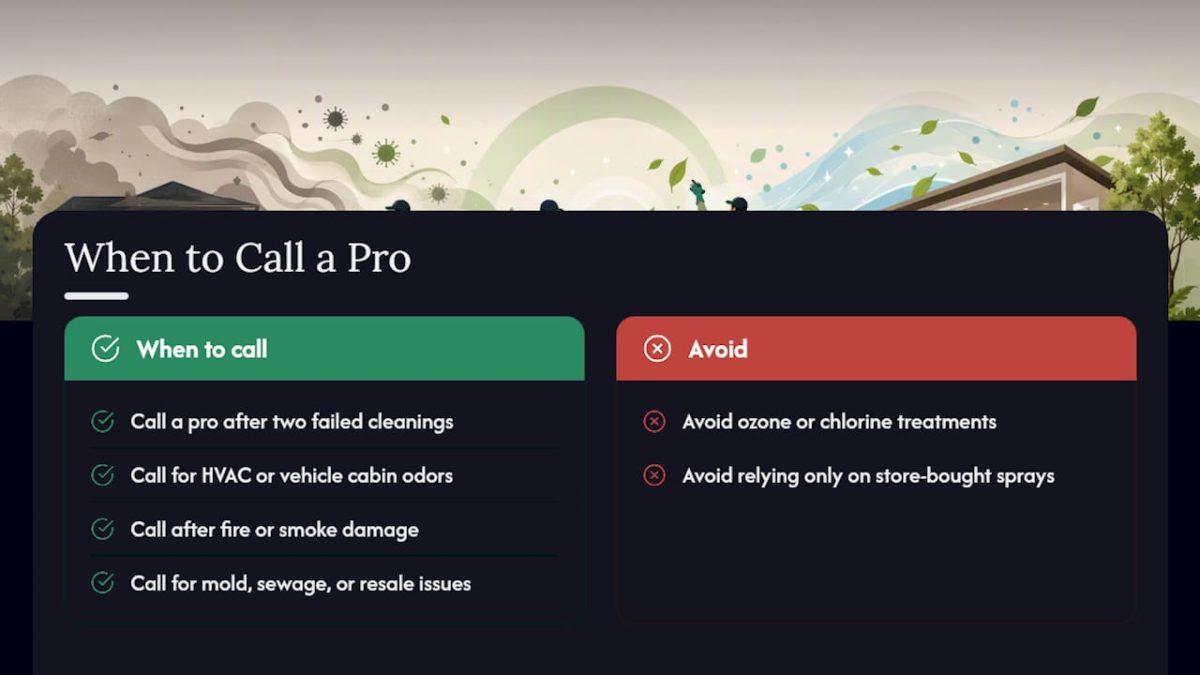
Call a professional immediately if any of these apply:
- Odor persists after two rounds of your own cleaning attempts
- Smell is present in HVAC ducts or a vehicle’s cabin air system
- You’re prepping a property for listing or a rental for turnover
- The space has post-fire smoke damage, mold, or sewage exposure
- Reputation or booking risk outweighs whatever you’d save doing it yourself
One professional intervention typically costs less than the alternative: repeated labor, guest compensation for bad reviews, lost bookings during turnover season, and early replacement of soft goods that never fully recovered from a DIY chemical treatment.
What Should You Ask Before Hiring an Odor-Removal Crew?
A good provider will answer every one of these questions without hesitation. A vague answer is itself useful information.
Checklist before you book:
- Licensed and insured technicians
- Explicit non-ozone, non-chlorine policy in writing
- Documented case studies in comparable settings (luxury vehicles, yachts, hospitality)
- Same or next-day availability for urgent jobs
- Clear, specific method descriptions for your odor type
- A measurable verification step at job completion
Ask directly:
- What diagnostics do you run before starting treatment?
- Which methods apply to my specific odor type?
- Can you show before-and-after results from a similar job?
- How long will the space or vehicle be unusable?
- Are your methods safe for occupants, pets, and furnishings?
- What follow-up or warranty applies if the odor returns?
Red flags include vague method names, heavy reliance on fragrance masking, no comparable case studies in high-end settings, and pricing that isn’t transparent until after the job starts. Always request a written scope of work and a verification checklist to sign once the job is done.
A Specialist’s View on Why Source-Level Treatment Wins
Diagnose first, treat at the source, and prefer green chemistries over anything that trades one problem for another. That’s the whole philosophy, and it holds up because it respects how odor compounds actually behave, not how they smell for the first ten minutes after a spray bottle passes over them.
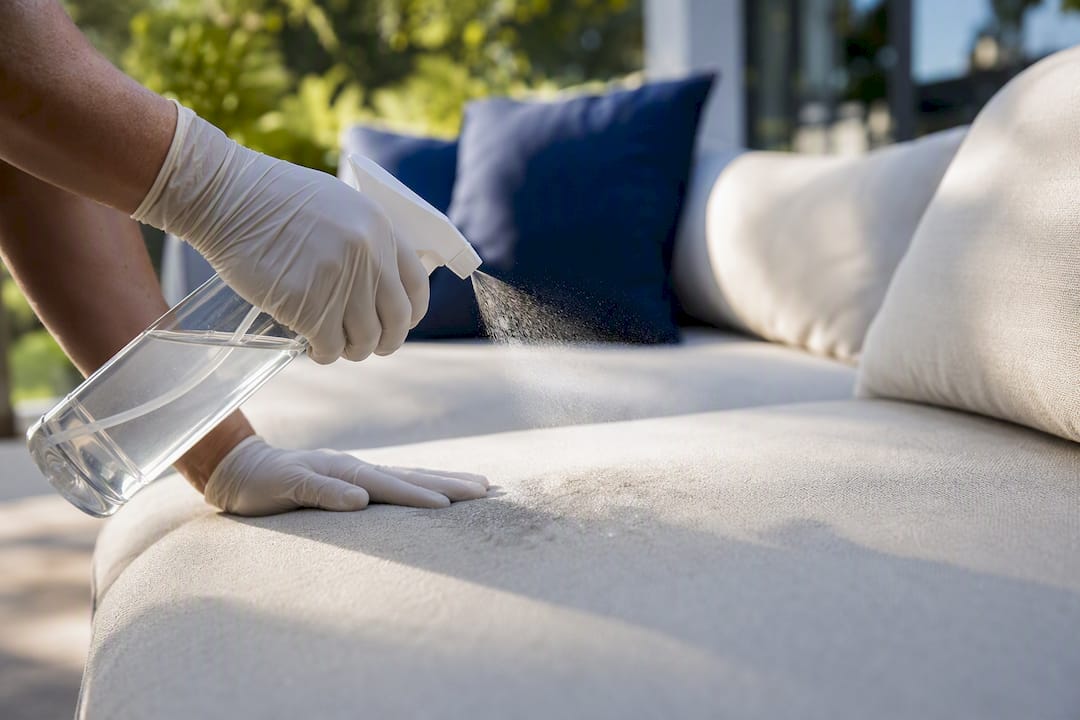
A common case: smoke odor that has migrated past the carpet and into the subfloor beneath it. Masking sprays never touch that layer. Targeted extraction combined with subfloor-level treatment does, and it stays gone because the compound causing the smell is physically removed, not covered.
Safety protocols matter just as much as the chemistry. Occupants and pets can reenter treated spaces once technicians confirm the area meets safe air quality thresholds, no ozone exposure, no chlorine residue, just a verified clean result.
Get an Eco-Friendly Odor Assessment for Your Property or Vehicle
Master Odor Removal specializes in permanent, source-level odor elimination for vehicles, yachts, hotels, vacation rentals, and commercial properties, using green-certified methods that skip ozone and chlorine entirely. That focus matters most for luxury interiors and hospitality spaces, where a masking spray that fades in a week isn’t an option and neither is a treatment that damages fine upholstery or finishes.

What sets the process apart shows up in the details clients actually check before booking:
- Licensed technicians trained in green-certified, non-ozone methods
- Documented case studies, including a luxury car odor removal project in Boca Raton
- Same or next-day availability for urgent turnover, listing, or resale timelines
- Before-and-after verification so you know the job actually worked, not just smelled better temporarily
If you manage a property portfolio, a fleet, or a single high-value asset that needs odor gone for good, request an evaluation through the commercial and hospitality odor removal page and get a scoped quote before your next turnover deadline.
Frequently Asked Questions
What are the main benefits of professional cleaning crews for odor removal?
The core benefits are permanent odor elimination at the source, protection against health symptoms tied to poor indoor air quality, preserved guest and buyer confidence, and savings on premature replacement of carpet, upholstery, and other soft materials.
Why do professional eco-friendly odor-removal services cost more than store-bought products?
Professional treatment includes diagnostics, targeted green chemistry application, and verification, none of which a spray bottle provides. The higher upfront cost usually beats paying for repeated DIY attempts plus eventual professional intervention anyway.
How long does a typical professional odor removal treatment take?
Light contamination often clears same-day. Most targeted jobs run one to three days, and cases involving subfloor or wall cavity damage can take longer. You can review specific timeline expectations before scheduling.
Are ozone and chlorine treatments safe for odor removal?
Ozone and chlorine carry occupant safety risks and can damage sensitive materials, which is why green-certified providers like Master Odor Removal avoid both in favor of hydroxyl generation, enzymatic treatment, and other non-toxic methods.
When should a business or property owner call a professional instead of trying DIY methods?
Call a professional if odor persists after two cleaning attempts, shows up in HVAC or vehicle cabin air systems, follows fire or smoke damage, involves mold or sewage exposure, or affects a property listing, rental turnover, or vehicle resale timeline.
This article is general information, not a substitute for advice from a qualified doctor. Consult a qualified healthcare professional about your own circumstances before acting on anything here.
Sources
- Indoor Odor Pollution: An Interdisciplinary Review from Sources to Control and an Intelligent Building Environment Management Framework
- What Facility Visitors Smell Shapes What They Think
- Commercial Property Value? Understanding Air Quality
Recent Comments