
Chlorine dioxide is generally the safer, more controllable choice for interior odor removal and most mold remediation work, while ozone edges it out only for rapid microbial kills in tightly monitored, unoccupied settings. The trade-off comes down to persistence and material risk: chlorine dioxide leaves a measurable residual that keeps working on hidden mold and deep-set odors, while ozone decomposes fast and can pit rubber, plastic, and metal if the dose or timing is off. The scenario breakdown below tells you which one actually fits your situation.
TL;DR:
- Chlorine dioxide penetrates deep into porous materials and leaves a residual that can suppress mold and odors for weeks, unlike ozone which dissipates quickly.
- Ozone achieves faster microbial kill rates in lab conditions but poses higher material risks and requires on-site generators with destruct units for safe use.
- Both gases must be generated on-site and monitored with calibrated equipment; relying on vague clearance times or unmeasured treatments can cause health and material damage.
- The risks of exposure are significant for both gases, with OSHA and EPA limits guiding safe reentry, and exceeding them can cause respiratory or material damage.
- Professionals prefer non-gas methods due to the complexity and risks of gas-based treatments, especially in occupied spaces, to ensure predictable, safe, and reliable results.
Table of Contents
- Ozone vs Chlorine Dioxide: Quick Comparison at a Glance
- How Ozone and Chlorine Dioxide Are Actually Made
- Which Gas Actually Kills More, Faster?
- What Are the Real Exposure Risks?
- Will Either Gas Damage Your Interior?
- How Should You Choose Between the Two?
- How Do Professionals Actually Control These Risks?
- Why We Skip Ozone and Chlorine Dioxide Entirely
- Sources
Ozone vs Chlorine Dioxide: Quick Comparison at a Glance
Neither gas is a universal fix. Each one earns its place under different conditions, and the strengths of one are often the weak points of the other.
Ozone (O3):
- Decomposes within minutes, so it leaves no chemical residue behind once ventilation clears the space.
- Faster against some pathogens under lab conditions, but that speed comes with corrosivity toward rubber seals, wiring, and finished metal.
- Requires an on-site generator and a destruct unit. Not something you run casually in an occupied room.
- Best suited to empty vehicles, sealed HVAC runs, and short unoccupied treatment windows.
Chlorine dioxide (ClO2):
- Diffuses into fabric, foam, and porous surfaces, which is why it tends to outperform ozone on deep upholstery odor and mold hiding behind drywall.
- Leaves a low-level residual that keeps suppressing regrowth after the initial treatment.
- Byproduct formation (chlorite) needs monitoring, and some materials can stain if the concentration runs high.
- Fits car interiors, closed-room mold jobs, and situations where you want odor control to hold for weeks, not hours.
How Ozone and Chlorine Dioxide Are Actually Made
Both gases share one operational fact that surprises many people: neither one ships in a bottle ready to use. Both must be generated on-site, right before application, because storing them in concentrated form is either impractical or dangerous.
Ozone forms when an electrical charge splits oxygen molecules (O2) into unstable single atoms that recombine into O3. That instability is the whole story with ozone. It reacts fast, breaks down fast, and needs a dedicated generator paired with a catalytic destruct unit to neutralize off-gas before people re-enter the space. No generator, no destruct system, no safe ozone job.
Chlorine dioxide comes from a chemical reaction, usually sodium chlorite combined with an acid or chlorine gas, producing ClO2 gas on demand. It is more stable than ozone in air, which is exactly why it can maintain a detectable residual for hours rather than dissipating in minutes. That persistence changes how technicians plan a job: less urgency around instant off-gassing, more attention to monitoring chlorite buildup over the treatment cycle.
Which Gas Actually Kills More, Faster?
The clearest head-to-head data on this comes from drinking-water disinfection research, and it tells a nuanced story. A controlled study on Cryptosporidium parvum oocysts found that 1 ppm of ozone achieved more than 90% inactivation in just 5 minutes. Chlorine dioxide needed roughly 1 hour at 1.3 ppm to hit a similar inactivation rate. On raw speed against that specific protozoan, ozone wins by a wide margin.
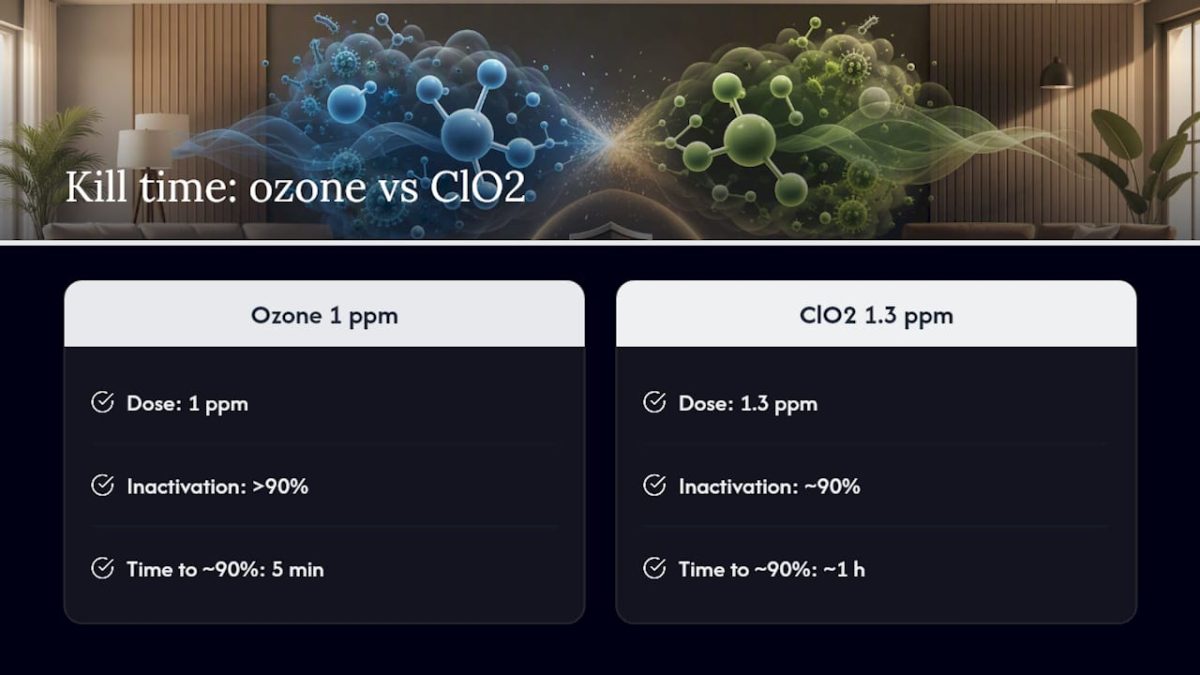
But speed under lab Ct conditions doesn’t translate directly to a moldy closet or a smoke-saturated car seat. Odor and mold remediation is a penetration problem more than a kill-time problem. Chlorine dioxide’s smaller, more stable molecule diffuses through biofilm layers and porous material in a way that ozone, reacting and decaying almost immediately at the surface, often can’t match. That’s part of why practitioners lean toward ClO2 for deep deodorization in enclosed interiors, saving ozone for jobs where a fast oxidant and practical off-gas destruction matter more than depth.
There’s also a distinction worth separating clearly: killing the microbe that causes an odor is not the same as neutralizing the mycotoxins or volatile byproducts it already released. Reviews of ozone’s virucidal activity against airborne SARS-CoV-2 and influenza A confirm strong performance against active pathogens in controlled air, but neither gas reliably erases odor compounds already bonded to fabric fibers or drywall paper.
What Are the Real Exposure Risks?
Both gases are genuinely dangerous above certain concentrations, and the numbers aren’t close to symbolic.
Exposure limits that matter: OSHA and NIOSH set the occupational exposure limit for chlorine dioxide at 0.1 ppm as an 8-hour time-weighted average, with a short-term limit of 0.3 ppm. Cross those thresholds and you’re looking at eye and respiratory irritation, with high concentrations capable of triggering bronchitis or pulmonary edema.
Ozone doesn’t carry a cleaner safety record. The EPA’s technical guidance on ozone disinfection flags it as a strong respiratory irritant at low airborne concentrations, which is exactly why occupied-space use is discouraged without engineering controls. High-dose exposure produces the same acute pattern: airway irritation, coughing, and in severe cases pulmonary injury.
Chlorine dioxide carries a second risk beyond inhalation. It breaks down into chlorite and chloride, and while inhalation is the main occupational exposure route, ingestion of contaminated water or surfaces is the primary general-population concern. Clearing a treated space for reentry means confirming gas levels have dropped below these thresholds with calibrated monitors, not just waiting on a timer or trusting your nose.
Will Either Gas Damage Your Interior?
Ozone is the more aggressive material risk of the two. Its oxidizing power, the same property that makes it effective, also degrades rubber gaskets, weakens certain plastics, tarnishes metal finishes, and can shorten the life of electronics left running in a treatment cycle that runs too long or too concentrated. Leather and vinyl upholstery are particularly vulnerable to premature cracking after repeated ozone exposure.
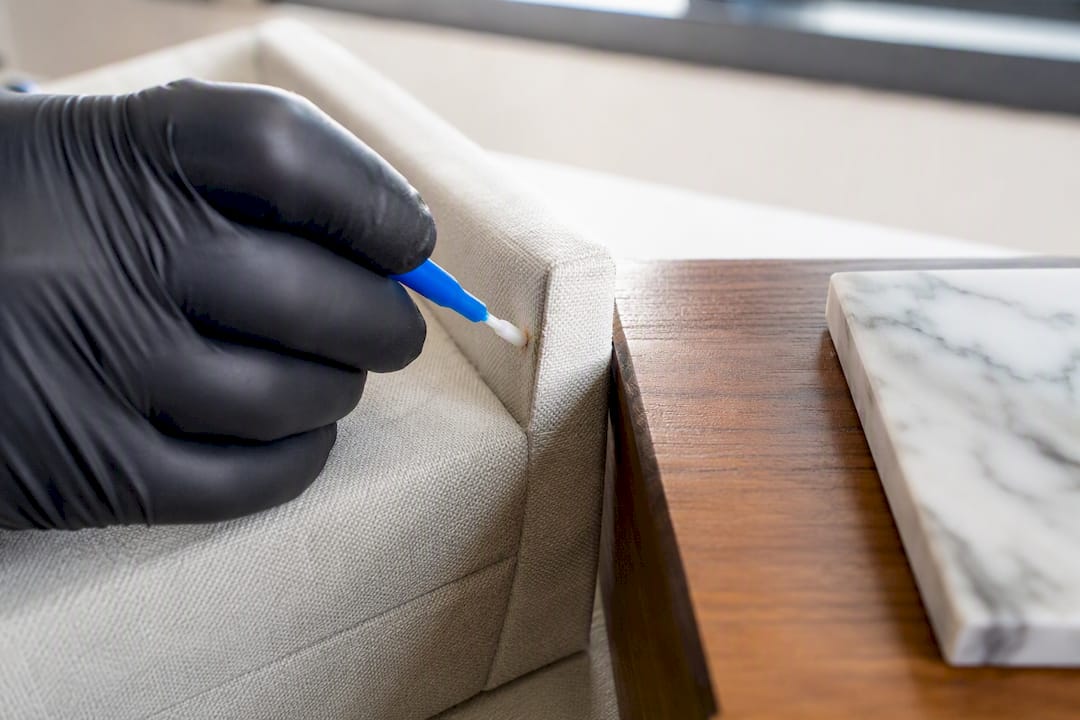
Chlorine dioxide is gentler on rubber and electronics but isn’t risk-free. The chlorite and chlorate residues it forms can stain porous or light-colored surfaces if concentrations run high or dwell time stretches too long. Either gas warrants a test spot on an inconspicuous section of upholstery, stone, or finished wood before a full treatment. Skipping that step is how a single job turns into two problems instead of one.
How Should You Choose Between the Two?
Match the gas to the job, not to whichever service happens to advertise the loudest.
- Choose chlorine dioxide when you need penetration into upholstery, carpet padding, or wall cavities, or when mold sits behind a surface rather than on top of it.
- Choose ozone only for controlled, unoccupied spaces where the treated materials are ozone-tolerant and rapid inactivation outweighs the corrosion risk.
- Verify ventilation and monitoring are part of any quote before agreeing to either treatment.
- Ask about reentry testing. A legitimate provider states a specific clearance reading, not a vague “should be fine by morning.”
- Walk away from consumer ozone machines marketed for occupied homes or cars. These units rarely include destruct systems or calibrated monitoring, and running one while you’re in the vehicle or the house is a documented respiratory hazard.
Pro Tip: If a company can’t tell you the exact ppm level they’re targeting and how they’ll confirm it’s cleared before you return to the space, that’s a sign they’re guessing, not measuring.
For more on the risks of relying on ozone alone, see why ozone treatments often leave residual odor problems and how direct chemical application compares to passive ozone. Drivers dealing specifically with lingering vehicle smells might also find value in diagnosing the actual odor source before treating it.
How Do Professionals Actually Control These Risks?
Certified technicians don’t just “run the gas and hope.” Ozone jobs use catalytic destruct units to break down off-gas before reoccupancy, paired with continuous air monitors that log readings against a documented clearance threshold. Chlorine dioxide jobs use scrubbers or dilution ventilation to manage residual concentration, with the same kind of calibrated monitoring confirming levels have dropped below the OSHA thresholds mentioned earlier.
PPE matters on both sides: respirators rated for oxidizing gases, sealed entry points, and posted reentry times based on actual readings, not estimates. Reoccupancy typically waits until monitored levels sit well under exposure limits, sometimes hours after the visible treatment ends.
This is exactly why many practitioners, including Master Odor Removal, lean toward direct chemical application and encapsulation methods instead. No gas generation, no off-gas destruction step, no reentry clock to manage.
Why We Skip Ozone and Chlorine Dioxide Entirely
We build our process around eco-friendly, non-ozone, non-chlorine methods for a reason grounded in exactly what this comparison shows: both gases demand precise generation equipment, exposure monitoring, and reentry clearance to use safely. That’s a lot of variables riding on getting every step right, every single time, across vehicles, homes, yachts, and commercial interiors.
We serve clients who need predictable, reliable service and fast turnaround times. Material preservation and predictable, repeatable results matter more to that client than shaving an hour off a treatment cycle. Our techniques aim to avoid introducing a corrosion risk or a residual byproduct question into leather seats or hardwood floors.
— Master
Sources
- Effects of ozone, chlorine dioxide, chlorine, and monochloramine on Cryptosporidium parvum oocyst viability
- NIOSH/OSHA chemical exposure information for chlorine dioxide
- Wastewater Technology Fact Sheet: Ozone disinfection (EPA)
- ATSDR Toxicological Profile for Chlorine Dioxide and Chlorite
If your interior odor problem calls for a solution that skips the gas monitoring and reentry math altogether, Masterodorremoval’s commercial odor removal service uses green-certified methods built for vehicles, homes, yachts, and commercial spaces alike, with same or next-day availability when you need results fast.
This article is general information, not a substitute for advice from a qualified doctor. Consult a qualified healthcare professional about your own circumstances before acting on anything here.
Recent Comments