
A musty smell in a walk-in closet almost always means trapped moisture, not disaster. That smell comes from microbial volatile organic compounds, the gases mold and mildew release as they feed on damp fabric, drywall, or dust. The compounds themselves don’t automatically mean you have dangerous mold, but ignoring them lets whatever is growing spread.
Your first move isn’t a spray or a candle. Empty the closet completely and figure out where the moisture is coming from before you touch a cleaning product.
Two cheap tools make the difference between guessing and knowing:
- A hygrometer ($10 to $15 at any hardware store) to read the closet’s relative humidity
- A box fan or clip fan to start moving air the moment the space is empty
Target number to remember: keep relative humidity at or below 50%. Above that, mold and mildew have exactly the conditions they need to keep producing the smell you’re trying to get rid of.
Key Takeaways
| Point | Details |
|---|---|
| Diagnose before you clean | Empty the closet and use a hygrometer to find the actual moisture source instead of masking the smell. |
| Clean with vinegar, not bleach | A 3:1 water-to-white-vinegar solution removes MVOC residue from hard surfaces without harsh fumes. |
| Dry for at least three hours | Run a fan into the emptied closet for three hours minimum; skipping this is why smells return. |
| Keep humidity at 50% or below | Check weekly with a hygrometer and use a dehumidifier or desiccants to hold that target long term. |
| Call a pro for structural signs | Master Odor Removal maps hidden moisture and uses eco-certified, non-ozone methods when DIY steps don’t resolve the odor. |
Table of Contents
- What Causes a Musty Smell in a Walk-In Closet?
- How Do You Find the Source of a Musty Odor?
- How Do You Deep Clean a Musty Closet?
- How Do You Remove Musty Smell From Clothes and Shoes?
- How Do You Control Humidity in a Walk-In Closet?
- What Habits Prevent a Musty Closet Smell From Coming Back?
- When Does a Musty Smell Mean You Need a Professional?
- A Priority Order Worth Following
- Why Choose Master Odor Removal for a Persistent Musty Smell
- Sources
What Causes a Musty Smell in a Walk-In Closet?
Masking the odor before finding its source is the single most common mistake homeowners make, and it’s counterproductive. Spraying an air freshener over a musty closet doesn’t remove the moisture feeding the odor; it just adds a second smell on top of the first while the underlying problem keeps growing.
Walk-in closets are uniquely prone to this because they’re often small, windowless, and packed tight with fabric that traps humidity against still air. A handful of conditions show up again and again:
- Damp laundry or gym clothes stuffed into a hamper without airflow
- Shoes stored right after wear, before they’ve fully dried out
- Poor ventilation from a door that stays shut around the clock
- A shared wall with a bathroom or laundry room, where steam and humidity migrate through drywall
- Condensation on an exterior wall the closet backs onto, especially in winter or humid climates
Once you know the likely cause, look for the physical evidence. Check for water stains or discoloration on baseboards and lower walls. Press gently on drywall near the floor. Soft, spongy panels mean moisture has been sitting there a while. Look at carpet edges and the underside of stored boxes for dark spotting, and smell items individually rather than trusting a general sniff of the room, since one damp sweater can carry the whole odor.
Pro Tip: Smell your shoes and hamper contents separately from the closet air itself. A musty smell that clings to specific items points to a textile problem you can solve tonight, not a structural one that needs a contractor.
How Do You Find the Source of a Musty Odor?
Finding the source takes fifteen minutes and a flashlight. Work through this order every time, since skipping steps is how people end up cleaning the wrong thing twice.
- Empty the closet entirely. Sort everything into three piles: keep, wash, and toss. Anything with visible mold spotting or a smell that doesn’t fade after airing out for an hour goes in the toss pile.
- Inspect the empty shell. Look at walls, the ceiling, baseboards, and the space behind any built-in shelving for staining, bubbling paint, or soft spots.
- Check the floor. If it’s carpeted, pull back an edge near the baseboard and smell directly at the pad. Carpet holds odor longer than any other surface in the room.
- Test humidity in different spots. Place the hygrometer on the floor, then on a mid-height shelf, for 20 minutes each. A reading that spikes near the back wall usually means condensation, not clutter.
- Note what’s on the other side of the wall. A closet backing a bathroom or laundry room inherits that room’s humidity even with no visible leak.
While you inspect, pay attention to a few specific trouble spots:
- Cardboard storage boxes, which absorb and hold moisture far longer than plastic bins
- Rugs or area rugs laid directly on a closet floor
- Hampers pushed into corners with no air movement around them
- Shoes lined up against an exterior wall, where they pick up ambient condensation
How Do You Deep Clean a Musty Closet?
Cleaning comes after you’ve identified the source, not before. Work through hard surfaces and flooring in this order:
- Vacuum or sweep everything first. Dust and lint hold odor and moisture, so clearing them out before you introduce any liquid keeps you from just pushing grime into corners.
- Mix a cleaning solution of three parts water to one part white vinegar. Wipe down walls, baseboards, shelving, and the closet floor. Vinegar’s acidity breaks down the organic residue mold and mildew leave behind, and it doesn’t leave the toxic fumes bleach does in an enclosed space.
- Treat carpet or rugs with baking soda. Sprinkle it generously, let it sit for at least an hour (overnight if the smell is strong), then vacuum thoroughly.
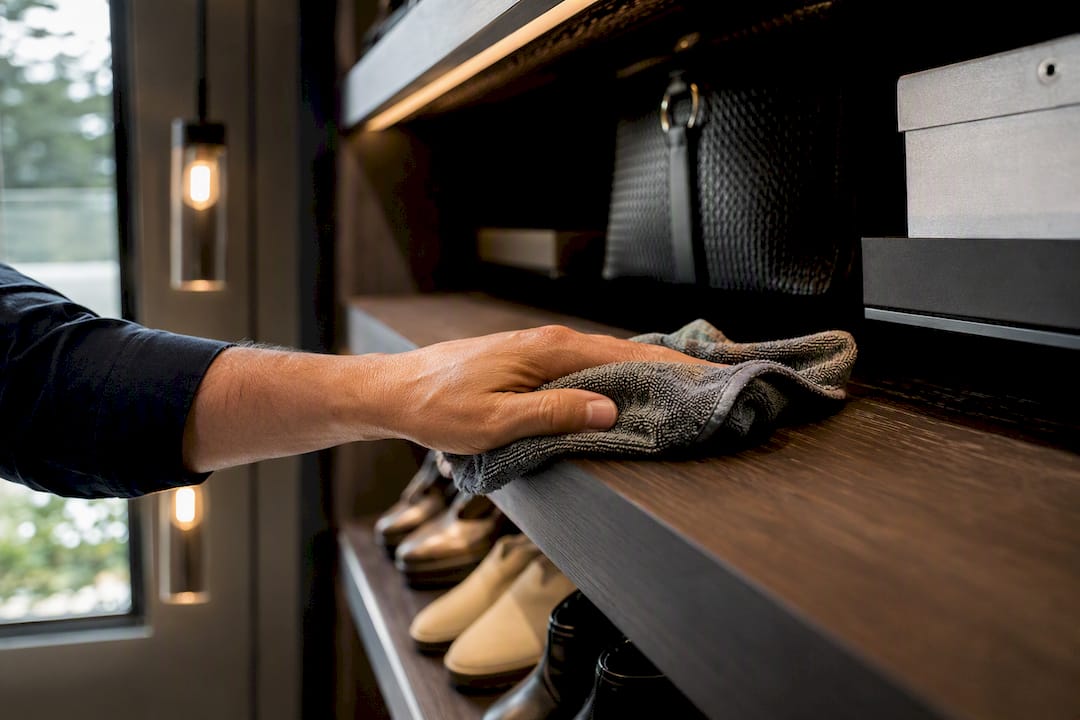
- Dry the space completely. Run a fan aimed into the closet for a minimum of three hours with the door propped open. Skipping this step is the single biggest reason musty smells come back within a week.
Don’t forget the spots people routinely skip: vents, the tops of shelves where dust settles undisturbed, and corners where two walls meet, since that’s where airflow is weakest and moisture lingers longest.
Pro Tip: Run your hand along the top shelf edge after wiping it down. If it feels tacky rather than dry within twenty minutes, your fan placement isn’t reaching that corner and you need to reposition it.
Carpet is where this protocol hits its limit. Padding under carpet absorbs moisture and organic material in a way surface cleaning can’t fully reach, so if the smell returns within a few days of a thorough clean, the carpet itself is likely the reservoir. At that point, replacing it with a hard surface like laminate or vinyl plank is often the only fix that actually holds.
How Do You Remove Musty Smell From Clothes and Shoes?

Textiles are usually salvageable. Shoes and porous storage need their own approach.
For clothing, check the care label and launder on the highest heat or sanitize cycle it allows. Add a half cup of white vinegar to the rinse cycle instead of extra detergent. Vinegar neutralizes odor at a molecular level rather than covering it, and it won’t leave the residue heavy fragrance boosters do.
Shoes need a different protocol since they can’t go in a washing machine:
- Pull out the insoles and let them air dry separately in sunlight for a full day
- Seal each shoe in a plastic bag and put it in the freezer for 24 hours to knock back any biological growth inside the material
- Once thawed and dry, pack the toe box with baking soda or activated charcoal overnight to pull out lingering odor
Cardboard boxes and fabric storage bins are the trickiest call. Once cardboard has absorbed moisture, it tends to hold onto organic material permanently even after it looks dry again. If a box smells musty after 24 hours of open-air drying, throw it out and switch to a plastic or breathable canvas bin instead of trying to salvage it.
Pro Tip: Don’t skip the freezer step for shoes you plan to store long-term, even if they don’t smell bad right now. It’s a cheap insurance policy against whatever’s growing where you can’t see it.
How Do You Control Humidity in a Walk-In Closet?
Cleaning solves the smell you already have. Humidity control keeps it from coming back, and this is the step most people skip because it feels like extra work after they’ve already scrubbed everything.
Keep the closet’s relative humidity at or below 50%, and check it with the same hygrometer you used during inspection. Recheck weekly for the first month after cleaning, then monthly once readings stabilize.
Your options scale with the size of the problem:
- Small electric dehumidifiers (compact, plug-in units) work well for closets that run consistently damp, especially in humid climates or basement-level rooms
- Passive desiccants like silica gel packs or moisture-absorbing crystals handle mild, occasional dampness and cost less upfront
- Low-wattage clip fans left running for an hour a day keep air moving without spiking your electric bill
- Physical spacing matters more than people expect: pull shelving two to three inches off an exterior wall to break the thermal boundary that causes condensation in the first place
That exterior-wall gap solves a problem most homeowners never diagnose correctly. A windowless closet against an outer wall often creates a localized cold spot where warm closet air meets a cooler surface and condenses, quietly, behind whatever’s stored against it. Moving shelving away from the wall and adding a little air circulation usually breaks that cycle without any construction involved.
Running the bathroom exhaust fan longer after showers, or improving whole-house ventilation, often does more than anything inside the closet itself.
What Habits Prevent a Musty Closet Smell From Coming Back?
Prevention is mostly about breaking one bad habit: putting anything away before it’s completely dry.
- Never hang or store damp clothes, wet umbrellas, or shoes with any residual moisture
- Leave breathing room between garments so air can actually circulate, not just sit trapped between fabric layers
- Rotate seasonal wardrobes rather than cramming a full closet year round
- Switch cardboard boxes for breathable canvas or ventilated plastic bins
- Add cedar blocks for a natural, mild deterrent, and replace any silica gel or desiccant packs every six to eight weeks since they stop absorbing once saturated
If the closet is carpeted, treat that flooring as a long-term liability rather than a permanent fixture. A quick vacuum and baking soda treatment buys time, but carpet padding holds onto whatever moisture reaches it, and repeated musty smells in the same carpeted closet are usually the flooring telling you it’s time for a hard-surface swap.
When Does a Musty Smell Mean You Need a Professional?
Most musty closets respond to the drying, cleaning, and humidity steps above within a week or two. A few warning signs mean it’s time to stop DIY-ing and call in help:
- Visible mold covering more than about 10 square feet
- Drywall that feels soft, bubbled, or crumbles when pressed
- Humidity readings that stay above 50% no matter how much you ventilate or dehumidify
- An odor that’s chemical, sour, or unusually sharp rather than the typical damp, earthy musty smell
- A smell that returns within days of a full clean and dry cycle, suggesting the moisture source is inside the wall rather than in the room
A professional odor removal visit typically starts with moisture mapping across the affected area, not just the closet itself, since musty odors often trace back to a leak or humidity source elsewhere in the wall cavity. Trained technicians use eco-certified neutralization methods rather than ozone or chlorine treatments, which can leave their own residue or health concerns in an enclosed space like a home with a musty odor problem.
Before any service visit, put together a short record: your hygrometer readings from the past week or two, photos of any staining or soft spots, and a quick list of what you’ve already tried. That saves the technician time and helps them zero in on whether the issue is surface-level or something behind the wall, like the structural humidity problems common in certain climates and building types.
A Priority Order Worth Following
The mistake I see homeowners make over and over is reaching for a solution before they’ve done the diagnosis. They buy a scented sachet, hang it up, and consider it handled, while the actual moisture source keeps working behind the scenes. Humidity readings get ignored because “it doesn’t feel that damp in there,” even though a hygrometer would tell them otherwise in thirty seconds.
Work the priority list in order: locate the source, dry the space, deep clean what’s porous, then lock in humidity control so it doesn’t just come back in a month. Calling a professional isn’t a last resort to be embarrassed about; it’s the right call once you’ve hit a structural wall or a humidity reading that won’t budge. Check your hygrometer seasonally, especially going into summer, and you’ll catch problems before they become smells.
— Master
Why Choose Master Odor Removal for a Persistent Musty Smell
When a closet has been cleaned, dried, and dehumidified and the musty smell still won’t quit, the problem usually isn’t in the closet anymore. It’s in the wall cavity, the subfloor, or an HVAC system feeding humid air right back in, and that’s a diagnosis a fan and a bottle of vinegar can’t make.

Masterodorremoval specializes in exactly that gap: eco-certified odor elimination that skips ozone and chlorine treatments entirely, so there’s no chemical residue left behind in a small, enclosed space like a walk-in closet. A service visit starts with moisture mapping to pinpoint where the odor is actually originating, not just where it’s strongest, followed by targeted remediation matched to the source rather than a blanket treatment. Same-day and next-day appointments are available for homeowners who don’t want to live with the smell for another week while they wait on a callback.
Before you book, pull together your hygrometer readings, a few photos of any staining, and a rundown of what you’ve already tried. That prep lets the technician move straight to solving the problem instead of starting from scratch. If you’re ready to get a persistent musty smell handled for good, explore Master Odor Removal’s commercial and residential odor removal services and get a visit scheduled.
Sources
The EPA’s mold and moisture guidance anchors the health and remediation steps in this article, alongside its cleanup guidance for different materials. Practical homeowner tactics draw from Martha Stewart’s air quality reporting and Realtor.
- Mold and Your Health — EPA
Recent Comments