
The fastest reliable way to make guestrooms and common areas truly odor-neutral is to hire a professional, green-certified remediation team that uses non-ozone, non-chlorine methods and licensed technicians. Masking sprays and standard housekeeping cannot neutralize tobacco or cannabis smoke that has penetrated textiles, drywall, and HVAC systems. Permanent elimination requires a science-backed four-step process: source removal, surface cleaning, vapor-phase neutralization, and verification.
Masterodorremoval specializes in exactly this work for hotels, motels, and vacation rentals, with same or next-day availability, licensed technicians, and a written service guarantee. The company’s green odor elimination approach uses HEPA combined with activated carbon filtration and vapor-based neutralizers, with zero ozone or chlorine chemistry in occupied spaces.
What the data shows: In controlled hotel-room tests at Treasure Island Hotel & Casino, vapor-phase neutralization significantly reduced housekeeping-rated odor scores from very high to undetectable within about half an hour.
Table of Contents
- What does a professional smoke-odor treatment actually include?
- How long does remediation take, and what does it cost?
- How should staff prepare a room before the technician arrives?
- What ongoing maintenance keeps rooms odor-neutral long-term?
- Why do non-ozone, non-chlorine methods matter for your guests?
- What questions should you ask before hiring a remediation provider?
- Key Takeaways
- What hospitality odor calls actually teach you
- Masterodorremoval: hospitality-grade odor removal, ready when you need it
- Useful sources and references
What does a professional smoke-odor treatment actually include?
Professional odor remediation follows a defined four-step sequence. Here is what each phase delivers:
- Vapor-phase neutralization. Deodorizing chemistry is distributed as vapor or thermal fog, reaching voids and porous surfaces that wet cleaning cannot access. Vapor-based neutralization is the step that delivers lasting results, not just temporary freshness.
“A room that smells clean after step three will often rebound within 48 hours if the HVAC coil or drain pan was not addressed. Treating only air or only surfaces is the single most common reason remediation fails in hospitality settings.” — Professional Odor Remediation Guidance
Deliverables to require in writing: before/after photos, technician notes, HVAC coil and drain-pan inspection report, material-replacement recommendations, and a re-treatment window in the contract.
Pro Tip: Ask for time-stamped before/after photos taken from the same angle. A provider who cannot produce these is not doing verification, they are doing guesswork.
How long does remediation take, and what does it cost?
| Contamination level | Typical service time | Minimum out-of-order time | Primary cost drivers |
|---|---|---|---|
| Surface-level (single stay) | 2–4 hours | 4–6 hours | Labor, filtration consumables |
| Penetrated textiles/walls | 4 hours | 1 day | Wet cleaning, vapor treatment, textile removal |
| HVAC/PTAC involved | 6 hours | 1–2 days | Mechanical cleaning, coil treatment, PTAC service |
| Long-term buildup (chronic room) | 1–3 days | 2–4 days | Material replacement, sealing, multiple treatment passes |
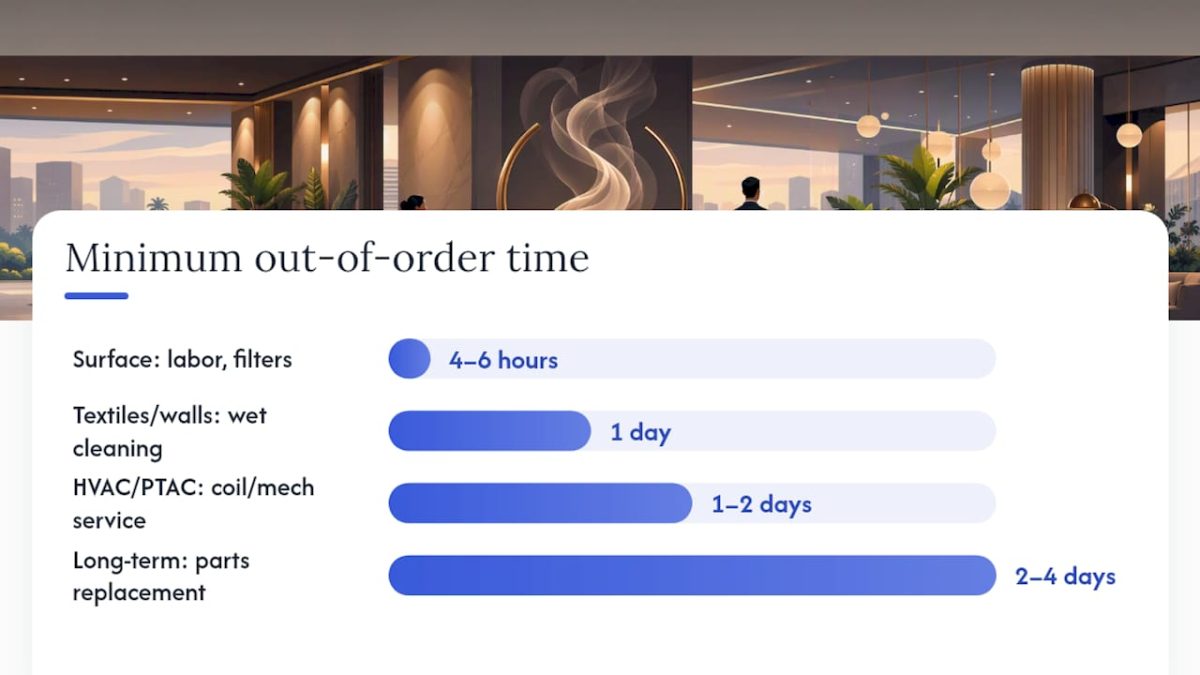
Pricing varies by region, room size, and complexity. HVAC involvement, emergency scheduling, and material replacement are the factors that push cost highest. The calculation that matters most: one out-of-order day in a mid-tier hotel room typically costs more in lost revenue than the remediation service itself, which makes speed of response a direct financial variable.
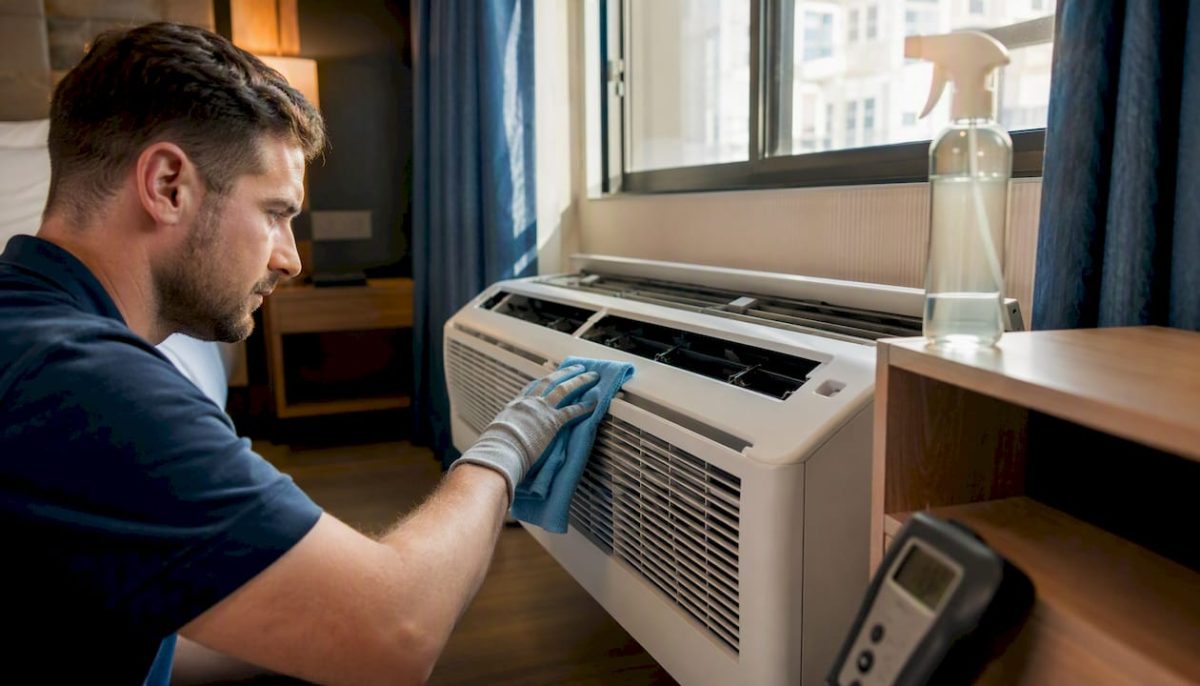
Eco-friendly PTAC cleaning addresses smoke-related odor sources in HVAC units directly, improving airflow and cutting recontamination risk after surface work is complete.
How should staff prepare a room before the technician arrives?
Preparation reduces service time and prevents recontamination. Walk your housekeeping and engineering teams through this before every remediation call:
- Remove all guest belongings and personal items from the room.
- Strip and bag all linens, towels, and soft goods separately from standard laundry.
- Open all closet doors, drawers, and cabinet panels.
- Note and document any prior cleaning actions (sprays used, ventilation run time).
- Log the smoke source if known: bed area, bathroom, balcony, window ledge.
- Set HVAC to fan-only mode and do not run heating or cooling until the technician clears it.
- Do not apply any fragrance sprays or air fresheners. They contaminate the technician’s baseline odor reading.
- Keep windows closed until the technician instructs otherwise. Premature ventilation disperses particles and makes source tracing harder.
- Photograph visible staining before any cleaning attempt.
- Hand the technician the complaint log. It cuts diagnosis time significantly.
Pro Tip: Keep a one-page room-prep checklist at the housekeeping station. Staff turnover is high in hospitality; a printed checklist means the prep is consistent regardless of who is on shift. Masterodorremoval’s smoke odor neutralization strategies include staff-facing documentation templates you can adapt.
What ongoing maintenance keeps rooms odor-neutral long-term?
A single remediation treatment holds longer when it is backed by a structured maintenance program. The most effective programs combine three layers:
- Periodic deep-clean cycles: Schedule professional remediation for high-risk rooms every 90–180 days, depending on occupancy and smoking-incident frequency.
- HVAC/PTAC preventative maintenance: Clean air vents and coils on a regular schedule. Smoke residue in ductwork is the most common source of odor rebound after surface remediation.
- In-room recirculating filtration: HEPA and activated carbon units running between guest stays reduce baseline airborne load and extend the life of each treatment.
- Spot treatments for targeted incidents: A rapid vapor-phase treatment after a confirmed smoking incident, before the odor sets into porous surfaces, is far cheaper than a full remediation.
For housekeeping protocol, separate appearance cleaning from odor-control tasks:
- Appearance cleaning (visual inspection, surface wipe, linen change) happens every turnover.
- Odor-control tasks (carpet extraction, upholstery treatment, filtration unit check) happen on a defined schedule, not just when a complaint arrives.
- PTAC filter inspection and replacement follows the manufacturer’s interval, not a calendar guess.
Service-contract options range from one-time remediation to recurring quarterly maintenance. High-occupancy properties with a history of smoking incidents benefit most from a recurring contract with defined response SLAs.
Why do non-ozone, non-chlorine methods matter for your guests?
The short answer: ozone and chlorine-based treatments require rooms to be unoccupied for extended periods, leave chemical residues that irritate airways, and conflict with most hotel sustainability programs. Green-certified, non-ozone chemistry is the only category appropriate for routine use in occupied hospitality spaces.
The professional methods that meet this standard:
- Bipolar ionization and plasma (when certified): UL-867 and UL-2998 zero-ozone certified systems can continuously neutralize smoke molecules and VOCs in occupied spaces. Certification matters; uncertified units may produce ozone as a byproduct.
- UV-C and controlled ozone catalysis: UV-C and plasma devices conforming to VDI 6022 and DIN EN standards are used for heavily contaminated rooms, but only in unoccupied conditions under controlled protocols.
Pro Tip: Ask any provider for their green certification documentation before signing a contract. Masterodorremoval’s eco-friendly methods page outlines exactly what certifications and standards their technicians work to.
Certifications and standards to request during procurement: UL-867, UL-2998 (zero-ozone), VDI 6022 compliance for air-handling equipment, and on-site technician licensing documentation.
What questions should you ask before hiring a remediation provider?
Use this list during vendor evaluation. A provider who hesitates on any of these is a red flag.
- What green certifications do your technicians and chemistry hold?
- Do you use ozone or chlorine as a routine treatment? (Correct answer: no, or only in tightly controlled unoccupied conditions.)
- Can you provide before/after photo documentation and a written HVAC inspection report?
- Do you have documented experience in hotel or short-term rental settings?
- What is your same-day or next-day availability for urgent calls?
- What does your re-treatment guarantee cover and for how long?
- Are your technicians licensed and insured?
Red flags to walk away from:
- No written verification or documentation offered.
- Reliance on masking fragrances as the primary treatment.
- Routine ozone or chlorine use without controlled-protocol documentation.
- Inability to show hospitality-specific case studies or client references.
- No re-treatment clause in the contract.
A strong contract includes: a re-treatment clause, a response SLA for urgent calls, and a performance metric (odor rating before and after, not just “treatment completed”).
Key Takeaways
Permanent smoke-odor elimination in hospitality requires a four-step professional process, green-certified chemistry, and HVAC treatment, not surface cleaning alone.
| Point | Details |
|---|---|
| Hire green-certified professionals | Use providers with UL-867/UL-2998 and VDI 6022 compliance, non-ozone, non-chlorine methods, and licensed technicians. |
| Always include HVAC treatment | Treating surfaces without addressing HVAC coils and PTAC units causes odor rebound within 48–72 hours. |
| Require before/after documentation | Time-stamped photos, technician notes, and a written re-treatment guarantee are the minimum proof of real remediation. |
| Build a maintenance cadence | Schedule deep-clean cycles every 90–180 days for high-risk rooms and run HEPA/activated carbon filtration between stays. |
| Masterodorremoval for hospitality | Masterodorremoval offers commercial odor removal with same/next-day availability, green-certified methods, and a written service guarantee for hotels and vacation rentals. |
What hospitality odor calls actually teach you
The pattern that shows up repeatedly in hospitality remediation work is this: properties that call early, after the first confirmed incident, spend a fraction of what properties spend after odor has migrated to adjacent rooms or embedded in HVAC systems. A surface-level treatment on day two costs a fraction of a multi-day HVAC remediation on day thirty.
The other consistent lesson is that documentation changes the conversation with guests. A property that can show a guest a before/after photo and a technician’s written report has a fundamentally different recovery conversation than one that says “we cleaned the room.” Proof of process is not just an operational nicety. It is a guest-relations tool.
Green-certified, non-ozone methods are not a marketing preference. They are the only category of treatment that allows a room to be returned to service quickly, without residual chemical risk to the next guest. Properties that have moved to this standard report fewer repeat incidents and shorter out-of-order windows, because the treatment actually eliminates the source rather than suppressing it temporarily.
Masterodorremoval: hospitality-grade odor removal, ready when you need it
When a room is out of service and a guest complaint is on record, you need a team that can be on-site the same day or next day, with the right chemistry and the documentation to back it up.

Masterodorremoval provides hospitality-focused odor removal using green-certified, non-ozone, non-chlorine methods and licensed technicians. The four-step process covers source removal, surface cleaning, vapor-phase neutralization, and full verification with before/after documentation. Service comes with a written guarantee and re-treatment coverage. To request an on-site estimate, have your room number, complaint log, and any prior cleaning notes ready. Contact Masterodorremoval directly to confirm same or next-day availability and ask for the hospitality service package, which includes HVAC inspection and staff-facing documentation.
Useful sources and references
The following sources support the methods, standards, and safety guidance in this article:
- Treasure Island Hotel Smoke Odors – Case Studies | Fresh Wave IAQ
- How to Get Rid of Odor in Commercial & Hospitality Spaces
- Odor- and smoke-free hotel rooms with UV-C and plasma
- Bipolar Ionization Odour Removal & Air Purification | PurAire Singapore – PROMEDUSA – PURIFYING AIR & SURFACES, REMOVING ODOURS SINCE 2006 AND TRUSTED BY OVER 900 HOTELS, PROPERTIES, AND PROFESSIONAL HOUSEKEEPERS
- Accord Eco Services – RS62: Eco-Friendly PTAC Cleaning for Hotels
- Master Odor Removal Green Odor Elimination – Master Odor Removal
- Science-backed eco-friendly odor elimination: 4 key steps – Master Odor Removal
- Master Odor Removal Smoke Odor Neutralization Strategies – Master Odor Removal
| Method | Best use case | Occupied spaces? | Certification to require |
|---|---|---|---|
| HEPA + activated carbon filtration | Baseline particulate and airborne odor reduction | Yes | Standard professional equipment |
| Vapor-phase neutralization | Penetrated porous surfaces, textiles, voids | Yes | Green-certified chemistry |
| Thermal fogging | Deep wall cavities, heavy textile contamination | No (during treatment) | Technician licensing |
| Bipolar ionization/plasma | Continuous in-duct neutralization | Yes (if certified) | UL-867, UL-2998 |
| UV-C / controlled ozone | Heavily contaminated rooms, intensive treatment | No | VDI 6022 |
Recent Comments