
TL;DR:
- Odor removal for liveaboards involves professional, whole-vessel treatments that eliminate odor-causing compounds within systems and fabrics.
- Eco-friendly methods like hydroxyl radical and enzymatic treatments outperform ozone and chlorine by breaking down molecules without damaging materials.
Odor removal for liveaboards is a professional, whole-vessel treatment that eliminates odor-causing compounds from air, fabrics, plumbing, and ventilation systems rather than covering them up. Done correctly, it delivers a permanent reset — but only when paired with targeted source remediation and a maintenance routine that prevents recontamination. Masterodorremoval offers green-certified professional treatments using bio-active enzyme applications, hydroxyl radical technology, and targeted source cleaning, with no ozone and no chlorine.
Table of Contents
- What causes odors on a liveaboard?
- How does professional odor removal work on a yacht?
- Why eco-friendly methods outperform ozone and chlorine on luxury vessels
- How to keep your liveaboard odor-free after treatment
- What to expect: timeline and cost structure
- When should you call a professional instead of handling it yourself?
- Key Takeaways
- Why the green-first approach is the only defensible choice for high-end liveaboards
- Masterodorremoval’s yacht services: book your diagnostic
What causes odors on a liveaboard?
Liveaboard smells are almost never a single-source problem. They build from several systems operating in a confined, humid space simultaneously.
The main contributors:
- Holding tanks and sanitation hoses. Seawater flushing introduces microorganisms that decay inside the tank, accelerating odor production. Saturated hoses are a separate issue: wipe one with a damp cloth and smell the cloth — if it reeks, the hose has permeated and needs replacing.
- Bilge and fuel/oil deposits. Stagnant bilge water mixed with fuel residue produces some of the most aggressive odors on any vessel.
- HVAC and AC condensate drains. Ducting and condensate pans accumulate mold and circulate odors throughout the cabin whenever the system runs.
- Soft materials. Upholstery foam, mattresses, and headliners absorb volatile organic compounds (VOCs) and release them slowly, especially when humidity rises or the AC cycles on.
- Galley residues and trash. Food odors embed in cabinetry and soft surfaces faster in a small, enclosed space than in any home kitchen.
- Moisture, mold, and mildew. Lockers, crawlspaces, and anchor chain lockers trap humidity and become incubators for mold colonies that spread through the air.
The persistence problem is what catches most owners off guard. Porous materials absorb odor molecules and re-release them hours or days after a masking spray has faded. HVAC circulation then picks up those re-released compounds and distributes them through every cabin. Spraying an air freshener addresses the symptom for maybe twenty minutes.
Holding-tank odor is a system problem. Ventilation and the chemistry of the flush water matter as much as the tank contents themselves. Freshwater flushing reduces the microorganisms introduced by seawater and cuts odor-causing decay at the source.
Two contributors that owners routinely overlook: vent line geometry and hose age. Vent lines longer than five feet with an inside diameter under 3/4 inch restrict airflow enough to make any tank treatment far less effective. And long vent runs that dip before rising trap gas in low spots, creating a continuous odor source regardless of what’s in the tank.
How does professional odor removal work on a yacht?
A professional engagement follows a clear sequence. Skipping any stage is why DIY attempts and single-spray treatments fail to hold.
Stage 1: Inspection and diagnosis. Technicians walk the vessel systematically, mapping odor intensity by zone, testing holding tank and bilge conditions, checking HVAC coils and condensate lines, measuring moisture levels in bulkheads and soft furnishings, and identifying saturated hoses. This step determines whether the problem is surface-level or deeply embedded in materials and systems.
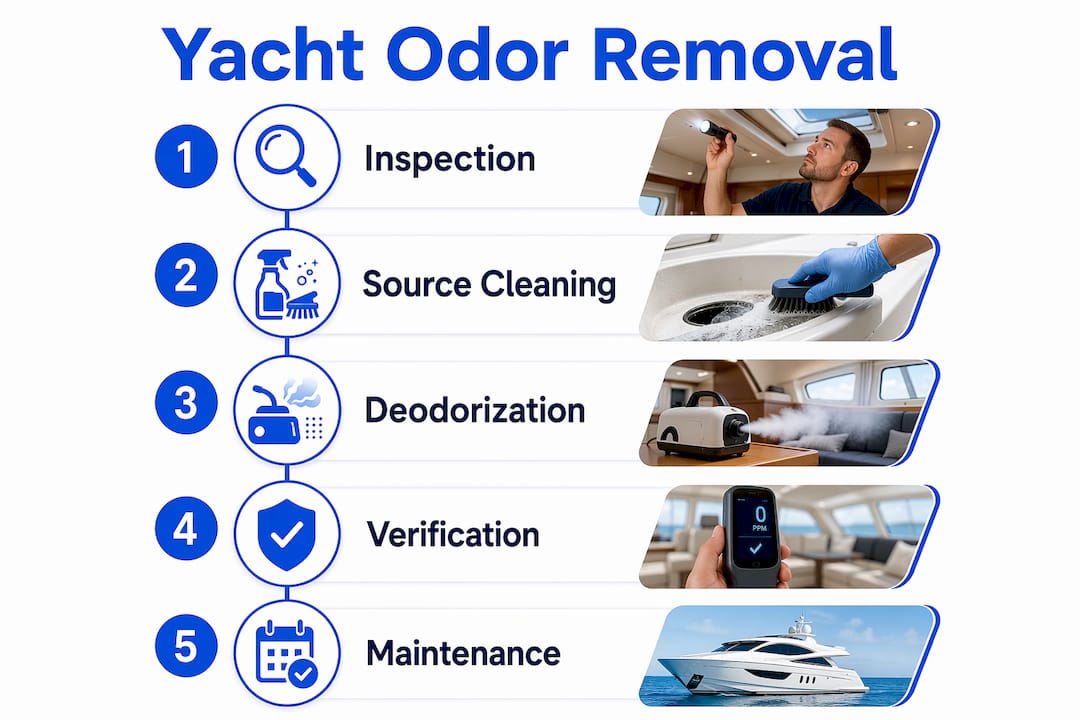
Stage 2: Targeted source work. No deodorization technology works if the source is still active. This stage covers holding-tank cleaning and pump-out, hose inspection and replacement where needed, bilge degreasing, HVAC coil and duct cleaning, and upholstery extraction. Enzyme and bacterial treatments for holding tanks can take about a week to fully reduce hydrogen sulfide and solids, so timing matters when scheduling a full treatment.
Stage 3: Whole-vessel deodorization. Three professional-grade options are used depending on the odor type and material sensitivity:
| Method | Primary use | Typical run time | Material safety |
|---|---|---|---|
| Enzymatic/bio-active treatment | Tanks, drains, organic residues | Days to one week | High — safe on all surfaces |
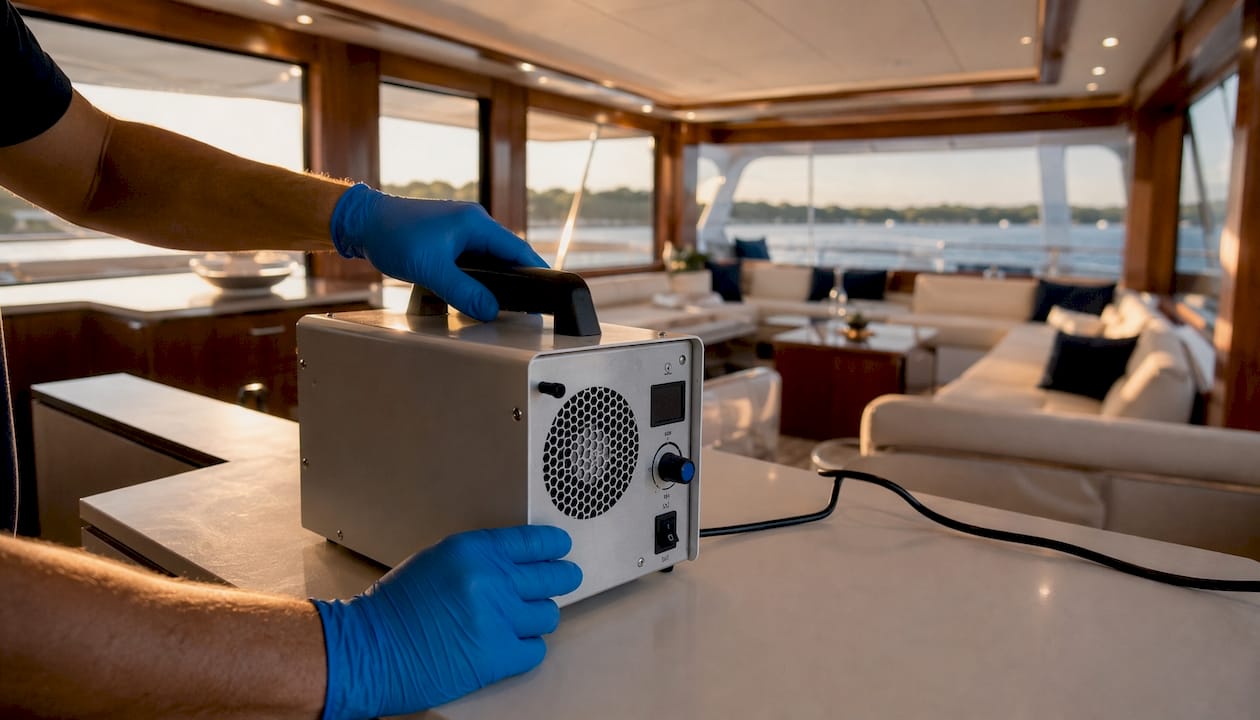
| Hydroxyl radical generator | Whole-vessel airborne and surface VOCs | about a week for stable results | High — no occupancy restriction |
| Targeted deep-cleaning and encapsulation | Fabrics, foam, headliners | Hours to one day | High when pH-appropriate products used |
Stage 4: Verification. Post-treatment checks run during active AC operation and again after a few days at sea. Technicians confirm odor levels in each zone, recheck HVAC output, and verify that holding-tank and bilge areas remain neutral. A signed service guarantee backs the result.
Masking agents and air-only devices do not remove odors embedded in soft furnishings. Perfumes, HEPA-only purifiers, and ozone shock only address airborne molecules temporarily — the compounds absorbed into foam and fabric remain untouched.
Masterodorremoval’s licensed technicians carry green certification and bring yacht-specific experience, including participation in the Fort Lauderdale International Boat Show. That field exposure matters: a technician who has worked across dozens of vessel types diagnoses faster and misses fewer hidden sources.
Pro Tip: Ask your technician to run the AC at full capacity during the post-treatment verification check. Odors that survive that airflow test are still present in the duct system and need a second pass on the coils.
Why eco-friendly methods outperform ozone and chlorine on luxury vessels
Green-certified odor elimination covers four main categories: enzymatic/bio-active treatments for tanks and drains; hydroxyl radical generators for whole-vessel molecular breakdown; targeted deep-cleaning and encapsulation for fabrics; and ventilation combined with moisture control.
Ozone shock treatments require unoccupied spaces and can degrade materials and electronics. Hydroxyl systems deliver comparable molecule-level breakdown without those occupancy and material risks — a meaningful advantage on a vessel with teak joinery, leather upholstery, and navigation electronics.
The practical reasons to avoid ozone and chlorine on a high-end liveaboard:
- Ozone at effective concentrations attacks rubber seals, plastics, and screen coatings on electronics.
- Chlorine-based chemistries bleach fabrics and corrode metal fittings in enclosed spaces.
- Both require full vessel evacuation and extended airing before re-entry, adding days to the project timeline.
- Neither addresses odor molecules already embedded in foam or fabric — they work on airborne compounds only.
Hydroxyl radical treatments, by contrast, break odor molecules down at the chemical level and reach surface-bound compounds in soft furnishings. They carry no occupancy restriction under normal operating conditions and leave no chemical residue on finishes or electronics. For a luxury interior specialist working on teak, leather, and high-end electronics, that distinction drives every method choice.
How to keep your liveaboard odor-free after treatment
A professional deep reset creates the conditions for a clean vessel. Keeping it that way requires consistent habits, not heroic effort.
Weekly and seasonal actions that matter most:
- Open lockers and storage compartments daily when aboard to break the humidity cycle.
- Run the AC with fresh-air intake when possible, and clean condensate drains monthly.
- Air mattresses and rotate cushions in direct sunlight every few weeks.
- Clean the galley thoroughly after every cooking session, including the area behind the stove.
For sanitation systems, freshwater flushing reduces microbial decay in the tank. Pump out at least every three weeks during active use, and treat the tank regularly with enzymatic products. Check vent lines annually for blockages and confirm they meet the geometry guidance above. When vent lines are restricted, active aeration systems outperform passive ventilation for problem tanks.
For fabrics, avoid perfumed masking sprays. They deposit fragrance molecules on top of embedded odors and make professional extraction harder later. Steam cleaning or professional upholstery extraction every season keeps foam from becoming a long-term odor reservoir. More guidance on boat odor prevention covers ventilation routines in detail.
An odor-free vessel is the result of continuous maintenance combined with occasional professional deep-reset treatments. A single one-off service without follow-up maintenance rarely holds for more than a season on an actively lived-aboard vessel.
Pro Tip: Schedule a maintenance tune-up before high-guest-use periods or immediately after returning from an extended lay-up. Both scenarios create conditions where odors re-establish quickly.
What to expect: timeline and cost structure
| Scope | Typical timeline | Pricing structure |
|---|---|---|
| Diagnostic visit | 1–2 hours | Flat diagnostic fee |
| Single deep treatment (small liveaboard) | Half-day to one full day | Per-service fee covering source work and deodorization |
| Mid-size yacht, moderate contamination | 1–3 days | Line-item charges for each source system addressed |
| Large yacht, embedded contamination | several days plus hydroxyl cycle | Day-rate for equipment plus source remediation |
| Full hydroxyl radical cycle | about a week | Equipment run-time rate plus technician visits |
Pricing varies by vessel size, accessibility of contaminated systems, extent of material saturation, and urgency. An on-site diagnostic is the only reliable way to produce an accurate quote. Exact figures are not publicly listed and depend on conditions found during inspection.
Cost guidance: Budget qualitatively in three tiers — a small liveaboard with surface-level odors costs significantly less than a mid-size yacht with embedded holding-tank and HVAC contamination, which in turn costs less than a large yacht requiring a full multi-day hydroxyl cycle and upholstery extraction program.
When should you call a professional instead of handling it yourself?
Some situations call for a professional immediately. Fuel or strong bilge fumes are a safety issue before they are an odor issue — evacuate and call a marine technician, not a cleaning service.
Beyond safety, these are the red flags that indicate DIY won’t hold:
- Odors return within days of masking or cleaning.
- Smells spread through the HVAC system to cabins that don’t have an obvious source.
- Holding-tank or bilge odors persist after normal pump-out and treatment.
- Visible mold appears inside lockers, behind panels, or in hidden cavities.
- Guests or crew report headaches or respiratory irritation below decks.
When vents or long vent lines are restricted, standard treatments perform poorly. Active aeration systems are the appropriate remediation in those installations — a professional can identify this during the diagnostic visit and recommend the right fix rather than repeating treatments that won’t work.
A diagnostic visit is the right first step when you’re unsure of the source. A full deep treatment is warranted when multiple systems are involved or when odors have been present for more than one season. A recurring maintenance contract makes sense for charter vessels, high-occupancy liveaboards, or any owner who wants to protect a significant investment without managing the details personally.
Key Takeaways
An odor-free liveaboard requires whole-vessel source removal, green-certified deodorization, and a consistent maintenance program — no single spray or one-off treatment holds without all three.
| Point | Details |
|---|---|
| Source removal comes first | Deodorization technology fails if the contaminated tank, hose, or duct is still active. |
| Green methods protect your investment | Hydroxyl radical and enzymatic treatments eliminate odors without degrading teak, leather, or electronics. |
| Maintenance prevents recontamination | Freshwater flushing, ventilation habits, and seasonal enzyme treatments keep results from fading. |
| Know the red flags | Odors returning after masking, HVAC spread, or visible mold all signal a professional is needed. |
| Masterodorremoval is a recommended option | Green-certified, no ozone, no chlorine, with licensed technicians and an on-site diagnostic for exact pricing. |
Why the green-first approach is the only defensible choice for high-end liveaboards
The conventional wisdom in boat odor control still leans on ozone generators and bleach-based products. That approach made sense when the goal was a clean-smelling bilge on a weekend cruiser. It does not make sense on a vessel with $50,000 in upholstery, teak joinery, and navigation electronics that cost more than most cars.
Ozone degrades rubber, attacks screen coatings, and requires full evacuation. Chlorine bleaches fabric and corrodes fittings. Both leave the underlying odor molecules in foam and soft furnishings untouched. You get a vessel that smells clean for a week and then reverts — with slightly more damaged materials each time.
The green-first approach is not a compromise. Hydroxyl radical treatments break odor compounds down at the molecular level and reach surface-bound VOCs that ozone never touches. Enzymatic treatments eliminate the microbial source in tanks and drains rather than temporarily suppressing it. The result holds longer, costs less over time, and does not shorten the life of your interior.
There is also a resale argument that owners underestimate. A vessel with documented professional odor remediation and a clean interior history commands a better price and sells faster. Buyers notice smell before they notice anything else. Masking that smell with fragrance is not a solution — it is a disclosure problem.
Masterodorremoval’s yacht services: book your diagnostic
Persistent liveaboard odors rarely have a single fix, and Masterodorremoval’s yacht odor removal service is built around that reality. The process starts with an on-site diagnostic that maps every odor source across the vessel, then moves through targeted source remediation, whole-vessel hydroxyl or enzymatic treatment, and a post-treatment verification check. No ozone. No chlorine. Licensed technicians with green certification and a satisfaction guarantee on every job.

Same-day and next-day availability means you are not waiting weeks for a quote or a service window. Exact pricing requires an on-site diagnostic, but the process is straightforward: one call, one visit, one clear scope of work. For owners who want to protect their interior and keep guests comfortable, request your diagnostic and get a quote based on what your vessel actually needs.
Recent Comments