
TL;DR:
- Musty smells in vacant homes are caused by mold and bacteria producing gases when digesting organic materials. Moisture and stagnant air accelerate mold growth, creating odors well before visible signs appear. Preventing odors requires controlling moisture, increasing airflow, and addressing hidden leaks to stop mold from thriving.
Musty smells in vacant homes are caused by microbial volatile organic compounds (MVOCs), gases released when mold and bacteria digest organic building materials in the presence of moisture and stagnant air. Understanding why vacant homes develop musty smells matters because the odor is not a cosmetic issue. It signals an established biological process that damages property value and air quality. The good news: once you know the root causes, the path to prevention and remediation becomes clear.
Why do vacant homes develop musty smells?
The musty odor in an empty house is not the smell of age or dust. It is the smell of mold metabolism. MVOCs are produced by mold and bacteria within 24–48 hours of moisture saturating organic building materials. That speed surprises most homeowners and real estate professionals who assume a property needs months to develop a problem.

The process starts with moisture. Mold spores, which exist naturally in every indoor environment, need only two things to activate: a food source and water. Drywall, wood framing, carpet padding, and ceiling tiles all serve as food. When relative humidity climbs above 60%, the conditions for fungal colonization are met. A vacant home with no HVAC running, no windows opened, and no occupants managing leaks can reach that threshold within days of being sealed.
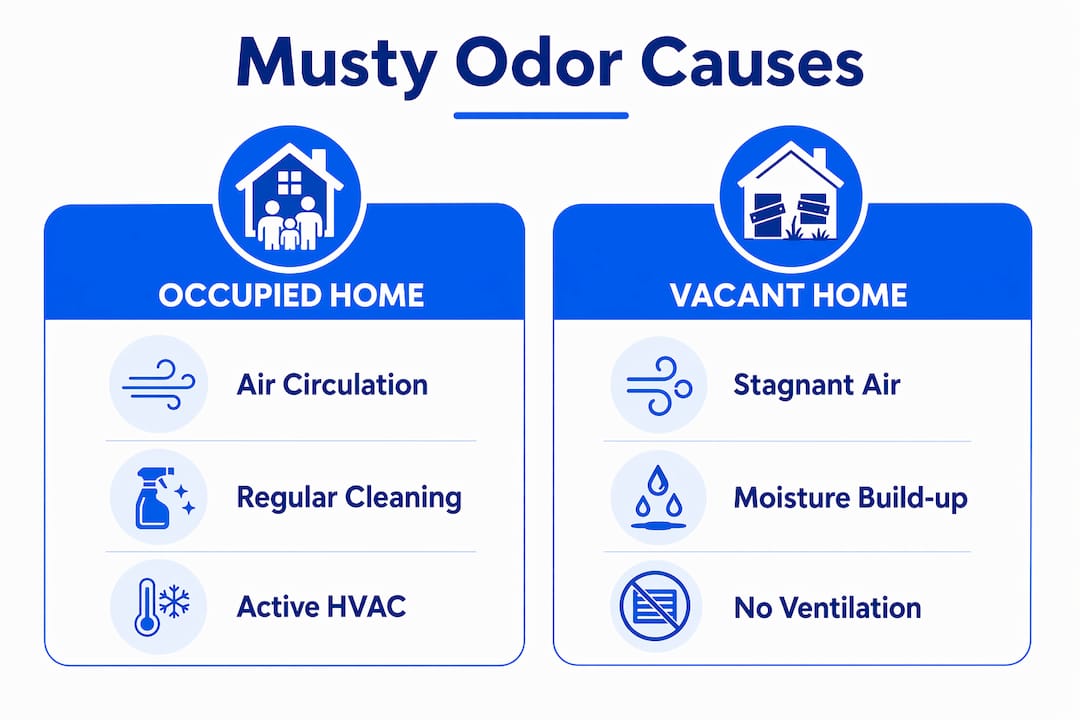
Stagnant air is the overlooked accelerant. Active households generate constant air movement through cooking, breathing, opening doors, and running appliances. When a home sits empty, that circulation stops entirely. Humidity concentrates in low spots, corners, and enclosed spaces. The result is a biological incubator that produces odors faster than most people expect.
What causes moisture to build up in an empty house?
Moisture accumulates in vacant homes through several distinct pathways, and most of them operate silently.
- Lack of ventilation. Sealed homes trap humid outdoor air that infiltrates through gaps, vents, and foundations. Without mechanical ventilation or occupant behavior to flush it out, humidity climbs steadily.
- Condensation. Temperature differences between interior surfaces and ambient air cause water vapor to condense on walls, windows, and pipes. Basements and crawlspaces are especially prone to this.
- Penetrating and rising damp. Moisture enters through cracks in foundations, failed flashing, or damaged roofing. Condensation, penetrating damp, and rising damp affect millions of homes, with the problem worsening significantly in unventilated buildings.
- Plumbing leaks. A slow drip under a sink or behind a wall goes undetected for weeks in a vacant property. By the time someone notices, mold is already established.
- Poor drainage. Grading that directs water toward the foundation, clogged gutters, and blocked downspouts all push moisture into the structure.
ASHRAE Standard 160 recommends keeping indoor relative humidity below 60% to prevent fungal growth. Vacant homes in humid climates routinely exceed that threshold in crawlspaces and basements, sometimes reaching 80% relative humidity. That range does not just support mold growth. It accelerates it.
Pro Tip: Before closing up a vacant property, set a digital hygrometer in the basement or crawlspace. If the reading exceeds 60% within a week, you need active moisture control before the home sits any longer.
How do mold and bacteria produce the musty odor?
The chemistry behind musty smells is straightforward once you understand what mold actually does. Mold does not just sit on a surface. It digests it. As mold breaks down organic materials, it releases gases as metabolic byproducts. Those gases are MVOCs.
The specific compounds responsible for the classic musty smell include geosmin, 1-octen-3-ol, and various aldehydes. Human noses detect these at extremely low concentrations, which is why a home can smell strongly musty even when visible mold growth is limited. The odor comes from metabolic gases, not from the spores themselves. That distinction matters for remediation.
Here is the sequence of events in a vacant home:
- Moisture saturates a porous material such as drywall or carpet padding.
- Dormant mold spores activate and begin colonizing the surface within 24–48 hours.
- Mold digests the organic material and releases MVOCs into the air.
- The gases accumulate in the stagnant air of the sealed home.
- The musty odor becomes detectable, often weeks after the mold colony is already well established.
A musty smell is a late-stage indicator. By the time you can smell it, mold has been actively growing for some time. The odor is not the beginning of the problem. It is evidence that the problem is already advanced.
Porous materials complicate remediation further. Carpet padding, drywall, and wood framing absorb MVOCs and re-release them slowly over time. This is why a home can still smell musty after the visible mold is removed and the moisture source is fixed. The materials themselves have become odor reservoirs.
Why are vacant homes uniquely vulnerable to musty odors?
A vacant home combines four conditions that together create near-perfect mold growth conditions: moisture, organic material, stagnant air, and extended time without intervention.
| Condition | In an occupied home | In a vacant home |
|---|---|---|
| Air circulation | Constant from occupant activity | Absent; air stagnates |
| Humidity control | HVAC and behavior regulate it | No active control |
| Leak detection | Noticed quickly | Can go undetected for weeks |
| Mold disruption | Cleaning and activity interrupt growth | Growth continues undisturbed |
Occupant absence removes every natural check on mold development. Vacancy eliminates HVAC use, window opening, and routine leak detection, allowing conditions to worsen unnoticed. A dripping pipe that an occupant would spot in a day can saturate a wall cavity for a month in an empty house.
Hidden locations are a particular problem. Crawlspaces, attics, wall cavities, and the space beneath bathroom floors are all areas where moisture accumulates and mold grows without any visible sign. By the time a real estate professional notices a musty smell during a showing, the mold colony may be extensive.
Pro Tip: When inspecting a vacant property, check the rental property cleaning checklist for moisture-prone areas often missed during standard walkthroughs, including under appliances, inside cabinet bases, and around water heater connections.
One diagnostic mistake is worth flagging. Not every musty or sewer-like smell in a vacant home comes from mold. Dry P-traps in unused drains allow sewer gases to enter the home, producing an odor that is often mistaken for mold. Pouring water into every drain in a vacant property is a simple first diagnostic step before assuming a mold problem.
How can you prevent and address musty smells in vacant homes?
Controlling moisture is the only effective way to stop mold growth and the musty odors that come with it. Odor elimination without moisture control always fails. The EPA confirms that removing all mold spores indoors is impossible. The only viable strategy is removing the conditions that allow spores to grow.
Ventilation and airflow
- Run HVAC systems on a schedule, even in vacant homes. A timer-controlled thermostat set to maintain 68–72°F keeps humidity in check.
- Install a mechanical ventilation system or energy recovery ventilator (ERV) if the home will sit empty for more than a few weeks.
- Avoid half-measures. Cracking an attic hatch or leaving a single window ajar does not create the continuous, engineered airflow needed to prevent stagnation. It creates uneven pressure that can pull humid outdoor air into wall cavities.
Moisture control
- Fix all plumbing leaks before the home is vacated.
- Install a vapor barrier in crawlspaces to block ground moisture from entering the structure.
- Check gutters, downspouts, and grading to direct water away from the foundation.
- Use a dehumidifier with an automatic drain line in basements and crawlspaces.
Routine inspections
- Schedule walkthroughs every two weeks for properties sitting vacant longer than a month.
- Check under sinks, around water heaters, and in crawlspaces at every visit.
- Pour water into all drains to keep P-traps filled and sewer gases sealed out.
Temporary odor measures
Baking soda, activated charcoal, and commercial odor absorbers reduce MVOC concentrations in the short term. They are useful during the period between identifying a problem and completing remediation. They are not a solution. Porous materials re-release absorbed MVOCs over time, so surface-level odor control without addressing the source always results in the smell returning.
Pro Tip: For a property listed for sale, schedule a professional odor assessment before the first showing. A musty smell during a showing is one of the fastest ways to reduce a buyer’s offer or kill a deal entirely.
Key Takeaways
Musty smells in vacant homes are caused by MVOC-producing mold colonies that thrive when moisture exceeds 60% relative humidity and air circulation is absent.
| Point | Details |
|---|---|
| MVOCs cause the odor | Mold digests organic materials and releases gases detectable at very low concentrations. |
| Moisture is the root cause | Relative humidity above 60% triggers fungal growth; controlling moisture stops the process. |
| Stagnant air accelerates growth | Vacant homes lack occupant-driven circulation, letting humidity concentrate and mold spread. |
| Musty smell signals advanced mold | By the time the odor is detectable, mold colonization is already well established. |
| Moisture control must come first | Odor removal without fixing moisture always results in the smell returning. |
What I’ve learned about musty odors that most guides get wrong
After working on musty odor cases across vacant homes, real estate listings, and investment properties, the pattern is consistent: homeowners and agents treat the smell as the problem. It is not. The smell is the report card. The problem is moisture that has been accumulating, often for weeks, without anyone noticing.
The second mistake I see constantly is relying on ventilation half-measures. Opening a few windows before a showing, running a fan for a day, or placing air fresheners throughout the home does nothing to address an established mold colony. It temporarily dilutes the odor. The mold keeps growing, and the smell returns within days. Continuous, engineered airflow is the standard. Anything less is theater.
The third mistake is skipping the moisture source entirely during remediation. I have seen properties where mold was cleaned from surfaces, walls were repainted, and new carpet was installed, only for the musty smell to return within two months. The crawlspace vapor barrier was never installed. The leak under the master bath was never fixed. The musty odor in a home always comes back when the moisture source stays active.
Real estate professionals managing vacant listings need to treat moisture control as a property preservation cost, not an optional upgrade. A property that develops mold during vacancy can lose significant value and require remediation that costs far more than prevention would have.
— Master
Masterodorremoval can eliminate musty odors in vacant homes
Vacant properties with established musty odors need more than cleaning. They need a professional who can identify the moisture source, treat the affected materials, and eliminate the MVOC contamination without harsh chemicals.

Masterodorremoval specializes in permanent odor elimination for homes, real estate listings, and investment properties using eco-friendly, green-certified methods. No ozone. No chlorine. The team offers same or next-day service and targets the biological source of the odor, not just the surface smell. For real estate professionals managing vacant listings, Masterodorremoval also provides move-in and move-out odor removal services designed to prepare properties for showings and new occupants. Contact Masterodorremoval to schedule an assessment before your next listing goes live.
FAQ
What exactly causes the musty smell in an empty house?
The musty smell comes from microbial volatile organic compounds (MVOCs), gases released by mold and bacteria as they digest organic building materials. The odor is not from mold spores but from the metabolic byproducts of active mold colonies.
How quickly can mold develop in a vacant home?
Mold can begin producing detectable odors within 24–48 hours of moisture saturating organic materials. Relative humidity above 60% is the critical threshold that triggers fungal growth.
Can you remove musty smells without fixing the moisture problem?
No. The EPA confirms that cleaning mold without addressing the moisture source always leads to recurrence. Odor removal must follow moisture control, not replace it.
Why does a vacant home smell musty even after cleaning?
Porous materials like carpet padding and drywall absorb MVOCs and re-release them slowly over time. Even after visible mold is removed, these materials continue to emit odor until they are treated or replaced.
Could the smell be something other than mold?
Yes. Dry P-traps in unused drains allow sewer gases to enter the home, producing an odor often mistaken for mold. Pouring water into every drain is a simple first diagnostic step in any vacant property.
Recent Comments