
TL;DR:
- Marijuana odor persists in cars because terpenes bond deeply to porous materials and recirculate through saturated HVAC systems. Effective removal involves source extraction, enzymatic cleaning, filter replacement, and ozone or charcoal treatments, sequenced properly. DIY methods like air fresheners and baking soda are temporary, while professional services target embedded compounds for lasting results.
Marijuana odor in car interiors persists because sticky, resinous terpenes like beta-caryophyllene, myrcene, and limonene bind chemically to porous upholstery, foam padding, and HVAC components, making surface-level cleaning useless against the underlying problem. The professional term for this process is volatile organic compound saturation, and it explains why masking scents with fragrances never solves the problem. Effective removal requires source extraction, deep enzymatic cleaning, cabin air filter replacement, and odor neutralization through activated charcoal or ozone treatment. According to field data, 62% of drivers who transport cannabis report persistent odor despite removal attempts. That number reflects how often people rely on the wrong tools.
Why does marijuana odor linger in car interiors?
Vehicles are uniquely hostile environments for odor removal. Cars concentrate volatile cannabis compounds 5 to 10 times more than typical rooms because of the high ratio of porous fabric surface area to enclosed air volume. A living room has open air circulation and minimal upholstery relative to its size. A car cabin is the opposite: seats, headliner, carpet, and door panels surround a tiny air pocket.
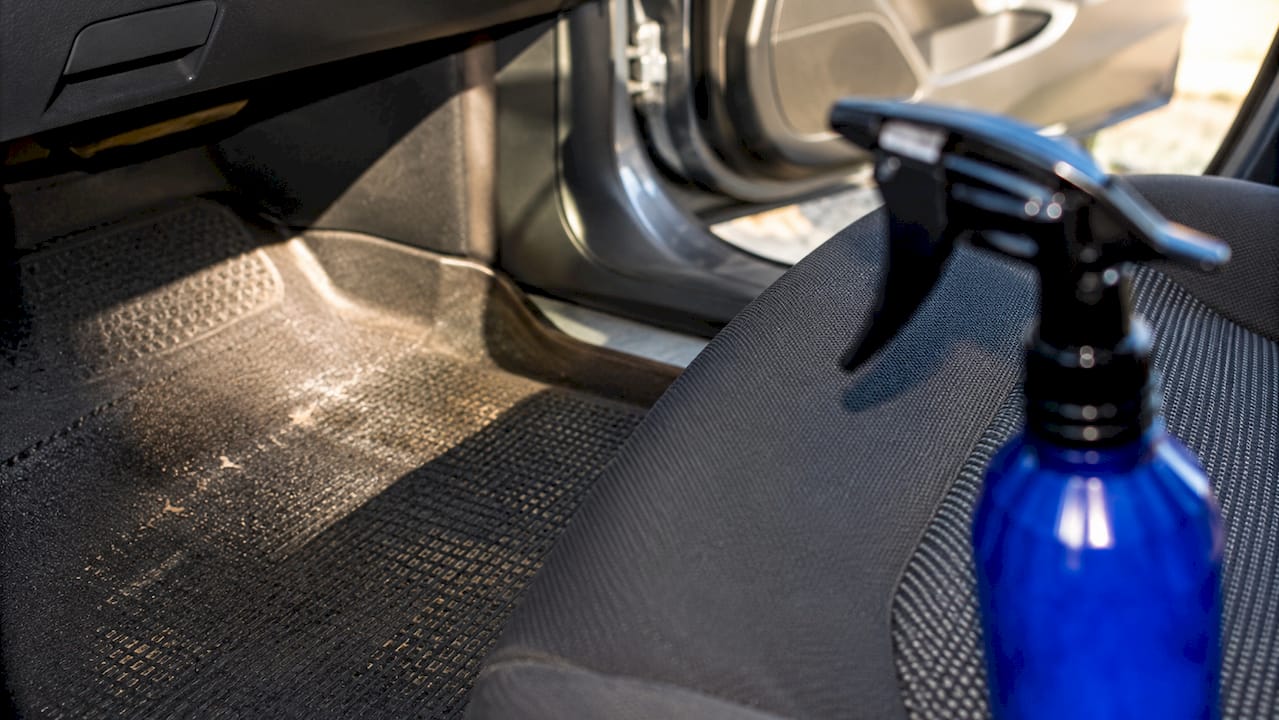
Terpenes are lipophilic, meaning they bond to fat-based materials. Upholstery foam, headliner backing, and carpet fibers all qualify. Once those compounds embed in the foam layer beneath your seat fabric, no amount of spraying the surface will reach them. Heat accelerates the problem. A parked car in summer sun can reach 130°F or higher, causing embedded terpenes to off-gas back into the cabin air and re-absorb into cooler surfaces when the car cools down. This cycle repeats every day.
The HVAC system compounds the issue further. Every time you run the fan, air pulls through a cabin air filter that may be saturated with cannabis residue, then circulates through ductwork coated in the same compounds. The headliner’s foam backing is particularly absorbent and difficult to treat because aggressive cleaning causes delamination, where the fabric separates from the foam. That inaccessibility is why professional steam extraction sometimes becomes the only viable path.
Pro Tip: Before any cleaning, run the HVAC on full recirculate for five minutes with the windows down. This flushes the duct system and gives you a clearer read on how saturated the filter and ducts actually are.
- Terpenes bond lipophilically to foam, carpet, and headliner backing
- Heat cycles cause daily off-gassing and re-absorption
- HVAC systems recirculate contaminated air through saturated filters
- Headliner foam is inaccessible to surface cleaning without risking delamination
- Simple airing out does not break molecular bonds
How effective are air fresheners, baking soda, and charcoal bags?
Most people reach for a can of Febreze or a Little Trees air freshener first. Both are temporary fixes. Store-bought air fresheners only mask marijuana odor rather than remove it at the molecular level. They add a competing scent on top of the terpene compounds, which remain fully intact in the upholstery. Within hours, the cannabis smell returns.
Baking soda performs slightly better because it neutralizes some acidic odor molecules on contact. Sprinkle it on carpets, let it sit for 30 minutes, then vacuum. It works as a supplementary step, not a primary solution. It cannot penetrate foam or reach HVAC components.
Activated charcoal bags are the most effective consumer option, but they come with strict conditions. Bamboo charcoal bags remove 60 to 75% of interior odor only after source removal and vacuuming. Charcoal adsorbs volatile organic compounds floating in the air but cannot pull embedded terpenes out of foam. They also require 48 to 72 hours of sealed exposure to work properly, and they do not reach HVAC ducts at all.
| Method | Mechanism | Pros | Cons | Treatment Duration |
|---|---|---|---|---|
| Air fresheners (Febreze, Little Trees) | Masking | Instant, cheap | Does not remove odor molecules | Hours |
| Baking soda | Surface neutralization | Inexpensive, safe | Cannot penetrate foam or ducts | 30 minutes |
| Activated charcoal bags | Adsorption of airborne VOCs | Ongoing absorption, non-toxic | Requires source removal first; misses HVAC | 48 to 72 hours |
| Enzyme cleaners (Biokleen, Nature’s Miracle) | Biological breakdown of odor molecules | Penetrates fabric fibers | Requires dwell time; not for headliner | 15 to 20 minutes per application |
| Ozone generator | Oxidation of odor compounds | Penetrates ducts and foam | Toxic above 0.1 ppm; can damage leather | 30 to 60 minutes |
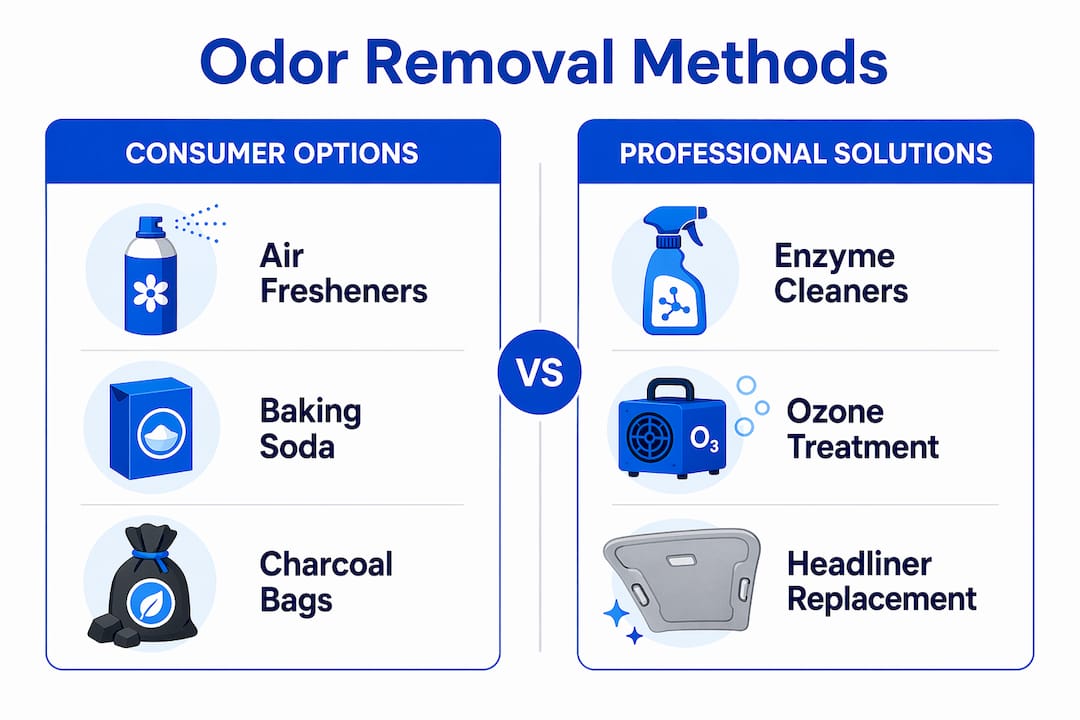
The table makes the hierarchy clear. Masking is the weakest approach. Biological breakdown through enzyme cleaners and oxidation through ozone treatment are the two methods that actually break terpene bonds. Use them in sequence, not as standalone fixes.
Step-by-step guide to removing marijuana odor from your car
This process works for moderate to heavy saturation. Follow each step in order. Skipping steps reduces the effectiveness of every step that follows.
Remove all physical residue. Collect and discard all cannabis packaging, ash, and residue from cup holders, door pockets, and under seats. Odor removal cannot begin while the source remains.
Vacuum every surface. Use a crevice tool to reach seat seams, floor mat edges, and the gap between the seat and center console. A brush attachment works on headliner fabric. This removes loose resin deposits before wet cleaning.
Wipe hard surfaces. Clean the dashboard, windows, door panels, and center console with a mild detergent solution. Follow with isopropyl alcohol on high-touch areas like the steering wheel and gear shift. Terpene residue coats glass surfaces and contributes to odor recirculation.
Apply enzyme cleaner to fabric surfaces. Spray Biokleen Bac-Out or Nature’s Miracle directly onto cloth seats, carpets, and floor mats. Let it dwell for 15 to 20 minutes before blotting dry with a microfiber cloth. Do not scrub, which spreads the compounds deeper into the foam. For the headliner, use a lightly dampened cloth with minimal product to avoid delamination.
Clean leather or vinyl separately. Use a dedicated leather cleaner like Chemical Guys Leather Cleaner, then follow with a conditioner. Harsh chemicals strip protective coatings and accelerate cracking. For detailed guidance on leather seat treatment, the material requires a different protocol than fabric.
Replace the cabin air filter. This is the single most overlooked step. Replacing the cabin air filter costs $8 to $20 and takes under 10 minutes. A saturated filter recirculates odor every time the HVAC runs. Upgrade to an activated carbon filter if you transport cannabis regularly.
Run an ozone generator treatment. Use a unit rated at 3,500 to 5,000 mg/h for 30 to 60 minutes with the car sealed and the HVAC fan set to recirculate. This pushes ozone through the duct system. Ventilate the car for at least two hours before re-entry. Ozone treatments must be limited to 60 minutes to avoid degrading leather, plastic trim, and rubber seals.
Place activated charcoal bags under the seats. After cleaning, charcoal bags provide ongoing adsorption of any residual airborne compounds. Replace or recharge them in direct sunlight every 30 days.
Pro Tip: For heavy saturation, repeat the enzyme cleaner application and ozone treatment after 48 hours. One cycle rarely eliminates deeply embedded terpenes. Two cycles with proper drying time between them produce significantly better results.
For a thorough walkthrough of car interior detailing techniques that complement this process, professional detailing resources cover foam extraction methods that go beyond spray-and-blot approaches.
When should you call a professional odor removal service?
DIY methods work well for light to moderate odor. Three signs indicate the problem has moved beyond what consumer products can fix. The smell returns within 24 hours of cleaning. The odor intensifies when the HVAC runs or when the car heats up in the sun. The headliner fabric has a persistent, concentrated smell that does not respond to surface treatment.
Professional detailers use hot water extraction, commonly called steam cleaning, with enzyme-based solutions. This process forces enzymatic cleaners deep into upholstery foam and extracts the dissolved compounds rather than leaving them to dry in place. Typical cost runs $150 to $300 depending on vehicle size and saturation level. Steam cleaning with enzymatic cleaners penetrates upholstery foam to extract embedded terpenes but requires professional equipment and expertise that consumer steam cleaners cannot replicate.
- Hot water extraction with enzyme solutions: $150 to $300
- Professional ozone treatment with controlled exposure: scheduled to protect interior materials
- HVAC duct cleaning and cabin air filter replacement: included in full-service packages
- Headliner replacement: $200 to $400, reserved for cases of long-term heavy saturation
Headliner replacement is the last resort. It is costly and time-consuming, but for a vehicle that has been used for smoking over months or years, the foam backing may be so saturated that no cleaning method reaches it. When selecting a provider, ask specifically whether they clean the HVAC ductwork and replace the cabin air filter. Many detailers skip both, which guarantees odor return. Masterodorremoval specializes in vehicle odor neutralization using eco-friendly, green-certified methods that avoid ozone and chlorine, making them a strong option for clients who want lasting results without chemical exposure risk.
Best practices for preventing marijuana odor in your car
Prevention costs far less than remediation. These habits keep your car interior neutral without requiring deep cleaning cycles.
- Avoid smoking or vaping inside the vehicle entirely. Consume outside whenever possible.
- Store cannabis in airtight, smell-proof containers or sealed glass jars during transport.
- Use washable seat covers on fabric seats to create a removable barrier against absorption.
- After any smoke exposure, open all four windows and run the HVAC on fresh air mode for at least 10 minutes to cross-ventilate.
- Vacuum the interior weekly and wipe hard surfaces with a damp microfiber cloth to prevent resin buildup.
- Replace the cabin air filter every three to six months, or immediately after any significant smoke exposure.
- Keep two to four activated charcoal bags in the cabin for continuous adsorption between cleaning sessions.
- Park in shade or a ventilated garage. Heat accelerates off-gassing from any residual terpenes, and repeated heat cycles deepen saturation over time.
Key takeaways
Eliminating marijuana odor in car interiors requires source removal, enzyme cleaning, cabin air filter replacement, and ozone treatment in sequence. No single product achieves lasting results on its own.
| Point | Details |
|---|---|
| Terpenes bind to porous materials | Surface sprays cannot reach embedded compounds in foam, carpet, or headliner backing. |
| Cabin air filter is the hidden culprit | Replacing a $8 to $20 filter stops odor recirculation through the HVAC system immediately. |
| Charcoal bags need source removal first | Activated charcoal removes 60 to 75% of airborne odor only after physical cleaning is complete. |
| Ozone treatment requires strict time limits | Run ozone generators for 30 to 60 minutes maximum to avoid damaging leather, plastic, and rubber. |
| Professional steam extraction for heavy cases | Hot water extraction with enzyme solutions reaches foam layers that DIY sprays cannot penetrate. |
What I’ve learned from treating hundreds of smoke-saturated vehicles
The single most common mistake I see is people spending money on the best air fresheners for car odor when the real problem is sitting inside the cabin air filter and the seat foam. A $40 charcoal bag placed in a car with a saturated filter is like mopping a floor while the faucet is still running. The filter has to go first.
The second mistake is treating the headliner too aggressively. I have seen DIY attempts that soaked the headliner with enzyme spray and caused full delamination, turning a $300 cleaning job into a $400 headliner replacement. Light application, minimal moisture, and professional extraction when in doubt.
What actually works is patience and sequencing. Physical removal, then enzyme treatment, then ozone, then charcoal for maintenance. Each step prepares the surface for the next. Skipping to ozone without vacuuming first just oxidizes loose resin into the fabric rather than removing it.
The 2026 product market has improved significantly. Enzyme formulations from brands like Biokleen and Nature’s Miracle are more concentrated than they were five years ago, and activated carbon cabin filters are now standard across most vehicle makes. The tools available to a careful DIY cleaner today are genuinely effective, provided they are used in the right order and with realistic expectations about how many cycles heavy saturation requires.
The clients who call me after two or three failed DIY attempts almost always skipped the cabin air filter and never addressed the HVAC system. That is where the odor lives between cleaning sessions.
— Master
Get professional help eliminating vehicle odor for good
When DIY methods fall short, Masterodorremoval delivers permanent odor elimination using science-backed, eco-friendly techniques that go far beyond what consumer products can achieve.

Masterodorremoval’s licensed professionals treat marijuana odor in car interiors with green-certified enzyme cleaning, targeted HVAC treatment, and cabin air filter replacement, without ozone or chlorine exposure. Same-day and next-day service is available for clients who need fast, reliable results. Whether you drive a daily commuter or a luxury vehicle, the process is tailored to your interior materials and saturation level. Visit the odor removal service page to book a consultation and get your vehicle smelling neutral and fresh.
FAQ
Why does weed smell stay in my car so long?
Cannabis smoke contains sticky terpenes that bind deeply to porous materials like upholstery foam, carpet, and headliner backing. The HVAC system then recirculates those compounds every time the fan runs, extending the odor indefinitely.
Do air fresheners actually remove marijuana odor from a car?
No. Air fresheners mask odor temporarily by adding a competing scent but do not break the molecular bonds of terpene compounds. The cannabis smell returns within hours once the masking fragrance fades.
How do I get rid of marijuana scent in my car’s HVAC system?
Replace the cabin air filter first, then run an ozone generator on recirculate mode for 30 to 60 minutes. This combination addresses both the filter saturation and the duct residue that cause odor to return after surface cleaning.
Can I use an ozone generator safely in my car?
Yes, with precautions. Use a unit rated at 3,500 to 5,000 mg/h, keep the treatment under 60 minutes to protect leather and plastic, and ventilate the car for at least two hours before re-entry. Ozone is toxic above 0.1 ppm and must never be used with people or pets inside.
When does car odor after smoking weed require professional treatment?
Call a professional when the smell returns within 24 hours of cleaning, intensifies with heat or HVAC use, or when the headliner has a concentrated odor that does not respond to surface treatment. These signs indicate saturation in foam layers that require hot water extraction or headliner replacement.
Recommended
- How to Eliminate Marijuana Odors from Your Home – Master Odor Removal
- Green Business Certified Car Odor Removal – Master Odor Removal
- Leather Seats and Leather Odor Removal – Master Odor Removal
#SmokeOdorRemoval
#CigaretteOdorRemoval
#CigarOdorRemoval
#MarijuanaOdorRemoval
#WeedSmellRemoval
#PetOdorRemoval
#CatUrineOdorRemoval
#DogOdorRemoval
#MustyOdorRemoval
#MoldOdorRemoval
#MildewOdorRemoval
#HVACOdorRemoval
#AirConditioningOdorRemoval
#VehicleOdorRemoval
#AutoOdorRemoval
#LuxuryVehicleOdorRemoval
#YachtOdorRemoval
#BoatOdorRemoval
#CondoOdorRemoval
#HomeOdorRemoval
#RentalPropertyOdorRemoval
#AirbnbOdorRemoval
#LuxuryHomeOdorRemoval
For social media and SEO visibility, I would also add these high-performing related hashtags:
#OdorRemoval
#OdorElimination
#OdorRemovalExperts
#LuxuryOdorRemoval
#NeutralIsTheNewScentStandard
#MasterOdorRemoval
#TobaccoOdorRemoval
#SmokeDamageRestoration
#IndoorAirQuality
#LuxuryAutos
#LuxuryHomes
#LuxuryYachts
#PropertyManagement
#AutoDetailing
#RealEstateProfessionals
#PreOwnedVehicles
#VehicleReconditioning
#HomeImprovement
#AirbnbHost
#YachtLife
#BoatLife
#PetOwners
#CommercialCleaning
#GreenCertified
#SouthFloridaBusiness
#MiamiHomes
#FortLauderdaleHomes
#BocaRatonHomes
#PompanoBeachBusiness
#OneAndDoneOdorRemoval
Recent Comments