
TL;DR:
- Smoke odor in cars persists because nicotine and tar residues bond deeply to porous surfaces and HVAC components, requiring professional chemical and mechanical removal. Surface cleaning and air fresheners only mask the smell temporarily, as they do not eliminate embedded residues that off-gas under heat and humidity. A comprehensive treatment, including deep cleaning, HVAC deodorization, filter replacement, and proper ventilation, is essential for lasting odor removal.
Smoke smell returns in cars because nicotine and tar residues chemically bond to every porous surface in the interior, including seat foam, carpets, headliners, and the HVAC system, making surface cleaning ineffective against the root cause. This phenomenon is known in toxicology as thirdhand smoke contamination, and it explains why smoke odor in cars persists long after the last cigarette. Air fresheners and wipe-downs do not dissolve these compounds. They simply layer new smells over a chemical problem that sits millimeters deep inside your upholstery and ductwork. Understanding why smoke smell returns in cars is the first step toward actually fixing it.
Why smoke smell returns in cars: the chemistry behind it
Thirdhand smoke residue is sticky, invisible, and contains hundreds of chemical compounds that bond aggressively to fabric, foam, plastic, and metal. This is not a surface stain you can wipe away. The residue penetrates deep into seat foam, headliner fabric, door panel padding, and carpet backing, where standard cleaning tools cannot reach.
The behavior of these residues changes with temperature and humidity. When your car sits in the sun, interior temperatures can reach 140 to 160°F, which volatilizes the embedded compounds and releases them back into the cabin air as gas. This is the off-gassing cycle. You clean the car, the smell fades, then a hot afternoon brings it back at full strength.
Humidity accelerates the problem further. Moisture causes residues to swell and release more volatile organic compounds (VOCs). In humid climates or during rainy seasons, car owners often notice the smell intensifying even without any new smoke exposure. The residue is not growing. It is simply reacting to its environment.
- Seat foam: Absorbs smoke particles through fabric and retains them even after surface shampooing
- Headliner: Porous fabric glued to a foam backing that traps residue and is easily damaged by aggressive cleaning
- Carpets and floor mats: Deep pile fibers hold particulates that vacuuming cannot fully extract
- Door panels and plastics: Micro-porous surfaces that absorb nicotine over time and off-gas under heat
Pro Tip: Park your car in a shaded area whenever possible. Reducing interior heat spikes slows the off-gassing cycle and keeps treated interiors smelling cleaner for longer between professional services.
Why surface cleaning and air fresheners fail to remove smoke odor
Surface sprays and air fresheners cover smell but cannot dissolve nicotine and tar residues bonded deep in surfaces. This is the core failure of most DIY smoke odor removal attempts. The smell disappears for a day or two, then returns, and many car owners assume the treatment worked partially. It did not work at all on the actual source.
Standard vacuuming removes loose particulates from the top layer of carpet fibers, but it cannot extract residue from the foam padding beneath. Shampooing with consumer-grade products cleans the fiber surface but leaves the foam substrate untouched. That foam is where the bulk of the odor source lives.
Masking agents create a compounding problem. Air fresheners often worsen odor by layering synthetic fragrance over smoke residue, creating a mixed chemical smell that is harder to neutralize later. Pine tree air fresheners hanging from your mirror are not treatment. They are delay.
The methods that actually fail most car owners include:
- Baking soda alone: Absorbs some surface odors but cannot reach embedded residues in foam or HVAC components
- Vinegar sprays: Neutralize some odor molecules on contact but evaporate before penetrating deep into materials
- Odor-eliminating sprays: Enzyme-based versions work better than fragrance sprays, but still require direct contact with the residue source
- Airing out with windows down: Reduces airborne VOC concentration temporarily but does not remove bonded residue from surfaces
The necessity of specialized chemical and mechanical treatment is not marketing language. It reflects the physical reality that nicotine and tar are adhesive compounds that require active chemical dissolution, not passive masking.
What role does the HVAC system play in recurring smoke odor?
The HVAC system is the most overlooked reservoir of smoke contamination in any vehicle. Failing to replace the cabin air filter ensures odor recirculation regardless of how clean the interior surfaces are. Every time you run the fan, a contaminated filter pushes smoke-laden air through the cabin.
The problem goes deeper than the filter. Smoke particles accumulate on the evaporator core and coat the interior walls of the ductwork. The evaporator core sits behind the dashboard and is nearly impossible to access without professional equipment. When the air conditioning runs, air passes over this contaminated surface and picks up odor molecules before entering the cabin.
Professional deodorization addresses this by introducing deodorizing foam via the fresh air intake with the fan running, coating the evaporator and ducts from the inside. This is not a procedure you can replicate with a spray can pointed at an air vent. The foam needs to reach the evaporator core itself.
| HVAC component | Contamination risk | Treatment required |
|---|---|---|
| Cabin air filter | High: traps smoke particles directly | Replace immediately; do not clean |
| Evaporator core | Very high: residue coats fins and retains odor | Professional foam deodorization via fresh air intake |
| Ductwork | Moderate: residue coats interior walls | Professional foaming treatment with fan running |
| Blower motor | Low to moderate: collects particulates over time | Inspection and cleaning by technician |
Pro Tip: Replace the cabin air filter before any professional odor treatment. If you treat the interior and HVAC without swapping the filter, you are reintroducing contamination the moment you turn on the fan.
What are the most effective methods to remove smoke smell from cars?
Removing smoke odor from a vehicle requires a multi-stage approach that addresses every contaminated surface and the HVAC system simultaneously. Treating only one area guarantees recurrence from the untreated sources.
Here is the professional protocol that actually works:
- Remove and clean all removable components. Take out floor mats, seat covers, and any fabric inserts. Clean them separately with enzyme-based cleaners that break down organic residue at the molecular level.
- Deep clean all interior surfaces. Use a steam cleaning process on seats, carpets, and door panels. Steam penetrates deeper than liquid sprays and loosens bonded residue without saturating foam.
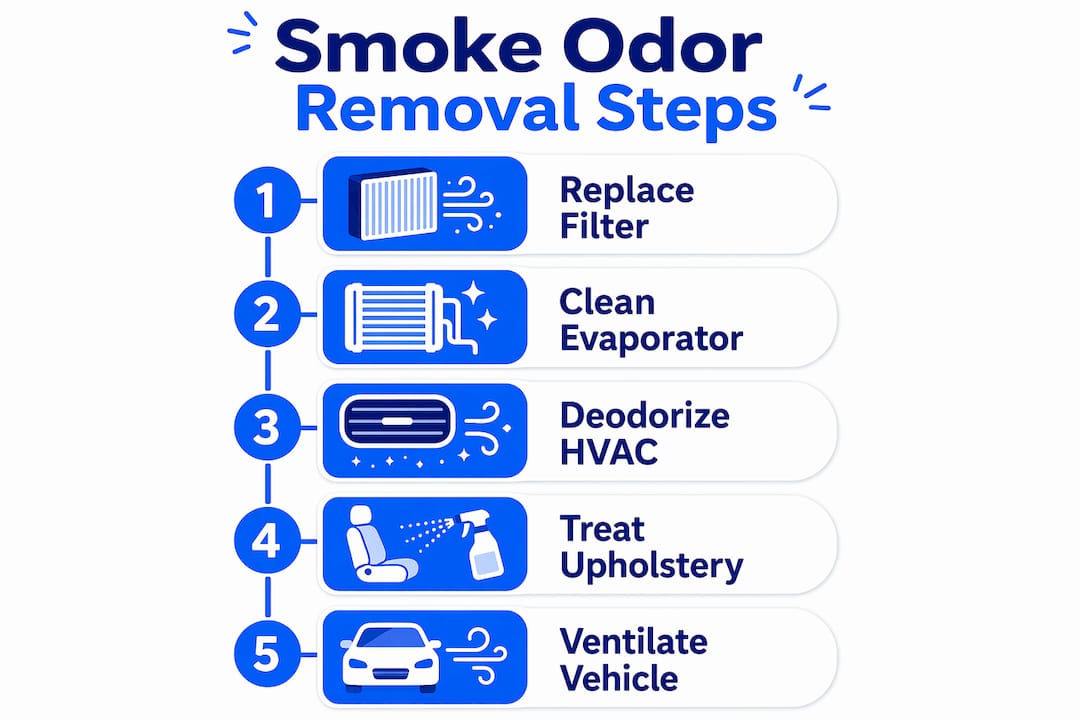
- Replace the cabin air filter. This step is non-negotiable. A contaminated filter will undo every other treatment within days.
- Treat the HVAC system. Run the fan on recirculate and introduce a professional-grade deodorizing foam through the fresh air intake to coat the evaporator core and ducts.
- Apply ozone treatment. Ozone treatment oxidizes odor molecules at the molecular level. Professional ozone sessions run 4 to 24 hours depending on contamination severity, followed by a 30 to 60 minute air-out before the vehicle is safe to use.
- Ventilate thoroughly. Short-burst ventilation combined with extended airing flushes residual VOCs and off-gassing compounds from the cabin after treatment.
For DIY approaches, enzyme cleaners and baking soda applied overnight to carpets and seats provide meaningful improvement for light contamination. Activated charcoal placed in the cabin for 48 to 72 hours absorbs residual VOCs after cleaning. Neither replaces professional treatment for heavily smoked vehicles.
One honest caveat: heavily smoked vehicles may achieve only 80 to 90% odor reduction even with professional ozone treatment and deep cleaning. The tobacco smoke residue in some vehicles is simply too deeply embedded in foam and structural components to eliminate completely without replacing those materials.
How do environmental factors cause smoke smell to return after treatment?
Even after a thorough cleaning, environmental conditions can trigger odor return from residues that were not fully removed. Heat is the primary driver. Interior temperatures that spike over 140°F cause sudden off-gassing of embedded compounds, producing a strong odor return that feels like the treatment failed. It did not fail entirely. It exposed the residue that remained.
Humidity compounds this effect. When moisture enters the cabin through open windows or a wet HVAC system, it activates residues that were dormant in dry conditions. Car owners in humid climates often report that smoke smell intensifies after rain, which is a direct result of moisture-triggered off-gassing.
A critical diagnostic mistake is also worth flagging here. Drivers often misdiagnose moldy or musty odors as smoke. A blocked HVAC drain or mold growth in the evaporator housing produces a sharp, unpleasant smell that is distinct from tobacco but easy to confuse after extended exposure. Treating for smoke when the source is mold wastes time and money.
The ongoing contamination risks that cause recurrence include:
- Continued smoking in the vehicle: Even occasional smoking reintroduces fresh residue before previous treatment has fully settled
- Passengers who smoke: Clothing and hair carry thirdhand smoke residue that transfers to upholstery
- Purchasing a used vehicle with smoke history: Previous owner contamination can take multiple treatment cycles to fully address
- Ignoring the trunk: Carpeted trunk liners absorb smoke from the cabin over time and off-gas back into the interior
Key takeaways
Smoke smell returns in cars because nicotine and tar residues bond chemically to porous surfaces and the HVAC system, and no surface-level treatment can dissolve those embedded compounds without a multi-stage professional protocol.
| Point | Details |
|---|---|
| Chemical bonding is the root cause | Nicotine and tar penetrate foam, fabric, and plastics, requiring chemical dissolution to remove. |
| HVAC system recirculates odor | A contaminated cabin air filter and evaporator core reintroduce smoke smell every time the fan runs. |
| Surface cleaning only masks the problem | Sprays and air fresheners layer fragrance over residue without breaking down the source compounds. |
| Heat triggers odor return | Interior temperatures above 140°F volatilize embedded residues and release them back into cabin air. |
| Multi-stage treatment is required | Effective removal combines deep cleaning, HVAC deodorization, filter replacement, and proper ventilation. |
What I’ve learned from treating smoke-saturated vehicle interiors
After working with hundreds of smoke-contaminated vehicles, the pattern I see most often is this: car owners spend weeks trying product after product, each one delivering two days of relief before the smell returns. By the time they call us, they have already spent more on sprays, fresheners, and DIY kits than a professional treatment would have cost.
The mistake is not the effort. The mistake is treating a chemical problem with cosmetic solutions. Nicotine does not respond to fragrance. Tar does not dissolve in a surface wipe. The odor removal process for tobacco smoke requires reaching the actual contaminated substrate, not the surface above it.
The HVAC system is where most treatments fall apart. I have seen vehicles with spotless interiors that still smell like an ashtray the moment the air conditioning turns on. The evaporator core is coated, the filter is saturated, and every breath of conditioned air carries residue through the cabin. Skipping HVAC treatment is the single most common reason smoke smell returns after a cleaning.
My practical advice: if you have already tried two or more DIY approaches without lasting results, stop adding products to the problem. Get the HVAC system treated, replace the cabin air filter, and use vehicle odor neutralization steps designed for the full interior system, not just the visible surfaces. Realistic expectations matter too. A vehicle smoked in daily for three years will not smell factory-fresh after one treatment. It will improve significantly, and subsequent treatments will close the gap further.
— Master
How Masterodorremoval eliminates persistent smoke odor from vehicles

Masterodorremoval specializes in the permanent elimination of tobacco smoke odor from vehicle interiors using eco-friendly, green-certified methods that are safe for luxury upholstery and sensitive materials. The process covers every contaminated surface, including seat foam, carpets, headliners, door panels, and the full HVAC system, without relying on ozone or chlorine treatments that can damage interiors or leave residual chemical smells. Same-day and next-day service is available for car owners who need results fast. If you have tried surface cleaning without lasting success, explore professional odor removal that addresses the actual source of the problem, not just the symptom.
FAQ
Why does smoke smell come back after I clean my car?
Smoke smell returns because nicotine and tar residues bond chemically to porous materials like seat foam, carpets, and HVAC components. Surface cleaning removes odor from the top layer but leaves the embedded residue intact, which off-gases back into the cabin under heat and humidity.
Does replacing the cabin air filter remove smoke smell?
Replacing the cabin air filter is a critical step, but it alone does not eliminate smoke odor. The evaporator core and ductwork also retain residue and must be treated with professional deodorizing foam to stop the HVAC system from recirculating contaminated air.
How long does professional smoke odor removal take?
Professional ozone treatment runs 4 to 24 hours depending on contamination severity, followed by a 30 to 60 minute ventilation period before the vehicle is safe to use. A full multi-stage treatment including deep cleaning and HVAC deodorization typically takes one full service day.
Can I use baking soda or charcoal to remove smoke smell permanently?
Baking soda and activated charcoal absorb surface-level VOCs and provide temporary improvement for light contamination, but neither can dissolve nicotine and tar residues bonded deep in foam and fabric. They work best as maintenance tools after professional treatment, not as standalone solutions.
Why does smoke smell get worse on hot days?
Interior temperatures reaching 140 to 160°F volatilize the chemical compounds embedded in upholstery and plastics, releasing them back into the cabin as gas. This off-gassing cycle is the reason smoke odor intensifies on hot days even in vehicles that have been cleaned.
Recommended
- Facts About Odor Removal Auto for Tobacco Smoke – Master Odor Removal
- Tobacco Smoke and Marjuana Smoke Odor Removal in Homes and Airbnbs – Master Odor Removal
- Super Car Buying and Odor Removal – Master Odor Removal
- Tobacco Odor Removal Bentley Motors – Master Odor Removal
#SmokeOdorRemoval
#CigaretteOdorRemoval
#CigarOdorRemoval
#MarijuanaOdorRemoval
#WeedSmellRemoval
#PetOdorRemoval
#CatUrineOdorRemoval
#DogOdorRemoval
#MustyOdorRemoval
#MoldOdorRemoval
#MildewOdorRemoval
#HVACOdorRemoval
#AirConditioningOdorRemoval
#VehicleOdorRemoval
#AutoOdorRemoval
#LuxuryVehicleOdorRemoval
#YachtOdorRemoval
#BoatOdorRemoval
#CondoOdorRemoval
#HomeOdorRemoval
#RentalPropertyOdorRemoval
#AirbnbOdorRemoval
#LuxuryHomeOdorRemoval
#OdorRemoval
#OdorElimination
#OdorRemovalExperts
#LuxuryOdorRemoval
#NeutralIsTheNewScentStandard
#MasterOdorRemoval
#TobaccoOdorRemoval
#SmokeDamageRestoration
#IndoorAirQuality
#LuxuryAutos
#LuxuryHomes
#LuxuryYachts
#PropertyManagement
#AutoDetailing
#RealEstateProfessionals
#PreOwnedVehicles
#VehicleReconditioning
#HomeImprovement
#AirbnbHost
#YachtLife
#BoatLife
#PetOwners
#CommercialCleaning
#GreenCertified
#SouthFloridaBusiness
#MiamiHomes
#FortLauderdaleHomes
#BocaRatonHomes
#PompanoBeachBusiness
#OneAndDoneOdorRemoval
Recent Comments