
TL;DR:
- Odor assessments provide measurable data that helps businesses control environmental smells impacting revenue, reputation, and employee performance. Combining electronic sensing with human evaluation, they enable targeted source identification and effective remediation, while guiding scent branding to enhance consumer connection. Regular proactive monitoring ensures regulatory compliance and prevents costly odor issues before they affect customer experience.
Odor assessment is the systematic process of detecting, measuring, and evaluating smells within a commercial environment to protect customer experience, employee health, and brand perception. The role of odor assessments in business extends far beyond complaint management. It gives property managers and business owners a measurable, repeatable method for controlling one of the most powerful and least managed sensory variables in any space. Tools like handheld electronic nose devices, human sniff testing panels, and scent diffusion systems each serve a distinct function in this process. When used together, they form a complete picture of how your environment smells and what that smell is costing you.
How odors affect customer experience and employee performance
Smell is the only sense with a direct neural pathway to the brain’s limbic system, which governs emotion and memory. That biological fact has real commercial consequences. Customers make subconscious judgments about a business within seconds of entering, and scent is a primary driver of those judgments.

The numbers are striking. Unpleasant odors drive 40% of customers out of stores before they complete a purchase, while pleasant scents increase dwell time by up to 40%. That means a single odor problem can cut your floor time and transaction volume simultaneously. Retailers also report that customers are 84% more likely to buy in a scented environment compared to an unscented one. That figure represents a measurable lift in revenue tied directly to olfactory conditions.
The impact does not stop at the customer. Office workers in environments with poor air quality linked to odors show a 9% drop in cognitive performance. For a team of 20 employees, that is the equivalent of losing nearly two full-time workers’ output every day. Payroll efficiency drops without any visible cause, and most managers never connect the problem to air quality.
The hospitality and retail sectors feel this most acutely. A hotel room that smells of mildew or prior guests signals neglect regardless of how clean the space actually is. A restaurant with lingering grease odors from the kitchen undermines the dining experience before the first course arrives. Scent creates context, and that context shapes every other perception a customer forms about your business. For more on managing this in hospitality settings, the hotel odor control guide from Masterodorremoval covers property-specific strategies in detail.
Key factors that amplify odor impact on business outcomes include:
- Customer dwell time: Longer stays correlate directly with higher average transaction values in retail.
- Perceived cleanliness: Scent is the primary proxy customers use to judge hygiene, even when surfaces are spotless.
- Staff productivity: Cognitive load increases in malodorous environments, slowing decision-making and communication.
- Brand recall: Scent memory is more durable than visual memory, making it a powerful tool for repeat business.
What odor evaluation techniques work best for commercial spaces?
The industry term for structured smell measurement is olfactometry, though most business owners encounter it through two practical formats: electronic sensing and human panel assessment. Both have legitimate uses, and the best programs combine them.
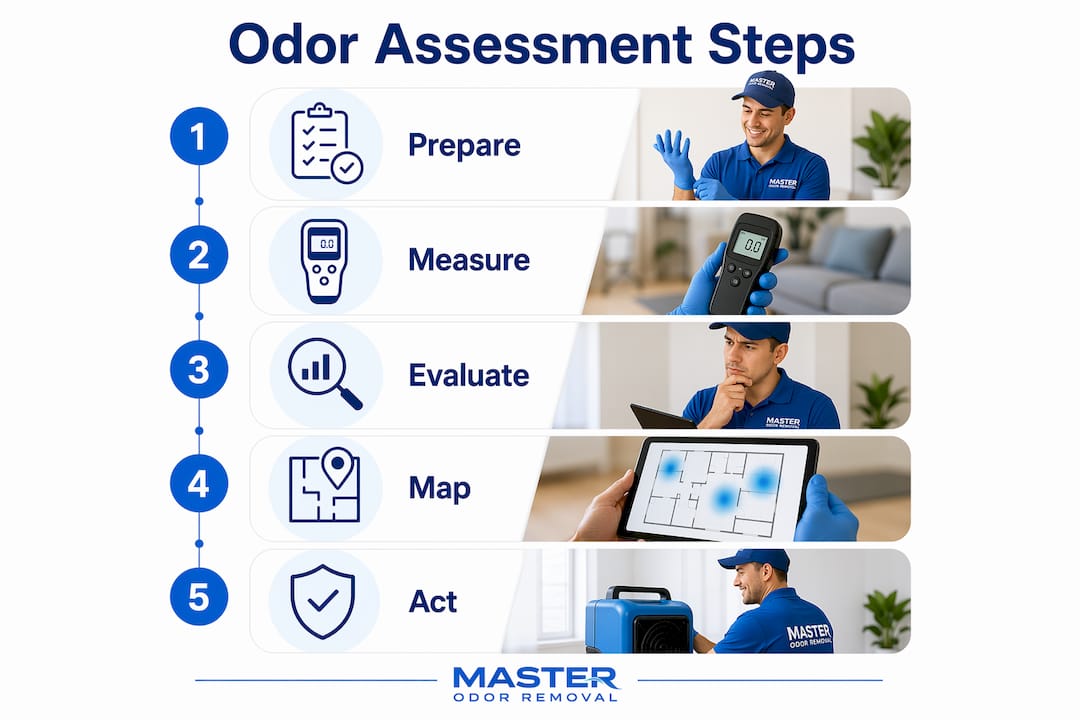
Handheld electronic nose devices measure odor concentration in units like g/m³ across a range of 0 to 9,999 g/m³, reducing response times from hours to minutes compared to lab-based sampling. These devices are fast, portable, and repeatable, making them ideal for daily monitoring and rapid source identification. A facility manager can walk a commercial kitchen, a locker room, and a storage area in under 30 minutes and get quantified readings for each zone.
Human sniff testing, also called sensory panel evaluation, brings trained assessors into the space to characterize odor type, intensity, and hedonic tone. This method captures nuance that sensors miss. An electronic nose can detect a chemical compound, but it cannot tell you whether that compound smells like wet cardboard or stale cooking oil. That distinction matters when you are trying to trace a source or communicate a problem to a remediation team.
Pro Tip: Schedule human sniff testing in the morning before cleaning products are applied. Masking agents from cleaning routines can suppress the baseline odor signature you are trying to measure, producing a false-clean reading.
Handheld meters require supplementation with human sniff testing for regulatory and high-stakes decisions because humidity, temperature, and background chemical interference all affect sensor accuracy. A reading taken on a humid August afternoon will differ from one taken on a dry January morning in the same space.
| Method | Strengths | Limitations |
|---|---|---|
| Handheld electronic nose | Fast, portable, quantified data | Affected by humidity and temperature; no odor characterization |
| Human sniff panel | Characterizes type and hedonic tone; regulatory-grade | Slower, requires trained assessors, subject to fatigue |
| Fixed sensor arrays | Continuous monitoring, trend data | High installation cost; requires calibration |
| Lab-based olfactometry | Gold standard for regulatory compliance | Slow turnaround; not practical for daily operations |
Implementing odor management from assessment to scent strategy
Assessment data is only useful if it drives action. The practical workflow moves from measurement to source identification, then to remediation, and finally to intentional scent design.
Once you have baseline readings, map them against your floor plan. High-concentration zones near HVAC returns, storage areas, or restrooms point to specific sources. Addressing those sources directly, whether through ventilation upgrades, material replacement, or professional odor removal, produces lasting results. Covering odors with air fresheners without addressing the source is the commercial equivalent of painting over rust.
The next layer is olfactory branding, which is the deliberate use of scent to reinforce brand identity and customer emotion. Smell triggers 35% memory recall compared to just 5% for visual cues. That gap explains why a signature scent in a retail or hospitality environment creates stronger brand associations than a logo or color palette alone. Singapore Airlines, for example, uses a proprietary scent called Stefan Floridian Waters across its cabins and flight attendant uniforms, creating a consistent sensory identity that passengers associate with the brand globally.
Scent congruence is the critical variable. A congruent scent aligned with brand identity boosts dwell time by up to 40% and increases perceived product value. An incongruent scent, such as a floral diffuser in an automotive showroom or a pine fragrance in a seafood restaurant, can actually reduce sales below the unscented baseline. The scent must match the category, the customer expectation, and the physical environment.
Practical steps for implementing a scent strategy after assessment:
- Neutralize first: Remove all negative odor sources before introducing any positive scent. Layering fragrance over a problem odor creates a worse composite smell.
- Match intensity to space size: Diffusion systems must be calibrated to room volume. Over-scenting triggers headaches and complaints faster than no scent at all.
- Test with your actual customer demographic: Scent preferences vary by age and cultural background. What reads as “fresh” to one group may read as “clinical” to another.
- Document your scent identity: Treat your chosen scent like a brand asset. Record the formula, the diffusion schedule, and the approved vendor so the experience stays consistent across locations.
Pro Tip: For multi-location businesses, use the same scent concentration and diffusion schedule at every property. Inconsistency in scent identity is as damaging to brand perception as inconsistency in logo use.
How to integrate odor assessments into regular business operations
Reactive odor management, waiting for a customer complaint before investigating, is the most expensive approach available. By the time a complaint surfaces, the problem has already affected dozens of visits and potentially generated negative reviews. Proactive odor monitoring integrated into daily operations prevents escalation and supports regulatory compliance simultaneously.
A practical integration schedule for most commercial properties looks like this:
- Daily: Staff conduct a brief sensory walkthrough at opening, before cleaning products are applied, and note any anomalies in a log.
- Weekly: Facility managers review log entries and run handheld device checks in high-risk zones such as restrooms, kitchens, and HVAC intake areas.
- Monthly: A structured assessment covers the full property, including storage areas and spaces not open to the public.
- Seasonally: Conduct a full assessment during peak odor conditions. Assessments during April through September capture worst-case scenarios because warm temperatures accelerate odor dispersion and intensify perceived concentration. Planning authorities reject assessments conducted outside this window for regulatory submissions.
- After incidents: Any water intrusion, pest activity, or HVAC failure triggers an immediate unscheduled assessment.
Staff training is the multiplier that makes this schedule work. Employees who understand what to look for and how to log it accurately give you an early warning system that no sensor array can replicate. Training does not need to be elaborate. A 30-minute orientation covering odor categories, logging protocol, and escalation thresholds is sufficient for most teams. For office environments specifically, the odor removal steps for facility managers resource from Masterodorremoval provides a practical framework for building this into standard maintenance procedures.
Regulatory compliance is a secondary benefit worth noting. Failing to manage odors effectively often leads regulatory bodies to impose stricter site conditions, which can restrict operating hours or require costly infrastructure changes. A documented monitoring program demonstrates good faith and gives you data to contest unfair enforcement actions.
Key takeaways
Odor assessments give business owners a measurable, repeatable method for protecting revenue, employee output, and brand perception from one of the most overlooked environmental variables in commercial operations.
| Point | Details |
|---|---|
| Odors directly affect revenue | Unpleasant smells drive 40% of customers out early; pleasant scents raise purchase intent by 84%. |
| Combine electronic and human methods | Handheld devices provide speed; trained sniff panels provide accuracy for high-stakes decisions. |
| Neutralize before you brand | Removing odor sources before adding scent is the only sequence that produces a positive result. |
| Scent congruence is non-negotiable | A mismatched scent reduces sales below the unscented baseline, making alignment critical. |
| Proactive monitoring prevents escalation | Integrating regular assessments into operations protects compliance and catches problems before customers do. |
Why odor assessment is the most underused tool in commercial property management
I have walked through hundreds of commercial spaces over the years, from luxury hotel suites to automotive showrooms to office buildings that cost tens of millions to build. The pattern I see repeatedly is this: owners invest heavily in lighting, furniture, and visual branding, then completely ignore what the space smells like. They find out there is a problem when a review mentions it publicly, at which point the damage is already done.
What surprises most clients is how quickly a structured assessment changes their perspective. Once you have a number attached to an odor, once you can point to a specific zone on a floor plan and say “this is where the problem originates and this is its measured intensity,” the conversation shifts from vague discomfort to solvable problem. That shift is where real improvement begins.
The scent branding piece is where I see the biggest missed opportunity. Most business owners think of odor management as purely defensive, as something you do to avoid complaints. The offensive play, using a deliberate, congruent scent to build memory and loyalty, is available to any business willing to do the assessment work first. You cannot build a scent identity on top of an unresolved odor problem. The sequence matters.
My honest advice: treat your first full odor assessment the same way you treat a financial audit. It tells you where you actually stand, not where you assume you stand. The findings are almost always surprising, and the cost of acting on them is almost always lower than the cost of ignoring them.
— Master
Professional odor assessment and removal for your business

Masterodorremoval works with commercial property owners, hospitality operators, and luxury venue managers who need odor problems solved permanently, not masked. Every project starts with a thorough assessment to identify sources, followed by eco-friendly, green-certified removal methods that avoid ozone and chlorine treatments entirely. The result is a genuinely neutral interior that is ready for whatever scent strategy you choose to build on top of it. Same-day and next-day service is available for urgent situations. If your space has an odor problem you have been managing reactively, it is time to address it properly. Explore professional odor removal services from Masterodorremoval, or review the full range of specialist removal solutions to find the right fit for your property.
FAQ
What is the role of odor assessments in business?
Odor assessments identify, measure, and evaluate smells in commercial environments to protect customer satisfaction, employee performance, and brand perception. They give business owners quantified data to address odor sources before they affect revenue or reputation.
How do odors affect consumer behavior?
Unpleasant odors cause 40% of customers to leave stores early, while pleasant, congruent scents increase purchase intent by up to 84%. Scent influences subconscious judgments about cleanliness and quality faster than any visual cue.
What tools are used to measure workplace odors?
Handheld electronic nose devices measure odor concentration rapidly across a range of 0 to 9,999 g/m³, while trained human sniff panels characterize odor type and intensity for regulatory-grade decisions. Most professional programs use both methods together.
How often should a business conduct odor assessments?
Daily staff walkthroughs, weekly device checks in high-risk zones, and monthly full-property assessments form a solid baseline. Seasonal assessments during April through September capture worst-case conditions most relevant to regulatory compliance and planning submissions.
What is scent branding and how does it benefit a business?
Scent branding is the deliberate use of a signature fragrance to reinforce brand identity and emotional association. Because smell triggers 35% memory recall compared to 5% for visual cues, a congruent scent creates stronger and more durable brand connections than most visual marketing tools.
Recent Comments