
TL;DR:
- Persistent office odors undermine professionalism, employee focus, and signal deeper management issues that air fresheners cannot fix. Effective removal requires identifying sources, enhancing ventilation, treating porous surfaces, controlling moisture, and, if necessary, consulting professionals for deep remediation. Implementing a routine maintenance schedule ensures lasting freshness and prevents recurring odor problems.
Persistent odors in a commercial office are not just unpleasant. They undermine employee focus, create a poor first impression for clients, and signal deeper facility management problems that air fresheners cannot fix. If you are managing a multi-person workspace, you already know that following proper office space odor removal steps is the only way to get lasting results. The mistake most facility teams make is treating the symptom rather than the cause. True odor elimination, as hospitality experts confirm, means achieving a neutral scent, not layering fragrances on top of a problem.
Table of Contents
- Key takeaways
- 1. Identify and eliminate odor sources in the office
- 2. Enhance ventilation and air exchange for odor dilution
- 3. Clean and treat porous surfaces and fabrics where odors linger
- 4. Address moisture control and HVAC maintenance to prevent mold-related odors
- 5. Implement a scheduled office deodorizing maintenance routine
- 6. Consider advanced odor abatement and professional remediation options
- My honest take on office odor management
- Ready to eliminate office odors for good?
- FAQ
Key takeaways
| Point | Details |
|---|---|
| Source control comes first | Identify and remove odor-generating materials before any cleaning or ventilation strategy will work effectively. |
| Ventilation is non-negotiable | MERV 13 or higher filters plus exhaust systems dilute and remove airborne odor compounds that surface cleaning cannot reach. |
| Porous surfaces hold odors longest | Carpets and upholstered chairs require baking soda treatment, vacuuming, and controlled drying to fully release trapped odors. |
| Moisture drives mold odors | Maintaining HVAC components and controlling humidity prevents the most stubborn and recurring musty smells in office buildings. |
| Professional help has a clear threshold | When standard steps fail after two or more thorough attempts, advanced remediation by licensed professionals is the right call. |
1. Identify and eliminate odor sources in the office
Every effective set of office space odor removal steps begins with a source audit. You cannot treat what you have not located, and spraying air freshener over a festering problem only delays the work you will eventually have to do anyway.
Start by walking the space systematically. Common odor sources in commercial offices include:
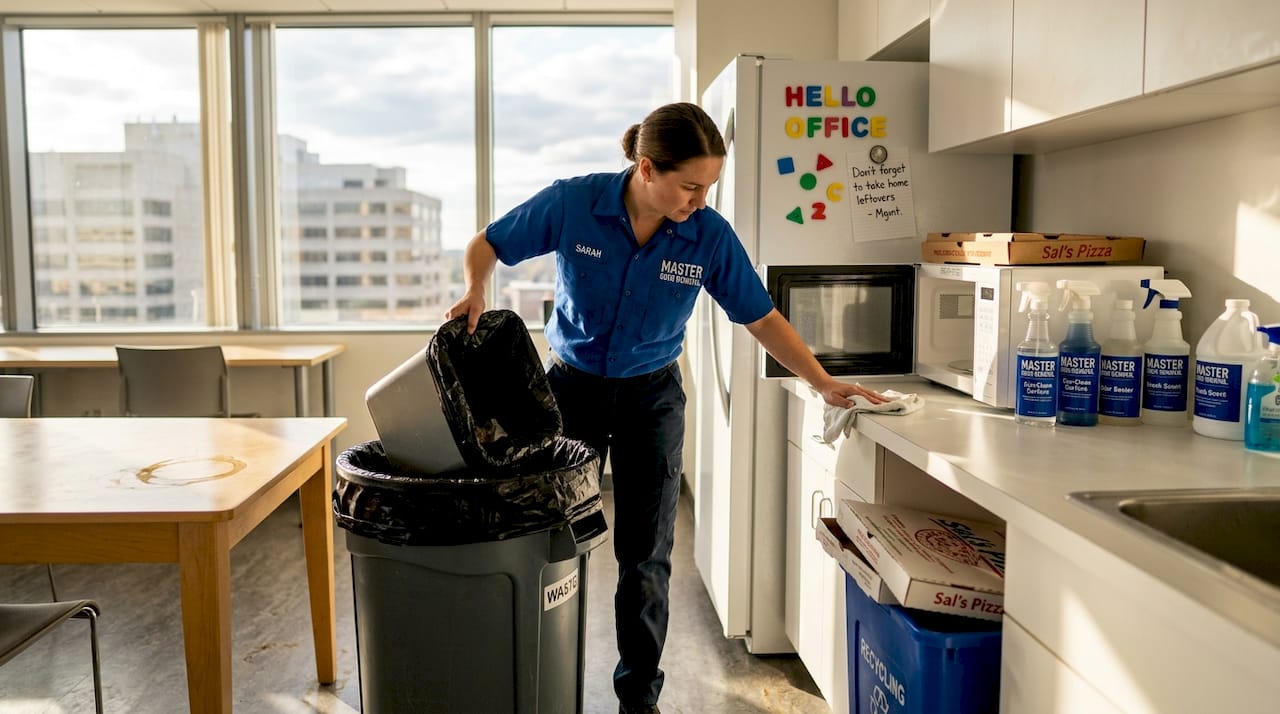
- Kitchen and break room areas: Expired food in refrigerators, grease-caked microwave interiors, and overflowing trash bins
- Carpets and area rugs: Accumulated food debris, beverage spills, and foot traffic residue
- Upholstered furniture: Office chairs, sofas, and fabric partitions absorb body odor and food smells over months
- Personal storage areas: Desks, lockers, and under-desk bins where food wrappers and damp clothing accumulate
- Trash and recycling stations: Infrequent liner changes and liquid residue in bins
Document where odors are strongest and at what times of day. A smell that peaks at noon and fades by 3 p.m. almost certainly originates in the kitchen. One that persists through the weekend points to a structural source like mold or a plumbing issue.
Hidden sources deserve particular attention. Odor persistence is frequently linked to HVAC damp components, including condensate drain pans and cooling coils that harbor microbial growth. Check these during your audit even if the smell does not seem HVAC-related.
Pro Tip: Walk the office at 7 a.m. before staff arrives. Without foot traffic and with the HVAC cycling, problem areas are dramatically easier to isolate. Take notes with timestamps and locations rather than relying on memory.
Once sources are documented, remove them. Throw out expired food, deep clean the microwave, replace trash bin liners, and bag any damp or soiled items. This step alone can eliminate 40 to 60 percent of common office smells before any further treatment begins.
2. Enhance ventilation and air exchange for odor dilution
Ventilation does what cleaning cannot. It removes odor compounds already airborne and prevents them from resettling onto surfaces. Coordinated source control, ventilation, and air cleaning form an interdependent system. Weakness in any one element limits the others.
For most commercial offices, mechanical ventilation through the HVAC system is the primary tool. Upgrade to MERV 13 or higher rated filters if you have not already. These capture fine particulate matter that carries odor compounds and significantly improve indoor air quality outcomes compared to standard MERV 8 filters.
Key ventilation strategies for office environments:
- Kitchen exhaust: Run range hoods during and immediately after any cooking or heating of food. Clean the grease filters monthly.
- Portable HEPA air purifiers: Place units rated for your square footage in break rooms, conference rooms, and high-density seating areas.
- Cross-ventilation: Open windows on opposing sides of the space when weather and building security allow. Even 15 minutes before staff arrives makes a measurable difference.
- HVAC scheduling: Program systems to run a full air exchange cycle 30 minutes before occupancy begins each morning.
Pro Tip: Position portable HEPA units near the odor source, not in the center of the room. A purifier sitting six feet from the coffee station or trash bin intercepts odor compounds before they spread.
Improving ventilation with HEPA purifiers alongside regular surface cleaning creates a compounding effect. Neither strategy fully works alone, but together they address both airborne and settled odor compounds.
3. Clean and treat porous surfaces and fabrics where odors linger
Hard surfaces are easy. Porous materials are where office odors live rent-free for months. Carpet fibers, chair padding, and fabric partitions act as odor reservoirs that slowly off-gas throughout the workday.
Follow these steps for fabric and carpet treatment:
- Vacuum thoroughly. Use a vacuum with an upholstery attachment on chairs, fabric walls, and soft furnishings. For carpets, use high suction and make two passes in perpendicular directions to lift embedded debris.
- Apply baking soda generously. Spread a visible layer over carpets and fabric surfaces. Allow it to sit for a minimum of three hours. Overnight treatment works best for severe odors.
- Vacuum again completely. Remove all baking soda residue. This step pulls odor compounds out of the material that the first vacuuming loosened.
- Mist with diluted white vinegar. Mix one part white vinegar with two parts water in a spray bottle. Apply a light mist to fabric surfaces. Do not saturate. Vinegar neutralizes alkaline odor compounds and evaporates without leaving residue.
- Allow full drying time. Use fans or increase HVAC airflow to dry treated areas within two to four hours. Damp fabric left unattended creates new moisture problems.
Baking soda applied overnight followed by vacuuming is consistently effective for fabric chair odors, while steam cleaning combined with ventilation enhances odor removal for carpets with deep contamination.
Pro Tip: Schedule fabric treatment for a Friday afternoon so surfaces can dry and off-gas over the weekend. Monday morning results are noticeably better than mid-week treatments.
For heavily contaminated chairs or carpeting that does not respond after two rounds of treatment, commercial enzyme-based fabric fresheners are worth the investment. They break down organic compounds at the molecular level rather than simply absorbing surface odors.
4. Address moisture control and HVAC maintenance to prevent mold-related odors
Musty smells that return within days of cleaning almost always trace back to moisture. Mold and mildew produce volatile organic compounds that no amount of surface cleaning will fix if the moisture source remains active.
| Moisture source | Risk level | Recommended action |
|---|---|---|
| HVAC condensate drain pans | High | Inspect and clean quarterly; treat with algaecide |
| Cooling coils in air handlers | High | Professional cleaning annually |
| High-humidity zones (server rooms, basements) | Medium-High | Install dedicated dehumidifiers |
| Roof leaks or plumbing seepage | Critical | Remediate structurally before any odor treatment |
| Single-pane windows with condensation | Medium | Improve weatherstripping and interior ventilation |
HVAC moisture pathways such as dirty condensate pans and fouled coils act as secondary odor sources, distributing mold spores and organic compounds throughout the entire occupied space each time the system runs.
Keep indoor relative humidity between 40 and 60 percent. Below 40 percent creates static and respiratory irritation. Above 60 percent accelerates mold growth on any porous surface in the building. A networked humidity monitoring system with alerts is a worthwhile facility management investment for any office over 5,000 square feet.
If your building has a pest management challenge in addition to moisture issues, address both simultaneously. Pest activity often correlates with the same damp, food-contaminated zones driving your odor complaints.
5. Implement a scheduled office deodorizing maintenance routine
Reactive odor management is expensive and ineffective. The offices that stay consistently fresh are the ones with a structured maintenance calendar, not the ones that scramble every time a complaint reaches HR.
A practical office deodorizing schedule looks like this. Daily: empty all trash bins, wipe kitchen surfaces, and run exhaust fans during and after any food preparation. Weekly: vacuum all carpets and upholstered surfaces, change HVAC pre-filters if heavily loaded, and inspect break rooms for odor sources. Monthly: deep clean the refrigerator, wipe down fabric partition walls, clean range hood filters, and inspect condensate drain pans. Quarterly: schedule professional HVAC coil inspection, apply a baking soda treatment across all carpets, and audit portable air purifier filter replacement schedules.
Consistency transforms odor control from a recurring crisis into routine facility maintenance. The same office that generated multiple odor complaints per month typically sees those complaints drop to near zero within six to eight weeks of implementing a disciplined schedule.
6. Consider advanced odor abatement and professional remediation options
When standard cleaning, ventilation, and moisture control do not resolve persistent odors after two thorough rounds of treatment, the problem is beyond general facility management scope. This is not a failure. It is a signal that the contamination is deeper than surface-level methods can reach.
Advanced odor abatement options include:
- Enzyme-based deep treatment: Applied by professionals to subfloor materials, wall cavities, and HVAC ductwork where odor compounds have migrated
- Thermal fogging: Penetrates porous materials and reaches areas impossible to clean manually
- Oxidation technologies: Neutralize complex odor compounds at the molecular level in unoccupied spaces
Advanced methods like ozone treatment and oxidation technologies require professional guidance and safety assessment before application in any occupied commercial building.
“Safety and efficacy of advanced odor abatement methods require professional assessment. General facility staff should not attempt ozone or chemical oxidizers without expert guidance.” — Industry safety standard for commercial odor remediation
One important note for office managers evaluating professional services: not all providers are equal in their approach to safety. Masterodorremoval explicitly avoids ozone and chlorine-based treatments, focusing on eco-certified methods that are safe for premium interiors and the people who occupy them. That distinction matters when you are responsible for employee health and expensive furnishings.
My honest take on office odor management
I have worked with offices ranging from small professional suites to large corporate floors, and the single most consistent mistake I see is the instinct to mask rather than eliminate. Someone notices an odor, an air freshener gets placed nearby, and the problem is considered handled. Three weeks later, the complaint comes back worse because the organic source has continued to develop under a layer of synthetic fragrance.
The facilities that get this right treat odor removal as a multi-system problem, not a cleaning task. Efficient odor removal requires coordinated multi-barrier control: source elimination, ventilation, surface treatment, and moisture management working together. Pull on one thread without addressing the others and you are back to square one.
What I have learned from experience is that fabric surfaces and moisture are almost always underestimated. Facility managers invest in professional carpet cleaning once a year and assume it is covered. But a high-traffic office chair that gets used 250 days per year and never treated is a slow-release odor machine. The DIY odor removal steps that actually work are not complicated. They just require consistency and the willingness to treat the source.
When those steps are genuinely not enough, calling in licensed professionals is not an admission of defeat. It is the right facility management decision.
— Master
Ready to eliminate office odors for good?
When standard steps have not delivered lasting results, your office needs more than a cleaning crew with air fresheners. Masterodorremoval specializes in permanent odor elimination for commercial spaces using eco-friendly odor elimination methods that protect your employees, your furnishings, and your reputation.

From persistent kitchen odors to deep-set mildew in carpets and HVAC-driven contamination, the team at Masterodorremoval provides fast, same or next-day service tailored to office environments. Every treatment targets the source, not the symptom. If you are ready to give your team a genuinely fresh workplace, explore professional office odor removal and see how a certified approach delivers results that last.
FAQ
What are the first steps to remove office smells?
Start by identifying and removing the odor source, whether that is expired food, damp materials, or mold. Source control followed by ventilation improvement is the most effective sequence before any surface cleaning begins.
How do you get odors out of office carpets and chairs?
Apply baking soda generously to carpet or fabric surfaces and allow it to sit for at least three hours or overnight for best results, then vacuum thoroughly. Follow with a light mist of diluted white vinegar for neutralization.
When should you call a professional for office odor removal?
Call a professional when odors return within days of thorough cleaning, when musty smells persist despite moisture control, or when the source is within HVAC ductwork, subfloor materials, or wall cavities that standard cleaning cannot reach.
Do air fresheners work for eliminating workplace odors?
No. Masking odors with heavy fragrances is not a solution and can worsen perception. True odor control requires source removal and air cleaning, with the goal of achieving a neutral scent rather than a perfumed one.
How often should HVAC systems be inspected for odor control?
Condensate drain pans should be inspected and cleaned quarterly, while cooling coils require professional cleaning at least annually. HVAC moisture management is one of the most overlooked drivers of persistent musty odors in commercial office buildings.
Recent Comments