
TL;DR:
- Cannabis odor is caused by sulfur compounds and terpenes that bind deeply to porous surfaces, making them difficult to eliminate. Effective removal requires immediate filtration, cleaning surfaces with enzymatic solutions, and addressing HVAC residues, with professional help for severe cases. Relying solely on masking products often fails, as thorough, science-based methods ensure long-term odor removal.
Cannabis smoke doesn’t behave like cooking smells or pet odors. It penetrates surfaces, saturates fibers, and leaves behind chemical compounds that no amount of air freshener will touch. If you’re trying to figure out how to eliminate marijuana odors from a bedroom, a rental property, or an entire floor of your home, you’ve probably already discovered that the obvious fixes don’t work. This guide skips the surface-level advice and gives you the actual science, a prioritized supply list, and a step-by-step removal process that addresses both the air and everything the smell has soaked into.
Table of Contents
- Key takeaways
- Why marijuana odors are so hard to eliminate
- What you need before you start
- Step-by-step odor removal process
- Common mistakes that stall your progress
- Verifying success and preventing odors from returning
- What experience has taught me about odor removal
- When professional help makes the difference
- FAQ
Key takeaways
| Point | Details |
|---|---|
| Act within 24 hours | Terpenes bind to porous materials fast, so faster action means easier removal. |
| Neutralize, don’t mask | Air fresheners temporarily cover odors but leave the underlying compounds untouched. |
| Treat air and surfaces together | Effective odor removal requires both HEPA filtration and enzymatic surface cleaning. |
| HVAC is a hidden reservoir | Replacing filters and cleaning ducts prevents recirculated odor after surface cleaning. |
| Know when to call a pro | Persistent or severe odors may need thermal fogging or professional remediation. |
Why marijuana odors are so hard to eliminate
Most people assume cannabis smells like any other smoke odor. It doesn’t. The chemistry behind it is genuinely more aggressive than tobacco or cooking fumes, and that explains why the standard fixes fail so reliably.
The core culprit is a class of volatile sulfur compounds, including 3-Methyl-2-butene-1-thiol, the exact same chemical responsible for skunk spray. That’s not a metaphor. The molecular overlap is real, which is why marijuana odor has that same offensive, penetrating quality that’s so difficult to shake. Alongside those sulfur compounds, cannabis combustion releases dozens of terpenes, aromatic molecules that give specific strains their distinct scent profiles.
Here’s what makes terpenes particularly stubborn. They are lipophilic, meaning they’re fat-soluble rather than water-soluble. They don’t just float in the air and dissipate. They bind chemically to organic materials including wood, drywall, carpet padding, upholstery foam, and clothing fibers. Water-based cleaning attempts can’t dissolve these oily residues without the right chemistry behind them.
Standard air fresheners and scented candles mask odors temporarily but do nothing to neutralize terpenes or combustion compounds. The odor returns the moment the fragrance dissipates — often stronger because the underlying compounds have had more time to settle.
The other factor most people overlook is the HVAC system. Every time air cycles through your ductwork, particles redistribute throughout the space. Smoke residue accumulates on duct walls, inside filter housings, and on fan blades, turning your heating and cooling system into a continuous odor dispenser.
What you need before you start
Showing up to a marijuana odor problem with a bottle of Febreze is like trying to paint over rust. The surface looks different for about a week. Getting the right tools assembled before you begin makes the difference between a one-shot fix and a month of repeated attempts.
Core supplies
- HEPA air purifier with activated carbon filter — non-negotiable for airborne particle removal
- Enzymatic cleaner (Nature’s Miracle or similar) — for fabrics, upholstery, and carpets
- White distilled vinegar — mixed with water for wall washing
- Trisodium phosphate (TSP) — for heavy-duty wall and baseboard cleaning
- Baking soda — dry application on carpets before vacuuming
- Microfiber cloths and scrubbing sponges
- Rubber gloves and a face mask for chemical handling
- Box fans for cross-ventilation during treatment
- Heavy-duty vacuum with HEPA filter
Product comparison: masking vs. neutralizing
| Product type | How it works | Eliminates odor? |
|---|---|---|
| Air freshener spray | Adds fragrance to override smell | No |
| Scented candle | Fragrance + minor air movement | No |
| Enzymatic cleaner | Breaks down odor molecules at the source | Yes |
| Activated carbon filter | Adsorbs volatile organic compounds from air | Yes (airborne) |
| Baking soda | Absorbs acidic odor molecules | Partially |
| TSP wall wash | Cuts through oily residue on hard surfaces | Yes (surfaces) |
Pro Tip: Set up cross-ventilation with box fans before you start any cleaning. One fan pulling air in through a window and another pushing air out on the opposite side creates the airflow needed to flush loosened particles out of the space instead of redistributing them.
Time is genuinely not on your side here. Terpenes bind to porous materials within 12 to 24 hours of exposure. A room smoked in yesterday is significantly harder to treat than one you start on the same day.
Step-by-step odor removal process
This is where marijuana odor cleaning steps get specific. Work through this in order. Skipping steps or doing them out of sequence is the most common reason people get partial results.
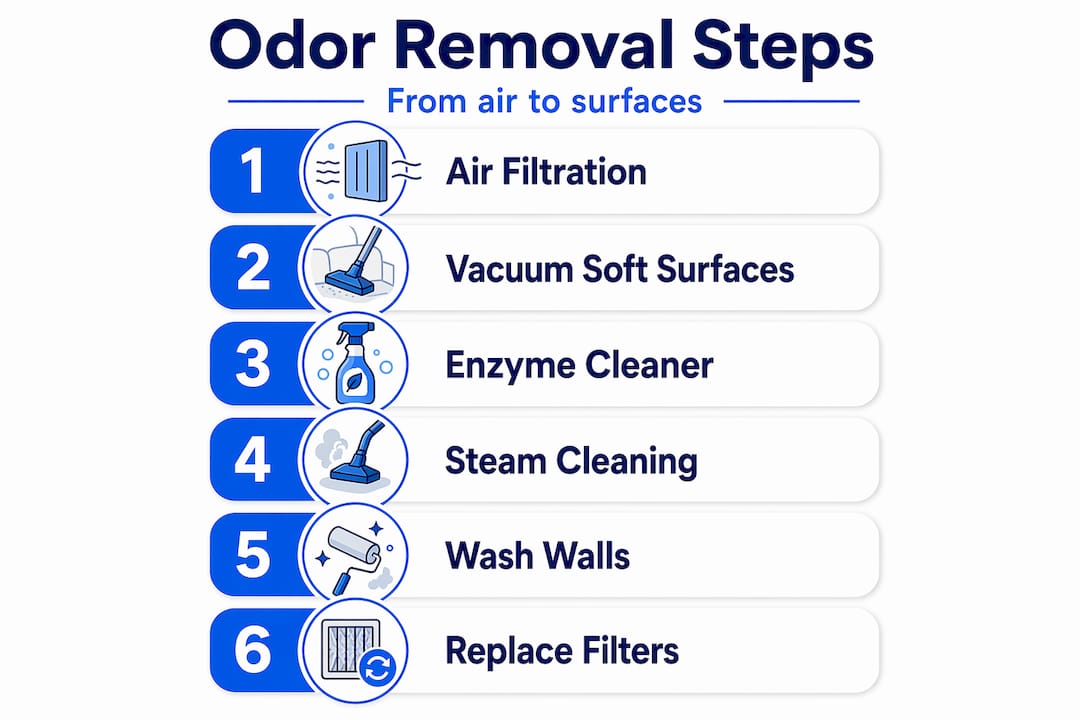
Step 1: Start air filtration immediately
Run a HEPA purifier with activated carbon in the affected room before you do anything else. HEPA filters capture particles down to 0.3 microns, and the activated carbon layer adsorbs volatile organic compounds directly from the air. This reduces the airborne load while you work on surfaces, so you’re not stirring particles back into a saturated environment.
Step 2: Vacuum all soft surfaces
Before applying any liquid cleaner, vacuum every carpet, rug, piece of upholstery, and fabric surface in the room. Use a HEPA-equipped vacuum. Sprinkle baking soda over carpets, let it sit for 30 minutes, then vacuum thoroughly. This pulls dry particles and residue out of fibers before you introduce moisture.
Step 3: Apply enzymatic cleaners to fabrics and upholstery
Enzymatic cleaners break down the molecular structure of odor-causing compounds rather than layering a new smell over them. Spray generously onto upholstery, let it dwell for the time specified on the label (usually 10 to 15 minutes), then blot dry. For machine-washable items, add enzymatic detergent and half a cup of white vinegar to the wash cycle.
Step 4: Steam clean carpets and heavy upholstery
Steam cleaning reaches into carpet padding where terpene residue settles over time. Renting a steam cleaner for a single afternoon addresses the layer of contamination that surface vacuuming simply cannot reach. Add an enzymatic cleaning solution to the steam cleaner’s reservoir rather than a standard carpet shampoo.
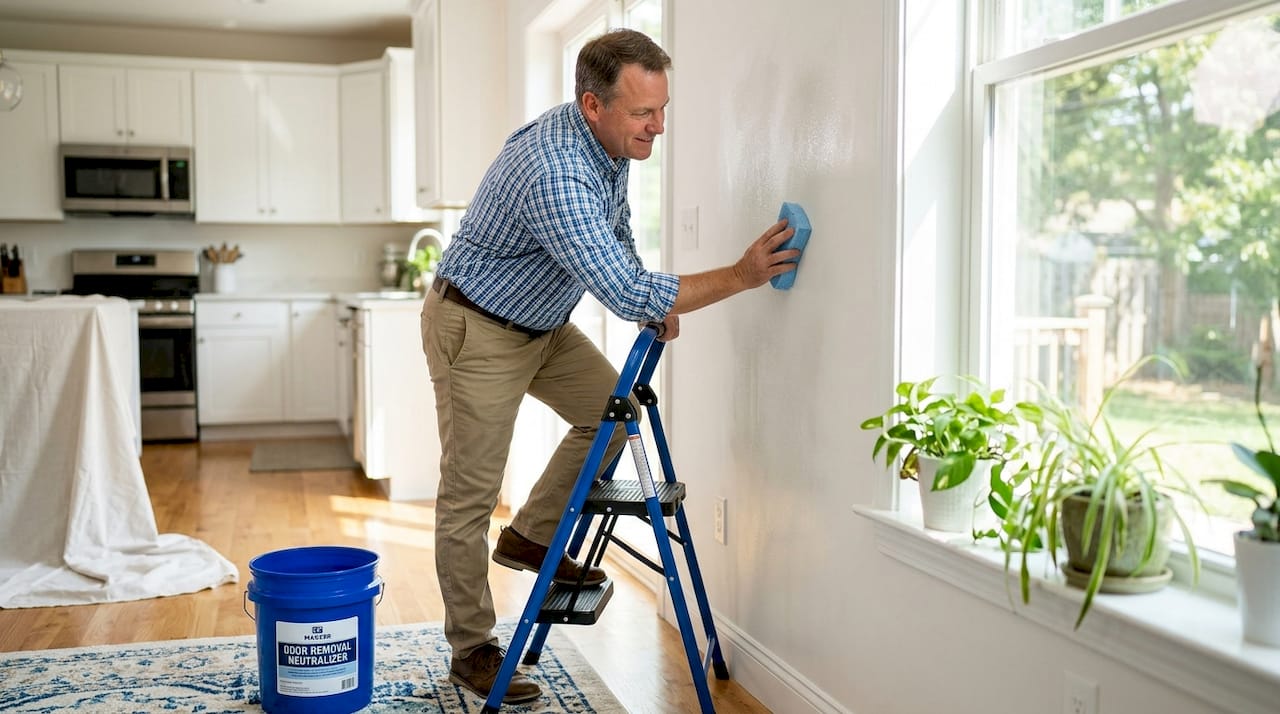
Step 5: Wash walls and hard surfaces
Mix TSP with warm water according to package directions and wash all painted walls, ceilings, baseboards, and trim. TSP cuts through the oily, lipophilic residue that has bonded to paint and drywall. Follow with a vinegar-and-water solution (equal parts) as a final wipe. Pay extra attention to corners, around light switches, and any area near where smoking occurred.
Step 6: Replace HVAC filters and address ductwork
Pull and replace your HVAC filters with MERV 13 or higher rated options immediately. For rooms with significant, long-term odor exposure, budget for professional duct cleaning. Residue that has accumulated on duct walls will keep reintroducing odor particles into the air for months if left unaddressed.
Pro Tip: After replacing your HVAC filter, tape a piece of activated carbon filter material over the return air vent for the first two weeks. This catches residual particles the new filter might miss during the transition period.
Odor removal method comparison
| Method | Best for | Time required | DIY or pro? |
|---|---|---|---|
| HEPA + carbon filtration | Airborne particles | Ongoing (days to weeks) | DIY |
| Enzymatic cleaning | Fabrics and upholstery | 1 to 2 hours | DIY |
| Steam cleaning | Carpets and deep fibers | 2 to 4 hours | DIY or rental |
| TSP wall wash | Hard surfaces and paint | 3 to 5 hours | DIY |
| Thermal fogging | Severe, embedded odors | 2 to 6 hours + airing | Professional |
For severe or chronic situations, thermal fogging by trained professionals reaches areas that no spray or wipe can access, including wall cavities, ceiling plenum spaces, and the interior of HVAC equipment. This is not a DIY method.
Common mistakes that stall your progress
Even with the right intent, most people make one of a handful of errors that leave them frustrated and still smelling cannabis two weeks later.
The biggest one is relying entirely on masking products. Candles, plug-in air fresheners, and even essential oil diffusers create a combined smell rather than eliminating the underlying odor. Air fresheners add fragrance but do not neutralize terpenes or combustion compounds. The effect is temporary and often makes the problem smell worse once the fragrance fades.
- Ignoring soft furniture. Couches, chairs, mattresses, and curtains are primary odor reservoirs. Cleaning walls while skipping upholstery guarantees partial results.
- Skipping the HVAC system. The most common reason cleaned rooms still smell is an unchanged filter recirculating contaminated air.
- Waiting too long to act. Every hour past that 24-hour window, terpene compounds bond more deeply to porous materials and become harder to lift.
- Using ozone without guidance. Ozone generators can break down odor molecules at the molecular level but require the space to be completely unoccupied and need careful handling to avoid material damage and health risks.
If you’ve completed all the DIY steps and the odor persists after a week of continuous HEPA filtration, that’s a clear signal the compounds have penetrated beyond surface-level reach. Professional remediation isn’t a last resort. It’s simply the right tool for the scale of the problem.
Verifying success and preventing odors from returning
You’ll know the marijuana odor removal process is working when the smell is no longer detectable cold, meaning first thing in the morning before cooking, candles, or any other scent enters the room. That baseline test is more reliable than checking mid-treatment.
For prevention moving forward, these habits make a measurable difference:
- Run a dedicated ventilated consumption space if smoking indoors is ongoing. A room with carbon filtration and sealed gaps under doors contains odor far more effectively than an open layout.
- Switch from combustion to dry herb vaporizers. Vaporizers generate a fraction of the odor compared to smoking because combustion produces far more aromatic byproducts.
- Change HVAC filters every 30 to 60 days in active-use areas, not every 90 days as the general guidance suggests.
- Wash soft furnishings monthly if the space sees regular use. This catches accumulation before it becomes a remediation project.
Pro Tip: Place a small activated carbon air purifier inside closets adjacent to smoking areas. Closets act as odor sinks and are almost always overlooked during cleaning.
Regular cleaning combined with continuous air filtration is what Health Canada identifies as the baseline standard for limiting cannabis odor intensity indoors, even acknowledging that no single system guarantees complete elimination in all settings.
What experience has taught me about odor removal
I’ve walked through hundreds of properties where the homeowner swore they’d “already tried everything.” Nine times out of ten, what they tried was masking. Candles, sprays, even leaving windows open for days. None of it touched the actual problem.
What I’ve learned is that the sequence matters as much as the products. You can have the right enzymatic cleaner and the right air purifier, but if you clean surfaces before running filtration, you’re stirring loose particles into air that’s already saturated. The purifier has to be running first.
The second thing people consistently underestimate is the HVAC. I’ve seen rooms that smelled completely neutral after three days of treatment come back with full odor within a week, because nobody changed the filter. The ductwork was releasing what the cleaning had pulled out of the surfaces.
My honest take: if the odor has been present for more than a month, or if multiple rooms are affected, DIY methods will reduce it but probably won’t eliminate it. Combining HEPA filtration with enzymatic cleaning works well for recent or moderate exposure. Chronic situations need professional-grade equipment that reaches where standard cleaning can’t. Knowing when to call someone isn’t defeat. It’s just realistic about what the chemistry requires.
— Master
When professional help makes the difference
Sometimes the scale of the problem simply outpaces what consumer products and elbow grease can handle. For landlords managing a unit with years of embedded odor, or homeowners preparing a property for sale, a professional service closes the gap between “better” and “completely gone.”

Masterodorremoval specializes in permanent odor elimination across homes, Airbnbs, vehicles, and commercial spaces. The team uses eco-friendly, green-certified methods with no ozone or chlorine treatments, which matters for spaces where safety and indoor air quality are non-negotiable. For residential and rental scenarios, Masterodorremoval’s smoke odor removal service covers both marijuana and tobacco odors with same or next-day availability. For property transitions, their move-out odor removal service prepares spaces to meet landlord and real estate standards. Results are guaranteed.
FAQ
What causes marijuana odor to linger so long indoors?
Marijuana odor is caused by volatile sulfur compounds and terpenes that bind chemically to porous surfaces within 12 to 24 hours, making them resistant to standard cleaning and ventilation.
Do air purifiers actually remove cannabis smell?
Yes, but only models with both a HEPA filter and an activated carbon layer. HEPA captures fine particles while activated carbon adsorbs volatile organic compounds directly from the air.
How long does marijuana odor removal take?
Mild exposure treated within 24 hours can clear in one to three days of combined air filtration and surface cleaning. Chronic exposure in multiple rooms may take one to two weeks, or require professional treatment.
Is ozone treatment safe for removing weed odor at home?
Ozone generators are effective at breaking down odor molecules but require the space to be fully unoccupied during treatment and should be handled by trained professionals to avoid health risks and material damage.
When should I hire a professional for marijuana odor removal?
If DIY methods haven’t resolved the odor after seven to ten days of consistent treatment, or if the exposure was long-term and covers multiple rooms, professional remediation with thermal fogging or specialized equipment is the practical next step.
Recent Comments