
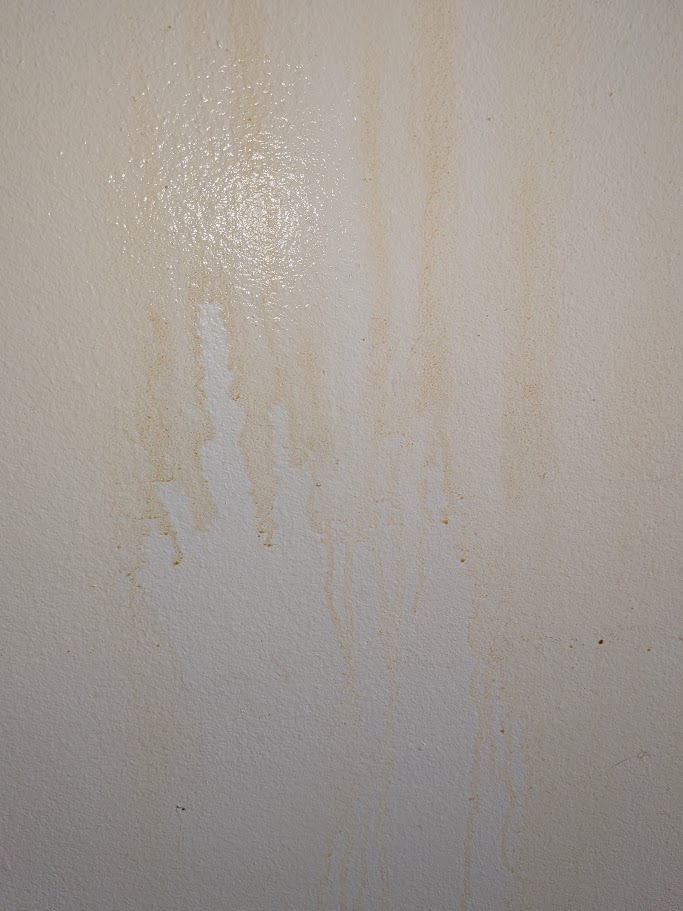
When you’re dealing with a previous smoker’s home, you’re not dealing with “odor in the air.”
You’re dealing with sticky, embedded chemical residue on walls, ceilings, trim, HVAC vents, and porous surfaces.
Here’s why direct liquid application is dramatically more effective than using a gas (like ozone or chlorine dioxide):
1️⃣ Tobacco Smoke Is a Physical Residue — Not Just a Smell
Cigarette smoke leaves behind:
Nicotine
Tar
Phenols
Sticky resins
Combustion byproducts
These adhere to surfaces and form a thin, oily film.
That yellowing on walls?
That’s not “odor.”
That’s chemical contamination.
Gas treatments don’t remove that film.
They only attempt to oxidize airborne odor molecules.
2️⃣ Gas Floats. Residue Sticks.
🚫 Gas-Based Treatment (Ozone / Chlorine Dioxide)
Circulates through air
Reacts with airborne odor molecules
Light surface contact
Cannot physically lift or remove residue
Leaves contamination behind
Ozone may temporarily “mask” the smell by altering some molecules — but the nicotine and tar remain embedded.
When humidity rises or walls warm up, the odor returns.
3️⃣ Direct Liquid Application = Physical & Chemical Neutralization
A direct liquid application works because it:
✔ Breaks down the sticky tar bond
✔ Dissolves nicotine residue
✔ Emulsifies oils
✔ Physically lifts contamination
✔ Neutralizes odor at the source
It’s not “air treatment.”
It’s surface decontamination.
That’s the difference.
4️⃣ Smoke Odor Lives in Porous Materials
Drywall
Paint
Wood trim
HVAC returns
Insulation
Cabinet interiors
Gas cannot penetrate deeply enough to remove embedded contamination.
A properly formulated liquid solution can:
Soak into porous surfaces
Chemically bind with odor molecules
Encapsulate and neutralize residue
5️⃣ Safety & Surface Integrity
Gas treatments can:
Damage rubber and wiring
Oxidize metals
Fade fabrics
Leave lingering reactive compounds
A controlled liquid application:
Targets only contaminated surfaces
Does not degrade materials
Leaves no reactive airborne byproducts
6️⃣ The Core Principle
If contamination is on the wall,
you treat the wall.
If contamination is in the air,
you treat the air.
Tobacco smoke in a former smoker’s home is primarily a surface contamination problem, not an air problem.
Simple Analogy
Using gas to remove tobacco residue is like:
Spraying perfume in a greasy kitchen instead of cleaning the grease.
Direct liquid application is:
Degreasing and wiping the surface clean.
Why Results Last
When the residue is:
Broken down
Lifted
Neutralized
There is nothing left to off-gas later.
That’s why properly treated homes:
Don’t “re-smell” in summer
Don’t reactivate with humidity
Don’t require repeat treatments
If you’d like, I can turn this into:
A property manager one-pager
A real estate listing support explanation
A home seller education sheet
Or a print-ready PDF marketing piece
Recent Comments